
The Rise of Local AI: How On-Device Models Are Changing Privacy and Computing
Advances in Neural Processing Units (NPUs) and compact language models have made it possible to run powerful AI directly on personal laptops and phones. This shift toward local inference promises zero-latency responses and absolute data privacy by keeping sensitive information off the cloud.
By Factlen Editorial Team
- Privacy Advocates
- Argue that local AI is the only way to truly secure sensitive data by ensuring it never leaves the user's device.
- Hardware Manufacturers
- View the shift to local AI as a massive upgrade cycle, driving demand for new NPU-equipped laptops and chips.
- Software Developers
- Appreciate local models for providing free, zero-latency API access for coding and application building.
- Cloud AI Providers
- Argue that while local AI is useful for simple tasks, the most advanced reasoning will always require massive centralized data centers.
What's not represented
- · Cybersecurity Analysts
- · Enterprise IT Administrators
Why this matters
As artificial intelligence becomes integrated into daily workflows, sending every prompt, document, and code snippet to a corporate cloud poses massive privacy risks. Local AI puts the power of generative models directly on your personal hardware, ensuring your sensitive data never leaves your device while eliminating subscription fees and network delays.
Key points
- Neural Processing Units (NPUs) are now standard in modern PCs, enabling efficient local AI.
- Small Language Models (SLMs) have been optimized to run smoothly on consumer hardware.
- Local inference guarantees absolute data privacy by keeping all processing on the device.
- Tools like Ollama and LM Studio allow users to run AI without cloud subscriptions.
- A hybrid approach routes simple tasks locally and complex tasks to secure cloud servers.
For the past three years, interacting with artificial intelligence meant sending data to a server and waiting for a response. Whether generating text, summarizing a document, or writing code, users were tethered to the cloud, relying on massive data centers to process their requests.[2][4]
That paradigm is rapidly shifting. In 2026, the tech industry has crossed a critical threshold, moving generative AI out of the cloud and directly onto personal devices. This "local-first" approach allows large language models to run natively on laptops, smartphones, and tablets, fundamentally changing how users interact with machine learning.[2][4][8]
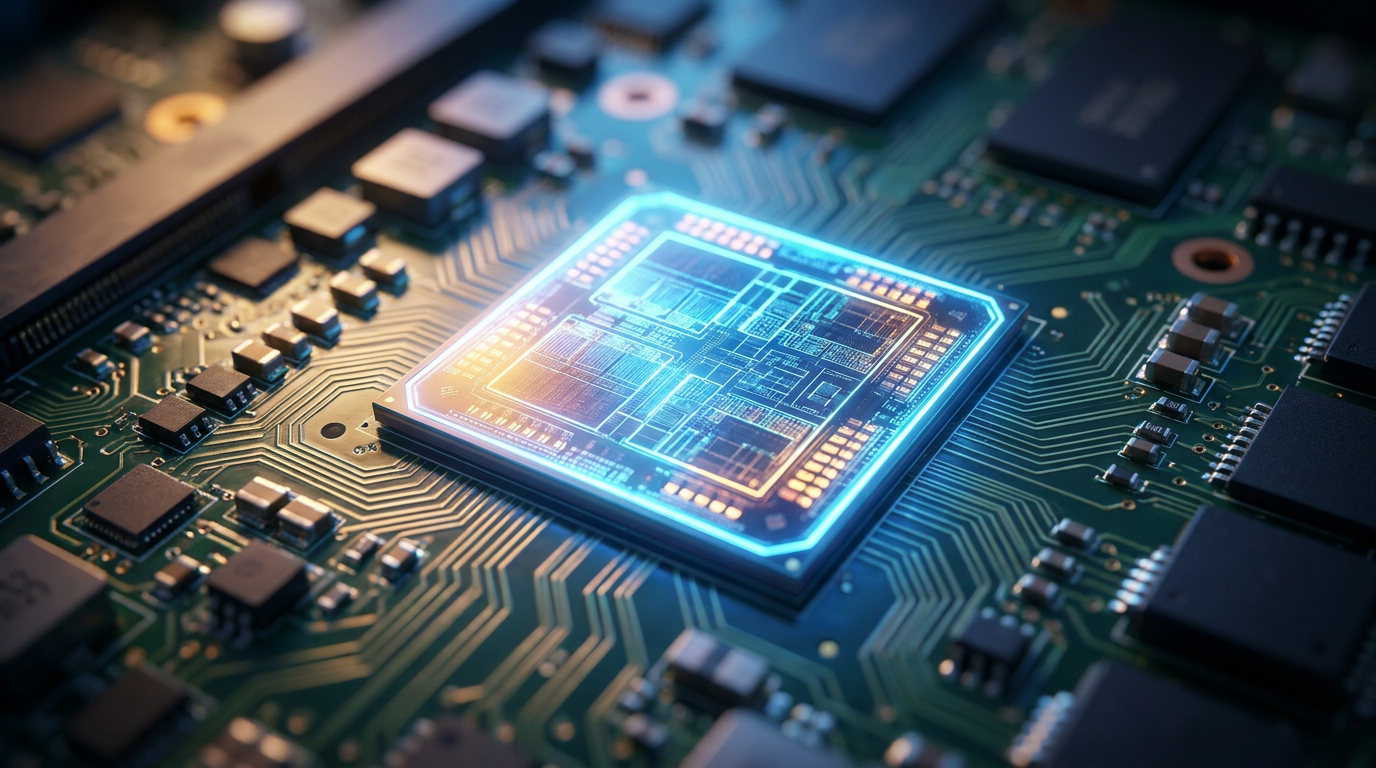
The driving force behind this transition is a hardware revolution centered on the Neural Processing Unit, or NPU. Historically, computers relied on Central Processing Units for general tasks and Graphics Processing Units for heavy parallel math, like rendering video games.[3][5]
While GPUs are excellent at the matrix multiplication required for artificial intelligence, they consume massive amounts of power and generate significant heat, making them impractical for continuous use on battery-powered laptops. NPUs solve this problem by providing specialized microprocessors built entirely from the ground up to accelerate machine learning algorithms with remarkable energy efficiency.[3][5]

PC and chip manufacturers have now standardized the NPU as a core component alongside the CPU and GPU. The industry measures NPU performance in TOPS, or Trillions of Operations Per Second. Modern processors, such as Intel's Core Ultra series, AMD's Ryzen AI, and Apple's M-series chips, now regularly exceed the 40 TOPS threshold required to run complex generative models smoothly in the background.[2][3][8]
Hardware is only half the equation. The software layer has seen equally dramatic advancements, particularly in the development of Small Language Models. Models like Microsoft's Phi-4 mini, Meta's Llama 3.2, and Mistral's edge models have been engineered to deliver high-quality reasoning while fitting within the strict memory constraints of consumer hardware.[2][4]
To make these models fit on a standard laptop, developers use a technique called quantization. This process reduces the precision of the model's internal weights—for example, compressing them from 16-bit to 4-bit formats—drastically shrinking the memory footprint without a catastrophic loss in capability.[3][7]

To make these models fit on a standard laptop, developers use a technique called quantization.
The tooling to run these quantized models has also been democratized. Applications like LM Studio provide a user-friendly graphical interface, allowing anyone to browse, download, and chat with open-source models just as easily as installing a standard desktop application.[4][6]
For developers, tools like Ollama offer a command-line interface and a local API, turning a personal laptop into an invisible AI infrastructure. This allows coding assistants and custom applications to query a local model exactly as they would query a cloud provider, but without the associated costs or network latency.[6]
The most immediate benefit of on-device AI is the complete elimination of latency. Cloud API calls typically add hundreds of milliseconds of network delay before the first word is generated. Local inference removes this bottleneck entirely, enabling real-time applications like instant voice translation and seamless code completion.[4][7]
Beyond speed, local AI offers robust offline capability. Users can now summarize sensitive documents on an airplane, draft emails in remote locations, or run coding assistants without an active internet connection.[4]
However, the most profound implication of the local AI movement is privacy. Regulatory pressures and consumer awareness have made data sovereignty a primary concern. When an AI model runs locally, the user's prompts, files, and personal context never leave the device.[1][2][4]
Apple has made this privacy-first architecture the cornerstone of its Apple Intelligence suite. The system relies heavily on on-device processing to understand personal context—like reading messages or calendar events—without ever collecting that data on corporate servers.[1]
Because local hardware still has capability ceilings, companies are adopting hybrid routing strategies. When a user asks a simple question, the on-device model handles it instantly. If a query is too complex for the local NPU, the system can seamlessly escalate it to the cloud.[4][7]

To maintain privacy during these escalations, Apple developed Private Cloud Compute. This system extends the security of the device into the cloud, processing complex requests on secure servers using stateless computation. The data is used exclusively to fulfill the request and is immediately erased, with independent researchers able to verify the code.[1]
How we got here
Late 2022
Cloud-based LLMs dominate the tech landscape, requiring massive data centers for all generative AI tasks.
Mid 2024
Apple introduces Apple Intelligence, heavily emphasizing on-device processing for privacy.
Late 2024
Microsoft launches the Copilot+ PC standard, requiring a minimum of 40 TOPS of NPU performance.
2025
Open-source tools like Ollama and LM Studio gain massive popularity, making local model deployment accessible to general users.
Early 2026
CES 2026 showcases a new generation of highly efficient NPUs and Small Language Models capable of running entirely offline.
Viewpoints in depth
Privacy Advocates
Focuses on data sovereignty and the absolute protection of user information.
Privacy advocates argue that the only way to truly secure sensitive data—like medical records, proprietary code, or personal messages—is to never transmit it in the first place. They view local AI as the ultimate safeguard against corporate data harvesting, ensuring that a user's digital life remains entirely within their physical control.
Software Developers
Focuses on the democratization of AI infrastructure and the elimination of API costs.
For developers, local models eliminate the financial barrier to entry for building AI applications. By running models locally, engineers can experiment endlessly, build custom coding assistants, and process massive amounts of text without worrying about API costs, rate limits, or internet outages.
Cloud AI Providers
Focuses on capability ceilings and the necessity of massive compute for advanced reasoning.
Cloud providers argue that while local models are impressive, the sheer physics of compute means a 4-pound laptop will never match a multi-billion dollar data center. They advocate for a hybrid approach where local AI handles trivial, everyday tasks, while the cloud remains the engine for complex reasoning and encyclopedic knowledge.
What we don't know
- How quickly local models will close the reasoning gap with frontier cloud models.
- Whether the battery drain of continuous local AI processing can be fully mitigated in ultra-thin laptops.
- How enterprise IT departments will manage and secure fleets of devices running decentralized AI models.
Key terms
- Neural Processing Unit (NPU)
- A specialized hardware chip designed specifically to accelerate machine learning algorithms efficiently without draining battery life.
- Quantization
- A compression technique that reduces the precision of an AI model's parameters, allowing it to run on devices with limited memory.
- Small Language Model (SLM)
- A compact version of a large language model, optimized to run locally on consumer hardware rather than massive server farms.
- TOPS
- Trillions of Operations Per Second; a metric used to measure the mathematical throughput and AI processing power of an NPU.
- Inference
- The process of running live data through a trained AI model to make a prediction or generate a response.
Frequently asked
Can I run a local AI on my current laptop?
It depends on your hardware. While older laptops can run highly compressed models slowly using their CPU, modern laptops with dedicated NPUs or powerful GPUs are required for a smooth, real-time experience.
Do local AI models cost money to use?
No. Once you download an open-source model to your device, running it is completely free and requires no subscription fees or API costs.
Are local models as smart as ChatGPT?
Not quite. Local models are smaller and optimized for specific tasks like drafting text or coding. For highly complex reasoning or encyclopedic knowledge, massive cloud models still hold an advantage.
How does local AI protect my privacy?
Because the AI model lives on your hard drive, the files and prompts you give it are processed entirely on your machine. No data is ever transmitted to a third-party server.
Sources
Source coverage
8 outlets
4 viewpoints surfaced








[1]ApplePrivacy Advocates
Apple Intelligence and privacy on iPhone
Read on Apple →[2]FenxiHardware Manufacturers
Local-first: AI leaves the cloud and runs on your PC thanks to NPUs
Read on Fenxi →[3]DEV CommunityHardware Manufacturers
The Best AI PCs and NPU Laptops For Engineers
Read on DEV Community →[4]AI MagicxCloud AI Providers
On-Device AI in 2026: Running LLMs Locally on Your Phone, Laptop, and IoT Devices
Read on AI Magicx →[5]MediumHardware Manufacturers
Unlocking Local Generative AI: Why Your Next PC Needs an NPU
Read on Medium →[6]Zen van RielSoftware Developers
Ollama vs LM Studio: Complete Comparison for Local LLM Development
Read on Zen van Riel →[7]RunAnywhereSoftware Developers
How to Run AI Models Locally in 2026
Read on RunAnywhere →[8]Enclave AIPrivacy Advocates
Local AI in Early 2026: CES Highlights and New Models
Read on Enclave AI →
Every angle. Every day.
Get ai stories with full source coverage and perspective breakdowns delivered to your inbox.