
The Explainer: Why Millions Are Walking Ancient Pilgrimage Routes in the 21st Century
Ancient pilgrimage routes like the Camino de Santiago and Japan's Kumano Kodo are seeing record-breaking numbers of modern walkers. Driven by a desire for digital disconnection and 'post-secular therapy,' a new generation is reviving thousand-year-old paths.
By Factlen Editorial Team
- Secular Seekers
- View the routes as therapeutic spaces for mental health, digital detox, and physical challenge.
- Religious Traditionalists
- View the routes primarily as sacred journeys of penance and devotion to a holy site.
- Host Communities
- View the routes as vital economic engines but worry about the strain of overtourism on rural infrastructure.
What's not represented
- · Long-distance hiking purists who avoid crowded trails
- · Environmental conservationists monitoring trail erosion
Why this matters
As digital burnout and secularization increase, millions are turning to ancient, physically demanding trails for mental health, community, and a sense of purpose. This massive shift is transforming rural economies and redefining how modern society approaches wellness and spirituality.
Key points
- Ancient pilgrimage routes are experiencing an unprecedented surge in popularity, drawing hundreds of thousands of walkers annually.
- Spain's Camino de Santiago reached a record 499,241 official completions in 2024, up from just 67 in 1972.
- Many modern walkers are secular, using the physically demanding trails for digital detox, mental health, and processing grief.
- The 'Dual Pilgrim' program, linking the Camino with Japan's Kumano Kodo, recently celebrated its 10,000th finisher.
- The massive influx of walkers has revitalized rural economies but also sparked concerns over overtourism and trail erosion.
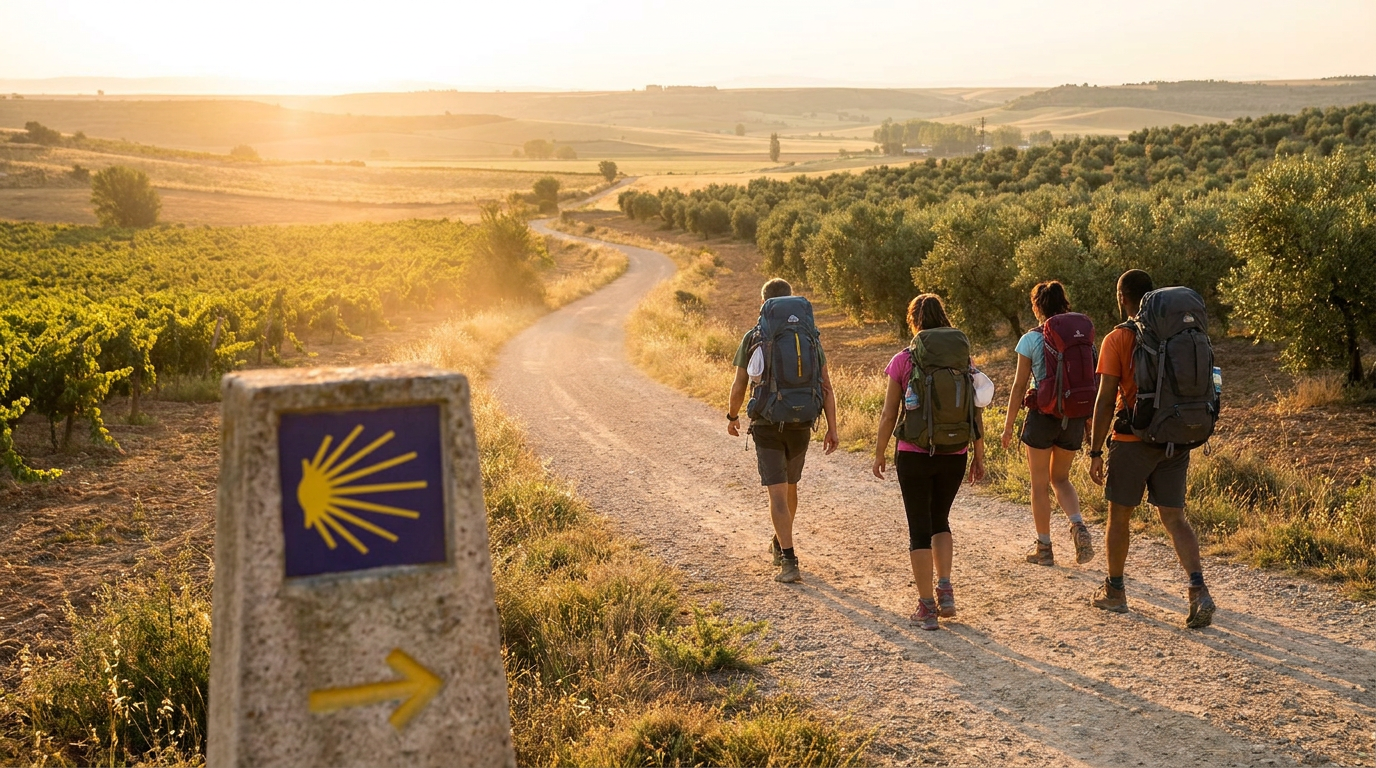
In an era defined by hyper-connectivity and secularization, one might expect medieval pilgrimage routes to be fading into historical obscurity. Instead, they are experiencing an unprecedented renaissance. Across Europe and Asia, ancient trails originally blazed by monks, emperors, and penitents are now crowded with modern walkers carrying ultralight backpacks and digital credentials. This resurgence is not merely a tourism trend; it represents a profound cultural shift in how people seek meaning, community, and mental clarity in the twenty-first century.[7]
The statistics behind this revival are staggering. In 1972, a mere 67 people officially completed Spain's Camino de Santiago, leaving the thousand-year-old route on the brink of being forgotten. By 2024, that number had surged to a record-breaking 499,241, and data from early 2025 suggests the annual total is now eclipsing half a million walkers. This exponential growth reflects a global awakening to the value of slow travel and structured reflection.[1][3][7]

This phenomenon extends far beyond the Iberian Peninsula. Italy's Via Francigena, a 2,000-kilometer route stretching from Canterbury to Rome that was first documented in 990 AD, has seen a similar resurrection. Left largely dormant for centuries, the path was revitalized in the late 1990s and now draws an estimated 50,000 walkers annually. Meanwhile, in Japan, the rugged Kumano Kodo trails—historically used by Buddhist monks and emperors to navigate the mountainous Kii Peninsula—are seeing record international foot traffic.[2][6]
The global nature of this revival is best illustrated by the "Dual Pilgrim" initiative. In 2015, local authorities officially twinned the Camino de Santiago and the Kumano Kodo, recognizing them as the world's only two UNESCO World Heritage pilgrimage networks. To earn the title, a walker must complete designated sections of both ancient routes. In April 2025, the program celebrated its 10,000th Dual Pilgrim, a milestone that underscores the deep cross-cultural appeal of long-distance walking.[2][7]

But who are these modern pilgrims, and why are they walking? While the routes are historically Catholic or Buddhist, demographic data reveals a profound shift in motivation. Nearly half of today's Camino walkers cite purely religious reasons for their journey, but the rest report a blend of spiritual, cultural, and personal motivations, or no religious affiliation at all. Sociologists and researchers have dubbed this modern phenomenon "post-secular therapy," noting that the trail provides a space for spiritual exploration outside the confines of traditional dogma.[4][5]
For many, the pilgrimage serves as an analog antidote to a relentlessly digital world. The physical demands of walking twenty to thirty kilometers a day force a radical simplification of daily life. Pilgrims carry only what they need on their backs, sleep in communal hostels, and adhere to the natural rhythm of the sun. This stripping away of modern conveniences and constant notifications creates a rare, distraction-free environment for introspection and mental reset.[5][7]
For many, the pilgrimage serves as an analog antidote to a relentlessly digital world.
Psychologists note that the repetitive, rhythmic nature of long-distance walking often induces a "flow state," where time and self-consciousness fade. This state is particularly effective for processing grief, navigating major life transitions, or recovering from occupational burnout. The trail provides a structured, physical manifestation of moving forward—one step at a time—which many walkers find deeply therapeutic and transformative.[5]
Beyond the internal journey, the social architecture of the pilgrimage is a major draw. The shared physical struggle creates an immediate, egalitarian bond among strangers from vastly different countries, ages, and socioeconomic backgrounds. This transient but intense community, often referred to by anthropologists as "communitas," offers a profound sense of belonging and shared purpose that many individuals find lacking in their everyday urban lives.[4][5][7]
To support this massive influx of walkers, an entire micro-economy has been reborn along these ancient paths. Walkers carry a "credencial," or pilgrim passport, collecting unique ink stamps at cafes, churches, and hostels along the way to prove their progression. Upon reaching the final destination—whether the Cathedral of Santiago de Compostela, the Vatican, or the Kumano Hongu Taisha—these stamped passports are exchanged for official certificates of completion, such as the Compostela or the Testimonium.[1][6]

The physical toll of the journey is not a deterrent; rather, it is a core component of the appeal. Blisters, muscle aches, and sheer exhaustion are universal equalizers on the trail. Overcoming these daily physical hurdles builds a profound sense of resilience that walkers carry back into their everyday lives. The pain is often viewed as a necessary catalyst for the mental and emotional breakthroughs that pilgrims seek.[5][7]
However, this modern renaissance is not without its friction. The sheer volume of walkers has placed immense strain on local infrastructure, particularly along the most popular stretches, such as the final 100 kilometers of the Camino Francés. Rural villages that once welcomed a quiet trickle of pilgrims are now grappling with the realities of overtourism, including noise pollution, trail erosion, and a shortage of affordable housing for local residents as properties are converted into tourist accommodations.[3][4][7]
There is also an ongoing debate regarding the "authenticity" of the modern pilgrimage experience. Traditionalists worry that the influx of secular tourists, luggage-transfer services, and luxury accommodations is diluting the ascetic, penitential spirit of the journey. Yet, defenders argue that the pilgrimage has always been a broad church, historically accommodating everyone from devout believers to wandering merchants and adventurers.[4][7]
Ultimately, the twenty-first-century pilgrimage boom reveals a deep, enduring human need for physical challenge, connection to nature, and structured reflection. Whether they are seeking divine intervention, healing from a profound loss, or simply a quiet break from their smartphones, millions of people are finding that the world's oldest paths still offer the most profound journeys.[5][7]
How we got here
990 AD
Archbishop Sigeric documents his journey from Rome to Canterbury, establishing the Via Francigena route.
1972
Only 67 people officially complete the Camino de Santiago, marking the modern low point of the route.
2015
The Camino de Santiago and Japan's Kumano Kodo are officially twinned, launching the Dual Pilgrim program.
2024
The Camino de Santiago breaks all historical records, issuing nearly half a million Compostela certificates.
Viewpoints in depth
Religious Traditionalists
View the routes primarily as sacred journeys of penance and devotion to a holy site.
For traditional believers, the pilgrimage is an act of faith, penance, and devotion. They emphasize the historical and theological roots of the trails, viewing the physical hardship as a spiritual offering. This camp often expresses concern that the sacred nature of the routes is being commodified by secular tourism and luxury services that remove the essential element of sacrifice.
Secular Seekers
View the routes as therapeutic spaces for mental health, digital detox, and physical challenge.
This growing demographic approaches the trail as a form of 'post-secular therapy.' For them, the value lies in the physical exertion, the connection to nature, and the egalitarian community formed along the way. They argue that the transformative power of the pilgrimage does not require religious adherence, and that the trails serve a vital modern purpose by offering an analog escape from a hyper-connected world.
Host Communities
View the routes as vital economic engines but worry about the strain of overtourism on rural infrastructure.
Local residents and municipal leaders recognize that the pilgrimage revival has injected crucial revenue into aging rural economies, saving many small villages from abandonment. However, they also bear the brunt of the crowds. This camp advocates for sustainable trail management, limits on daily walker numbers, and regulations on tourist accommodations to prevent the routes from destroying the very communities that support them.
What we don't know
- Whether the surge in pilgrim numbers will plateau or continue to grow exponentially in the coming decade.
- How local municipalities will balance the economic benefits of the trails with the environmental and social costs of overtourism.
Key terms
- Credencial
- A pilgrim's passport used to collect ink stamps from hostels, cafes, and churches along the route to prove the journey's progression.
- Compostela
- The official certificate of completion issued by the Cathedral of Santiago de Compostela to pilgrims who walk at least the final 100 kilometers.
- Albergue
- A communal, dormitory-style hostel specifically reserved for pilgrims walking the Camino de Santiago.
- Dual Pilgrim
- An official designation for someone who has completed designated sections of both the Camino de Santiago and Japan's Kumano Kodo.
Frequently asked
Do you have to be religious to walk a pilgrimage?
No. While the routes have religious origins, nearly half of modern walkers cite cultural, personal, or fitness reasons rather than strict religious devotion.
How long does it take to walk the Camino de Santiago?
The most popular route, the Camino Francés, takes about 30 to 35 days to walk in its entirety, though many people choose to walk shorter sections over a week.
What is the minimum distance required to get a certificate?
For the Camino de Santiago, pilgrims must walk at least the last 100 kilometers (or cycle 200 kilometers) to receive the official Compostela.
Where do pilgrims sleep?
Most stay in dedicated pilgrim hostels called albergues in Spain, minshukus in Japan, or monasteries, which offer basic communal lodging.
Sources
Source coverage
7 outlets
3 viewpoints surfaced







[1]Oficina de Acogida al PeregrinoHost Communities
Official Pilgrim Statistics
Read on Oficina de Acogida al Peregrino →[2]Tanabe City Kumano Tourism BureauHost Communities
Dual Pilgrim Program Reaches 10,000 Milestone
Read on Tanabe City Kumano Tourism Bureau →[3]The Catholic HeraldReligious Traditionalists
The Camino de Santiago is set to see a record-breaking number of pilgrims this year
Read on The Catholic Herald →[4]Zenit News AgencyReligious Traditionalists
Spain's famed Camino wraps up the year with a record half million pilgrims
Read on Zenit News Agency →[5]ResearchGateSecular Seekers
Pilgrimage as post-secular therapy
Read on ResearchGate →[6]European Association of the Via FrancigenaHost Communities
The Via Francigena Revival
Read on European Association of the Via Francigena →[7]Factlen Editorial TeamSecular Seekers
Synthesis by Factlen editorial team
Read on Factlen Editorial Team →

Every angle. Every day.
Get culture stories with full source coverage and perspective breakdowns delivered to your inbox.