
How Enhanced Geothermal Systems Are Unlocking Clean Energy Anywhere
By borrowing drilling techniques from the oil and gas industry, next-generation geothermal projects are turning the Earth's ubiquitous underground heat into a scalable, 24/7 clean power source.
By Factlen Editorial Team
- Geothermal Developers & Industry
- Argue that leveraging oil and gas drilling techniques makes geothermal a scalable, bankable solution for global baseload power.
- Grid Operators & Utilities
- Value EGS primarily as a reliable, 24/7 'firm' power source to balance the intermittency of wind and solar.
- Federal Researchers
- Focus on derisking the technology through advanced subsurface monitoring and funding pilot demonstrations.
- Environmental Analysts
- Support the clean energy potential but emphasize the need for strict monitoring of induced seismicity and water usage.
What's not represented
- · Fossil fuel industry executives
- · Local Utah residents near the drilling sites
Why this matters
As the world transitions to renewable energy, the grid desperately needs 'firm' power that runs when the sun isn't shining and the wind isn't blowing. If enhanced geothermal scales as projected, it could replace fossil fuel baseload plants entirely, stabilizing electricity prices and grid reliability.
Key points
- Next-generation geothermal uses oil and gas drilling techniques to create artificial underground reservoirs, bypassing the need for natural hot springs.
- Fervo Energy's Cape Station in Utah is slated to deliver 100 megawatts of continuous power by late 2026, scaling to 500 megawatts.
- A recent breakthrough by Lawrence Berkeley National Lab successfully monitored microseismic activity at 338°F for seven months, proving extreme-heat reservoirs can be safely managed.
- The U.S. Department of Energy estimates enhanced geothermal could unlock 150 gigawatts of clean, 24/7 baseload power by 2050.
The transition to a zero-carbon electricity grid has a glaring vulnerability: the weather. While solar and wind power have become incredibly cheap, they are inherently intermittent. When the sun sets and the wind dies down, grid operators must rely on 'firm' power—energy that can be dispatched on demand, 24 hours a day. Historically, that has meant burning natural gas or coal. But a rapidly maturing technology known as Enhanced Geothermal Systems (EGS) is poised to provide a clean, inexhaustible alternative by tapping into the massive heat radiating from the Earth's core.[4][7]
Geothermal energy is not a new concept. For over a century, humans have harvested underground steam to spin turbines and generate electricity. However, conventional geothermal plants are geographically cursed. They require a rare convergence of three natural elements: extreme underground heat, permeable rock, and naturally occurring water. Because of these strict geological prerequisites, traditional geothermal has been largely confined to volcanic regions like Iceland or specific fault lines in the American West, accounting for less than 1% of global electricity generation.[4][8]
Next-generation geothermal flips this paradigm. Instead of hunting for naturally occurring underground reservoirs, engineers are now building them. By drilling deep into hot, dry, impermeable rock, developers can use hydraulic fracturing to create artificial fracture networks. They then inject water into these newly created fissures, allow the surrounding rock to heat the fluid, and pump it back to the surface to generate power.[4][8]

This breakthrough relies heavily on technologies pioneered by the oil and gas industry during the shale revolution. Horizontal directional drilling allows engineers to maximize their contact with hot rock layers, while advanced stimulation techniques create the necessary permeability. By adapting these fossil-fuel extraction methods for clean energy, EGS transforms geothermal from a location-bound lottery into a scalable infrastructure project that can theoretically be deployed anywhere the drill bit can reach hot rock.[4][8]
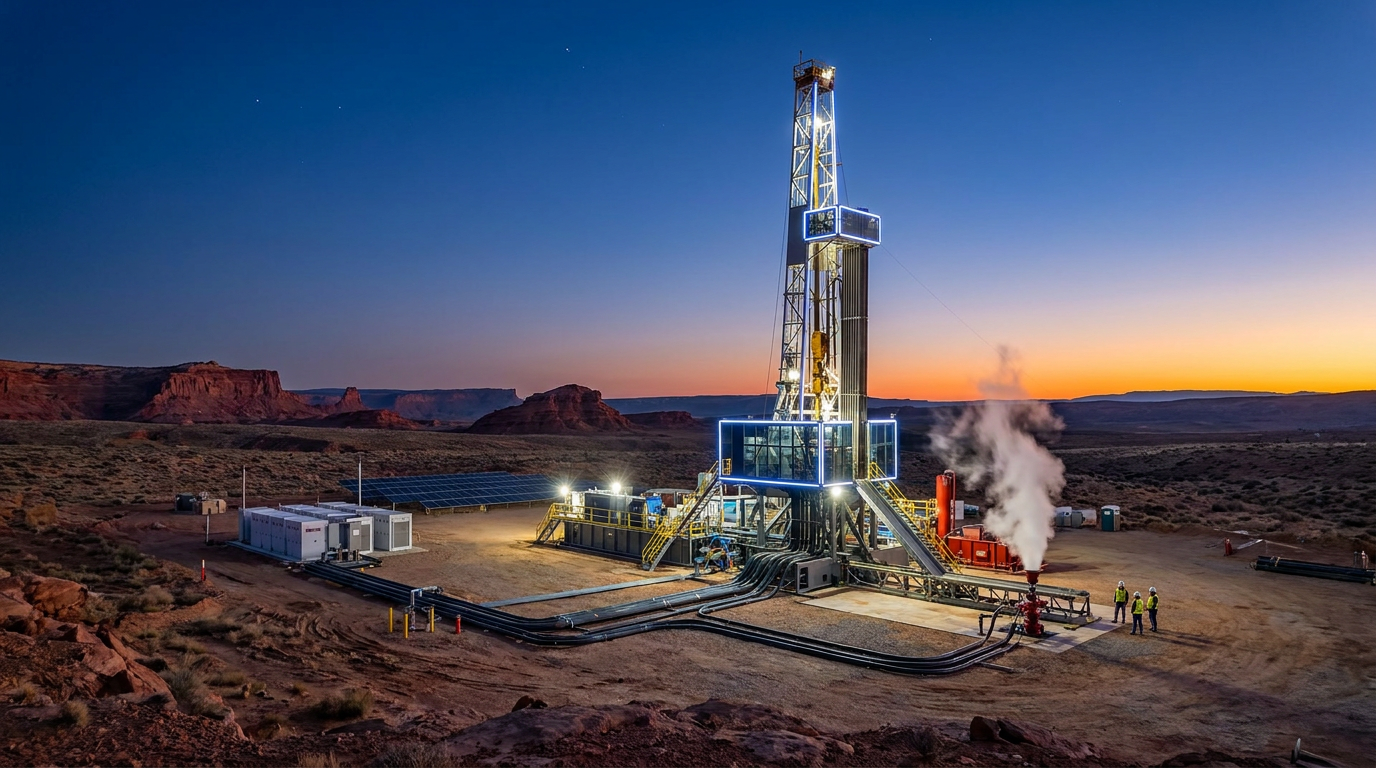
The commercial viability of this approach is currently being proven in the high desert of Beaver County, Utah. Fervo Energy, a leading geothermal developer, is constructing Cape Station, a massive EGS facility that aims to deliver its first 100 megawatts of continuous power to the grid by late 2026. At full buildout, the multi-phase project is permitted to generate 500 megawatts—enough to power roughly 355,000 homes annually.[1][2]
Wall Street has taken notice of the sector's rapid maturation. In May 2026, Fervo Energy went public on the Nasdaq, raising nearly $1.89 billion and achieving a market valuation exceeding $10 billion. This massive influx of capital signals a profound shift in market confidence. Investors are betting that EGS is no longer just a promising science experiment, but a bankable, scalable asset class capable of competing with traditional energy infrastructure.[2]
Wall Street has taken notice of the sector's rapid maturation.
The economics of EGS are improving at a staggering pace. Because the process relies on repeating the same drilling and fracturing techniques across multiple wells, developers benefit from a steep learning curve. Between 2022 and 2025, Fervo reported reducing its drilling times by 75% and slashing per-foot drilling costs by 70%. As these upfront capital expenditures drop, the levelized cost of geothermal energy is inching closer to parity with natural gas and next-generation nuclear power.[1]

However, operating miles underground presents extreme technical hurdles. At depths of 7,000 feet, temperatures routinely exceed 300°F—an environment that quickly degrades or destroys conventional electronic sensors. To safely manage artificial reservoirs, operators need real-time data on how the rock is fracturing and how fluids are moving. You cannot efficiently manage a subsurface system that you cannot measure.[3]
A major breakthrough on this front was announced in early 2026 by researchers at the Lawrence Berkeley National Laboratory (LBNL). Working at the Cape Station site, geophysicists successfully deployed a custom-built, high-temperature seismometer nearly 7,000 feet underground. The instrument operated continuously for seven months in 338°F heat, recording microseismic activity without failing. This unprecedented durability allows operators to map fracture networks with pinpoint accuracy, optimizing heat extraction and ensuring the structural integrity of the reservoir.[3]

Continuous seismic monitoring is also critical for addressing one of the primary environmental concerns surrounding EGS: induced seismicity. The process of fracturing deep rock inherently creates micro-earthquakes. While these events are typically too small to be felt at the surface, precise monitoring is required to ensure that fluid injection does not trigger larger, damaging tremors on existing fault lines. The LBNL sensors provide the real-time feedback loop necessary to manage injection pressures safely.[3][4]
Water consumption is another hurdle for EGS deployment, particularly in the arid American West where many early projects are located. While EGS uses less water than traditional coal or nuclear plants, the artificial reservoirs still experience some fluid loss over time. To eliminate water dependency entirely, the industry is simultaneously developing Advanced Geothermal Systems (AGS). Unlike EGS, which circulates fluid through open rock fractures, AGS uses a closed-loop system of sealed pipes embedded in the hot rock, transferring heat via conduction without any fluid touching the geological formation.[4][8]
Looking further ahead, researchers at institutions like MIT are pursuing 'Superhot Rock' (SHR) geothermal. This concept involves drilling even deeper to reach temperatures approaching 400°C, where water enters a supercritical state. Supercritical fluids carry exponentially more energy than regular steam, meaning a single SHR well could potentially generate ten times the electricity of a standard EGS well. Startups are currently developing millimeter-wave energy drills to vaporize rock, aiming to make these extreme depths economically accessible.[6]
The stakes for the energy transition are immense. The U.S. Department of Energy estimates that advanced geothermal systems could unlock up to 150 gigawatts of clean, reliable capacity in the United States alone by 2050. That represents roughly a quarter of the country's current total electricity capacity, providing the exact kind of stable, 24/7 baseload power needed to retire the remaining fleet of fossil fuel plants.[5][7]

For decades, geothermal energy was the forgotten stepchild of the renewable revolution—reliable but hopelessly constrained by geography. Today, armed with advanced drilling rigs, high-temperature sensors, and billions in fresh capital, the industry is breaking free from those natural limits. The heat of the Earth is ubiquitous; now, the technology to harvest it is finally catching up.[1][4]
How we got here
2023
Fervo Energy breaks ground on the Cape Station EGS project in Beaver County, Utah.
Dec 2024
The International Energy Agency reports that next-generation geothermal has the technical potential to meet global electricity demand 140 times over.
July 2025
Lawrence Berkeley National Lab deploys a custom high-temperature seismometer 7,000 feet underground at Cape Station.
Feb 2026
The LBNL seismometer completes a record-breaking seven months of continuous operation at 338°F.
May 2026
Fervo Energy goes public on the Nasdaq, raising nearly $1.89 billion to scale its geothermal pipeline.
Late 2026
Cape Station is scheduled to deliver its first 100 megawatts of continuous clean power to the grid.
Viewpoints in depth
Geothermal Developers
Focus on the speed of iteration and the ability to scale geothermal anywhere.
Industry leaders argue that by drilling multiple horizontal wells from a single pad, they are driving down costs exactly as the shale industry did over the past decade. They view the Earth's crust as an inexhaustible battery that just needs the right drill bit, emphasizing that the technology is no longer a science experiment but a bankable infrastructure asset ready for massive capital deployment.
Grid Operators
Focus on grid reliability and the desperate need for zero-carbon baseload power.
As coal plants retire and AI data centers demand unprecedented amounts of continuous power, utilities are increasingly desperate for zero-carbon energy that doesn't depend on the weather. Grid operators view enhanced geothermal as the missing puzzle piece in the energy transition, willing to sign long-term power purchase agreements at a premium because of its 24/7 availability.
Federal Researchers
Focus on safety, measurement, and derisking the technology for commercial use.
Scientists at national laboratories argue that the industry cannot scale safely without next-generation sensors that survive extreme underground environments. By developing tools to continuously monitor deep reservoirs, they aim to ensure that artificial fractures behave predictably, optimize heat extraction, and prevent fluid injection from triggering dangerous seismic events.
What we don't know
- Whether the steep cost reductions seen in early drilling will hold true across different geological formations nationwide.
- How quickly regulatory permitting can adapt to widespread geothermal drilling, which currently faces longer approval times than oil and gas.
- The long-term water consumption rates of artificial reservoirs over decades of continuous operation.
Key terms
- Enhanced Geothermal Systems (EGS)
- A technology that creates artificial underground reservoirs by fracturing hot, dry rock and circulating fluid to extract heat.
- Firm Power
- Electricity generation that can be reliably dispatched on demand at any time, regardless of weather conditions.
- Induced Seismicity
- Minor earthquakes and tremors caused by human activity, such as injecting fluids deep underground to fracture rock.
- Advanced Geothermal Systems (AGS)
- A closed-loop geothermal method that circulates fluid through sealed underground pipes, extracting heat via conduction without releasing fluid into the rock.
- Supercritical Fluid
- A substance held at a temperature and pressure where distinct liquid and gas phases do not exist, allowing it to transfer heat with extreme efficiency.
Frequently asked
What is the difference between conventional and enhanced geothermal?
Conventional geothermal relies on naturally occurring underground hot water reservoirs. Enhanced Geothermal Systems (EGS) create artificial reservoirs by fracturing hot, dry rock and injecting water.
Does enhanced geothermal cause earthquakes?
The fracturing process creates micro-earthquakes, usually too small to be felt. However, strict seismic monitoring is required to ensure fluid injection doesn't trigger larger events on existing fault lines.
How much power will the Cape Station project generate?
Fervo Energy's Cape Station in Utah is expected to deliver its first 100 megawatts by late 2026, eventually scaling to 500 megawatts—enough to power roughly 355,000 homes.
Why is geothermal considered 'firm' power?
Unlike solar and wind, which fluctuate with the weather and time of day, geothermal plants draw on the constant heat of the Earth's core, generating electricity 24 hours a day, 365 days a year.
Sources
Source coverage
8 outlets
4 viewpoints surfaced







[1]Canary MediaGeothermal Developers & Industry
Fervo Energy IPO filing reveals 3.65 GW geothermal pipeline
Read on Canary Media →[2]Utah Money WatchGeothermal Developers & Industry
Fervo Energy soared in its Nasdaq debut, but its proving ground is in Utah
Read on Utah Money Watch →[3]Lawrence Berkeley National LaboratoryFederal Researchers
Scaling enhanced geothermal systems with continuous monitoring
Read on Lawrence Berkeley National Laboratory →[4]World Resources InstituteEnvironmental Analysts
The Promise of Next-Generation Geothermal
Read on World Resources Institute →[5]U.S. Department of EnergyFederal Researchers
Next-Generation Geothermal Energy Field Tests
Read on U.S. Department of Energy →[6]MITFederal Researchers
Next-generation geothermal
Read on MIT →[7]Switchgear MagazineGrid Operators & Utilities
Enhanced geothermal systems may unlock up to 150 GW of reliable clean energy
Read on Switchgear Magazine →[8]VallourecGeothermal Developers & Industry
Beyond Natural Permeability: Understanding Next-Generation Geothermal
Read on Vallourec →



Every angle. Every day.
Get guides stories with full source coverage and perspective breakdowns delivered to your inbox.