
A Quantum State That Lasts Forever: The Science of Time Crystals
Physicists are creating new phases of matter that move perpetually without losing energy, defying traditional laws of thermodynamics and unlocking the future of quantum computing.
By Factlen Editorial Team
- Theoretical Physicists
- Focus on the fundamental rewriting of thermodynamic laws and the nature of non-equilibrium matter.
- Quantum Engineers
- Focus on harnessing these states for stable quantum memory and error correction.
- Materials Scientists
- Focus on macroscopic applications, like visible time crystals and new physical materials.
What's not represented
- · Classical Thermodynamicists
- · Commercial Tech Investors
Why this matters
If scientists can harness quantum states that never degrade, it solves the biggest roadblock in quantum computing—memory loss—paving the way for ultra-powerful computers and sensors that could revolutionize medicine, cryptography, and materials science.
Key points
- Time crystals are a new phase of matter that exhibit perpetual motion without requiring or losing energy.
- Recent 2026 breakthroughs have successfully linked time crystals to mechanical devices and made them visible.
- Researchers used structured randomness on a 78-qubit processor to create long-lived prethermal states.
- These discoveries could solve the decoherence problem in quantum computing, enabling perfectly stable memory.
The Second Law of Thermodynamics is the universe's ultimate grim reaper. It dictates that everything eventually decays, cools, and stops. Entropy always increases, and perpetual motion is widely considered a myth. According to classical physics, a machine that moves forever without an energy source is fundamentally impossible.[6]
But in the quantum realm, physicists are proving that the universe's absolute rules have loopholes. A new phase of matter—a quantum state that lasts forever—is moving from theoretical whiteboards to laboratory reality, challenging our deepest assumptions about how energy and motion work.[1]
Known broadly as "time crystals" or long-lived prethermal states, these systems exhibit constant, repeating motion without ever losing or requiring energy. They tick like a clock that never winds down, existing in a permanent state of non-equilibrium that defies traditional thermodynamics.[1][6]
The concept sounds like science fiction, and for a long time, it was treated as such. In 2012, Nobel laureate Frank Wilczek proposed that just as ordinary crystals have atoms arranged in repeating spatial patterns, a new kind of crystal could have a structure that repeats in time.[1]

The physics community was initially skeptical. A system that moves perpetually at its lowest energy state (its "ground state") seemed to violate the fundamental laws of physics. If a ball is resting at the bottom of a valley, it shouldn't be able to keep rolling back and forth on its own.[6]
Yet, experiments over the last decade have repeatedly vindicated Wilczek. The most recent breakthroughs in 2026 have pushed these "forever states" out of the realm of abstract math and into tangible, controllable systems that engineers can actually use.[1]
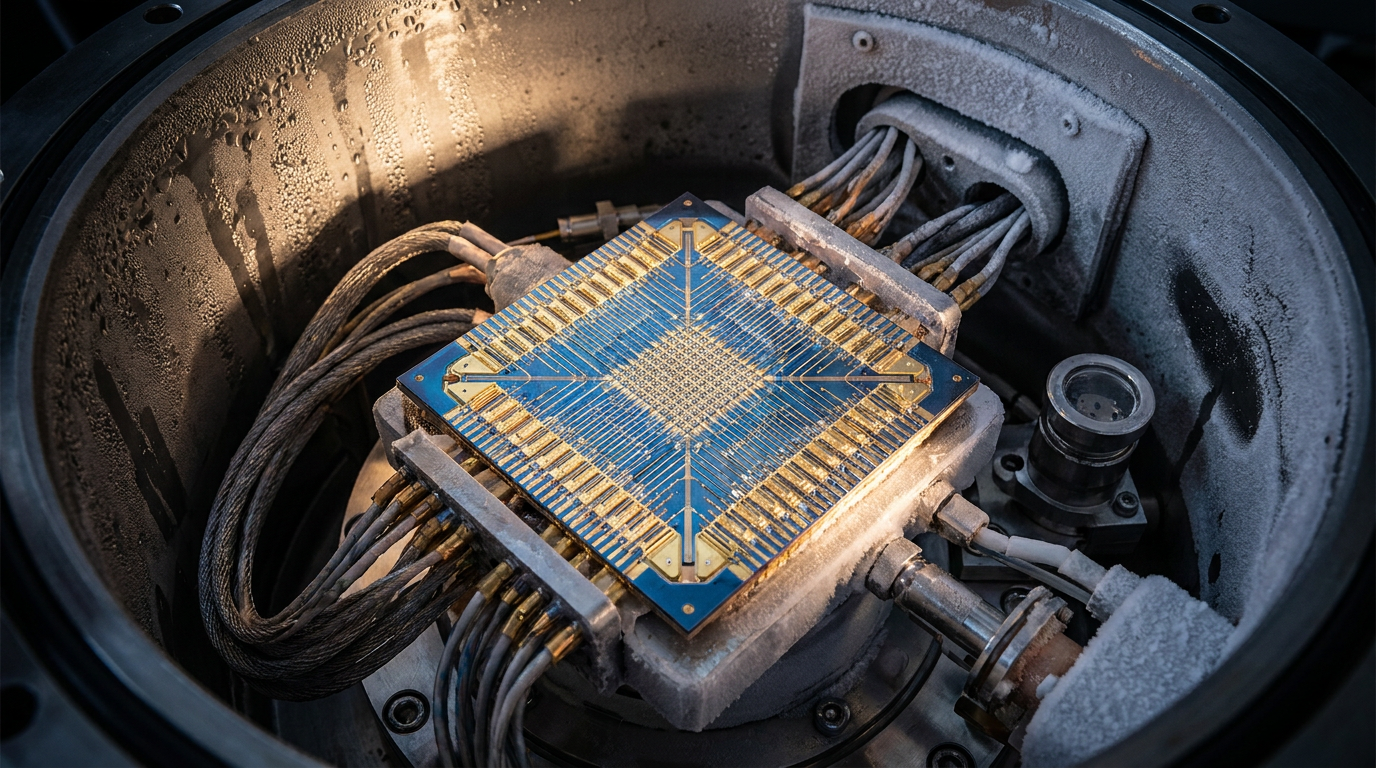
In a landmark 2026 study, an international team led by Imperial College London used a 78-qubit superconducting quantum processor to demonstrate a "prethermal state." This experiment provided crucial evidence that large quantum systems can remain stable for unexpectedly long periods.[2]
Normally, when a quantum system is driven by external forces, it heats up and loses its delicate quantum structure—a destructive process called decoherence. But the Imperial team used a technique called "structured randomness" to trick the system into ignoring the noise.[2]
Normally, when a quantum system is driven by external forces, it heats up and loses its delicate quantum structure—a destructive process called decoherence.
By hitting the processor with a carefully designed binary random drive, they suppressed the uncontrolled heating. The system entered a stable, highly ordered phase that lasted for an unexpectedly long time, defying the usual thermodynamic decay that plagues quantum computers.[2]

Meanwhile, researchers at Aalto University recently achieved another major milestone by linking a time crystal to the macroscopic world. They successfully connected a time crystal, formed in a superfluid under ultracold conditions, to a tiny mechanical oscillator.[3]
This mechanical linkage proved that time crystals can be controlled and interacted with without destroying their delicate perpetual motion. It is the first critical step toward using them as functional, readable components in larger machines and sensors.[3]
Even more visually striking, a team at the University of Colorado Boulder managed to create a visible time crystal using liquid crystals—the exact same class of materials found in everyday smartphone and television displays.[4]
Under a microscope, the CU Boulder team observed shifting stripes that kept cycling through the exact same pattern for hours. Unlike previous quantum experiments that required indirect measurement, this was a phase of matter repeating in time, directly observable by the human eye.[4]

Other thermodynamic loopholes are also being exposed alongside time crystals. Physicists at the University of Stuttgart recently demonstrated that quantum engines made of correlated particles can exceed the traditional Carnot efficiency limit, producing extra work beyond what heat alone allows.[5]
So, do these discoveries mean we finally have a perpetual motion machine? Not quite. While the internal motion of a time crystal continues forever, you cannot extract infinite free energy from it. Attempting to siphon power would break the closed loop and halt the motion entirely.[1][6]
However, the practical applications are immense. The biggest hurdle in modern quantum computing is memory; qubits are notoriously fragile and prone to decoherence. A quantum state that naturally resists decay could serve as the ultimate, perfectly stable quantum memory drive.[2][6]
How we got here
2012
Nobel laureate Frank Wilczek first proposes the theoretical concept of a time crystal.
2016
Scientists experimentally confirm the existence of time crystals for the first time.
2021
Researchers use Google's Sycamore quantum computer to create a highly stable time crystal.
Jan 2026
Imperial College London demonstrates long-lived prethermal states on a 78-qubit processor.
May 2026
Aalto University and CU Boulder achieve mechanical linkages and visible macroscopic time crystals.
Viewpoints in depth
Theoretical Physicists
Focus on the fundamental rewriting of thermodynamic laws and the nature of non-equilibrium matter.
For theoretical physicists, the existence of time crystals and prethermal states is a profound philosophical shift. The Second Law of Thermodynamics has long dictated that systems must eventually settle into thermal equilibrium—a state of maximum entropy and rest. Time crystals exploit a loophole in quantum mechanics, proving that matter can exist in a permanent state of non-equilibrium. This forces a reevaluation of how energy, motion, and rest are defined at the atomic scale.
Quantum Engineers
Focus on harnessing these states for stable quantum memory and error correction.
Engineers building the next generation of quantum computers view these discoveries through a highly practical lens. The Achilles' heel of modern quantum computing is decoherence; qubits lose their information almost instantly when exposed to environmental noise. Because time crystals and prethermal states naturally resist decay and maintain their structure over time, they offer a blueprint for building self-correcting quantum memory that doesn't require massive, power-hungry cooling systems.
Materials Scientists
Focus on macroscopic applications, like visible time crystals and new physical materials.
Materials scientists are taking these abstract quantum concepts and bringing them into the macroscopic world. By replicating time-crystal behavior in visible mediums like nematic liquid crystals, they are opening the door to entirely new classes of materials. These 'space-time crystals' could lead to self-healing optical materials, advanced sensors that operate at room temperature, and materials whose physical properties cycle dynamically without degrading.
What we don't know
- Whether time crystals can be scaled up to operate reliably at room temperature.
- How to extract useful computational work from a time crystal without collapsing its delicate state.
- If other undiscovered phases of non-equilibrium matter exist beyond time crystals.
Key terms
- Time Crystal
- A phase of matter where particles move in a repeating pattern over time, rather than just being arranged in a repeating pattern in space.
- Ground State
- The lowest possible energy state of a quantum system. Time crystals exhibit motion even when they are in this state.
- Prethermal State
- A long-lived, stable quantum state that resists heating up and losing its structure, even when driven by external forces.
- Decoherence
- The process by which a quantum system loses its delicate quantum properties due to interaction with its environment.
- Qubit
- The basic unit of quantum information, analogous to a classical computer bit but capable of existing in multiple states simultaneously.
Frequently asked
Are time crystals perpetual motion machines?
They exhibit perpetual motion internally, but they cannot be used to generate infinite free energy. Extracting energy from them would destroy their delicate quantum state.
What does a time crystal actually look like?
Most exist only as mathematical states inside quantum processors, but recent experiments using liquid crystals have created visible versions that look like shifting, repeating microscopic stripes.
Why are time crystals useful?
Because they resist losing their structure over time, they could be used to create perfectly stable memory for quantum computers or incredibly precise atomic clocks.
Sources
Source coverage
6 outlets
3 viewpoints surfaced




[1]New ScientistTheoretical Physicists
A quantum state that lasts forever may finally be within our grasp
Read on New Scientist →[2]NatureQuantum Engineers
Binary structured random drives enable long-lived prethermal phases
Read on Nature →Optomechanical control of a time crystal
Read on Nature Communications →Observation of a topological solitonic space-time crystal in a nematic liquid crystal system
Read on Nature Materials →[5]Science AdvancesTheoretical Physicists
Quantum engines exceed the Carnot limit via correlated particles
Read on Science Advances →[6]Factlen Editorial TeamTheoretical Physicists
Synthesis by Factlen editorial team
Read on Factlen Editorial Team →
Every angle. Every day.
Get science stories with full source coverage and perspective breakdowns delivered to your inbox.