
The Science of Induction Cooking: How Electromagnetism is Reshaping the Modern Kitchen
As induction cooktops rapidly replace traditional gas and electric stoves, understanding the physics behind them reveals why they cook faster, waste less energy, and dramatically improve indoor air quality.
By Factlen Editorial Team
- Public Health Advocates
- Focus on eliminating indoor NO2 and PM2.5 emissions by removing combustion appliances from homes.
- Culinary Professionals
- Value the performance benefits of speed, precision, and a cooler working environment.
- Energy Regulators
- Prioritize the reduction of energy waste and the electrification of homes to meet climate goals.
- Home Consumers
- Balance the upfront cost and cookware upgrades against long-term savings, safety, and convenience.
What's not represented
- · Traditional Cookware Manufacturers
- · Natural Gas Utility Providers
Why this matters
Switching to induction isn't just a culinary upgrade; it fundamentally alters the energy footprint and air quality of your home. By eliminating combustion, households can reduce harmful indoor pollutants by over 50 percent while cutting cooking times.
Key points
- Induction cooktops use electromagnetism to generate heat directly inside the cookware, rather than heating the surrounding air.
- The technology transfers up to 90 percent of its energy to the food, making it significantly more efficient than gas or traditional electric stoves.
- Eliminating open combustion removes harmful indoor air pollutants like nitrogen dioxide, drastically improving respiratory health.
- Professional kitchens are adopting induction for its pinpoint temperature control, faster boiling speeds, and cooler ambient working environments.
- Cookware must contain ferromagnetic materials, such as cast iron or magnetic stainless steel, to function on an induction surface.
The kitchen stove is undergoing its most significant technological leap since the introduction of the microwave oven. As households increasingly prioritize energy efficiency and indoor air quality, induction cooking has moved from a high-end luxury niche to the center of the modern culinary conversation.[1]
To understand the magnitude of this shift, one must first look at the legacy systems it is replacing. Traditional gas stoves rely on the combustion of fossil fuels to create an open flame, while conventional electric stoves use electrical resistance to heat a metal coil. Both methods are inherently inefficient, as they must first heat the air around the burner before that heat transfers to the cookware.[6]
Induction cooking, by contrast, bypasses the middleman. While it sounds like science fiction, the technology is firmly grounded in the laws of electromagnetism—a relationship between electricity and magnetism first discovered in the early 19th century by physicists like Hans Christian Oersted.[4]
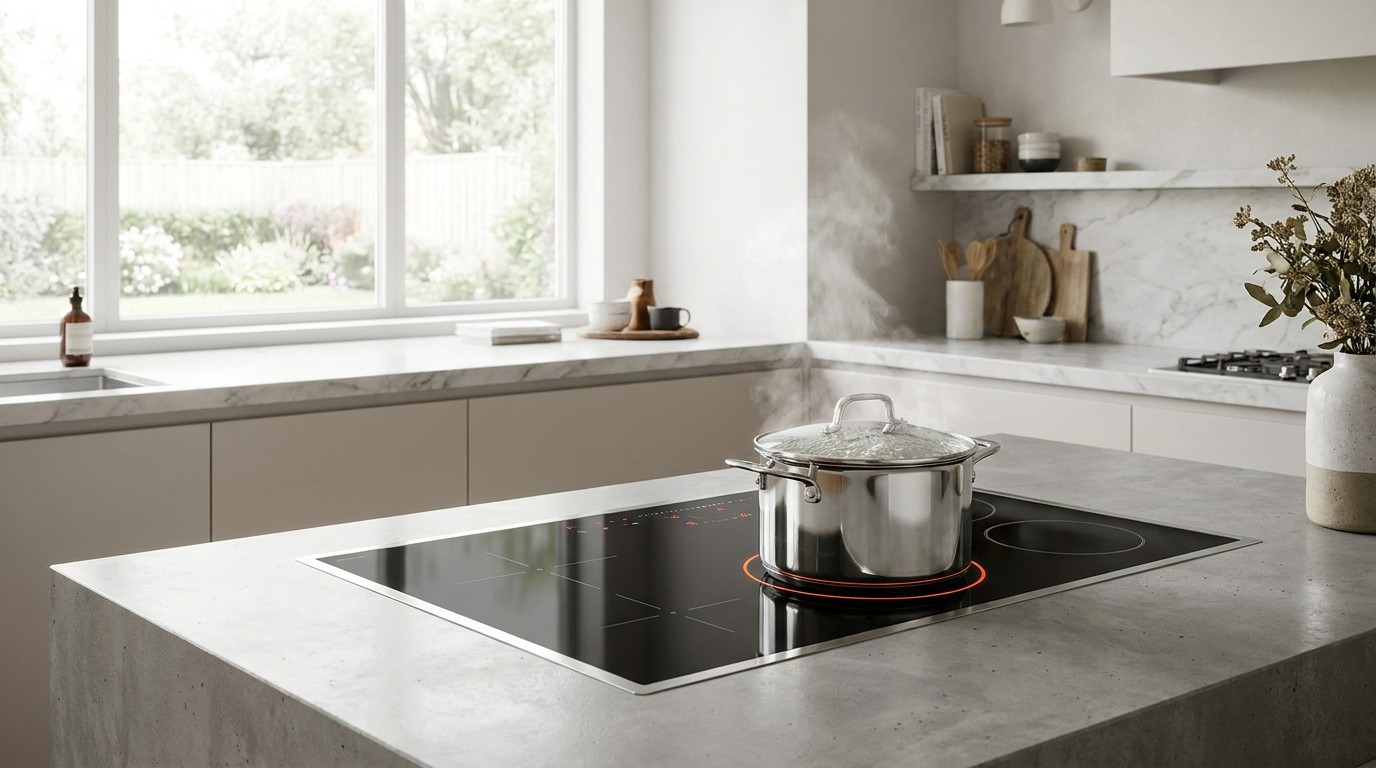
Beneath the deceptively simple, smooth glass surface of an induction cooktop lies a tightly wound copper coil. When the stove is powered on, an alternating electrical current flows through this coil, generating a dynamic, high-frequency magnetic field directly above the cooking zone.[3][4]
The true magic happens when a compatible pot or pan is placed on this magnetic field. The field penetrates the metal of the cookware, inducing a fast-moving, swirling electrical current inside the base of the pan. These are known as eddy currents, and they behave much like the swirling waters of a fast-moving stream.[3]
As these electrons vibrate and bounce around, they encounter the natural electrical resistance of the pan's metal. This resistance, combined with a phenomenon called magnetic hysteresis, generates intense, immediate heat. In essence, the induction mechanism transforms the cookware itself into a self-contained heating element, while the glass surface remains relatively cool.[4]

Because the heat is generated directly inside the metal, induction boasts an astonishing energy transfer efficiency. Testing demonstrates that induction systems transfer between 85 and 90 percent of their drawn energy directly into the food. In stark contrast, traditional gas stoves hover around 30 to 40 percent efficiency, bleeding the majority of their heat into the surrounding kitchen air.[6]
This direct energy transfer translates to unrivaled speed. Because no thermal energy is wasted heating the ambient environment, an induction cooktop can bring a pot of water to a rolling boil 30 to 40 percent faster than a high-BTU professional gas burner.[6]
Beyond speed and efficiency, the transition to induction is increasingly driven by a growing awareness of respiratory health. Gas stoves are combustion appliances, meaning they release byproducts like nitrogen dioxide (NO2), carbon monoxide, and fine particulate matter (PM2.5) directly into the home—pollutants heavily linked to childhood asthma.[8]

Beyond speed and efficiency, the transition to induction is increasingly driven by a growing awareness of respiratory health.
A landmark pilot study conducted by the Columbia University Mailman School of Public Health evaluated the impact of transitioning from gas to induction in Bronx public housing. The researchers found that replacing gas stoves with induction units resulted in a 56 percent reduction in average daily NO2 concentrations, fundamentally altering the indoor air quality of the apartments.[2]
These findings align with a recent National Institutes of Health report, which highlighted a 60 percent overall reduction in indoor air pollutants when households made the switch. The report noted that eliminating combustion at the source is particularly impactful for vulnerable populations, including children and the elderly.[8]
In the culinary world, the debate between gas and induction has historically been contentious. Many professional chefs were trained exclusively on gas and valued the visual feedback of an open flame. However, the industry is experiencing a rapid paradigm shift as the performance benefits of induction become impossible to ignore.[5]
Induction allows for pinpoint digital temperature control that gas simply cannot match. Chefs can hold a steady, precise simmer for delicate sauces or melt chocolate without the need for a cumbersome double boiler. The immediate response time mimics the instant-off capability of gas, but with far greater accuracy.[5][6]
High-volume commercial kitchens are increasingly adopting hybrid or full-induction setups. By eliminating open flames, restaurants drastically reduce the ambient temperature of the kitchen, improving staff comfort and significantly lowering HVAC cooling costs during peak service hours.[5]

Regulatory tailwinds are also accelerating the adoption curve. The U.S. Department of Energy has introduced updated efficiency standards that cap the annual energy use of electric cooktops. These new thresholds, which take full effect in the coming years, are pushing manufacturers to prioritize induction technology, resulting in a flood of new models across all price tiers in 2026.[7]
The primary hurdle for new users is cookware compatibility. Because the entire system relies on magnetic fields, pots and pans must contain ferromagnetic materials. Cast iron, carbon steel, and magnetic stainless steel work perfectly, while pure copper, aluminum, or glass cookware will not heat up unless they feature a specialized bonded steel base.[4]
Fortunately, diagnosing your current kitchen arsenal is incredibly simple. The ultimate test requires nothing more than a standard refrigerator magnet; if the magnet sticks firmly to the bottom of the pan with a solid clink, the cookware is ready for an induction cooktop.[3]
As manufacturing volumes increase and prices continue to normalize, induction cooking is poised to become the default standard. It represents a rare technological convergence where culinary precision, environmental stewardship, and public health all point in the exact same direction.[1]
How we got here
1820
Danish physicist Hans Christian Oersted discovers the fundamental relationship between electricity and magnetism.
Mid-1950s
General Motors' Frigidaire division demonstrates early induction stoves on a touring showcase.
2023
The U.S. Department of Energy proposes revised efficiency rules for residential cooking products.
2024
Columbia University publishes a landmark study showing a 56% drop in indoor NO2 when switching from gas to induction.
2026
New federal energy standards drive a massive expansion of induction models across all price tiers.
Viewpoints in depth
Public Health Advocates
Emphasize the urgent need to remove combustion appliances from homes to protect respiratory health.
Researchers point to mounting evidence that gas stoves act as significant sources of indoor air pollution. By emitting nitrogen dioxide and fine particulate matter, gas cooking has been linked to childhood asthma and cardiovascular issues. For these advocates, the transition to induction is less about culinary preference and more about treating the kitchen as a critical environment for preventative health, especially in low-income housing where ventilation is often inadequate.
Culinary Professionals
Focus on the performance benefits of speed, precision, and a cooler working environment.
While traditionalists have long defended the visual feedback of an open gas flame, modern chefs are increasingly won over by induction's raw performance. The ability to boil water in half the time and hold a precise simmer without scorching delicate sauces transforms service. Furthermore, eliminating open flames drastically reduces the ambient temperature of commercial kitchens, improving staff comfort and lowering air conditioning costs.
Energy Regulators
Prioritize the reduction of energy waste and the electrification of homes to meet climate goals.
With induction transferring up to 90 percent of its energy directly to the cookware, regulators view the technology as a cornerstone of residential energy efficiency. By implementing stricter consumption caps, agencies like the Department of Energy are effectively phasing out inefficient radiant electric and gas models, pushing the market toward induction to ease the burden on the electrical grid and reduce overall greenhouse gas emissions.
What we don't know
- How quickly the secondary market for used gas stoves will decline as local municipalities continue to restrict new gas hookups.
- Whether the electrical grid infrastructure in older residential buildings can seamlessly support the high-amperage requirements of widespread induction adoption without costly panel upgrades.
Key terms
- Electromagnetism
- The physical interaction between electricity and magnetism, utilized in induction to create a magnetic field from an electric current.
- Eddy Currents
- Loops of electrical current induced within the metal of the cookware by the alternating magnetic field, which generate heat.
- Magnetic Hysteresis
- The resistance of a magnetic material to changes in its magnetization, contributing to the rapid heating of the pan.
- Ferromagnetic
- Materials like iron or certain steel alloys that are highly susceptible to magnetization, making them compatible with induction stoves.
- Nitrogen Dioxide (NO2)
- A harmful gas produced by combustion, including gas stoves, linked to respiratory issues like asthma.
Frequently asked
Do I need to buy all new pots and pans for an induction stove?
Not necessarily. Any cookware made of cast iron or magnetic stainless steel will work. You can test your current pans by seeing if a magnet sticks to the bottom.
Is induction cooking the same as a traditional electric stove?
No. Traditional electric stoves use a heating element that gets hot and transfers heat to the pan. Induction uses magnetic fields to make the pan itself the heating element.
Does induction cooking use more electricity?
Induction is actually more energy-efficient than traditional electric or gas stoves because it transfers 85 to 90 percent of the energy directly into the food, wasting very little heat.
Are induction cooktops safe to touch?
The cooktop itself does not generate heat, so it remains relatively cool. However, the glass can become warm from the residual heat of the hot pan resting on it.
Sources
Source coverage
8 outlets
4 viewpoints surfaced








[1]Factlen Editorial TeamHome Consumers
Synthesis by Factlen editorial team
Read on Factlen Editorial Team →[2]Columbia UniversityPublic Health Advocates
Study Finds Switching From Gas to Electric Stoves Cuts Indoor Air Pollution
Read on Columbia University →[3]Rewiring AmericaHome Consumers
How an induction stove works
Read on Rewiring America →[4]Explain That StuffHome Consumers
How induction cooking works
Read on Explain That Stuff →[5]RestaurantwareCulinary Professionals
Induction vs Gas for Commercial Kitchens
Read on Restaurantware →[6]Shop AppliancesCulinary Professionals
Induction vs Gas for Luxury Kitchens: Which Premium Cooktop Is Right for You?
Read on Shop Appliances →[7]ServiceMagEnergy Regulators
Appliance Trends 2026: The Induction Flood
Read on ServiceMag →[8]AEWHALEPublic Health Advocates
Induction Cooking Cuts Indoor Air Pollution by 60% – NIH-Backed Evidence
Read on AEWHALE →

Every angle. Every day.
Get lifestyle stories with full source coverage and perspective breakdowns delivered to your inbox.