
How AI-Powered 'Self-Driving Labs' Are Automating Scientific Discovery
Autonomous laboratories combining AI and robotics are executing closed-loop experiments without human intervention, accelerating materials and drug discovery up to 100 times faster.
By Factlen Editorial Team
- Autonomous Science Advocates
- Argue that removing human bottlenecks through full AI-robotic integration is essential for solving urgent global challenges in energy and medicine.
- Regulatory & Safety Officials
- Emphasize that while AI can accelerate discovery, human experts must remain in the loop to validate data and ensure safety in critical applications.
- Commercial Cloud Lab Providers
- Focus on the democratization and commercialization of autonomous hardware, turning expensive robotic infrastructure into accessible, subscription-based services.
What's not represented
- · Bench Scientists
- · Academic Grant Committees
Why this matters
By removing the human bottleneck from the physical execution of experiments, self-driving labs are compressing the timeline for critical breakthroughs in clean energy and life-saving therapeutics from decades to mere months.
Key points
- Self-driving labs combine AI and robotic automation to execute scientific experiments without human intervention.
- These systems operate in a continuous Design-Build-Test-Learn loop, accelerating discovery up to 100 times faster.
- The technology is currently driving major breakthroughs in clean energy materials and pharmaceutical drug discovery.
- New FDA and EMA guidelines require human oversight for any AI-driven decisions affecting drug quality or safety.
- Subscription-based 'cloud labs' are democratizing access to this expensive robotic infrastructure for smaller startups.
The chemical universe is vast and largely unmapped, containing billions of potential molecules that could cure diseases or power next-generation batteries. For centuries, scientific discovery has relied on a painstaking, manual process of trial and error. A researcher formulates a hypothesis, synthesizes a compound at the bench, tests its properties, and analyzes the results—a cycle that can take weeks or even months for a single molecule. This human bottleneck has historically gated the pace of innovation in everything from life-saving therapeutics to clean energy technologies, leaving the vast majority of the chemical space entirely unexplored.[6]
But in 2026, a radical shift is underway in research facilities around the globe that promises to eliminate this bottleneck entirely. Enter the 'self-driving laboratory' (SDL), a transformative paradigm that merges artificial intelligence, robotic automation, and advanced characterization into a single, closed-loop system. Much like an autonomous vehicle navigates a physical landscape using an array of sensors and algorithms, an SDL uses AI as its navigational GPS to boldly chart the unknown chemical landscape. By removing the human from the physical execution of the experiment, these facilities can run round-the-clock, synthesizing and testing compounds without interruption or fatigue.[2][3]
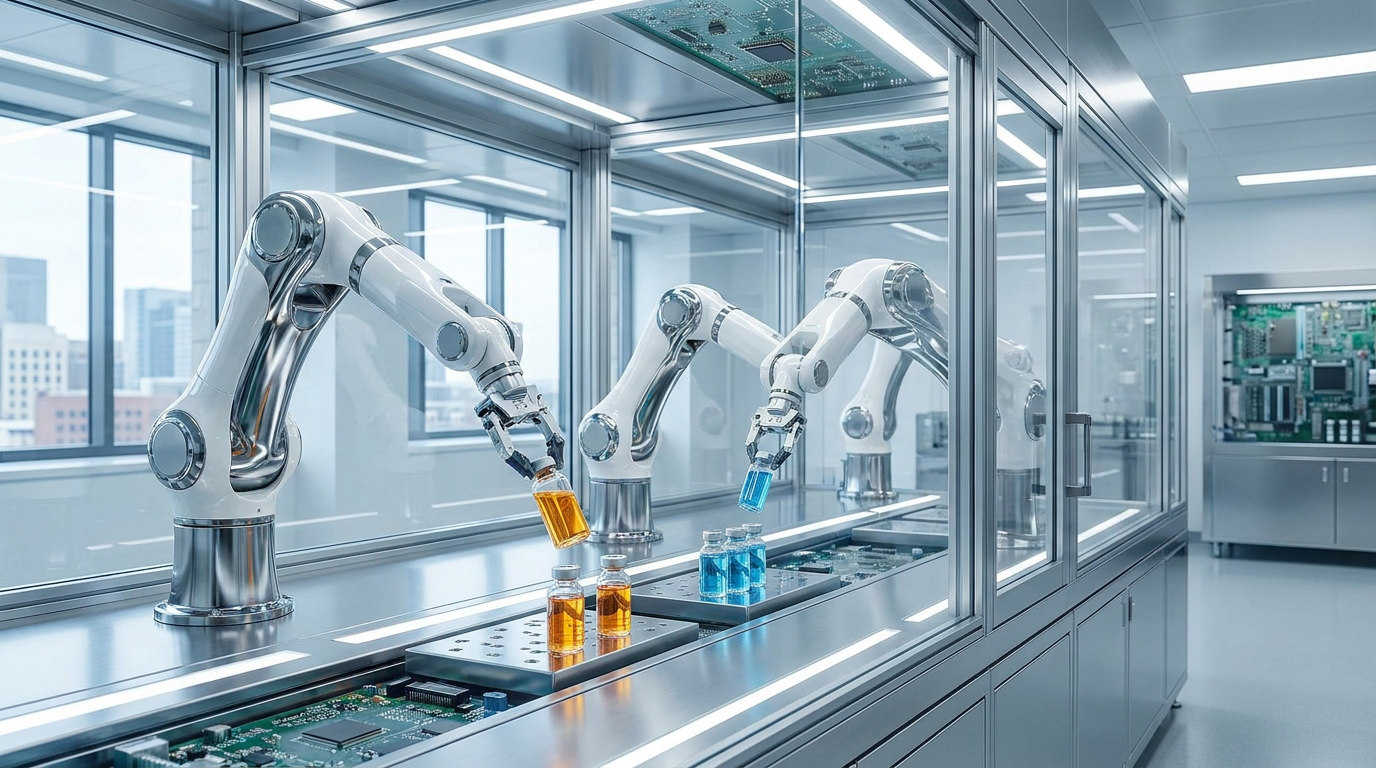
The architecture of a self-driving lab fundamentally rewires the traditional scientific method into a continuous, highly efficient Design-Build-Test-Learn loop. The AI 'brain' of the system begins the cycle by analyzing vast troves of existing scientific literature, patent databases, and historical experimental datasets to design a promising new experiment. It then translates this theoretical hypothesis into precise, machine-readable instructions and sends them to robotic arms and automated fluidic systems. These machines act as the 'muscle' of the laboratory, physically mixing reagents, controlling environmental temperatures, and synthesizing the target material with absolute precision, eliminating the risk of human error in the preparation phase.[1][3]
Once the novel material or molecule is physically created, automated analytical instruments immediately step in to test its physical and chemical properties. The results of these high-throughput tests are fed back into the AI model in real time, closing the loop. Using advanced statistical techniques like Bayesian optimization and active learning, the system updates its understanding of the chemical space and intelligently plans the next, most promising experiment. Each cycle sharpens the model's predictive accuracy, and each improved model makes the subsequent experiment significantly more targeted, allowing the system to zero in on optimal compounds with remarkable efficiency.[2][5]

The resulting acceleration in the pace of research is staggering. Compared to conventional chemical and materials science workflows, self-driving labs can accelerate discovery up to 100 times faster. At North Carolina State University, which currently hosts the largest system of automated labs at any U.S. academic institution, researchers are utilizing an autonomous catalysis lab called Fast-Cat to rapidly optimize specialty chemicals. What once took a team of graduate students years to accomplish can now be achieved by an autonomous system in a matter of days.[2]
Beyond individual academic institutions, the push for autonomous science is backed by massive institutional investments and coordinated national initiatives. The Acceleration Consortium, a leading global network devoted entirely to this technology, recently deployed a state-of-the-art fleet of 50 autonomous robots, an initiative funded by a record-breaking Canadian federal research grant. These highly sophisticated systems are not just theoretical academic curiosities meant for publishing papers; they are actively discovering novel molecules and advanced materials that possess immediate commercial potential for industrial applications, signaling a major shift in how applied research is funded and executed.[1][3]
In the realm of materials science, the impact of this automation is already being acutely felt in the clean energy sector, where the demand for new materials is urgent. AI-accelerated discovery pipelines are currently being deployed to find novel electrocatalysts for hydrogen production, optimize solid oxide cells, and develop new nanomaterials for high-capacity, fast-charging batteries. By compressing the discovery timeline from decades of manual trial-and-error to mere months of automated optimization, self-driving labs are providing the rapid, data-driven innovation required to meet ambitious global clean energy targets and accelerate the transition away from fossil fuels.[5][6]
In the realm of materials science, the impact of this automation is already being acutely felt in the clean energy sector, where the demand for new materials is urgent.
The pharmaceutical industry is experiencing a similar, heavily funded revolution as companies race to integrate AI into their discovery pipelines. Systems like IBM's RoboRXN have demonstrated the remarkable ability to automatically convert dense chemical preprint literature into structured knowledge graphs, seamlessly generating complete synthetic routes for entirely new compounds. This capability allows researchers to discover and synthesize ideal drug candidates with unprecedented speed, fundamentally altering the economics of early-stage drug discovery. By drastically reducing the time and cost required to identify viable molecules, these systems are dramatically lowering the barrier to finding targeted treatments for rare and neglected diseases.[3][6]

However, the transition from scripted robotic automation to genuine agentic AI remains primarily a complex software challenge, rather than a hardware limitation. While robotic arms, automated liquid handlers, and high-throughput spectrometers are highly capable and widely available on the commercial market, the missing piece has historically been the middleware. Connecting disparate, proprietary instruments from different manufacturers into a cohesive, intelligent system that can make autonomous decisions requires a sophisticated software architecture. Bridging the gap between a machine that simply follows a script and an AI agent that can adapt to unexpected experimental results is the current frontier of the industry.[1]
In 2026, the industry is finally overcoming this software hurdle through the proliferation of specialized AI agents and the adoption of standardized communication protocols across laboratory hardware. Large language models and graph neural networks are now capable of generating complex, multi-step synthesis paths that account for real-world chemical constraints. Simultaneously, active learning algorithms drastically reduce the overall experimental burden by predicting exactly which tests will yield the most informative data. This allows the autonomous system to confidently skip thousands of unnecessary, dead-end reactions, focusing its physical resources only on the most promising avenues of inquiry.[5]
Despite these immense technical leaps in both hardware and software, the regulatory landscape imposes necessary and strict constraints, particularly in healthcare and therapeutics. In January 2026, the FDA and EMA jointly published the Guiding Principles of Good AI Practice in Drug Development. This landmark framework established the first global regulatory alignment on the use of artificial intelligence in pharmaceutical environments, ensuring that the rush toward laboratory automation does not compromise patient safety or the integrity of clinical data. The guidelines provide a clear roadmap for how autonomous systems can be safely integrated into highly regulated industries.[4]
The core regulatory reality established by these new international guidelines is that AI outputs in GxP (Good Practice) environments must be treated strictly as recommendations rather than final, unreviewable decisions. A qualified human expert must still review and approve any AI-driven action that directly affects product quality, safety, or clinical efficacy. Consequently, while a self-driving lab might autonomously run thousands of preliminary screening tests to identify a promising compound, human oversight remains a mandatory, legally required gatekeeper before any AI-discovered drug candidate is allowed to advance into human clinical trials.[4][6]

Because of these strict regulatory constraints and lingering software integration limitations, most commercial self-driving labs today operate at Level 2 or 3 on a standardized five-level autonomy scale. At these levels, the systems handle closed-loop optimization on specific, narrow tasks while human scientists set the overarching research goals, provide the initial parameters, and manage any unexpected exceptions. True Level 5 autonomy—where a laboratory operates entirely without human intervention from initial hypothesis generation to final product formulation and regulatory submission—remains a future aspiration that will require further advancements in both artificial general intelligence and regulatory frameworks.[1]
Yet, the democratization of this powerful technology is accelerating rapidly through the rise of commercial 'cloud labs.' These subscription-based platforms offer remote-control access to massive, fully automated experimental facilities that would otherwise be prohibitively expensive to build. A small startup with nothing more than a laptop and an internet connection can now run high-throughput, AI-guided experiments on millions of dollars worth of robotic hardware located halfway across the world. This model is effectively leveling the playing field between lean biotech firms and massive pharmaceutical conglomerates, fostering a more diverse and competitive landscape for scientific innovation.[3][6]
This shift toward automated infrastructure represents much more than just a technological upgrade; it is a fundamental reimagining of the scientist's role in the 21st century. By offloading the repetitive, manual labor of pipetting, mixing, and screening to tireless robotic systems, human researchers are finally freed from the physical constraints of the laboratory bench. They can instead focus their time and cognitive energy on higher-level creative thinking, complex experimental design, interpreting nuanced data, and solving the profound theoretical problems that machines cannot yet grasp.[2][6]

As self-driving labs continue to scale in both capability and global accessibility, the synergy between human intuition and artificial intelligence will only deepen. We are entering an unprecedented era where the physical execution of the scientific method itself is being automated at scale. This transformation promises a near future where critical breakthroughs in personalized medicine, sustainable energy storage, and advanced materials are limited only by the bounds of our scientific imagination, rather than our physical capacity to manually run the necessary experiments.[2][6]
How we got here
2011
The Materials Genome Initiative establishes the foundational paradigm of using high-throughput computation to build open materials databases.
2020
IBM introduces RoboRXN, an autonomous chemical synthesis platform powered by cloud computing and AI models.
2025
Commercial cloud labs begin offering widespread subscription-based access to automated experimental infrastructure.
Jan 2026
The FDA and EMA jointly publish the Guiding Principles of Good AI Practice in Drug Development, establishing rules for AI in regulated labs.
Viewpoints in depth
Autonomous Science Advocates
Argue that removing human bottlenecks through full AI-robotic integration is essential for solving urgent global challenges.
Researchers and technologists in this camp view the traditional scientific method as too slow to address pressing crises like climate change and emerging pandemics. They argue that by fully automating the Design-Build-Test-Learn loop, self-driving labs can explore chemical spaces millions of times larger than humanly possible. Their ultimate goal is Level 5 autonomy, where AI systems independently generate hypotheses, execute physical experiments, and publish findings with zero human intervention.
Regulatory & Safety Officials
Emphasize that while AI can accelerate discovery, human experts must remain in the loop to validate data and ensure safety.
Regulators and bioethics experts acknowledge the immense potential of laboratory automation but warn against delegating quality-critical decisions to black-box algorithms. They point to the 2026 FDA and EMA guidelines as a necessary safeguard, arguing that AI should function as a powerful recommendation engine rather than an autonomous decision-maker. This camp stresses that human oversight is legally and ethically required to prevent algorithmic hallucinations from advancing unsafe drug candidates or hazardous materials into production.
Commercial Cloud Lab Providers
Focus on the democratization of autonomous hardware, turning expensive robotic infrastructure into accessible, subscription-based services.
This perspective is driven by startups and tech conglomerates building the middleware and physical infrastructure for remote science. They argue that the true revolution isn't just speed, but access. By offering 'science-as-a-service,' cloud lab providers believe they can level the playing field, allowing a small team of researchers with a laptop to execute the same high-throughput, AI-guided experiments as a massive pharmaceutical company, thereby decentralizing scientific innovation.
What we don't know
- How quickly regulatory bodies will allow Level 4 or Level 5 autonomous systems to operate in highly sensitive fields like virology or synthetic biology.
- The long-term impact of cloud labs on traditional university research infrastructure and funding models.
- Whether the software middleware can scale to seamlessly integrate legacy laboratory equipment that was not designed for AI control.
Key terms
- Self-Driving Lab (SDL)
- A highly automated research facility where AI designs experiments, robots execute them, and the system learns from the results in a continuous loop.
- Closed-Loop Experimentation
- A process where the results of an experiment are automatically fed back into an AI model to instantly design and optimize the next experiment.
- Bayesian Optimization
- A statistical strategy used by AI to efficiently search for the best solution by predicting which experiments will yield the most valuable new information.
- Cloud Lab
- A centralized, highly automated laboratory that scientists can access and control remotely via the internet to run experiments.
- Active Learning
- A machine learning technique where the AI actively queries the system to run specific tests that will best improve its own predictive accuracy.
Frequently asked
What is a self-driving laboratory?
A self-driving laboratory is a research facility that combines artificial intelligence, robotics, and automated testing to run scientific experiments in a continuous, closed loop without human intervention.
How much faster are self-driving labs compared to traditional methods?
Self-driving labs can accelerate the discovery of new molecules and materials up to 100 times faster than conventional manual experimentation.
Can AI legally approve new drugs in these labs?
No. Under 2026 FDA and EMA guidelines, AI outputs in regulated environments are treated as recommendations. A human expert must still approve any decisions affecting product quality or safety.
What is a cloud lab?
A cloud lab is a commercial facility that allows researchers to remotely design and execute automated experiments via the internet, offering subscription-based access to expensive robotic hardware.
Sources
Source coverage
6 outlets
3 viewpoints surfaced






[1]NatureAutonomous Science Advocates
Inside the 'self-driving' lab revolution
Read on Nature →[2]NC State UniversityAutonomous Science Advocates
Self-driving labs are accelerating the discovery of new molecules and materials
Read on NC State University →[3]Royal Society PublishingCommercial Cloud Lab Providers
Autonomous, 'self-driving' laboratories for scientific discovery
Read on Royal Society Publishing →[4]U.S. Food and Drug AdministrationRegulatory & Safety Officials
Guiding Principles of Good AI Practice in Drug Development
Read on U.S. Food and Drug Administration →[5]PatSnapAutonomous Science Advocates
AI-Accelerated Materials Discovery: The 2026 Innovation Landscape
Read on PatSnap →[6]Factlen Editorial TeamCommercial Cloud Lab Providers
Synthesis by Factlen editorial team
Read on Factlen Editorial Team →



Every angle. Every day.
Get ai stories with full source coverage and perspective breakdowns delivered to your inbox.