
The Evidence Behind 'Missing Middle' Zoning Reforms: Do They Actually Lower Housing Costs?
A growing body of empirical data from early-adopter cities reveals that eliminating single-family zoning can successfully stabilize rents, provided local governments remove bureaucratic hurdles to construction.
By Factlen Editorial Team
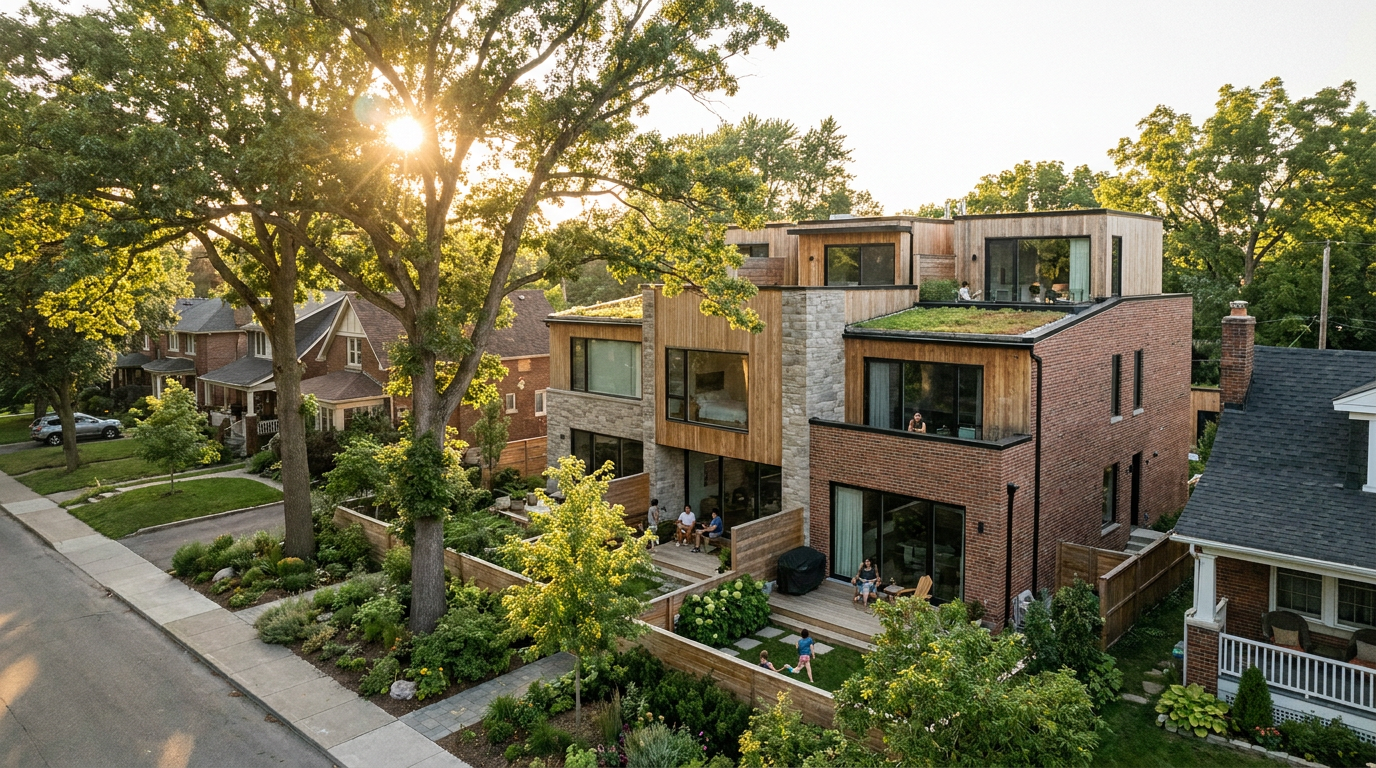
- Supply-Side Reformers
- Argue that eliminating restrictive zoning barriers is the most effective way to build more housing and lower costs.
- Empirical Housing Researchers
- Focus on measuring actual market feasibility, construction costs, and the real-world outcomes of policy changes.
- Local Control Defenders
- Express concern over the loss of neighborhood character and the potential strain on local infrastructure from increased density.
What's not represented
- · Renters in gentrifying neighborhoods
- · Small-scale residential developers
Why this matters
Housing affordability is the primary financial stressor for millions of families. Understanding which local policies actually work empowers voters to advocate for proven, data-backed solutions in their own communities.
Key points
- "Missing middle" housing refers to moderate-density structures like duplexes and triplexes that fit into single-family neighborhoods.
- Auckland's 2016 upzoning led to a massive construction boom, adding over 10,000 new attached dwellings in six years.
- Minneapolis kept rent growth to just 1% over five years by increasing its housing stock, compared to 14% growth statewide.
- California's SB 9 reveals that legalizing density does not guarantee construction if high costs and local regulations remain.
- Successful zoning reform requires pairing legalization with streamlined permitting and reduced bureaucratic friction.
The housing affordability crisis has forced cities to rethink the American dream of the detached single-family home. For decades, restrictive zoning laws effectively banned the construction of duplexes, triplexes, and small apartment buildings—often termed "missing middle" housing—across vast swaths of urban land.[6]
Proponents of zoning reform argue that re-legalizing these moderate-density structures is the most effective way to increase housing supply and stabilize rents without dramatically altering neighborhood character. Until recently, this was primarily a theoretical debate.[6]
Today, a growing body of empirical evidence from early-adopter cities provides a clearer picture of what actually happens when municipalities abolish single-family exclusive zoning. The data reveals that while upzoning can successfully tame rent growth, simply changing the law is not a magic wand.[6]

The strongest evidence for the supply-side argument comes from Auckland, New Zealand. In 2016, the city upzoned approximately three-quarters of its residential land to allow for more intensive housing.[2]
A rigorous quasi-experimental study published in the Journal of Urban Economics found that the policy triggered a massive construction boom. Researchers concluded that the upzoning resulted in over 10,000 additional dwellings being built over six years, primarily attached multi-family units.[2]

Similar supply responses are emerging in North America. In Portland, Oregon, the city implemented the Residential Infill Project in 2021, allowing up to four units on nearly all residential lots. According to researchers at the University of Toronto, missing middle housing jumped from 13.4% of total permits to 44.7% in the two years following the reform.[4]
The most closely watched American case study is Minneapolis, which in 2020 became the first major U.S. city to eliminate single-family zoning citywide through its 2040 Plan.[5]
The most closely watched American case study is Minneapolis, which in 2020 became the first major U.S.
An analysis by the Pew Charitable Trusts found that between 2017 and 2022, Minneapolis increased its housing stock by 12%, while the rest of Minnesota managed only a 4% increase. The influx of new units had a profound impact on affordability.[1]
During that five-year period, rents in Minneapolis grew by just 1%. In stark contrast, rents across the rest of Minnesota surged by 14%. Pew researchers estimate that this moderation saves the average Minneapolis renter roughly $1,700 per year compared to the statewide trend.[1]

The Auckland data corroborates this price-moderating effect. Economists found that six years post-reform, rents for three-bedroom family homes in Auckland were 22% to 35% lower than they would have been in a synthetic control scenario without the upzoning.[2]
Furthermore, the increase in housing supply correlates with broader social benefits. While homelessness rose by 14% across the rest of Minnesota from 2017 to 2022, it actually declined by 12% in Hennepin County, which includes Minneapolis.[5]
However, while Minneapolis and Auckland showcase the potential of zoning reform, California's experience highlights the friction of implementation. In 2022, California enacted Senate Bill 9 (SB 9), a landmark law allowing homeowners to split lots and build up to four units on single-family parcels statewide.[3]
Initial projections suggested SB 9 could make 700,000 new homes financially feasible. Yet, a review by the Terner Center for Housing Innovation at UC Berkeley found that actual uptake in the first year was minimal.[3]
Los Angeles, a city of nearly four million people, received just 211 applications for new units under SB 9 in 2022. San Diego reported a mere seven applications. The Terner Center identified multiple barriers preventing homeowners from utilizing the law.[3]

High construction costs, elevated interest rates, and a lack of development expertise among everyday homeowners severely limit the financial viability of lot splits. Furthermore, local municipalities often impose restrictive design rules, height limits, and maximum unit sizes that render SB 9 projects mathematically impossible to build.[3]
The evidence suggests that for missing middle housing to scale, zoning reform must be paired with streamlined permitting and a reduction in bureaucratic friction. When municipalities actively support the transition—as seen in Minneapolis's elimination of parking minimums—the market responds.[1][5]
Ultimately, the data indicates that ending single-family zoning is a necessary but insufficient condition for solving the housing crisis. While it provides a proven mechanism to stabilize rents and increase density, realizing its full potential requires aligning financial incentives, building codes, and local political will.[6]
How we got here
2016
Auckland, New Zealand upzones three-quarters of its residential land, triggering a historic construction boom.
2020
Minneapolis implements its 2040 Plan, becoming the first major U.S. city to eliminate single-family exclusive zoning.
2021
Portland adopts the Residential Infill Project, leading to a sharp increase in missing middle housing permits.
2022
California enacts Senate Bill 9, legalizing lot splits and up to four units on single-family parcels statewide.
2024
Pew Charitable Trusts publishes data showing Minneapolis successfully decoupled its rent growth from the rest of the state.
Viewpoints in depth
Supply-Side Reformers
Argue that restrictive zoning is the primary driver of the housing affordability crisis.
This camp, which includes YIMBY (Yes In My Back Yard) advocates and urban planners, points to the laws of supply and demand. They argue that decades of single-family exclusive zoning artificially capped the number of homes that could be built in high-opportunity areas, driving up prices for the existing stock. By re-legalizing "missing middle" housing, they believe cities can organically increase density, lower the barrier to entry for first-time homebuyers, and create more walkable, transit-friendly communities. The data from Minneapolis and Auckland serves as their primary proof of concept.
Empirical Housing Researchers
Focus on measuring the actual market feasibility and economic outcomes of policy changes.
Economists and housing researchers emphasize that legalizing density on paper does not automatically translate to new homes in reality. They analyze the friction points—such as construction costs, interest rates, parking minimums, and local permitting delays—that determine whether a project is financially viable. This camp cautions against viewing zoning reform as a panacea, noting that without subsidies or streamlined bureaucratic processes, the private market will struggle to build affordable units at scale, as evidenced by the slow rollout of California's SB 9.
Local Control Defenders
Express concern over the loss of neighborhood character and the strain on local infrastructure.
Often characterized as NIMBY (Not In My Back Yard) by their critics, this perspective argues that sweeping state or citywide upzoning strips communities of their ability to manage growth. They raise concerns that replacing single-family homes with multi-unit structures will overwhelm local infrastructure, increase traffic congestion, and alter the aesthetic fabric of established neighborhoods. Furthermore, some argue that upzoning primarily benefits for-profit developers rather than low-income residents, potentially accelerating gentrification and the demolition of existing affordable housing stock.
What we don't know
- How high interest rates and elevated construction costs will impact the long-term viability of small-scale infill development.
- Whether the rent-stabilizing effects seen in Minneapolis and Auckland can be replicated in cities with significantly less available land.
- The long-term impact of upzoning on the displacement of vulnerable renters in rapidly gentrifying neighborhoods.
Key terms
- Missing Middle Housing
- A range of multi-unit or clustered housing types, compatible in scale with single-family homes, that help meet the demand for walkable neighborhoods.
- Upzoning
- The process of changing local zoning codes to allow for higher-density development, such as replacing single-family zoning with multi-family zoning.
- Single-Family Zoning
- A land-use regulation that restricts development on a parcel of land to only one detached residential dwelling.
- Synthetic Control
- A statistical method used by researchers to evaluate policy impact by comparing a treated city to a mathematically constructed 'twin' city that did not adopt the policy.
Frequently asked
Did ending single-family zoning ruin neighborhoods in Minneapolis?
No. The majority of new construction occurred along commercial corridors and transit routes, and the policy successfully stabilized rents without drastically altering the physical character of most residential streets.
Why aren't more people building duplexes in California under SB 9?
High construction costs, elevated interest rates, and complex local design regulations have made it financially and logistically difficult for everyday homeowners to utilize the law.
Does building more housing actually lower rent?
Evidence from Auckland and Minneapolis strongly suggests that significantly increasing the housing supply moderates rent growth and improves overall affordability compared to regions that restrict construction.
Sources
Source coverage
6 outlets
3 viewpoints surfaced






[1]Pew Charitable TrustsSupply-Side Reformers
Minneapolis Land Use Reforms Offer a Blueprint for Housing Affordability
Read on Pew Charitable Trusts →[2]Journal of Urban EconomicsEmpirical Housing Researchers
The impact of upzoning on housing construction in Auckland
Read on Journal of Urban Economics →[3]Terner Center for Housing InnovationEmpirical Housing Researchers
California's HOME Act: One Year In
Read on Terner Center for Housing Innovation →[4]University of Toronto School of CitiesSupply-Side Reformers
Eight Ways to Enable Missing Middle Housing
Read on University of Toronto School of Cities →[5]Smart Cities DiveSupply-Side Reformers
Minneapolis housing reforms kept rent growth low: Pew
Read on Smart Cities Dive →[6]Factlen Editorial TeamSupply-Side Reformers
Synthesis by Factlen editorial team
Read on Factlen Editorial Team →
Every angle. Every day.
Get real estate stories with full source coverage and perspective breakdowns delivered to your inbox.