
Why Astrotourism is Taking Over America's National Parks
As light pollution obscures the stars for 80% of Americans, a booming astrotourism industry is driving millions to certified Dark Sky Parks to experience the vanishing wonder of the night sky.
By Factlen Editorial Team
- Astrotourism Advocates
- Travelers and industry experts who view pristine night skies as a profound way to connect with nature and drive sustainable economic growth.
- Conservationists
- Ecologists and researchers focused on the detrimental impacts of artificial light on wildlife behavior, circadian rhythms, and ecosystem health.
- Park Management
- Administrators balancing public access with strict lighting regulations to preserve natural darkness as a core wilderness resource.
What's not represented
- · Indigenous communities sharing traditional sky knowledge
- · Local municipalities bordering parks facing lighting upgrade costs
Why this matters
Light pollution is quietly erasing our connection to the cosmos and disrupting global ecosystems, but the rise of astrotourism proves that preserving natural darkness is both ecologically vital and economically lucrative.
Key points
- Astrotourism has become a $10 billion industry as travelers seek out pristine night skies.
- Utah leads the world in dark sky preservation with 26 certified International Dark Sky Places.
- Artificial Light At Night (ALAN) severely disrupts the circadian rhythms of wildlife and humans alike.
- Light pollution is entirely reversible, making dark sky preservation a highly actionable conservation effort.
- The National Park Service is actively retrofitting lighting to protect natural darkness as a core resource.
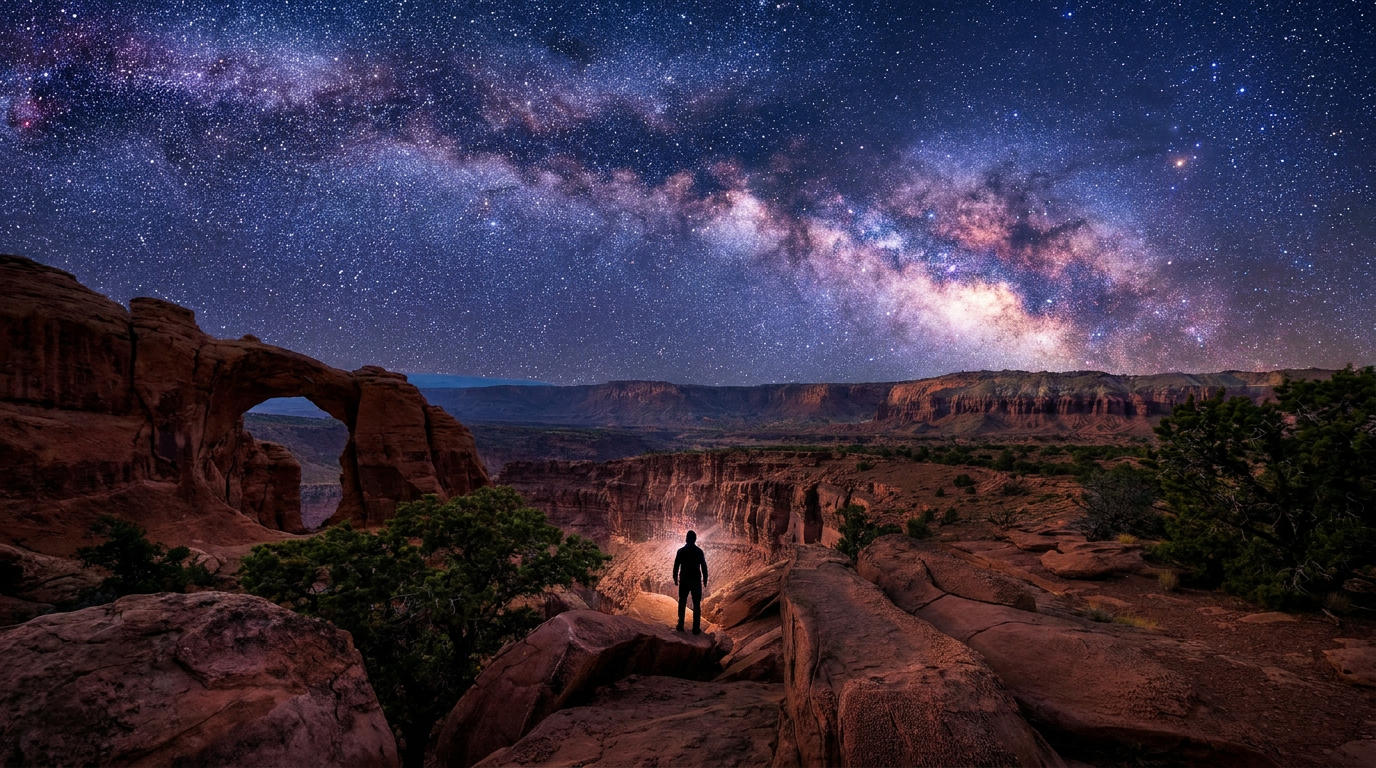
For generations, the quintessential American road trip culminated at the edge of a canyon or the base of a towering sequoia, timed perfectly for the midday sun. But in 2026, a rapidly growing segment of travelers is waiting for the sun to set before their adventure truly begins. "Astrotourism"—traveling specifically to experience pristine, star-filled night skies—has evolved from a niche hobby into a major driver of global travel.[3]
This shift is driven by a profound modern scarcity: true darkness. Today, an estimated 80 percent of Americans, and a third of humanity globally, live under skies so saturated with artificial light that the Milky Way is completely invisible from their homes. For many, visiting a remote national park is the first time they will ever see the glittering band of our home galaxy, transforming a simple camping trip into a profound cosmic encounter.[3][5]
The vanguard of this movement is the International Dark Sky Places program, managed by Dark Sky International. To earn the coveted "International Dark Sky Park" certification, a location must possess an exceptional quality of starry nights and a nocturnal environment that is specifically protected for its scientific, natural, educational, and public enjoyment. It is not enough to simply be far from a city; parks must implement strict outdoor lighting policies and commit to ongoing public education.[2]
The United States National Park Service (NPS) has embraced this mandate, treating natural darkness as a critical resource on par with clean water and old-growth forests. The NPS Night Skies Team actively monitors light pollution across the country, using specialized wide-field cameras to quantify skyglow. They work to retrofit existing park infrastructure, replacing harsh white bulbs with shielded, amber-toned lights that point downward, ensuring the parks themselves do not contribute to the problem.[1]

The results of these efforts are spectacular. Death Valley National Park recently ranked as the premier stargazing destination in the United States. The park boasts a rating of Class 1 on the Bortle scale—the darkest possible measurement of the night sky. Combined with its famously dry desert air and a 72 percent clear-night score, Death Valley offers an unparalleled window into the universe.[4]
But the undisputed capital of American astrotourism is Utah. The state holds the highest concentration of certified Dark Sky Parks in the world, with 26 designated locations including Arches, Canyonlands, and Bryce Canyon. In neighboring Arizona, stargazing has officially surpassed daytime hiking as the most popular programming offered at Grand Canyon National Park.[3]
The economic implications are staggering. Analysts estimate that the global nighttime tourism market is currently worth $10 billion and is projected to double to $20 billion by 2035. This surge is partly fueled by younger generations; viral "SpaceTok" videos have inspired a wave of Gen Z travelers to prioritize celestial events, from meteor showers to the upcoming August 2026 solar eclipse.[3]

Analysts estimate that the global nighttime tourism market is currently worth $10 billion and is projected to double to $20 billion by 2035.
Yet, the push for Dark Sky Parks is not merely about boosting tourism revenue; it is a critical ecological intervention. The phenomenon of Artificial Light At Night (ALAN) has fundamentally altered the nocturnal environment, creating "skyglow" that can travel over 200 miles from urban centers into protected wilderness areas.[1][5]
For billions of years, life on Earth evolved under a strict daily cycle of light and dark. The sudden introduction of ALAN disrupts the circadian rhythms of countless species. Nearly half of all species on Earth are nocturnal, relying on the cover of darkness for hunting, foraging, mating, and hiding from predators.[1][5]
The impacts on wildlife are profound and often fatal. Migratory birds, which largely travel at night using the stars for navigation, are frequently disoriented by urban light domes. They can be drawn off course, leading to exhaustion or deadly collisions with illuminated buildings. On the coasts, artificial lighting disorients newly hatched sea turtles, drawing them inland toward highways instead of out toward the reflective safety of the ocean.[1][5]
Even at the microscopic level, the food web is unraveling. Nocturnal insects, particularly moths, are fatally attracted to artificial lights, disrupting their mating rituals and making them easy prey. This localized insect collapse ripples upward, depriving bats, birds, and amphibians of their primary food sources.[5]

Humans are not immune to the biological toll of a vanishing night. Exposure to artificial light at night suppresses the body's production of melatonin, the hormone responsible for regulating sleep. Chronic disruption of the human circadian rhythm has been linked to a host of health issues, including sleep disorders, obesity, and an increased risk of certain cancers.[5]
Fortunately, unlike chemical contamination or plastic pollution, light pollution is entirely and instantly reversible. The moment a poorly designed streetlamp is turned off or shielded, the darkness returns. This makes the fight against light pollution one of the most accessible and immediately rewarding conservation efforts of the 21st century.[1][5]
Visitors to Dark Sky Parks are taught to become active participants in this preservation. Park rangers encourage the use of red-light flashlights, which do not disrupt human night vision or disturb nocturnal wildlife. Cell phone flashlights are discouraged, and visitors are taught to simply sit quietly and allow their eyes the 20 to 30 minutes required to fully adapt to the dark.[1]

As 2026 brings a solar maximum—promising vibrant auroras pushing further south than usual—and a highly anticipated solar eclipse, the sky is demanding our attention. Astrotourism offers a rare intersection of economic growth and environmental conservation, proving that sometimes, the most valuable thing we can do for the planet is simply to turn off the lights and look up.[3][6]
How we got here
2001
The International Dark Sky Places program is founded to encourage communities and parks to preserve dark sites.
2007
Natural Bridges National Monument in Utah becomes the world's first certified International Dark Sky Park.
2013
Death Valley National Park receives its Dark Sky certification, later ranking as the top stargazing park in the US.
2024
A peak in solar activity brings vibrant auroras to lower latitudes, sparking a massive surge in astrotourism interest.
2026
Astrotourism is named a top global travel trend as millions prepare for the August total solar eclipse.
Viewpoints in depth
Astrotourism Advocates
Travelers and industry experts who view pristine night skies as a profound way to connect with nature and drive sustainable economic growth.
For astrotourism advocates, the night sky is the ultimate untouched wilderness. Industry analysts point to the explosive growth of nighttime tourism—now a $10 billion global market—as proof that modern travelers are desperate to disconnect from their screens and reconnect with the cosmos. They argue that monetizing the dark sky through guided tours, indigenous storytelling, and specialized lodging creates a powerful financial incentive for remote communities to protect their nocturnal environments rather than industrialize them.
Conservationists
Ecologists and researchers focused on the detrimental impacts of artificial light on wildlife behavior, circadian rhythms, and ecosystem health.
Conservationists view the loss of the night sky not just as an aesthetic tragedy, but as an ecological crisis. They emphasize that Artificial Light At Night (ALAN) acts as a pervasive pollutant that disrupts the evolutionary biology of nearly half the planet's species. From sea turtles drawn toward highways to migratory birds exhausted by urban skyglow, ecologists argue that preserving and expanding dark sky sanctuaries is a critical, life-saving intervention for global biodiversity.
Park Management
Administrators balancing public access with strict lighting regulations to preserve natural darkness as a core wilderness resource.
For the National Park Service and organizations like Dark Sky International, the challenge lies in practical implementation. Managing a Dark Sky Park requires rigorous lighting audits, retrofitting infrastructure with shielded amber bulbs, and constantly educating the public on dark-sky etiquette. Park managers argue that natural darkness is a heritage resource just like a historic building or a rare forest, requiring active, ongoing defense against the encroaching light domes of expanding cities.
What we don't know
- Whether the rapid influx of astrotourists will eventually degrade the remote environments they are coming to see.
- How quickly municipalities bordering national parks will adopt dark-sky lighting ordinances to prevent skyglow.
Key terms
- Astrotourism
- A growing trend of traveling specifically to experience pristine, star-filled night skies and celestial events.
- Bortle Scale
- A nine-level numeric scale that measures the night sky's brightness and the observability of celestial objects, with Class 1 being the darkest.
- Artificial Light At Night (ALAN)
- Human-made illumination that alters the natural patterns of light and dark in ecosystems.
- Skyglow
- The brightening of the night sky over inhabited areas caused by the scattering of artificial light in the atmosphere.
- Light Trespass
- Artificial light that falls where it is not intended or needed, often spilling into protected natural areas.
Frequently asked
What makes a park an International Dark Sky Park?
A park must possess an exceptional quality of starry nights, implement strict outdoor lighting policies, and commit to ongoing public education about light pollution.
Why is light pollution harmful to wildlife?
Artificial light disrupts the circadian rhythms of nocturnal animals, throws migratory birds off course, and disorients hatchling sea turtles trying to find the ocean.
How can I reduce light pollution at home?
You can reduce light pollution by using outdoor lights only when necessary, shielding fixtures so light points downward, and using warm-white or amber bulbs instead of bright blue-white LEDs.
When is the best time to visit a Dark Sky Park?
The best viewing occurs on clear, moonless nights, typically an hour and a half after sunset or before sunrise. Summer months offer the best views of the Milky Way core.
Sources
Source coverage
6 outlets
3 viewpoints surfaced






[1]National Park ServicePark Management
Protecting and Restoring Night Skies
Read on National Park Service →[2]Dark Sky InternationalPark Management
International Dark Sky Places
Read on Dark Sky International →[3]Outside OnlineAstrotourism Advocates
Why Dark Sky Tourism Is More than Just a Trend
Read on Outside Online →[4]ForbesAstrotourism Advocates
Death Valley National Park Ranks As Best US National Park Site For Stargazing
Read on Forbes →[5]The Wilderness SocietyConservationists
Light pollution is an environmental issue that often goes unnoticed
Read on The Wilderness Society →[6]Factlen Editorial TeamConservationists
Synthesis by Factlen editorial team
Read on Factlen Editorial Team →
Every angle. Every day.
Get travel stories with full source coverage and perspective breakdowns delivered to your inbox.