
The Password is Dying: Passkeys Reach 5 Billion Active Users in 2026
Global passkey adoption has hit critical mass, with 5 billion credentials now in use, fundamentally altering the cybersecurity landscape by eliminating the threat of phishing.
By Factlen Editorial Team
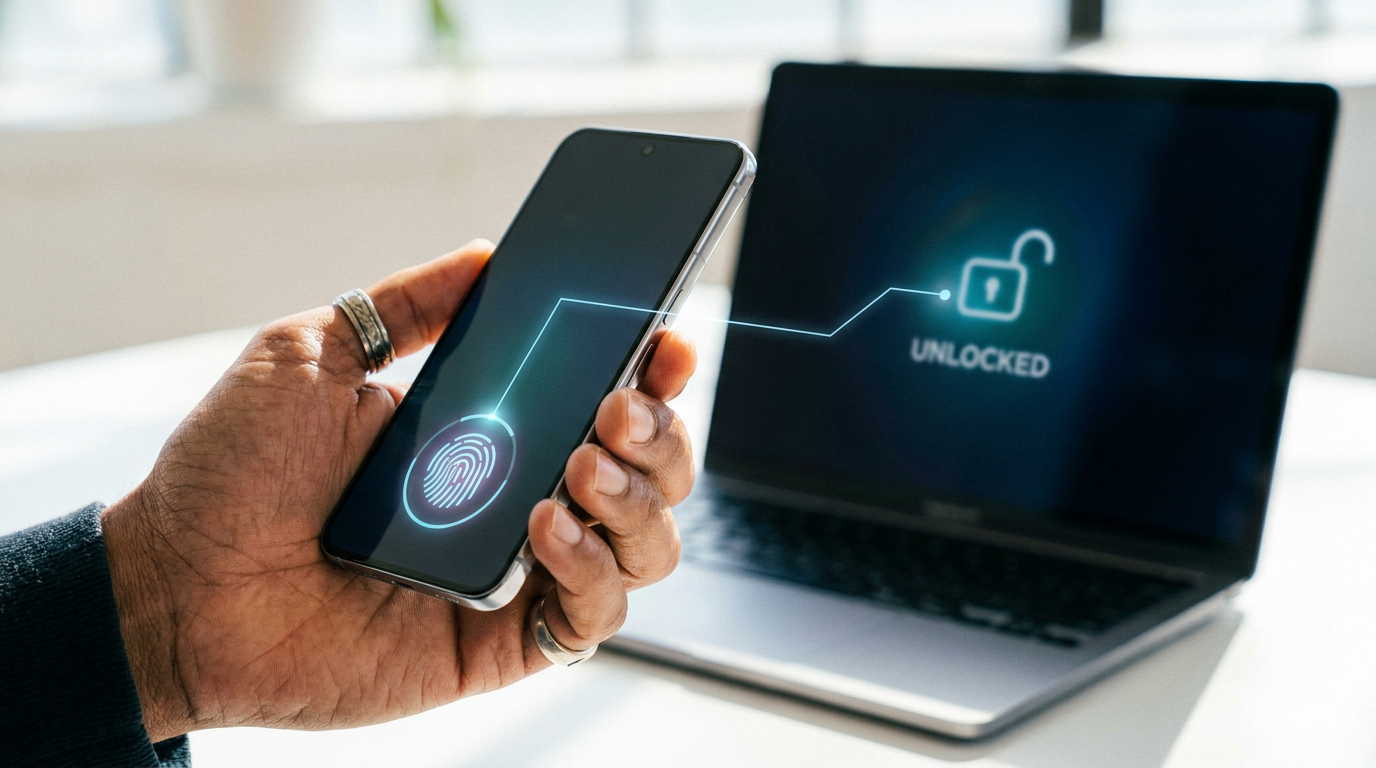
- Security Advocates
- Argue that passkeys fundamentally break the phishing lifecycle and must replace passwords entirely across all platforms.
- Enterprise IT Leaders
- Value the security benefits but struggle with legacy system compatibility, user education, and account recovery workflows.
- End Users
- Appreciate the speed of biometric logins but often face UX friction when different software ecosystems compete to handle passkeys.
What's not represented
- · Legacy System Vendors
- · Privacy Advocates
Why this matters
Passwords are the root cause of most major cyberattacks, identity theft, and online fraud. The global shift to passkeys fundamentally breaks the phishing lifecycle, saving users time while securing their most sensitive personal and financial data against server breaches.
Key points
- An estimated 5 billion passkeys are now in active use globally.
- Consumer awareness of passkeys has reached 90%, with 75% enabling at least one.
- Passkeys reduce average sign-in time from 31.2 seconds to just 8.5 seconds.
- The technology fundamentally eliminates phishing by removing shared secrets.
- While 68% of enterprises are deploying passkeys, 57% still rely on passwords for daily logins.
- Organizations using passkeys report a 35% reduction in helpdesk costs.
The password is dying, and the numbers finally prove it. As of mid-2026, an estimated 5 billion passkeys are in active use worldwide, marking a permanent shift in how humanity accesses the internet.[1]
For decades, the cybersecurity industry has treated human memory as its weakest link. Passwords are inherently vulnerable: if they are simple enough to remember, they are easy to guess; if they are complex, users inevitably reuse them across multiple sites, creating a cascading risk when a single server is breached.[7]
The FIDO Alliance's "State of Passkeys 2026" report reveals that this paradigm is finally breaking. Consumer awareness of passkeys has reached 90%, up significantly from the previous year, and 75% of users have now enabled a passkey on at least one of their accounts.[1]

The mechanism behind this shift relies on public-key cryptography rather than shared secrets. When a user creates a passkey, their device generates a unique cryptographic keypair. The public key is shared with the app or website, while the private key never leaves the secure enclave of the user's device.[4]
This architecture fundamentally eliminates phishing. Because there is no password to intercept or server-side hash to steal, attackers cannot trick users into handing over their credentials via fake login pages. The cryptographic exchange simply will not execute if the domain does not perfectly match.[5]
The evidence for passkey efficacy is not just theoretical; it is highly measurable in time saved. According to industry benchmarks, the average passkey sign-in takes just 8.5 seconds, compared to a grueling 31.2 seconds for a traditional password coupled with a multi-factor authentication (MFA) code.[5]

Major technology providers have driven this consumer adoption. Microsoft reports that hundreds of millions of users now sign into services like OneDrive and Copilot using passkeys every day, citing significantly higher sign-in success rates and lower exposure to credential-based attacks.[3]
Major technology providers have driven this consumer adoption.
However, while consumers are rapidly adopting biometric logins, the enterprise sector presents a more complicated picture. The data shows a stark divide between organizational ambition and operational reality.[2]
While 68% of organizations are deploying or piloting passkeys for their employees, a concerning 57% still rely on phishable authentication methods for their primary day-to-day sign-ins.[1][2]

This organizational inertia stems from several well-documented friction points. IT decision-makers cite legacy system compatibility, budget constraints, and concerns around account recovery as primary barriers to full passwordless deployment.[4]
"Identity security is no longer just an authentication challenge; it is an enterprise governance challenge," notes a joint study by the FIDO Alliance and HID. The research highlights that fragmented governance and disconnected systems create real business risk, even when organizations possess the right technology.[6]
Another significant hurdle is the user experience (UX) fragmentation that occurs when multiple ecosystems collide. Industry analysts point out that the everyday experience of passkeys can become inelegant when a user's web browser, operating system, and third-party password manager all compete to claim ownership of the passkey prompt.[2]
Despite these friction points, the return on investment for early enterprise adopters is highly compelling. Organizations that have successfully deployed passkeys report a 47% improvement in security posture, 45% faster login times, and a 35% reduction in helpdesk costs related to password resets.[4]

Furthermore, fears regarding account recovery appear to be subsiding as IT departments gain experience with the technology. Currently, 89% of organizations report high confidence in their ability to restore access when an employee loses their device or passkey.[1]
The transition away from passwords is no longer aspirational; it is strictly operational. The focus for the cybersecurity industry has shifted from proving that passkeys work to eliminating the remaining friction in legacy enterprise environments.[1][7]
As the 5 billion milestone demonstrates, the infrastructure for a passwordless internet is fully built. The remaining challenge is simply retiring the outdated habits that have compromised digital security for the last thirty years.[7]
How we got here
2012
The FIDO Alliance is founded to solve the password problem through open standards.
2022
Apple, Google, and Microsoft announce expanded support for the FIDO standard, bringing passkeys to mainstream operating systems.
May 2024
World Password Day is officially rebranded as World Passkey Day to reflect the industry shift.
May 2025
The FIDO Alliance reports that consumer awareness of passkeys has reached 75%.
May 2026
Passkeys hit critical mass with 5 billion active credentials in use globally.
Viewpoints in depth
Security Advocates
Why passkeys are the only viable defense against modern phishing.
Security professionals and organizations like the FIDO Alliance argue that user education and complex password requirements have failed. Because passkeys rely on public-key cryptography, they remove the human element from the security equation entirely. There is no shared secret stored on a server that can be breached, and the credential cannot be handed over to a lookalike phishing site. For this camp, the complete eradication of the password is the only acceptable end state.
Enterprise IT Leaders
The operational realities of migrating legacy corporate networks.
While acknowledging the security benefits, enterprise IT departments face significant friction in deployment. Migrating a workforce to passkeys requires updating legacy applications, retraining employees, and establishing robust account recovery protocols for when devices are lost. This camp emphasizes that deploying passkeys and eliminating passwords are two different milestones, and many organizations are currently stuck in a hybrid state where phishable fallbacks remain active.
End Users
The demand for speed weighed against ecosystem fragmentation.
Consumers overwhelmingly prefer the 8.5-second biometric sign-in experience over managing complex passwords and MFA codes. However, users frequently express frustration with ecosystem fragmentation. When a user's web browser, operating system, and third-party password manager all compete to handle the passkey prompt, the resulting UX can be confusing. This camp's primary demand is seamless interoperability across all their devices, regardless of the manufacturer.
What we don't know
- How quickly legacy enterprise software vendors will update their systems to support native passkey authentication.
- Whether the UX friction between competing operating systems and password managers will be resolved through stricter industry standards.
- The long-term impact of quantum computing on the underlying public-key cryptography used by current passkey standards.
Key terms
- Passkey
- A passwordless authentication method utilizing public-key cryptography and device-bound biometrics to verify user identity.
- FIDO Alliance
- An open industry association whose mission is to develop and promote authentication standards that reduce reliance on passwords.
- Public-Key Cryptography
- A cryptographic system that uses pairs of keys: public keys which may be disseminated widely, and private keys which are known only to the owner.
- Phishing
- A cyber attack where criminals impersonate legitimate organizations to trick users into revealing sensitive information like passwords.
- Multi-Factor Authentication (MFA)
- A security system that requires more than one method of authentication from independent categories of credentials to verify the user's identity.
Frequently asked
What exactly is a passkey?
A passkey is a digital credential tied to your device (like a phone or laptop) that uses cryptography and biometrics (fingerprint or face scan) to log you in without a password.
How do passkeys stop phishing?
Passkeys do not use a shared secret. Because there is no password to steal and the cryptographic key only works on the legitimate website, attackers cannot trick you into giving away your login on a fake site.
What happens if I lose the device holding my passkey?
Most passkeys are synced securely to the cloud via your platform provider (like Apple iCloud, Google Password Manager, or a third-party manager), allowing you to recover them on a new device.
Are passwords completely gone in 2026?
No. While 5 billion passkeys are in use, 57% of organizations still rely on passwords for daily employee logins due to legacy systems and organizational inertia.
Sources
Source coverage
7 outlets
3 viewpoints surfaced







[1]FIDO AllianceSecurity Advocates
The State of Passkeys 2026: Global Consumer and Workforce Report
Read on FIDO Alliance →[2]PCMagEnterprise IT Leaders
Passkey-Adoption Report Finds Many Orgs Don't Know How to Quit Passwords
Read on PCMag →[3]Microsoft Security BlogSecurity Advocates
World Passkey Day: Advancing passwordless authentication
Read on Microsoft Security Blog →[4]DescopeSecurity Advocates
2026 FIDO Report: Passkeys at Global Scale
Read on Descope →[5]shattered.ioEnd Users
Passkeys vs Passwords: 8.5s vs 31s Sign-In
Read on shattered.io →[6]Business WireEnterprise IT Leaders
New FIDO Alliance and HID Study Reveals Major Gap Between Identity Security Confidence and Reality
Read on Business Wire →[7]Factlen Editorial TeamEnd Users
Synthesis by Factlen editorial team
Read on Factlen Editorial Team →


Every angle. Every day.
Get technology stories with full source coverage and perspective breakdowns delivered to your inbox.