
How Acoustic Enrichment and Micro-Fragmentation Are Rewriting the Future of Coral Reefs
Marine biologists are deploying radical new techniques—from broadcasting healthy reef sounds to intentionally shattering corals—to accelerate reef growth by up to 40 times and outpace climate change.
By Factlen Editorial Team
- Marine Biologists & Technologists
- Advocates for active, high-tech interventions like acoustic enrichment and genetic selection to rebuild reefs.
- Conservation Policymakers
- Focuses on scaling localized successes into global frameworks and funding large-scale resilience projects.
- Coastal Communities & NGOs
- Emphasizes the immediate economic and cultural survival tied to reef health and locally-led restoration.
What's not represented
- · Commercial fishing industry
- · Coastal developers
Why this matters
Coral reefs support a quarter of all marine life, protect coastlines from storm surges, and sustain billions of dollars in global economic activity. These breakthroughs prove that human intervention can actively rebuild these vital ecosystems rather than just managing their decline.
Key points
- A 2026 study reveals that one-third of the world's coral reefs are naturally resilient to climate change.
- Micro-fragmentation allows marine biologists to grow 100-year-old corals in just two years by triggering a rapid healing response.
- Acoustic enrichment uses underwater speakers to play healthy reef sounds, increasing coral larval settlement by up to seven times.
- Assisted evolution selectively breeds heat-adapted corals to ensure restored reefs can survive future warming events.
For years, the scientific consensus surrounding coral reefs has been defined by a sense of impending doom. The Intergovernmental Panel on Climate Change (IPCC) previously warned that up to 90 percent of the world's reefs could perish under current warming trajectories. However, a June 2026 study presented at the Our Ocean Conference in Mombasa has fundamentally challenged that timeline. Researchers from the Wildlife Conservation Society and Macquarie University mapped the world's oceans in unprecedented detail, discovering that roughly one-third of all coral reefs—spanning 166,000 square kilometers—are naturally "climate-resilient" and capable of surviving major thermal shocks.[2]
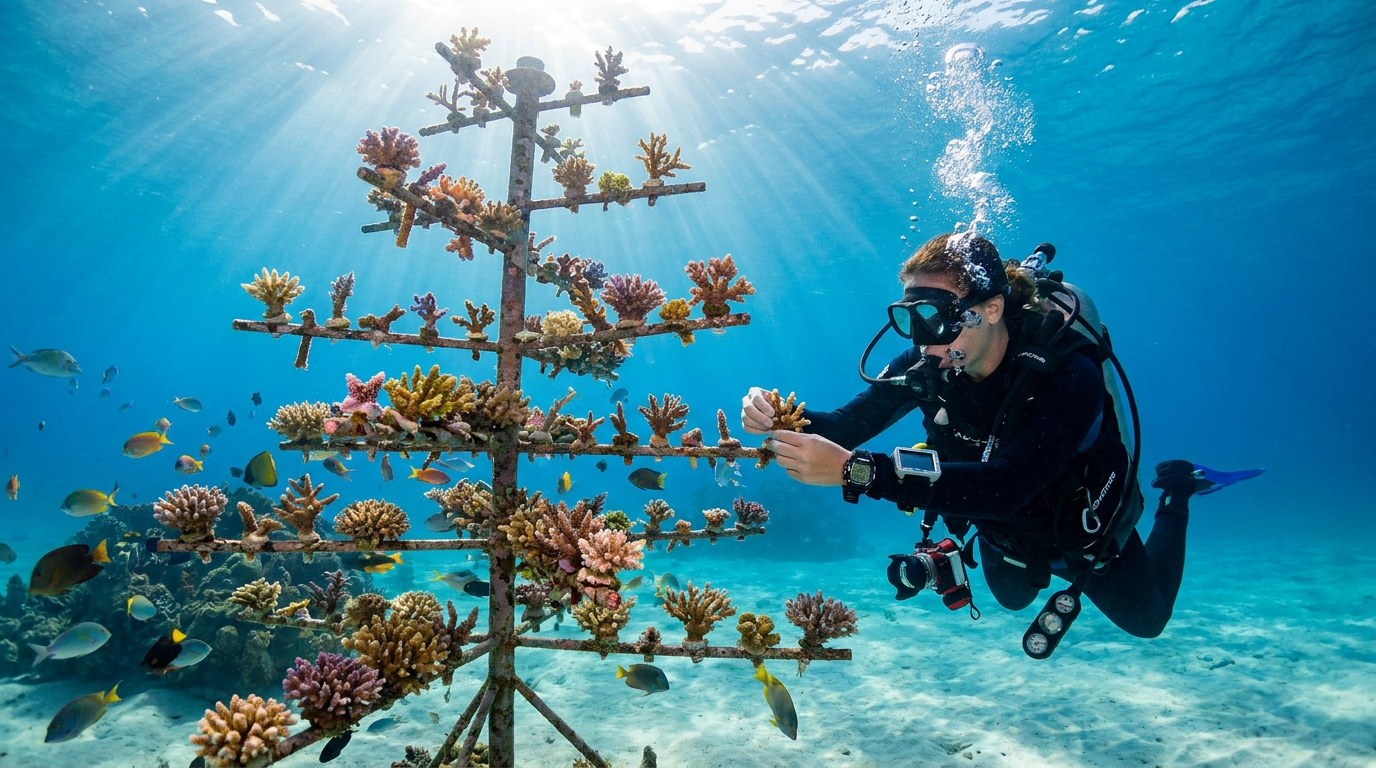
This revelation is shifting the global conservation paradigm from passive protection to aggressive, high-tech intervention. Marine biologists are no longer just cordoning off marine parks, restricting fishing access, and hoping for the best; they are actively rebuilding the ocean's architecture from the seafloor up. By combining biological hacks with acoustic engineering and genetic selection, scientists are accelerating coral growth and coaxing marine life back to barren underwater landscapes. These interventions are transforming reef conservation from a discipline of managed decline into a field of active ecological engineering.[1]
The most transformative breakthrough in physical reef restoration is a technique known as micro-fragmentation. For decades, coral gardening relied on breaking off large chunks of healthy coral and transplanting them to new locations. This was a painstakingly slow process, fundamentally limited by the animal's naturally sluggish growth rate, which often measures just a few centimeters per year. The paradigm shifted entirely when Dr. David Vaughan, a marine biologist working in the Florida Keys, accidentally shattered a piece of elkhorn coral in his laboratory. Expecting the specimen to die, he was shocked by what he observed over the following weeks.[7]
Instead of dying, the tiny fragments exhibited an explosive healing response. Vaughan discovered that when corals are cut into pieces as small as a single square centimeter, the animal's biological imperative to repair itself kicks into overdrive. These "micro-fragments" grow up to 40 times faster than they would in the wild. When placed near each other on a ceramic tile, the genetically identical clones recognize one another and quickly fuse back together into a single, unified organism.[7]

The implications for restoration scale are staggering. Using traditional methods, a massive boulder coral takes roughly a century to reach the size of a basketball. Through micro-fragmentation, restoration teams can cultivate a 100-year-old coral in just two years. Nurseries from Puerto Rico to the Great Barrier Reef now house thousands of these rapidly growing fragments in climate-controlled tanks. Once they reach an ideal maturity, these hardened, fast-growing colonies are out-planted onto degraded reefs, rapidly restoring the three-dimensional structure that marine life depends on.[1][7]
However, the technique carries a significant biological risk: the threat of monoculture. Because micro-fragmentation relies on cloning a single parent coral, the resulting colonies are genetically identical. If a novel disease or an extreme marine heatwave strikes the restored reef, the entire population could be wiped out simultaneously, much like the vulnerabilities seen in commercial agriculture when a single crop strain is overused. To build true resilience, scientists must ensure that restored reefs possess a diverse genetic library capable of withstanding unpredictable future threats.[7]
To mitigate this vulnerability, scientists are pairing micro-fragmentation with a strategy known as "assisted evolution." In Fiji's Mamanuca Islands, the United Nations Environment Programme supports "Reefs of Hope" gene-bank nurseries. Researchers intentionally select coral strains that have survived recent mass bleaching events and cluster them together in protected underwater environments. When these heat-adapted survivors spawn, they cross-pollinate, producing a new generation of larvae naturally equipped with the genetic traits required to handle warmer oceans. This ensures the fast-growing corals are also the most resilient.[6]
Researchers intentionally select coral strains that have survived recent mass bleaching events and cluster them together in protected underwater environments.
Yet, growing resilient coral is only half the battle; the reef must also attract the broader ecosystem of marine life required to sustain it. This is where the emerging science of "acoustic enrichment" comes into play. For years, scientists assumed coral larvae drifted aimlessly on ocean currents, entirely at the mercy of the tides until they accidentally bumped into a suitable rock. The reality, researchers have recently discovered, is far more complex and sensory-driven. Corals, despite lacking ears or a central nervous system, are acutely sensitive to the vibrations of their environment and actively navigate toward hospitable habitats.[4][5]
A healthy reef is a cacophony of biological noise—the persistent crackling of snapping shrimp, the low grunts of territorial fish, and the scraping of parrotfish beaks against limestone. Research from the Woods Hole Oceanographic Institution and the University of Exeter has proven that microscopic coral larvae use this acoustic signature as a homing beacon to find a place to settle. The sound indicates a thriving ecosystem with the right balance of algae and structural complexity for a young coral to survive.[4][5]
When a reef dies from severe bleaching or storm damage, it goes completely silent. Without the acoustic cues of a living ecosystem, new larvae float right past the degraded habitat, preventing natural recovery and leaving the reef barren for years. To break this cycle, researchers have begun deploying underwater loudspeakers in the center of dead coral patches. By broadcasting high-fidelity recordings of thriving, healthy reefs, scientists are effectively creating an acoustic mirage, tricking marine life into returning to the area and kick-starting the ecosystem's natural regeneration process.[4][5]

The results of these acoustic interventions have been dramatic. Studies show that playing healthy reef sounds increases coral larval settlement rates by up to seven times within the first 36 hours of dispersal. Furthermore, the audio track attracts the juvenile fish necessary to clean the reef and prepare the surface for coral growth. In field experiments on the Great Barrier Reef, acoustically enriched patches saw their fish populations double, with species diversity increasing by 50 percent compared to silent control sites.[4][5]
Even with fast-growing corals and acoustic beacons, restoration cannot succeed if the physical foundation of the reef is unstable. Severe storms and ship groundings often pulverize the intricate limestone framework into a field of loose, shifting rubble. If new corals are planted on this unstable debris, they are easily buried, flipped, or crushed by the next strong wave, rendering the restoration efforts useless. A solid, immovable substrate is the absolute prerequisite for any successful coral out-planting initiative, forcing scientists to become underwater construction workers.[3]
To solve this structural problem, the National Oceanic and Atmospheric Administration (NOAA) has pioneered "rubble stabilization" techniques following ship groundings in Hawaii and Puerto Rico. Divers manually secure the loose, broken parts of the reef to the seafloor using specialized meshes, rebar, and marine-grade cement bases, creating a solid, unified foundation out of the debris. Once the rubble is locked in place, the micro-fragmented corals have a permanent, secure home to anchor onto, allowing the reef to safely rebuild its three-dimensional complexity without the risk of being washed away.[3]

The stakes for these interventions extend far beyond marine biology. Coral reefs support more than a quarter of all marine species and provide critical food security for millions of people globally. Economically, natural assets like the Great Barrier Reef are valued at over $95 billion, underpinning tens of thousands of jobs in tourism and commercial fishing. Furthermore, reefs act as vital natural breakwaters, absorbing up to 97 percent of incoming wave energy and protecting vulnerable coastal cities from devastating storm surges.[1][4]
The ocean is undeniably changing, and the overarching threats of agricultural runoff, overfishing, and carbon emissions remain severe challenges that must be addressed on a global scale. But the narrative that coral reefs are simply doomed relics of a cooler planet is being actively rewritten. Armed with underwater speakers, diamond-blade coral saws, and a deeper understanding of marine genetics, scientists are proving that with the right interventions, the ocean's most vital ecosystems can be engineered to survive and thrive in the 21st century.[1][2][6]
How we got here
2018
Dr. David Vaughan accidentally discovers the micro-fragmentation technique after shattering a coral in his lab.
2019
Researchers publish findings showing that acoustic enrichment can double fish populations on degraded reefs.
2024
Woods Hole Oceanographic Institution confirms that multiple species of coral larvae use sound to navigate and settle.
2025
NOAA successfully tests manual rubble stabilization techniques in Hawaii to rebuild reefs destroyed by ship groundings.
June 2026
A landmark study reveals that 166,000 square kilometers of global reefs are naturally climate-resilient.
Viewpoints in depth
Marine Biologists & Technologists
Advocates for active, high-tech interventions like acoustic enrichment and genetic selection to rebuild reefs.
This camp argues that passive conservation—simply protecting reefs from fishing and pollution—is no longer sufficient in a rapidly warming ocean. They champion active, engineered interventions. By utilizing micro-fragmentation and acoustic enrichment, technologists believe we can artificially accelerate natural recovery processes, buying crucial time for coral ecosystems while the world works to reduce global carbon emissions.
Conservation Policymakers
Focuses on scaling localized successes into global frameworks and funding large-scale resilience projects.
Policymakers and government agencies emphasize the need to integrate these scientific breakthroughs into broader climate adaptation strategies. They point out that while growing coral in a lab is a massive achievement, the real challenge lies in funding and deploying these solutions across hundreds of thousands of square kilometers of ocean. They advocate for international treaties and significant financial investments to move these techniques from experimental pilot programs to standard ecological infrastructure.
Coastal Communities & NGOs
Emphasizes the immediate economic and cultural survival tied to reef health and locally-led restoration.
For island nations and coastal populations, reef restoration is not an abstract scientific pursuit; it is a matter of survival. This viewpoint stresses that restoration efforts must be community-led and accessible. Initiatives like the 'Reefs of Hope' program in Fiji demonstrate that empowering local fishers and residents to cultivate and protect their own coral nurseries ensures long-term stewardship and directly supports local food security and eco-tourism.
What we don't know
- Whether micro-fragmented corals grown in nurseries will possess the same long-term structural integrity as naturally slow-growing corals.
- How effectively acoustic enrichment can be scaled across massive, open-ocean reef systems rather than localized patches.
- If assisted evolution and selective breeding can keep pace with the accelerating rate of ocean acidification and extreme thermal shocks.
Key terms
- Micro-fragmentation
- A restoration technique that involves cutting corals into tiny pieces to trigger an accelerated healing and growth response.
- Acoustic enrichment
- The use of underwater loudspeakers to broadcast the sounds of a healthy ecosystem, attracting marine life to degraded areas.
- Assisted evolution
- The process of selectively breeding corals that have survived heatwaves to create new generations of climate-resilient reefs.
- Rubble stabilization
- Securing loose, broken reef debris to the seafloor to create a solid foundation for new corals to grow on.
Frequently asked
What is micro-fragmentation?
A technique where corals are cut into tiny pieces, stimulating a rapid healing response that allows them to grow up to 40 times faster than normal.
How does acoustic enrichment work?
Scientists play recordings of healthy reef sounds (like snapping shrimp and fish) on underwater speakers to attract coral larvae and juvenile fish to degraded areas.
Are all coral reefs doomed by climate change?
No. A recent 2026 study found that approximately one-third of the world's coral reefs are naturally 'climate-resilient' and capable of surviving major ocean warming events.
Why is rubble stabilization necessary?
Before new corals can be planted, the loose, broken reef foundation caused by storms or ships must be secured so the new corals aren't crushed or buried by shifting debris.
Sources
Source coverage
7 outlets
3 viewpoints surfaced







[1]Factlen Editorial TeamMarine Biologists & Technologists
Synthesis by Factlen editorial team
Read on Factlen Editorial Team →[2]Bangkok PostConservation Policymakers
Study sparks hope for 'climate-resistant' coral reefs
Read on Bangkok Post →[3]NOAA FisheriesConservation Policymakers
Innovative Coral Restoration Begins in Hawaiʻi After Ship Grounding
Read on NOAA Fisheries →[4]ScienceDailyMarine Biologists & Technologists
Researchers use the sounds of healthy coral reefs to encourage growth of a new species of coral larvae
Read on ScienceDaily →[5]Nature CommunicationsMarine Biologists & Technologists
Acoustic enrichment can enhance fish community development on degraded coral reef habitat
Read on Nature Communications →[6]UN Environment ProgrammeCoastal Communities & NGOs
Reefs of Hope: Climate Focused Coral Adaptation in a Warming Ocean
Read on UN Environment Programme →[7]BBC EarthMarine Biologists & Technologists
How to regrow a coral reef
Read on BBC Earth →
Every angle. Every day.
Get environment stories with full source coverage and perspective breakdowns delivered to your inbox.