
Scientists Identify 166,000 Square Kilometers of Coral Reefs Capable of Surviving Climate Change
A landmark global study has mapped vast areas of climate-resilient coral reefs, tripling previous estimates and offering a targeted roadmap for marine conservation.
By Factlen Editorial Team
- Marine Conservationists
- Focus on leveraging this data to expand Marine Protected Areas and protect 'source reefs' from local stressors.
- Climate Modelers
- Focus on the data synthesis, the 2.1°C threshold, and the mechanisms of thermal refugia, emphasizing that emissions cuts are still mandatory.
- Coastal Communities
- Focus on the practical implementation of reef protection, balancing conservation with sustainable fishing and local livelihoods.
What's not represented
- · Commercial fishing industry representatives
- · Tourism boards of affected nations
Why this matters
By pinpointing exactly which coral reefs can survive global warming, this research provides a precise roadmap for conservation, shifting the narrative from inevitable ecosystem collapse to targeted, actionable protection that could save a quarter of all marine life.
Key points
- Scientists identified 166,000 sq km of coral reefs capable of surviving climate change.
- The findings triple previous estimates of global coral resilience.
- Resilient reefs survive via cooler currents, genetic adaptation, or rapid ecological recovery.
- Only 28% of these identified climate refugia are currently protected.
- The study's models assume global warming does not exceed 2.1°C above pre-industrial levels.
The prevailing narrative around coral reefs has long been one of inevitable, irreversible decline. Driven by severe marine heatwaves and mass bleaching events, scientists have repeatedly warned that these vital ecosystems are on the brink of collapse. For years, the scientific consensus leaned heavily toward the idea that tropical reefs would be one of the first major casualties of a warming planet, with some projections suggesting near-total eradication by the end of the century.[3][5]
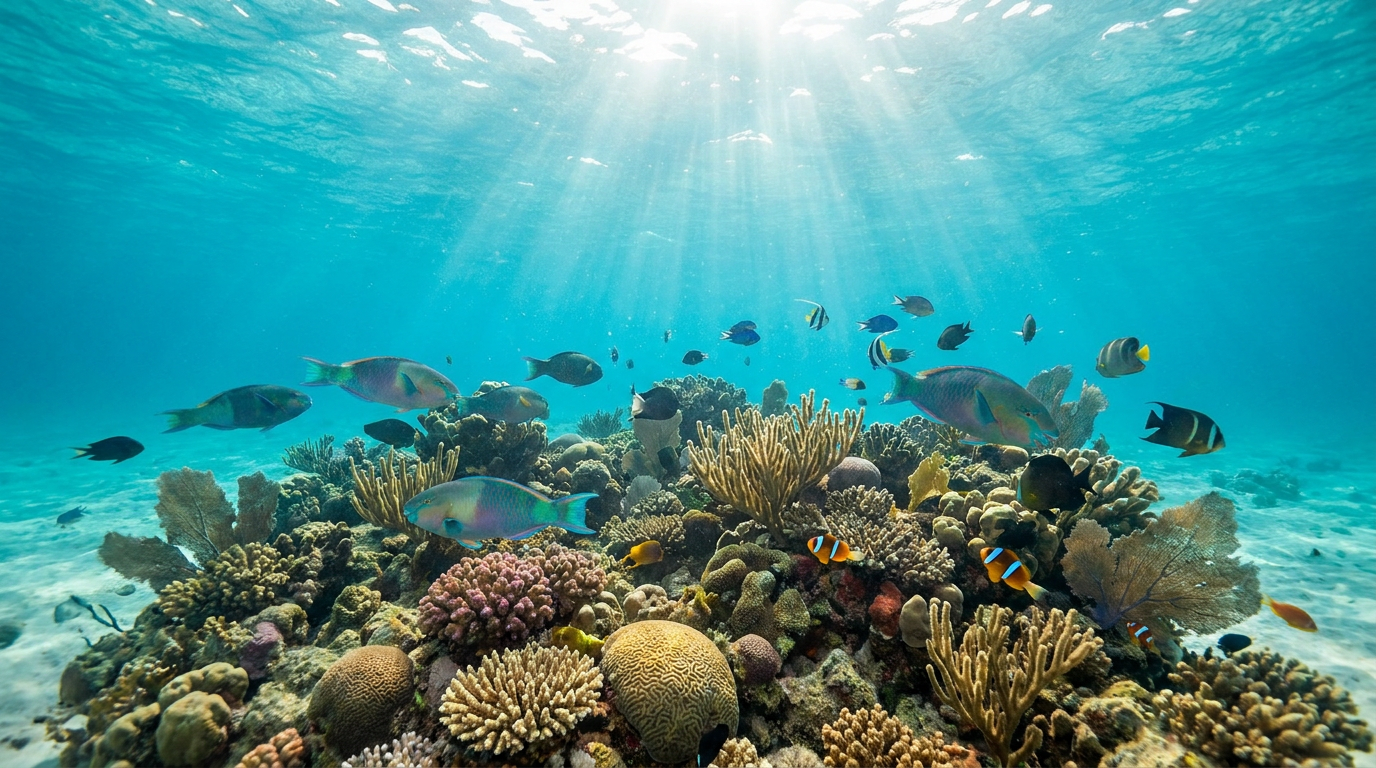
But a landmark study unveiled this week is fundamentally challenging that fatalistic outlook. Researchers have identified more than 166,000 square kilometers (roughly 64,000 square miles) of coral reefs worldwide that possess the biological and environmental conditions necessary to survive future global warming. This discovery offers a vital new perspective for marine ecosystems that sustain a quarter of all ocean life.[2][4][5]
Presented at the Our Ocean Conference in Mombasa, Kenya, the research triples previous estimates of how much coral might endure the climate crisis. Spanning 71 countries and 100 territories, these resilient pockets represent roughly a third of the world's total reef systems. The findings provide a rare and actionable note of hope, shifting the conversation from managing a decline to actively securing a future.[2][5][6]
"Coral reefs are often framed as ecosystems beyond saving," said Emily Darling, director of coral conservation at the Wildlife Conservation Society (WCS) and a co-author of the study. "Our research shows that there are three times more reefs that may be capable of surviving the climate crisis than previously thought. We know where the hope is and what we need now is political will."[3][4][5]

The findings, currently undergoing peer review for the journal Environmental Research Letters, are the result of a massive data synthesis led by the WCS and Macquarie University. The project builds upon the landmark 2018 "50 Reefs" study, which was the first to systematically map potential coral survival zones and helped direct over $100 million in conservation funding.[1][2][3]
To locate these modern havens, scientists trained a machine-learning model on nearly 45,000 human observations of coral cover gathered over 65 years. By analyzing 42 distinct environmental factors—ranging from ocean currents to cyclone paths—the program generated a map 10,000 times more detailed than any previous assessment, pinpointing exact coordinates where corals are actively defying the heat.[1][2][4]
The researchers categorized these resilient zones into three distinct types of "climate refugia," each relying on a different mechanism for survival. The first category, "avoidance refugia," consists of reefs shielded from the worst thermal stress by unique local geography and oceanography.[2][4]
In these avoidance zones, deep-water upwelling, cooler ocean currents, or natural shading from coastal features like mangroves keep water temperatures significantly lower than the surrounding ocean. Researchers have documented such thermal buffers in places like the Palau archipelago and specific atolls in Micronesia, where unique water flows protect the reefs from extreme heat spikes that devastate adjacent areas.[1][4]
The second category, "resistance refugia," involves corals that have undergone rapid genetic adaptation. Often dubbed "super corals," these organisms have evolved to withstand higher baseline temperatures and severe bleaching events that would easily devastate less resilient colonies.[2][4]
The second category, "resistance refugia," involves corals that have undergone rapid genetic adaptation.
Scientists studying these resistance zones have found that chronic exposure to moderate stress can sometimes trigger localized adaptations, raising the corals' bleaching thresholds. These heat-tolerant strains are considered critical reservoirs of genetic diversity, potentially holding the key to reseeding other, more vulnerable reefs in the future.[3][4]
The final category is "recovery refugia." These are reefs that do experience severe bleaching and damage during marine heatwaves, but possess an extraordinary capacity to bounce back and rebuild their ecosystems.[2]

Recovery refugia typically benefit from high ecological integrity—meaning they have robust fish populations, low levels of local pollution, and strong connectivity to other healthy reefs. When a bleaching event occurs, the lack of compounding local stressors allows the coral to rebuild its cover and function much faster than degraded counterparts.[2][6]
Geographically, the newly identified refugia are widely distributed, but more than half of the resilient reef area is concentrated within the waters of just five nations: Australia, the Bahamas, Cuba, Indonesia, and the Philippines. Australia's Great Barrier Reef, despite suffering massive bleaching elsewhere, harbors several of these highly resilient pockets.[3][4][6]
However, identifying these havens is only the first step; securing them is the immediate challenge. Currently, only 28 percent of the climate-resilient reefs identified in the study fall within established marine protected areas (MPAs) or conserved zones.[3][6]

This leaves more than 119,000 square kilometers of critical coral habitat exposed to localized threats like overfishing, coastal development, and agricultural runoff. Conservationists are launching a global campaign, "Our Reefs, Our Future," urging governments to prioritize these specific coordinates in their "30 by 30" biodiversity commitments—the international goal to protect 30 percent of marine environments by the end of the decade.[2][5]
Protecting these specific reefs is not just about saving isolated patches of coral; it is about maintaining a network of "source reefs." Because ocean currents carry coral larvae over vast distances, a healthy, protected refugium can act as a biological engine, continuously exporting heat-tolerant offspring to help degraded neighboring reefs recover.[3]
Despite the optimism, the researchers emphasize that these refugia are not invincible. The study's models estimate survival based on a projected global temperature increase of 2.1 degrees Celsius above pre-industrial levels. If global emissions push warming significantly beyond that threshold, even these robust havens could eventually succumb to the heat.[4]

Furthermore, the authors caution that their models rely on historical patterns, which may underestimate the severity of "novel future states" as the climate system enters uncharted territory. The existence of refugia does not negate the urgent need to reduce global greenhouse gas emissions; rather, it buys the oceans crucial time.[4]
Ultimately, the study shifts the marine conservation paradigm from a narrative of helpless observation to one of targeted intervention. By proving that a substantial portion of the world's coral is biologically equipped to survive the coming decades, scientists have provided a precise map of where to deploy resources, proving that the fight for the ocean's most diverse ecosystems is far from over.[2][5]
How we got here
2018
The landmark '50 Reefs' study is published, providing the first systematic global assessment of coral reefs likely to withstand climate change.
Early 2023
The Fourth Global Coral Bleaching Event begins, devastating reefs worldwide and accelerating fears of irreversible ecosystem collapse.
June 16, 2026
Scientists present new AI-driven research at the Our Ocean Conference in Kenya, identifying 166,000 sq km of climate-resilient reefs across 71 countries.
Viewpoints in depth
Marine Conservationists
Advocates emphasize the urgent need to formally protect these identified refugia before local threats destroy them.
For conservation groups like the Wildlife Conservation Society, the data is a call to action rather than a reason to relax. They argue that identifying these resilient zones is useless if they are subsequently destroyed by overfishing, coastal development, or agricultural runoff. Through campaigns like 'Our Reefs, Our Future,' conservationists are pushing governments to incorporate these specific coordinates into their '30 by 30' biodiversity commitments, ensuring these 'source reefs' are protected so they can reseed degraded areas in the future.
Climate Modelers
Scientists stress that the resilience of these reefs is strictly conditional on keeping global temperature rise below 2.1°C.
While celebrating the discovery of vast climate refugia, climate modelers and data scientists caution against interpreting the findings as a free pass on emissions. The machine-learning models used in the study project survival based on a maximum global temperature increase of 2.1 degrees Celsius. Modelers warn that if greenhouse gas emissions push warming beyond this threshold, or if the oceans enter 'novel future states' with unprecedented combinations of heat and acidification, even these highly adapted super corals will likely collapse.
Coastal Communities
Local populations focus on balancing the strict protection of these reefs with their own reliance on the ocean for food and income.
For the millions of people living in the 71 countries where these refugia are located, coral reefs are not just ecological wonders—they are critical infrastructure. Reefs provide essential protein through artisanal fishing and protect coastlines from storm surges. Coastal community advocates argue that expanding Marine Protected Areas (MPAs) to cover the unprotected 72% of these resilient reefs must be done in partnership with local populations, ensuring that conservation efforts do not inadvertently cut off sustainable livelihoods or food security.
What we don't know
- Whether these resilient reefs can survive if global temperatures rise beyond the modeled 2.1°C threshold.
- How 'novel future states'—unprecedented combinations of heat, acidification, and storms—might bypass the corals' current adaptive mechanisms.
- Whether governments will act fast enough to protect the 72% of these refugia that currently lack formal conservation status.
Key terms
- Thermal refugia
- Areas where natural conditions, such as cooler ocean currents or deep-water upwelling, protect ecosystems from extreme heat stress.
- Bleaching event
- A stress response where corals expel the symbiotic algae living in their tissues, turning them completely white and leaving them vulnerable to starvation and disease.
- Super corals
- Corals that have undergone rapid genetic adaptation, allowing them to withstand higher baseline temperatures and severe heatwaves.
- Marine Protected Area (MPA)
- A designated region of the ocean where human activities, such as fishing and drilling, are strictly regulated or prohibited to conserve the marine ecosystem.
Frequently asked
What is a coral climate refugium?
It is a specific area of the ocean where local conditions—such as cooler currents, genetic adaptation, or lack of pollution—allow coral reefs to survive and recover from global warming better than surrounding areas.
How much of the world's coral is considered resilient?
The new study identified roughly 166,000 square kilometers of resilient reefs, which accounts for about one-third of the world's total coral reef systems.
Are these resilient reefs currently protected?
Mostly no. Only about 28 percent of the identified climate-resilient reefs currently fall within established marine protected areas, leaving the majority vulnerable to local threats like overfishing.
Does this mean coral reefs are safe from climate change?
No. The study models survival up to a 2.1°C increase in global temperatures. If warming exceeds this threshold, even these highly resilient reefs could face collapse.
Sources
Source coverage
7 outlets
3 viewpoints surfaced







[1]The New York TimesClimate Modelers
New Coral Study Identifies Areas Where Reefs Are Hanging On
Read on The New York Times →[2]Oceanographic MagazineMarine Conservationists
Reef relief: Scientists map 165,000km² of climate resilient coral
Read on Oceanographic Magazine →[3]Inside Climate NewsClimate Modelers
As Global Warming Threatens Corals Worldwide, Scientists Search for 'Super Reefs' That Can Take the Heat
Read on Inside Climate News →[4]The Straits TimesClimate Modelers
Scientists found some coral reefs can survive climate change
Read on The Straits Times →[5]The IndependentMarine Conservationists
Scientists just identified 166,000 sq km of coral reef capable of surviving climate change
Read on The Independent →[6]Taipei TimesCoastal Communities
Vast areas of climate-resistant coral reefs found: study
Read on Taipei Times →[7]Wildlife Conservation SocietyMarine Conservationists
Machine-learning and prioritization models reveal climate refugia for coral reefs into 2050
Read on Wildlife Conservation Society →

Every angle. Every day.
Get science stories with full source coverage and perspective breakdowns delivered to your inbox.