
The Science of the Maillard Reaction: How Heat Transforms Flavor in Home Cooking
The Maillard reaction is the complex chemical cascade responsible for the browning and savory flavors in roasted, baked, and seared foods. Understanding its mechanics allows home cooks to manipulate temperature and moisture for better culinary results.
By Factlen Editorial Team
- Culinary Professionals
- Focus on practical kitchen applications, flavor development, and techniques to maximize browning.
- Food Chemists
- Focus on the molecular mechanisms, amino acid interactions, and precise thermal conditions of the reaction.
- Editorial Synthesis
- Bridges the gap between laboratory science and everyday home cooking.
What's not represented
- · Industrial Food Manufacturers
- · Flavor Chemists
Why this matters
Understanding the Maillard reaction empowers home cooks to stop blindly following recipes and start manipulating heat, moisture, and pH to consistently produce restaurant-quality flavors in their own kitchens.
Key points
- The Maillard reaction is a chemical interaction between amino acids and reducing sugars under heat.
- It is responsible for the browning and complex savory flavors in roasted, baked, and seared foods.
- The reaction requires temperatures between 140°C and 165°C (280°F to 330°F) to occur rapidly.
- Moisture is the enemy of browning; food must be dry for surface temperatures to exceed the boiling point of water.
- Alkaline environments, such as those created by baking soda or lye, accelerate the browning process.
- Unlike caramelization, which only involves sugars, the Maillard reaction requires proteins to develop flavor.
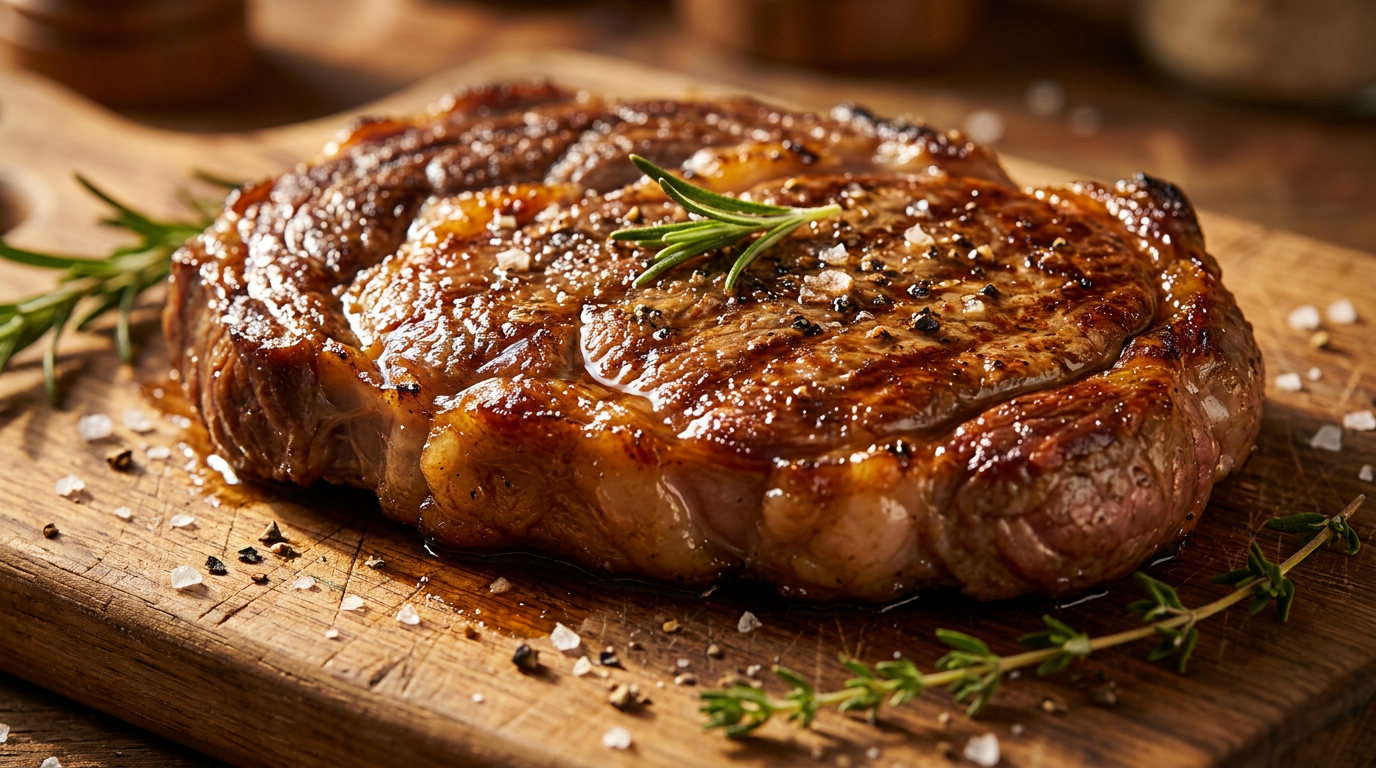
The smell of a bakery in the early morning, the sizzle of a steak hitting a hot cast-iron pan, and the golden crust of a toasted marshmallow all share a common scientific denominator. It is a chemical cascade that transforms raw, bland ingredients into complex, savory masterpieces.[8]
This phenomenon is known as the Maillard reaction, often referred to by chefs and food scientists as the 'flavor reaction.' It is the engine behind the non-enzymatic browning of foods and the creation of hundreds of distinct aromatic compounds that make cooked meals appetizing.[3][5]
Despite its ubiquity in kitchens worldwide, the reaction was not discovered by a chef. In 1912, French physician and chemist Louis-Camille Maillard first described the process while attempting to reproduce biological protein synthesis in a laboratory setting.[1][7]
Maillard observed that when a solution containing amino acids and reducing sugars was heated, it produced a distinct brown color. He had inadvertently unlocked the fundamental mechanism of browning, a discovery that would eventually become a pillar of modern food science and culinary arts.[2][4]

At its core, the Maillard reaction is a complex chemical dance between proteins and carbohydrates. When heat is applied to food, the nucleophilic amino group of an amino acid reacts with the reactive carbonyl group of a reducing sugar, such as glucose or fructose.[1][4]
This initial interaction forms an unstable chemical intermediate known as a glycosylamine. Almost immediately, the glycosylamine undergoes a structural rearrangement to become a ketosamine, setting the stage for a massive cascade of subsequent reactions.[2][4]
As the ketosamines break down, they produce a staggering variety of new flavor and aroma molecules. Depending on the specific amino acids and sugars present in the raw food, the reaction can generate pyrazines, which offer a toasted flavor, or meaty furans and sweet furanones.[4][5]
This is why baking bread smells entirely different from roasting meat or frying fish, even though all three processes rely on the exact same underlying chemical reaction. The unique combination of building blocks in each food dictates the final aromatic profile.[3]
This is why baking bread smells entirely different from roasting meat or frying fish, even though all three processes rely on the exact same underlying chemical reaction.
In the final stages of the Maillard cascade, the reaction produces large, complex polymer molecules called melanoidins. These melanoidins are responsible for the appealing brown color that characterizes a perfectly seared steak or the crust of a brioche loaf.[1][4]
However, the Maillard reaction does not occur under just any cooking conditions. Temperature and moisture are the two most critical gatekeepers. The reaction typically proceeds rapidly only when surface temperatures reach between 140 and 165 degrees Celsius (280 to 330 degrees Fahrenheit).[1][6]
This temperature requirement explains why boiling, poaching, or steaming food will never produce a brown crust or roasted flavor. The boiling point of water is 100 degrees Celsius (212 degrees Fahrenheit), which acts as a thermal ceiling, preventing the food's surface from reaching the necessary heat threshold.[3][8]

For home cooks, managing moisture is the secret to unlocking the Maillard reaction. Because water must evaporate before the surface temperature of the food can exceed 100 degrees Celsius, patting meat dry with a paper towel before searing is essential to avoid steaming the protein in its own juices.[3][8]
Beyond temperature and moisture, the pH level of the cooking environment plays a significant role in how quickly the reaction occurs. An alkaline environment accelerates the process by deprotonating the amino groups, thereby increasing their reactivity with sugars.[1][2]
Culinary professionals frequently exploit this chemical quirk. For example, bakers apply an alkaline lye wash to pretzel dough before baking, which rapidly deepens the color to a dark, glossy brown. Similarly, adding a pinch of baking soda to onions can drastically reduce the time it takes to brown them.[1][8]

It is common for home cooks to confuse the Maillard reaction with caramelization, but the two are distinct chemical processes. Caramelization is the breakdown of simple sugars under high heat, requiring no proteins or amino acids whatsoever.[5][6]
The Maillard reaction begins at a lower temperature than caramelization and produces a much wider array of complex, savory flavor compounds. While caramelization gives us the sweet depth of spun sugar or caramel sauce, the Maillard reaction provides the savory depth of roasted coffee and fried dumplings.[1][5]
While the Maillard reaction is overwhelmingly responsible for the flavors humans crave, it does have a threshold where the magic turns to ruin. If temperatures climb too high, the reaction gives way to pyrolysis—the final breakdown of molecules that leads to burning, charring, and acrid, bitter flavors.[1][4]

Furthermore, researchers note that pushing the reaction too far at excessively high temperatures can lead to the formation of acrylamide, a probable carcinogen. Cooking at more moderate temperatures and avoiding heavy charring can mitigate this byproduct while still developing rich flavors.[1][4]
Ultimately, the Maillard reaction is a testament to the science embedded in our daily lives. As Nobel Prize-winning chemist Jean-Marie Lehn noted, it is by far the most widely practiced chemical reaction in the world, transforming the act of cooking from mere sustenance into a deeply sensory experience.[1][8]
How we got here
1912
French chemist Louis-Camille Maillard first describes the reaction while attempting to reproduce biological protein synthesis.
1953
Chemist John E. Hodge publishes the definitive mechanism of the reaction, establishing the chemical pathways still referenced today.
2002
Researchers discover that acrylamide can form as a byproduct of the reaction at extremely high temperatures.
Viewpoints in depth
Food Chemists' View
Focuses on the molecular pathways and thermal thresholds of the reaction.
For food scientists and chemists, the Maillard reaction is a highly predictable, albeit complex, sequence of molecular events. They view the process through the lens of nucleophilic attacks and protonation states. From this perspective, optimizing food quality means strictly controlling variables like water activity, pH, and specific amino-acid-to-sugar ratios to reliably produce desired pyrazines and furans while minimizing undesirable byproducts like acrylamide.
Culinary Professionals' View
Focuses on practical techniques to maximize flavor development in the kitchen.
Chefs and culinary instructors approach the Maillard reaction as a tool for building sensory depth. Rather than calculating molecular weights, they focus on environmental controls: aggressively drying the surface of proteins before searing, managing pan crowding to prevent steam buildup, and utilizing alkaline ingredients like baking soda to accelerate browning. For the culinary world, the reaction is the fundamental difference between a bland, boiled meal and a restaurant-quality dish.
What we don't know
- The exact composition of all the hundreds of flavor compounds generated during the reaction, as many are produced in incredibly minute quantities.
- The precise long-term health impacts of consuming moderate amounts of acrylamide formed during typical home cooking.
Key terms
- Melanoidins
- Large polymer molecules created at the end of the Maillard cascade that give browned food its distinctive color.
- Reducing Sugars
- Sugars, such as glucose and fructose, that feature a reactive carbonyl group capable of interacting with amino acids.
- Glycosylamine
- An unstable chemical intermediate formed in the very first step of the Maillard reaction.
- Pyrolysis
- The final breakdown of food molecules at extremely high temperatures, leading to burning and acrid flavors.
- Acrylamide
- A chemical compound that can form in some foods during high-temperature cooking processes, currently studied for potential health risks.
Frequently asked
What is the difference between the Maillard reaction and caramelization?
Caramelization is the breakdown of simple sugars under high heat. The Maillard reaction is more complex, requiring the interaction of both amino acids (proteins) and reducing sugars to create savory flavors.
Why doesn't boiled meat turn brown?
Water boils at 100°C (212°F), which acts as a temperature ceiling. The Maillard reaction requires surface temperatures between 140°C and 165°C (280°F to 330°F) to proceed rapidly.
How can I speed up the Maillard reaction at home?
You can accelerate the reaction by ensuring the surface of your food is completely dry before cooking, or by slightly increasing the alkalinity of the food, such as adding a pinch of baking soda to onions.
Does the Maillard reaction produce harmful chemicals?
At excessively high temperatures, the reaction can produce acrylamide, a probable carcinogen. Cooking at moderate temperatures and avoiding heavy charring minimizes this risk.
Sources
Source coverage
8 outlets
3 viewpoints surfaced








[1]WikipediaFood Chemists
Maillard reaction
Read on Wikipedia →[2]National Center for Biotechnology InformationFood Chemists
Maillard Reaction: Mechanism, Influencing Parameters, Advantages, Disadvantages, and Food Industrial Applications: A Review
Read on National Center for Biotechnology Information →[3]Modernist CuisineCulinary Professionals
The Maillard Reaction
Read on Modernist Cuisine →[4]BBC Science FocusFood Chemists
What is the Maillard reaction?
Read on BBC Science Focus →[5]HowStuffWorksCulinary Professionals
The Maillard Reaction and the Science of Browning Foods
Read on HowStuffWorks →[6]MasterClassCulinary Professionals
What Is the Maillard Reaction?
Read on MasterClass →[7]HexCladCulinary Professionals
The Maillard Reaction and Its Magical Effect on Steak
Read on HexClad →[8]Factlen Editorial TeamEditorial Synthesis
Synthesis by Factlen editorial team
Read on Factlen Editorial Team →

Every angle. Every day.
Get food drink stories with full source coverage and perspective breakdowns delivered to your inbox.