
How AI Tutors Are Finally Solving Education's 40-Year-Old '2 Sigma Problem'
Generative AI is democratizing the massive learning gains of one-on-one tutoring, offering a scalable solution to a decades-old educational challenge.
By Factlen Editorial Team
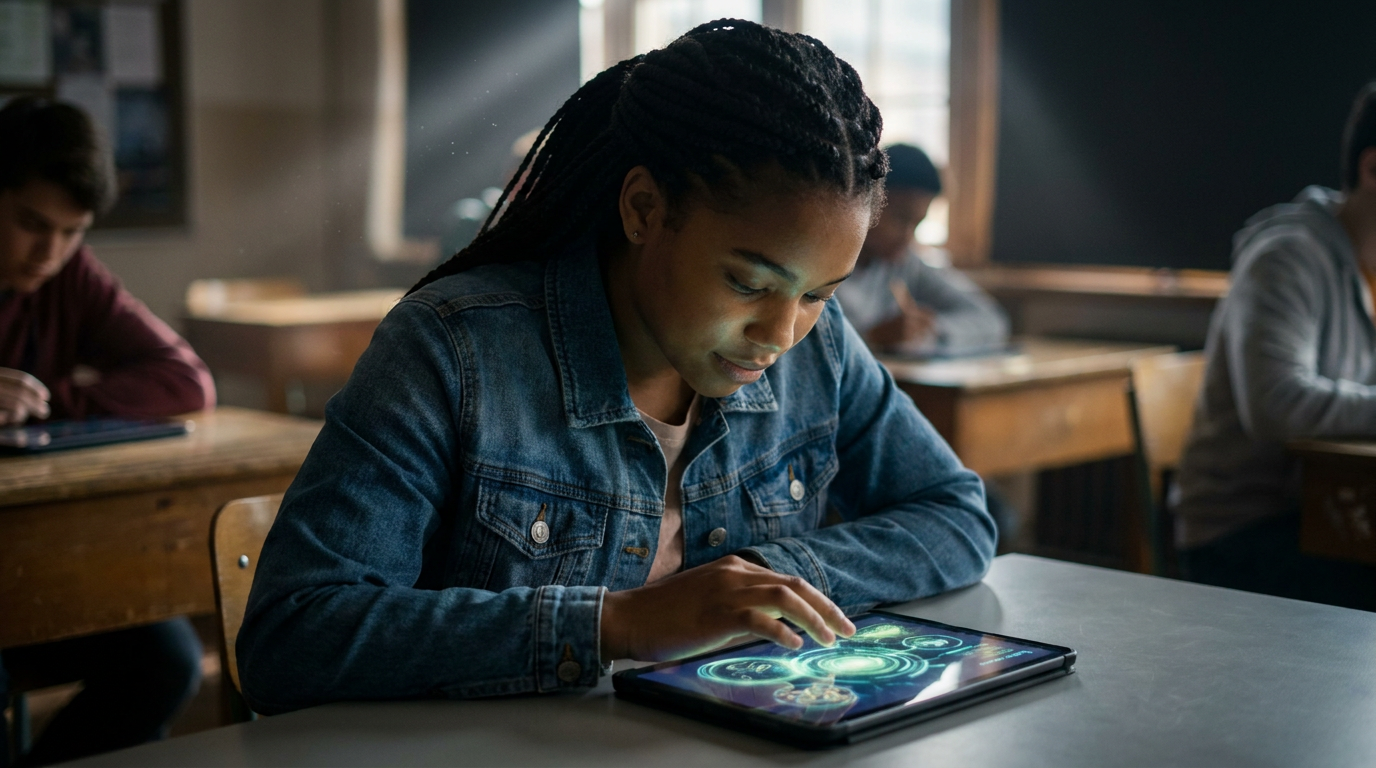
- EdTech Optimists
- Believe AI can democratize one-on-one tutoring and fundamentally solve the 2 sigma problem.
- Pedagogical Realists
- Argue AI only handles the mechanical aspects of learning and cannot replace human instruction.
- Classroom Educators
- Note that AI tools are only effective if students are motivated to use them.
What's not represented
- · Students from underfunded districts without reliable internet access
- · Data privacy advocates concerned about AI tracking student learning patterns
Why this matters
For decades, the most effective form of teaching—one-on-one tutoring—was too expensive to scale. AI is now delivering those exact learning gains for under $50 per student, fundamentally changing how schools, universities, and corporate training programs operate.
Key points
- Benjamin Bloom's 1984 study proved 1-on-1 tutoring improves performance by two standard deviations.
- AI tutors replicate this effect through deep personalization, mastery-based progression, and immediate feedback.
- A 2025 randomized trial found AI tutoring outperformed in-class active learning by up to 1.3 standard deviations.
- Cost-effectiveness studies show AI interventions can deliver 1.5 years of learning gains for roughly $48 per pupil.
- Educators warn of a 'motivation gap,' noting that passive students often fail to engage with AI tools.
- Experts view AI as a copilot that handles mechanical personalization, freeing teachers to focus on social and emotional learning.
In 1984, educational psychologist Benjamin Bloom published a study that would haunt instructional designers for the next four decades. By comparing traditional lecture-based classrooms with one-on-one tutoring, Bloom discovered something extraordinary: the average tutored student performed two standard deviations better than their classroom peers. In practical terms, the tutored student outperformed 98 percent of traditionally taught learners. This massive leap in efficacy became known as the "2 Sigma Problem."[1][2]
The "problem" was not the pedagogy, but the economics. Bloom had definitively proven that personalized, one-on-one tutoring combined with mastery learning was the optimal way for humans to learn. Yet, schools, universities, and corporate training programs simply could not afford to assign a dedicated human tutor to every single learner. For forty years, the 2 Sigma Problem remained a structural limitation of the global education system—a known cure that was too expensive to manufacture at scale.[2][9]
Today, the rapid maturation of Large Language Models (LLMs) has fundamentally altered that math. Generative AI is shifting the educational landscape from a model of scarce human attention to one of abundant, personalized guidance. By deploying AI-powered tutors that can adapt to individual learning styles, educational institutions are attempting to democratize the 2-sigma effect, offering the first concrete, scalable solution to Bloom's decades-old challenge.[2][9]

The success of these new systems relies on replicating the three core conditions that made Bloom's human tutors so effective. The first is deep personalization. Pre-2020 intelligent tutoring systems operated on rigid logical decision trees and static scaffolding pathways. Modern AI tutors, however, generate contextual explanations on the fly. If a student excels in algebra but falters in geometry, the system dynamically adjusts the difficulty, pacing, and terminology to match the learner's exact cognitive state.[1][2]
The second condition is mastery-based progression. In a traditional classroom, the syllabus moves forward regardless of whether every student has grasped the current concept, inevitably leaving some behind to accumulate knowledge gaps. AI tutors enforce a "mastery floor," requiring students to demonstrate 90 percent comprehension of a topic before unlocking the next module. Because the AI can generate infinite practice variations, students are never forced to move on until they are genuinely ready.[1][9]
The third, and perhaps most psychologically significant, condition is immediate, non-judgmental feedback. In a crowded classroom, students are often embarrassed to raise their hands and admit they do not understand a foundational concept. AI tutors respond with infinite patience. A student can ask a chatbot to explain a basic fraction ten times in ten different ways without fear of peer judgment or teacher frustration, creating a psychologically safe environment for trial and error.[4][9]
The empirical evidence supporting this approach is becoming difficult to ignore. A 2025 randomized controlled trial published in Scientific Reports delivered one of the strongest validations to date. The study found that an AI tutor, designed around pedagogical best practices, significantly outperformed traditional in-class active learning. Students using the AI system achieved an effect size between 0.73 and 1.3 standard deviations—closing in on Bloom's legendary 2.0 benchmark—and did so in less time than their classroom peers.[7]
The empirical evidence supporting this approach is becoming difficult to ignore.
The economic implications of these gains are staggering. A 2026 report from the Brookings Institution analyzed recent trials, including a Stanford University study of a human-AI tutoring system. The analysis revealed that AI-enhanced tutoring produced learning gains equating to 1.5 to 2 years of traditional schooling. More importantly, the per-pupil cost of this intervention was approximately $48. For developing nations or underfunded districts grappling with severe teacher shortages, this represents a highly scalable lifeline.[4]

Longitudinal data from major platforms reinforces these findings. Khan Academy's November 2024 efficacy report on its Khanmigo AI tutor tracked hundreds of thousands of students. The data showed that "highly active" learners—those who used the platform for just 30 minutes a week, or 18 hours over the school year—experienced roughly 20 percent greater-than-expected learning gains on nationally normed assessments compared to their peers.[8]
Yet, despite the soaring metrics, educators caution that AI is not a frictionless magic bullet. The most glaring limitation of the technology is the "motivation gap." While AI can perfectly explain a concept, it cannot force a student to care about it. In early 2026, Sal Khan himself acknowledged this reality, noting that for unmotivated students, having access to an AI tutor was largely a "non-event" because they simply chose not to engage with it.[6][9]
Khan compared the passive AI assistant to a student sitting in the back of the classroom who refuses to raise their hand. No amount of technological availability changes the outcome if the learner lacks the intrinsic drive to ask questions. Teachers report that while high-achieving students use AI to dig deeper into subjects, struggling students often click around for a few minutes, attempt to use the tool as a search engine for quick answers, and then disengage.[6]
Academic studies have echoed these classroom observations. A 2025 mixed-methods study published in the Journal of Teaching and Learning investigated the effectiveness of Khanmigo in undergraduate physics education. While students perceived the AI positively and appreciated its step-by-step guidance, the quantitative analysis found no statistically significant differences in short-term learning outcomes between students using the AI tutor and those simply using Google Search.[3]
This points to a deeper philosophical debate about what constitutes education. Educational researchers argue that AI tutors currently operate in a narrow band of cognition. According to the CAPITAL framework of learning, AI is highly effective at "rehearsal and exposition"—delivering academic content and drilling factual knowledge. However, researchers estimate this accounts for only about 16 percent of the holistic learning process.[5]

The remaining 84 percent involves social sense-making, emotional regulation, and metacognitive awareness. An AI tutor cannot model what it means to wrestle with the provisional nature of knowledge, nor can it teach a student how to debate conflicting evidence with a peer. There is also the persistent risk of "cognitive offloading," where students use the AI to bypass the productive friction and struggle that is biologically necessary to form long-term memories.[2][5]
Ultimately, the consensus emerging among both technologists and educators is that AI will not replace the human teacher. Instead, the ideal model is one of a copilot. By offloading the mechanical burden of mass personalization, automated grading, and adaptive reviews to the machine, the human instructor is freed from administrative exhaustion.[2][9]

Bloom's 2 Sigma Problem is finally solvable today, not because a chatbot can perfectly mimic a human mentor, but because it can handle the repetitive mechanics of mastery learning at scale. This technological delegation allows teachers to return to the most vital, irreplaceable tasks of their profession: validating content, calibrating cognitive load, and guiding learners in developing the critical thinking, social intelligence, and motivation that no algorithm can provide.[2][9]
How we got here
1984
Benjamin Bloom publishes his landmark study identifying the '2 Sigma Problem' of scalable tutoring.
2011
Meta-analyses show early Intelligent Tutoring Systems (ITS) provide moderate gains but fail to match human tutors.
2023
Khan Academy introduces Khanmigo, leveraging generative AI to simulate conversational 1-on-1 tutoring.
Late 2024
Longitudinal data reveals active AI tutor users experience 20% greater-than-expected learning gains.
2025
RCTs demonstrate AI tutoring outperforming traditional in-class active learning by over a full standard deviation.
Viewpoints in depth
EdTech Optimists
Believe AI can democratize one-on-one tutoring and fundamentally solve the 2 sigma problem.
This camp, which includes platform developers and early-adopter districts, points to massive cost-efficiency gains. They argue that delivering 1.5 years of learning growth for under $50 per student is an unprecedented breakthrough. For them, the ability to provide infinite patience, immediate feedback, and personalized pacing at scale is the realization of a 40-year-old educational dream.
Pedagogical Realists
Argue AI only handles the mechanical aspects of learning and cannot replace human instruction.
Researchers in this camp emphasize that learning is fundamentally a social and emotional process. They argue that AI tutors only address the 'rehearsal and exposition' phases of education—roughly 16% of the learning spectrum. They warn that over-relying on AI neglects critical metacognitive development, such as learning how to debate conflicting evidence or persist through genuine intellectual frustration.
Classroom Educators
Note that AI tools are only effective if students are motivated to use them.
Teachers on the ground report a significant 'motivation gap.' While highly driven students use AI tutors to accelerate their learning, struggling or passive students often treat the AI as a search engine to find quick answers, or simply ignore it. This camp stresses that AI cannot replace the human relationship required to inspire a reluctant learner.
What we don't know
- How to effectively motivate passive or struggling students to proactively engage with AI tutors.
- The long-term impact of 'cognitive offloading' on students' ability to retain information without AI assistance.
- How the role of the traditional classroom teacher will formally evolve as AI takes over primary content delivery.
Key terms
- Bloom's 2 Sigma Problem
- The educational dilemma identified in 1984 showing that one-on-one tutoring is vastly superior to classroom instruction, but too expensive to provide to every student.
- Mastery-Based Progression
- An educational philosophy where students must demonstrate a high level of competence (often 90%) in a topic before moving on to the next one.
- Cognitive Offloading
- The tendency to rely on external tools like AI to do the thinking, which can sometimes bypass the productive friction necessary for deep learning.
- Retrieval-Augmented Generation (RAG)
- An AI technique that restricts a chatbot to only pull information from a specific, trusted database rather than the open internet, reducing errors.
Frequently asked
What is Bloom's 2 Sigma Problem?
A 1984 finding that students receiving one-on-one tutoring performed two standard deviations better than classroom peers. The 'problem' was that scaling this level of personalized attention was financially impossible.
Do AI tutors hallucinate or give wrong answers?
While early models struggled, modern educational AI systems use Retrieval-Augmented Generation (RAG) to ground their answers in approved curricula, significantly reducing errors compared to open chatbots.
Will AI replace human teachers?
No. Research indicates AI is highly effective for delivering content and practicing procedures, but cannot replicate the social, emotional, and metacognitive guidance that human teachers provide.
Sources
Source coverage
9 outlets
3 viewpoints surfaced









[1]StudientEdTech Optimists
How AI Solves Bloom's 2 Sigma Problem
Read on Studient →[2]AWorldEdTech Optimists
Scalable AI tutoring: how AI solves Bloom's 2 Sigma problem
Read on AWorld →[3]Journal of Teaching and LearningPedagogical Realists
Leveraging 'Khanmigo' Generative AI-Powered Tool for Personalized Tutoring to Learn Scientific Concepts
Read on Journal of Teaching and Learning →[4]Brookings InstitutionEdTech Optimists
What the research shows about generative AI in tutoring
Read on Brookings Institution →[5]Substack / Rose LuckinPedagogical Realists
AI Tutors Support 16 Percent of Learning. What About the Other 84 Percent?
Read on Substack / Rose Luckin →[6]ChalkbeatClassroom Educators
Sal Khan admitted Khanmigo 'was a non-event' for most students
Read on Chalkbeat →[7]Scientific ReportsEdTech Optimists
AI tutoring outperforms in-class active learning: an RCT introducing a novel research-based design
Read on Scientific Reports →[8]Khan AcademyEdTech Optimists
Khan Academy Efficacy Results, November 2024
Read on Khan Academy →[9]Factlen Editorial TeamClassroom Educators
Synthesis by Factlen editorial team
Read on Factlen Editorial Team →
Every angle. Every day.
Get education stories with full source coverage and perspective breakdowns delivered to your inbox.