
From Vertical Scroll to Global Screen: How Webtoons Are Rewriting the Anime Production Pipeline
As Korean digital comics dominate streaming charts, Japanese studios are overhauling their traditional animation techniques to adapt full-color, smartphone-native stories.
By Factlen Editorial Team
- Japanese Animation Studios
- Focused on the technical translation of vertical formats into premium cinematic experiences.
- Webtoon Publishers
- Focused on bypassing traditional print gatekeepers to achieve rapid global distribution.
- Global Streaming Platforms
- Focused on securing exclusive, built-in audiences to drive subscriber growth.
What's not represented
- · Traditional Japanese Manga Publishers
- · Independent 2D Animators
Why this matters
The webtoon-to-anime pipeline is breaking Japan's historical monopoly on anime source material, accelerating global releases, and changing how the next generation of blockbuster franchises is animated and distributed.
Key points
- Korean webtoons are rapidly becoming a primary source of intellectual property for the Japanese anime industry.
- The vertical, one-way scroll of digital comics translates surprisingly well to linear video storyboards.
- Premium adaptations like Solo Leveling require up to 10 months of production time per episode to maintain cinematic quality.
- Studios are adopting new technologies, such as Sony's mobile motion-capture system, to animate complex character designs.
- Webtoon Entertainment currently has over 20 anime adaptations in active development for global release.
- English dubbing teams operate on a compressed two-to-three week schedule to ensure simultaneous global premieres.
The biggest paradigm shift in modern Japanese animation isn't happening on a drafting desk in Tokyo—it's happening on smartphones in Seoul. As blockbuster series like Solo Leveling dominate global streaming charts, the anime industry is increasingly looking beyond its traditional borders for source material. Instead of relying exclusively on black-and-white Japanese manga, studios are adapting Korean webtoons: full-color, digitally native comics designed to be scrolled vertically. This transition is rewriting the rules of how anime is storyboarded, animated, and distributed to a global audience.[1][5]
For decades, the anime production pipeline followed a rigid, predictable path. A creator would publish a black-and-white manga in a weekly print magazine, and if it garnered enough reader surveys and volume sales, a production committee would fund a 16:9 animated adaptation. The studio's primary job was to add color, voice acting, and motion to static, right-to-left page spreads.[7]
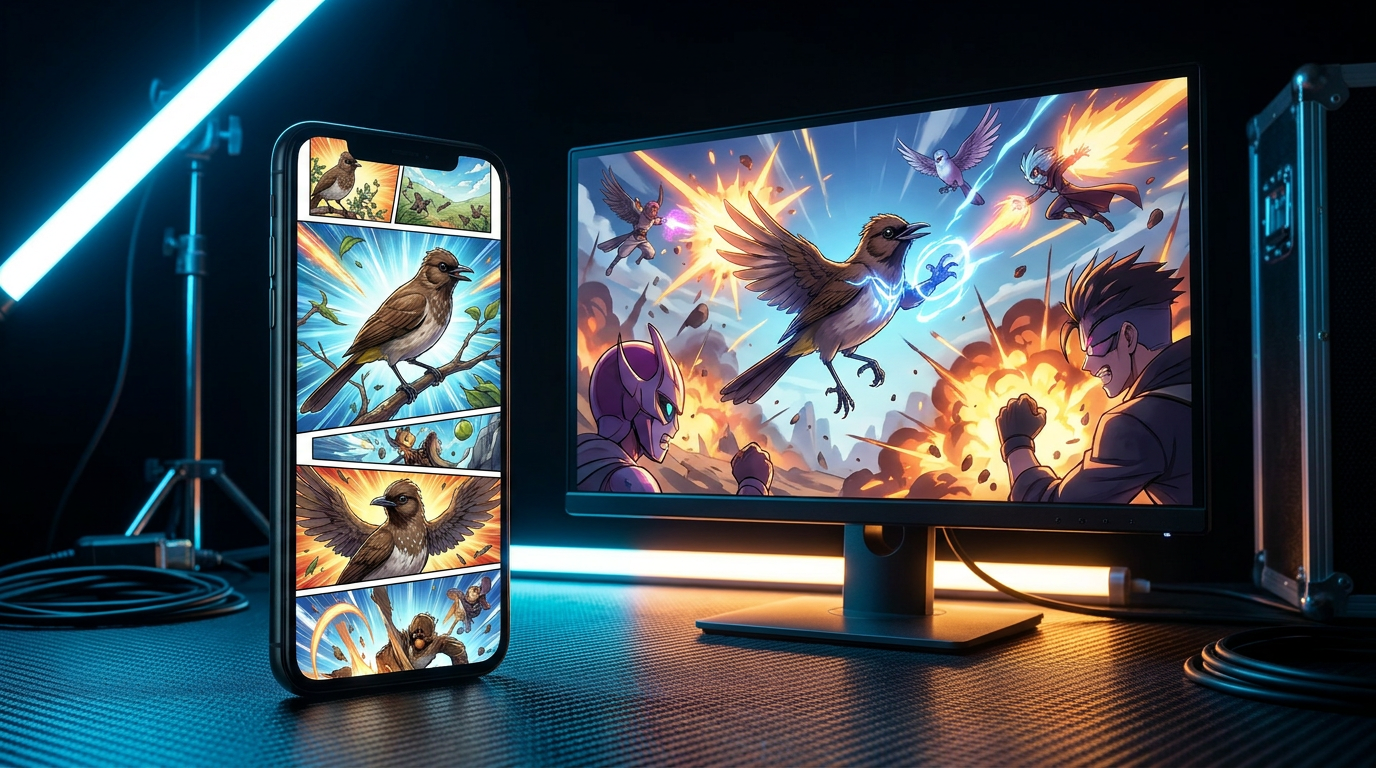
Webtoons, or manhwa, fundamentally break that mold. Born in the digital era, these comics are optimized for the mobile screen. They feature vibrant, full-color panels stacked in an infinite vertical column, allowing readers to consume the story with a seamless, one-handed downward swipe. This format, known colloquially as "webtoonization," has evolved into a distinct storytelling discipline that requires a completely different approach to pacing and layout.[6]
The economic momentum behind this shift is staggering. Webtoon Entertainment, one of the largest digital comic platforms, currently has over 20 anime adaptations in active development. Meanwhile, global streaming giants like Netflix and Crunchyroll are aggressively courting Korean publishers, holding exclusive pitch meetings to secure the next viral hit. For these platforms, webtoons offer a pipeline of pre-validated intellectual property with millions of built-in fans.[5]

Translating an infinite vertical scroll into a standard television monitor presents a unique set of artistic challenges. Directors can no longer rely on the dramatic page-turns or double-page spreads that define traditional manga. Instead, they must deconstruct a continuous ribbon of art and reassemble it into discrete, cinematic shots.[6]
Surprisingly, many animators are finding that the smartphone format actually streamlines the directorial process. Masakazu Hishida, the director behind the anime adaptation of the webtoon Viral Hit, noted that the one-way scrolling nature of digital comics is highly compatible with anime storyboard structures. Because the reader cannot easily skip back and forth between panels, the narrative flows in a strict, linear progression.[2]
This linear flow mimics the passage of time in video. In traditional manga, the reader's eye line is constantly zigzagging across the page, and artists sometimes cross the "imaginary line"—a cinematography rule that dictates spatial relationships—to fit panels together. Webtoons rarely commit this error. The downward scroll forces a consistent perspective, meaning the panels are already sequenced much like the shots in an animation timeline.[2]
The downward scroll forces a consistent perspective, meaning the panels are already sequenced much like the shots in an animation timeline.
However, what webtoons offer in structural clarity, they complicate in pacing. A standard webtoon chapter is designed for micro-consumption, meant to be read in two to three minutes during a subway commute. The narrative beats are quick, and chapters frequently end on abrupt cliffhangers to ensure the reader returns the following week.[6][7]
To construct a cohesive 24-minute anime episode, directors must stitch together multiple short chapters. This requires careful calibration to ensure the episode doesn't feel like a disjointed series of rapid-fire events. Screenwriters often have to expand upon the source material, adding transitional scenes and deepening character interactions to let the story breathe within the longer broadcast format.[7]
The visual expectations are also significantly higher. Because manga is traditionally black-and-white, anime studios have the creative freedom to define the color palette and lighting. Webtoons, however, are fully colored and heavily stylized from the first panel. Fans expect the anime to not just match, but elevate the vibrant, high-fidelity art they already know.[1]

Meeting these expectations requires an unprecedented investment of time. For the hit series Solo Leveling, the production team at A-1 Pictures reportedly spent up to 10 months completing a single episode. In an industry notorious for grueling schedules and fast turnarounds, dedicating nearly a year to perfect the action choreography, lighting, and visual effects of a single installment is a radical departure from the norm.[1]
To maintain this level of quality without bankrupting the studio, animators are turning to cutting-edge technology. The stylish, long-limbed character designs typical of Korean manhwa make fluid action sequences notoriously difficult to draw by hand. To solve this, studios are integrating motion capture directly into the 2D animation pipeline.[3]

During the production of Solo Leveling, A-1 Pictures utilized Sony's "mocopi" system—a mobile motion-capture setup that uses six lightweight sensors and a smartphone app. Instead of animating complex martial arts sequences entirely from scratch, the team captured real human movement to block out the scenes. This allowed animators to streamline the foundational motion and focus their labor on the intricate, hand-drawn details that give the show its premium feel.[4]
The modernization of the pipeline extends all the way to the final delivery. The audience for webtoon adaptations is inherently global, meaning the traditional model of broadcasting in Japan and waiting months for an international release is no longer viable. Streaming platforms demand near-simultaneous global premieres.[5]
This has triggered a logistical sprint in the localization sector. To achieve a "SimulDub"—where the English voice track is released alongside the Japanese broadcast—translators, directors, and voice actors operate on a compressed two-to-three week turnaround per episode. Even after an episode has spent 10 months in animation, the audio teams are racing the clock to ensure fans worldwide experience the story at the exact same moment.[1]
Ultimately, the webtoon-to-anime pipeline represents a maturation of the medium. By fusing the rapid, digital-first storytelling of Korean creators with the meticulous craftsmanship of Japanese animation studios and the distribution power of American streaming platforms, the industry has built a new engine for global entertainment. It is a collaborative ecosystem that proves the future of anime is no longer bound to the printed page.[5][7]
How we got here
2016
The Solo Leveling web novel begins serialization, later adapted into a massively popular webtoon.
October 2019
Crunchyroll and Webtoon announce a strategic partnership to co-produce animated adaptations.
Spring 2020
Tower of God premieres, marking one of the first major Crunchyroll Originals based on a Korean webtoon.
Early 2024
The Solo Leveling anime debuts to record-breaking global viewership, validating the premium adaptation model.
July 2025
Netflix and Crunchyroll hold exclusive pitch meetings with Korean publishers to secure future webtoon IPs.
June 2026
Webtoon Entertainment confirms over 20 new anime adaptations are actively moving through the production pipeline.
Viewpoints in depth
Japanese Animation Studios
Focused on the technical translation of vertical formats into premium cinematic experiences.
For the studios actually drawing the frames, the shift from manga to webtoon is a double-edged sword. On one hand, the linear, top-to-bottom flow of a webtoon translates naturally into video storyboards without the visual zigzagging of traditional comic panels. On the other hand, because webtoons are fully colored and highly detailed from the start, fans expect a massive visual upgrade. Studios like A-1 Pictures have had to adopt new technologies, like motion capture, and extend production timelines to nearly a year per episode just to meet these elevated expectations.
Webtoon Publishers
Focused on bypassing traditional print gatekeepers to achieve rapid global distribution.
Korean publishers and digital platforms view anime adaptations as the ultimate growth multiplier. Unlike the traditional Japanese manga industry, which relies on decades-old print magazine hierarchies, webtoon platforms offer creators real-time data on readership. When a series hits number one on a smartphone app, publishers can immediately pitch it to global streaming giants like Netflix and Crunchyroll. For them, the anime pipeline is a high-speed vehicle to turn local digital comics into global multimedia franchises.
Global Streaming Platforms
Focused on securing exclusive, built-in audiences to drive subscriber growth.
For platforms like Crunchyroll and Netflix, webtoons represent a goldmine of pre-validated intellectual property. Instead of taking a risk on an original script, they can invest in a webtoon that already boasts millions of weekly scrolling readers. These platforms are aggressively funding the production committees for these adaptations, knowing that a hit series will not only drive streaming subscriptions but also fuel lucrative secondary markets in mobile gaming and merchandise.
What we don't know
- Whether the 10-month production cycle per episode is financially sustainable for studios without massive backing from streaming giants.
- How traditional Japanese manga publishers will adapt their digital strategies to compete with the rapid global distribution of Korean webtoons.
- If the integration of motion-capture technology will eventually become the standard for all 2D action anime, or remain reserved for high-budget adaptations.
Key terms
- Webtoon
- A digital comic format originating in South Korea, designed to be read by scrolling vertically on a smartphone.
- Manhwa
- The general Korean term for comics and print cartoons, often used interchangeably with webtoons in the digital era.
- Mocopi
- A lightweight, mobile motion-capture system developed by Sony, increasingly used by animators to block out complex action sequences.
- SimulDub
- The process of producing and releasing a translated, voice-dubbed version of an episode almost simultaneously with its original broadcast.
- Imaginary Line
- A cinematography rule that maintains consistent spatial relations between characters on screen, which traditional manga sometimes breaks but webtoons naturally preserve.
Frequently asked
Why are webtoons easier to storyboard than manga?
Because the vertical scroll forces a one-way flow of time and prevents the reader's eye from zigzagging, which translates smoothly into linear video storyboards.
How long does it take to animate a premium webtoon adaptation?
High-end adaptations like Solo Leveling can take up to 10 months per episode to ensure cinematic quality and fluid action.
What is a SimulDub?
It is the process of translating and recording an English voice track in just two to three weeks, allowing the dub to release almost simultaneously with the Japanese broadcast.
Will webtoons replace traditional manga?
No, but they offer a parallel pipeline. Manga remains a massive industry, but webtoons provide streaming platforms with a faster route to global, digitally-native audiences.
Sources
Source coverage
7 outlets
3 viewpoints surfaced







[1]Screen RantGlobal Streaming Platforms
Solo Leveling's Team Took Their Time, Prioritizing Quality Over Speed
Read on Screen Rant →[2]AnimehunchJapanese Animation Studios
Viral Hit Director Explains Why Webtoons Are More Compatible With Anime Storyboards
Read on Animehunch →[3]Animation World NetworkJapanese Animation Studios
Inside the 'Solo Leveling' Season 2 Production Pipeline
Read on Animation World Network →[4]SonyJapanese Animation Studios
Streamlining Animation Production with mocopi: The Case of Solo Leveling
Read on Sony →[5]Anime CornerWebtoon Publishers
WEBTOON Entertainment Aiming for Over 20 Anime Adaptations
Read on Anime Corner →[6]DreamwallWebtoon Publishers
Webtoonization: Adapting to the Digital Era of Storytelling
Read on Dreamwall →[7]Factlen Editorial TeamGlobal Streaming Platforms
Synthesis by Factlen editorial team
Read on Factlen Editorial Team →

Every angle. Every day.
Get entertainment stories with full source coverage and perspective breakdowns delivered to your inbox.