
St. Petersburg Residents Build Community-Owned Grocery Store to Eradicate Local Food Desert
After years of corporate supermarket closures, a South St. Petersburg neighborhood has secured city funding and grown its membership to launch a cooperative grocery store.
By Factlen Editorial Team
- Co-op Organizers
- Advocates argue that community ownership is the only sustainable solution to systemic food insecurity.
- Local Government
- City officials balance the desire to support grassroots initiatives with the need for financial prudence.
- Urban Farmers
- Local agricultural producers view the co-op as a vital partner for sustainable food systems.
- Neighborhood Residents
- Families seek reliable, walkable access to fresh food after years of corporate chain closures.
What's not represented
- · Corporate grocery chains that previously exited the neighborhood
- · Commercial real estate developers in South St. Petersburg
Why this matters
When corporate grocery chains abandon neighborhoods, residents are often left with long commutes just to buy fresh produce. This community-owned model offers a blueprint for how neighborhoods nationwide can reclaim their food sovereignty, keep local dollars circulating, and build long-term resilience against corporate redlining.
Key points
- South St. Petersburg residents are building a community-owned grocery store to combat a decade-long lack of fresh food access.
- The One Community Grocery Co-op recently secured a $50,000 city grant for feasibility studies and site planning.
- The initiative currently has 190 member-owners and aims to reach 300 to secure a physical storefront.
- While the store is in development, organizers are hosting pop-up markets supplied by local urban farmers.
- Advocates emphasize the cooperative model as a way to keep economic benefits circulating within the neighborhood.
For nearly a decade, the residents of South St. Petersburg, Florida, have watched a revolving door of corporate grocery chains open and eventually abandon their neighborhood. When the area's last accessible supermarket, a Save-A-Lot, shuttered its doors in late 2025, it left thousands of families without reliable access to fresh produce. The closure exacerbated an already dire situation, forcing residents to rely on corner stores and gas stations that stock highly processed foods, or to endure long, difficult commutes on public transportation just to purchase basic nutritional necessities for their families.[2]
Rather than waiting for another corporate chain to take a chance on the neighborhood, the community is taking ownership of its food supply. The One Community Grocery Co-op, a grassroots initiative years in the making, is gaining significant momentum in its mission to open a fully community-owned and democratically governed grocery store. Born out of local budget reviews and neighborhood town halls, the cooperative aims to permanently break the cycle of corporate dependency by building an institution that is fundamentally anchored to the people who rely on it every day.[1][4]
The initiative recently achieved a major breakthrough when the St. Petersburg City Council approved a $50,000 grant to help fund the co-op's pre-development efforts. This crucial financial injection will cover the early-stage requirements necessary to bring the physical store to life, including comprehensive feasibility studies, architectural site selection, and detailed performance planning. For a grassroots organization built on individual community contributions, securing municipal backing provides both the capital and the institutional legitimacy needed to attract further investment and move from the conceptual phase into concrete urban development.[1]

This financial backing represents a hard-fought victory for local organizers and neighborhood advocates. Just months earlier, in November 2025, a city budget committee had voted against providing the funds, temporarily stalling the project's momentum. That initial denial sparked a broader, highly publicized debate across St. Petersburg about whether the local government should support community-led food initiatives or pursue entirely city-run alternatives. Ultimately, the successful push to secure the grant demonstrated the organizing power of the co-op's members and reaffirmed the city's commitment to exploring cooperative economic models.[5]
The co-op model is intentionally designed to succeed in environments where traditional, profit-driven grocery models have consistently failed. Board President Erica "Zenzele" Hardison emphasizes that corporate chain stores make operational decisions based strictly on their bottom line, often vacating marginalized neighborhoods the moment profit margins dip below corporate targets. A cooperative, by contrast, operates under a completely different mandate. Because it is owned by the shoppers themselves, the primary goal is community service and food security, ensuring that the store remains a stable, long-term anchor regardless of broader corporate retail trends.[6]
The co-op model is intentionally designed to succeed in environments where traditional, profit-driven grocery models have consistently failed.
To secure a permanent brick-and-mortar location and prove the model's financial viability, the organization has set a strict target of 300 member-owners. As of early 2026, the co-op has successfully signed on 190 members, representing a steady and encouraging increase from the 150 members recorded during the immediate aftermath of the Save-A-Lot closure. This growing base of owners provides the essential seed capital required to leverage larger commercial loans and demonstrates to potential real estate partners that the neighborhood is deeply invested in the store's long-term success.[1][2]
Becoming an individual member-owner requires a one-time equity investment of $225, which organizers have structured to be payable in monthly installments of $25 to ensure maximum accessibility for low-income households. While anyone in the community will eventually be able to walk in and shop at the store, only member-owners hold voting rights. This democratic structure allows residents to directly determine store policies, select the product offerings that best reflect the neighborhood's cultural preferences, and elect the board of directors that will oversee the store's executive management.[2][6]

The chronic lack of walkable grocery options has placed a disproportionately heavy burden on South St. Pete residents, many of whom lack access to personal vehicles. Navigating the city's public transit system with a week's worth of groceries is a cumbersome, exhausting, and time-consuming reality for families relying on distant supermarkets. By establishing a centrally located, community-owned store, the co-op aims to eliminate these logistical barriers, giving residents the ability to purchase fresh, healthy food within their own neighborhood without sacrificing hours of their day in transit.[2]
Advocates within the co-op frequently reframe the neighborhood's situation, shifting the public narrative away from the commonly used term "food desert" in favor of "food apartheid." This linguistic distinction is vital, organizers argue, because it highlights that the lack of fresh food is not a naturally occurring ecological phenomenon. Instead, it is the direct result of systemic zoning policies, historical economic redlining, and corporate neglect that disproportionately affect minority and low-income communities. Addressing food apartheid requires intentional, structural solutions like community ownership rather than temporary charitable interventions.[4]
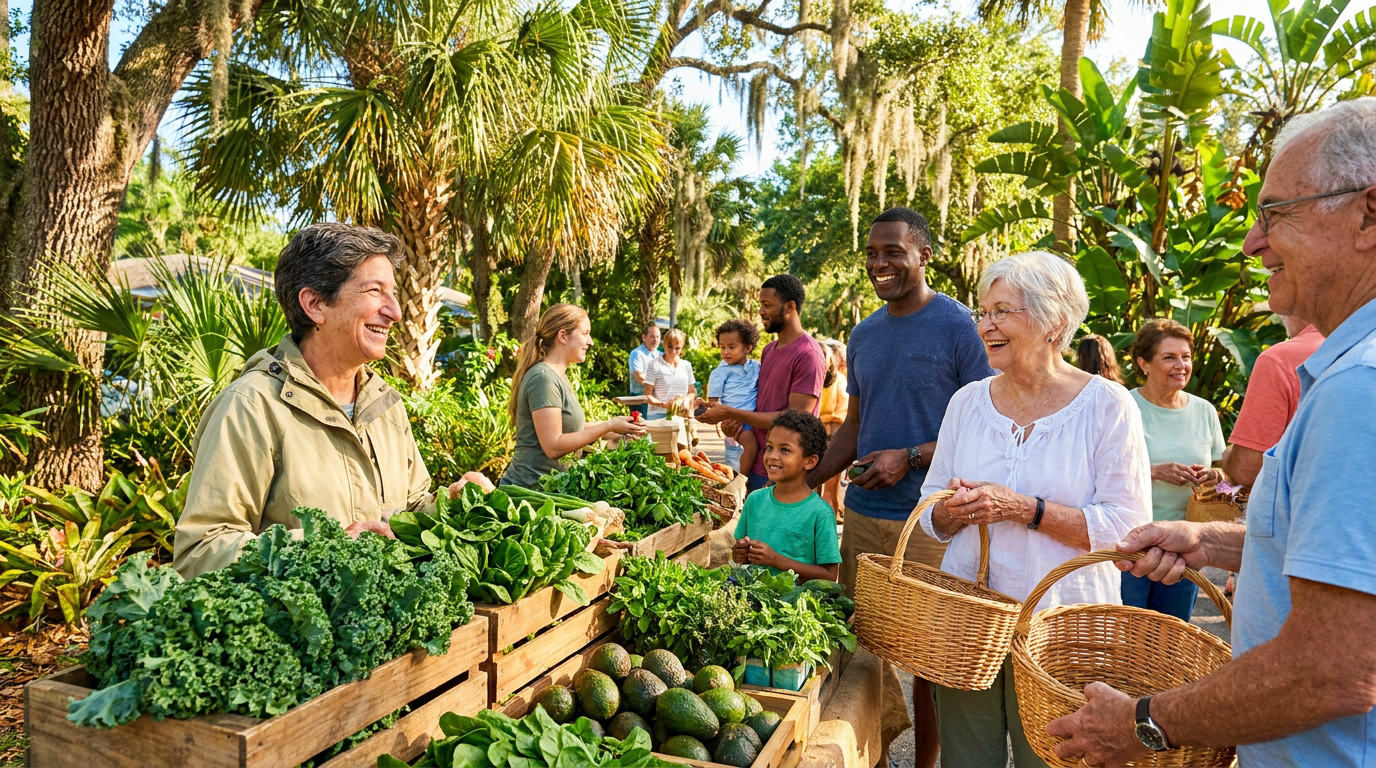
While the search for a permanent physical location continues and the membership drive pushes toward its 300-person goal, the co-op is not waiting to address the neighborhood's immediate nutritional needs. Organizers have proactively launched a series of pop-up grocery events, bringing fresh fruits, vegetables, and staple goods directly into South St. Pete. These interim markets serve a dual purpose: they provide immediate relief to families struggling with food access, while also serving as highly visible community outreach events that help recruit new member-owners to the cooperative cause.[1]

These pop-up markets rely heavily on strategic partnerships with local agricultural producers, such as Greens N' Things Urban Farm. Operator Eric Law works closely with landowners across the city to cultivate fresh produce, creating a collaborative ecosystem that bypasses traditional corporate supply chains. By sourcing food locally, the co-op strengthens regional food access, reduces the environmental impact of long-distance transportation, and ensures that the grocery dollars spent by South St. Pete residents are reinvested directly back into the local economy rather than being extracted by out-of-state corporations.[1]
With the city's pre-development grant now officially secured and the membership base steadily climbing toward its critical threshold, the One Community Grocery Co-op is moving tangibly closer to breaking ground. For the residents of South St. Pete, the realization of this project represents far more than just a convenient place to buy fresh vegetables. It serves as a powerful blueprint for economic empowerment, neighborhood resilience, and true food sovereignty, proving that communities can successfully build their own infrastructure when traditional corporate systems leave them behind.[1][5][6]
How we got here
2015
The People's Budget Review collects input from South St. Pete residents, highlighting the urgent need for reliable food access.
2017–2018
The One Community Grocery Co-op is formed by local residents to create a sustainable alternative to corporate grocery chains.
October 2025
The area's last accessible grocery store, a Save-A-Lot, closes its doors, intensifying the community's push for a co-op.
November 2025
A city budget committee initially votes against providing a $50,000 pre-development grant, temporarily stalling the project.
March 2026
The St. Petersburg City Council approves the $50,000 grant, and the co-op reaches 190 member-owners.
Viewpoints in depth
Co-op Organizers
Advocates argue that community ownership is the only sustainable solution to systemic food insecurity.
Organizers emphasize that traditional corporate grocery models are inherently unsuited for marginalized neighborhoods because their decisions are driven entirely by profit margins. When a store isn't hitting corporate targets, it closes, leaving the community stranded. By shifting to a cooperative model, the store's primary mandate becomes serving its member-owners rather than distant shareholders. This ensures that the grocery store remains a stable, long-term anchor that keeps local dollars circulating within the neighborhood economy.
Local Government
City officials balance the desire to support grassroots initiatives with the need for financial prudence.
While the St. Petersburg City Council ultimately approved the $50,000 pre-development grant, the debate leading up to the vote highlighted concerns over risk and municipal responsibility. Some committee members initially questioned whether the city should invest public funds into a cooperative model or explore city-run grocery alternatives. Ultimately, proponents on the council argued that empowering a community-led organization is a more sustainable and politically viable approach than attempting to manage a municipal grocery store.
Urban Farmers
Local agricultural producers view the co-op as a vital partner for sustainable food systems.
For urban farmers operating within city limits, the co-op represents a reliable, community-focused buyer for their produce. Operators like Greens N' Things Urban Farm rely on local partnerships to sustain their agricultural efforts. By supplying the co-op's interim pop-up markets, these farmers are able to scale their operations, reduce the carbon footprint of food transport, and ensure that the economic benefits of food production remain within the local ecosystem.
What we don't know
- The exact physical location of the future grocery store remains undetermined pending feasibility studies.
- It is unclear how long the site acquisition and construction phases will take once the 300-member goal is reached.
- The total capital required to fully build out and stock the brick-and-mortar store has not yet been finalized.
Key terms
- Food Desert
- A geographic area where residents have limited access to affordable, nutritious food, typically due to an absence of grocery stores.
- Food Apartheid
- A term used by advocates to describe food insecurity as a result of systemic policies and economic redlining, rather than a naturally occurring phenomenon.
- Cooperative (Co-op)
- A business or organization that is owned and democratically governed by its members, who share in its benefits and decision-making.
- Pre-development Grant
- Early-stage funding used to cover the initial costs of a project, such as feasibility studies, architectural plans, and site selection.
Frequently asked
How much does it cost to join the co-op?
An individual lifetime membership costs $225. To make it accessible, this can be paid in full or in $25 monthly installments.
Do I have to be a member to shop there?
No. Once the physical grocery store opens, anyone in the community will be allowed to shop there. However, only member-owners have voting rights to influence store decisions.
Where will the new grocery store be located?
A specific location has not been finalized. The co-op is using a recent $50,000 city grant to conduct feasibility studies and refine site plans within South St. Petersburg.
What is the co-op doing while the store is being built?
Organizers are currently hosting pop-up grocery events in the neighborhood, partnering with local urban farms to provide fresh produce to residents immediately.
Sources
Source coverage
6 outlets
4 viewpoints surfaced





[1]FOX 13 NewsNeighborhood Residents
St. Pete residents push for community-owned grocery store in 'food desert'
Read on FOX 13 News →[2]WTSPNeighborhood Residents
Grocery co-op pushes for new store in South St. Pete to fill gap left by Save-A-Lot closing
Read on WTSP →[3]WUSF Public MediaUrban Farmers
Florida Matters Live & Local: South St. Pete's food concerns
Read on WUSF Public Media →[4]The Weekly ChallengerCo-op Organizers
One Community Grocery Co-op
Read on The Weekly Challenger →[5]St. Pete Is Super CoolLocal Government
St. Pete's Grocery Store Showdown: A Big Idea Hits a Wall
Read on St. Pete Is Super Cool →[6]One Community Grocery Co-opCo-op Organizers
Building a community-owned grocery store in South St. Petersburg, Florida
Read on One Community Grocery Co-op →
Every angle. Every day.
Get community stories with full source coverage and perspective breakdowns delivered to your inbox.