
AI Models Detect Pancreatic Cancer Up to Three Years Before Symptoms Appear
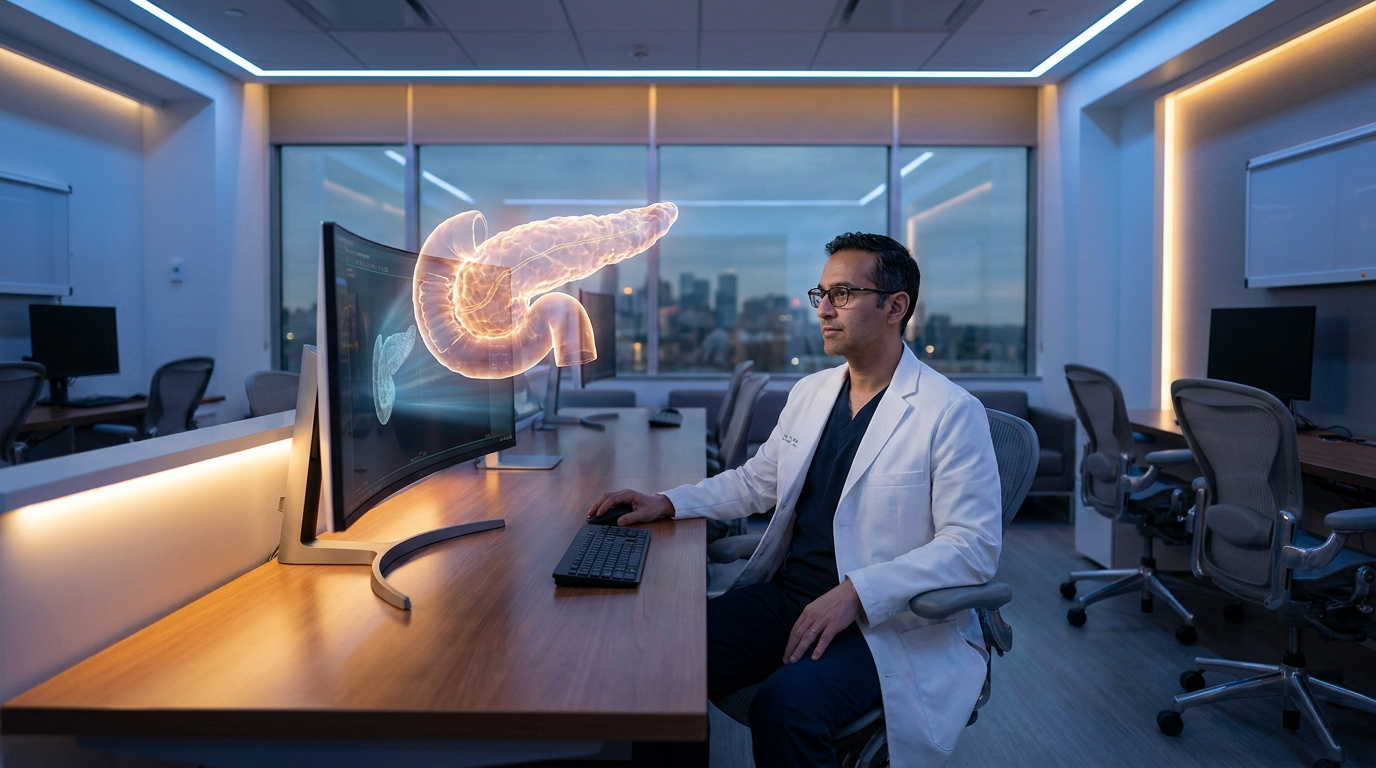
New artificial intelligence systems from the Mayo Clinic and Chinese researchers are successfully identifying microscopic signs of pancreatic cancer on routine CT scans years before human doctors can, offering a life-saving head start against one of medicine's deadliest diseases.
By Factlen Editorial Team
- Clinical Oncologists
- Focused on how early detection fundamentally changes patient survival odds and treatment options.
- Medical AI Researchers
- Focused on the technical leap of radiomics and deep learning in medical imaging.
- Global Health Advocates
- Focused on the accessibility and cost-effectiveness of software-based screening using existing infrastructure.
What's not represented
- · Patients who received early AI diagnoses
- · Medical insurance providers evaluating screening coverage
Why this matters
Pancreatic cancer is almost always fatal because it is caught too late. By using AI to spot the disease years before symptoms arise on scans patients are already getting, doctors can shift from offering palliative care to performing life-saving, curative surgeries.
Key points
- AI models developed in the US and China can now detect pancreatic cancer up to three years before symptoms appear.
- The systems analyze routine, non-contrast CT scans to find microscopic tissue changes invisible to human radiologists.
- In clinical studies, the REDMOD system correctly identified 73% of previously missed early-stage pancreatic cancer cases.
- By catching the disease before it spreads, doctors can perform curative surgeries rather than relying on late-stage palliative care.
For decades, pancreatic cancer has been one of medicine’s most devastating diagnoses, earning a grim reputation as a "silent killer" because it almost never presents symptoms until it is too late to cure. But a wave of newly published clinical data reveals that artificial intelligence has successfully cracked the disease's stealthy progression. Two independent AI systems—one developed in the United States and another in China—have demonstrated the ability to detect the earliest microscopic signs of pancreatic cancer up to three years before human radiologists can spot a tumor.[1][2]
The breakthrough fundamentally alters the timeline of a disease that is projected to become the second-leading cause of cancer-related deaths globally by 2030. Currently, more than 85% of pancreatic ductal adenocarcinoma cases are diagnosed at an advanced stage, when the cancer has already spread to other organs and surgical intervention is no longer an option. By the time patients experience the hallmark symptoms of jaundice, unexplained weight loss, or sudden-onset diabetes, their treatment options are severely limited.[1][2]
The most recent milestone comes from a joint research effort by the Mayo Clinic and the University of Texas MD Anderson Cancer Center. Their AI system, known as the Radiomics-Based Early Detection Model (REDMOD), was trained to analyze routine abdominal CT scans that patients had undergone for entirely unrelated medical reasons, such as kidney stones or gastrointestinal distress.[2][6]
In findings published in the journal Gut, researchers tested REDMOD on nearly 1,000 CT scans, including historical imaging from patients who were later diagnosed with pancreatic cancer but had been cleared by standard radiology reports at the time of the scan. The results were unprecedented: REDMOD correctly identified the presence of cancer in 73% of the previously missed cases.[1][2]

On average, the AI flagged the abnormalities 16 months before the patients received their official clinical diagnosis. In some rare instances, the system detected the warning signs up to 36 months in advance. By comparison, human radiologists reviewing the same historical scans were only able to detect early signs in 38.9% of the cases, highlighting the vast gap between human visual perception and machine analysis.[1]
The secret to REDMOD’s success lies in a field known as radiomics. Traditional radiology relies on doctors looking for visible masses, lesions, or structural deformations. REDMOD, however, does not look for a tumor. Instead, it analyzes the mathematical texture of the tissue, searching for microscopic changes in cellular density and structural patterns that precede the formation of a visible mass. These subtle radiomic signals are entirely invisible to the naked human eye, but they act as a digital fingerprint for impending malignancy.[1][6]
This American breakthrough mirrors an equally profound advancement out of China. Researchers from the Shanghai Institution of Pancreatic Disease, Johns Hopkins University, and Alibaba’s DAMO Academy recently unveiled PANDA (Pancreatic Cancer Detection with Artificial Intelligence). Published in Nature Medicine, the PANDA system utilizes a three-stage deep learning process to locate the pancreas, search for potential lesions, and classify the specific type of abnormality.[3][5]

This American breakthrough mirrors an equally profound advancement out of China.
In massive clinical trials, PANDA demonstrated a staggering 92.9% sensitivity and 99.9% specificity for cancer detection. The system proved so effective that it successfully identified 26 distinct pancreatic lesions that had been entirely missed by human doctors in clinical settings. Recognizing its life-saving potential, the U.S. Food and Drug Administration (FDA) granted PANDA a Breakthrough Device Designation, fast-tracking its path to clinical deployment.[3][4]
What makes both REDMOD and PANDA particularly revolutionary is their reliance on existing medical infrastructure. Neither system requires patients to undergo new, expensive, or invasive testing procedures. They operate entirely on standard, non-contrast CT scans—images that are already captured millions of times a year in hospitals worldwide.[2][4]
This compatibility means the AI can run silently in the background of a hospital's radiology department, acting as an automated safety net. If a patient comes into the emergency room after a minor car accident and receives an abdominal CT scan, the AI can analyze the pancreas as a secondary protocol, potentially catching a lethal cancer years before the patient ever feels sick.[2]
Medical experts emphasize that this opportunistic screening could be particularly transformative for high-risk populations. Patients with a family history of the disease, or those who have recently been diagnosed with sudden-onset diabetes—a known early indicator of pancreatic distress—could have their routine scans run through these AI models as a standard preventative measure.[2]

The success in the pancreas is already cascading into other hard-to-detect abdominal cancers. Following the deployment of PANDA, Chinese researchers introduced the GRAPE model, an AI system designed to detect early-stage gastric (stomach) cancer using the same non-contrast CT imaging techniques. Historically, CT scans were considered largely ineffective for gastric cancer screening due to the stomach's constantly changing shape and distension.[4]
Yet, trained on nearly 100,000 scans from 20 medical centers, the GRAPE model achieved an 85.1% sensitivity rate in spotting early stomach tumors, vastly outperforming human radiologists. In one notable case, the AI detected signs of gastric cancer in a 45-year-old patient using a scan taken six months prior for an unrelated issue, long before any gastrointestinal symptoms emerged.[4]
The transition from laboratory success to real-world clinical application is already underway. The People's Hospital Affiliated with Ningbo University has used the DAMO PANDA system to screen over 40,000 people, successfully detecting early-stage cases that routine tests missed, including a microscopic 1.5-centimeter lesion that was immediately treated with curative surgery.[4]

Meanwhile, the Mayo Clinic and MD Anderson teams are preparing to test REDMOD in larger, more diverse global populations. Their immediate goal is to integrate the software directly into real-world clinical workflows and further refine the algorithm to minimize false positives, ensuring that patients are not subjected to unnecessary biopsies.[1]
For the oncology community, these AI models represent a long-awaited paradigm shift. By giving medicine a new set of digital eyes capable of tireless, microscopic analysis, artificial intelligence is poised to turn one of the most elusive and lethal cancers into a manageable, surgically curable condition.[1][4]
How we got here
2023
The PANDA model is published in Nature Medicine, proving deep learning can detect pancreatic lesions missed by humans.
April 2025
The FDA grants Breakthrough Device Designation to the PANDA system to fast-track its clinical deployment.
May 2026
Mayo Clinic publishes REDMOD results in Gut, demonstrating the ability to detect pancreatic cancer up to 3 years early.
Viewpoints in depth
Clinical Oncologists
Focused on how early detection fundamentally changes patient survival odds.
For oncologists, the excitement surrounding REDMOD and PANDA is purely mathematical: catching pancreatic cancer at Stage 1 rather than Stage 4 is the difference between a curative surgery and palliative care. Because the pancreas is hidden deep in the abdomen, tumors grow silently. By the time a patient feels pain or turns jaundiced, the cancer has typically metastasized. Oncologists view these AI tools as the first viable 'safety net' that can opportunistically screen patients who are getting CT scans for unrelated reasons, effectively moving the diagnosis window forward by years and saving tens of thousands of lives.
Medical AI Researchers
Focused on the technical leap of radiomics and deep learning in medical imaging.
Computer scientists and AI researchers emphasize that these models represent a shift in how we define 'seeing' a disease. Human radiologists are trained to look for macroscopic anatomical changes—a visible lump or a deformed duct. AI models like REDMOD use radiomics to analyze the mathematical texture of the tissue at a pixel level. They are not looking for a tumor; they are looking for the microscopic cellular density changes that precede a tumor. Researchers argue this proves AI's role in medicine isn't just to automate human tasks, but to perceive biological signals that humans are physically incapable of seeing.
Global Health Advocates
Focused on the accessibility and cost-effectiveness of software-based screening.
Public health experts highlight the democratization of care that these AI models offer. Developing a new biological screening blood test or requiring specialized MRI machines would limit early detection to wealthy nations and elite hospitals. Because REDMOD and PANDA operate on standard, non-contrast CT scans, the infrastructure already exists globally. Advocates point out that a hospital in a low-resource setting can simply upload their routine scans to a cloud-based AI, instantly giving their patients access to world-class oncological screening without needing to purchase a single piece of new hardware.
What we don't know
- How frequently the AI might flag benign anomalies (false positives), potentially leading to unnecessary anxiety or invasive biopsies.
- Whether medical insurance providers will cover the cost of running opportunistic AI screening on routine CT scans.
- Exactly how long it will take for these AI models to be universally deployed across rural and low-income hospital networks.
Key terms
- Radiomics
- A field of medicine that extracts large amounts of quantitative data from medical images to uncover disease patterns invisible to the human eye.
- Pancreatic Ductal Adenocarcinoma
- The most common and aggressive type of pancreatic cancer, accounting for over 85% of all cases.
- Non-contrast CT scan
- A standard computed tomography scan performed without injecting a specialized dye into the patient's bloodstream.
- Sensitivity
- In medical testing, the ability of an algorithm or test to correctly identify patients who actually have the disease, avoiding false negatives.
- Specificity
- The ability of a test to correctly identify people who do not have the disease, avoiding false positives.
Frequently asked
Why is pancreatic cancer usually caught so late?
It rarely causes symptoms in its early stages, and the pancreas is located deep within the abdomen, making tumors impossible to feel during routine physical exams.
Do patients need a special type of scan for this AI?
No. Both the REDMOD and PANDA systems are designed to analyze standard, non-contrast CT scans that are already routinely performed in hospitals for other reasons.
What is radiomics?
Radiomics is a technique that extracts microscopic, quantitative data from medical images, allowing AI to analyze tissue textures and patterns that are invisible to the human eye.
When will this be available in my hospital?
While systems like PANDA are already deployed in select Chinese hospitals, models like REDMOD are currently entering larger clinical trials to refine their accuracy before a widespread global rollout.
Sources
Source coverage
6 outlets
3 viewpoints surfaced






[1]Times NowClinical Oncologists
AI Breakthrough Could Detect Pancreatic Cancer 3 Years Early, Before Symptoms Even Begin
Read on Times Now →[2]Vivid Voice NewsClinical Oncologists
AI breakthrough from Mayo Clinic could detect pancreatic cancer up to three years early
Read on Vivid Voice News →[3]BGRGlobal Health Advocates
China's AI Is Detecting Pancreatic Cancer That Doctors Might Miss
Read on BGR →[4]XinhuaGlobal Health Advocates
China's AI breakthrough set to be game-changer for early cancer detection
Read on Xinhua →[5]Nature MedicineMedical AI Researchers
Large-scale pancreatic cancer detection via non-contrast CT and deep learning
Read on Nature Medicine →[6]GutMedical AI Researchers
Radiomics-based early detection of pancreatic ductal adenocarcinoma
Read on Gut →


Every angle. Every day.
Get ai stories with full source coverage and perspective breakdowns delivered to your inbox.