
How 'Self-Driving Labs' Are Automating Scientific Discovery
By combining artificial intelligence with robotic execution, autonomous laboratories are accelerating the discovery of new materials and therapeutics.
By Factlen Editorial Team
- Automation Advocates
- Focus on the speed, scale, and democratization of scientific discovery.
- Data & Integration Skeptics
- Highlight the severe software and standardization bottlenecks holding back true autonomy.
- Human-in-the-Loop Proponents
- Emphasize that AI should augment, rather than replace, human scientific intuition.
What's not represented
- · Laboratory technicians facing role displacement
- · Open-source hardware developers
Why this matters
The physical execution of experiments has long been the slowest part of the scientific method. By automating the 'design-build-test' loop, researchers can discover clean energy materials and life-saving drugs in days rather than years.
Key points
- Self-driving labs (SDLs) combine AI, robotics, and real-time sensors to automate the scientific method.
- These systems operate on a closed 'Design-Build-Test-Learn' loop, updating their own hypotheses based on experimental results.
- Most commercial systems currently operate at Level 2 or 3 autonomy, focusing on narrow optimization tasks.
- The primary bottleneck to full autonomy is software middleware and standardizing data fusion across different instruments.
- Researchers aim to use SDLs to accelerate the discovery of clean energy materials, batteries, and pharmaceuticals.
The scientific method has a fundamental speed limit. While human minds and computer simulations can conceptualize millions of new molecular structures or battery materials, physically mixing, baking, and testing those compounds in a laboratory often takes months of tedious manual labor.[7]
That physical bottleneck is finally breaking. Across materials science, chemistry, and biology, a new paradigm known as the "self-driving laboratory" (SDL) is moving rapidly from academic proof-of-concept to commercial reality.[3][5]
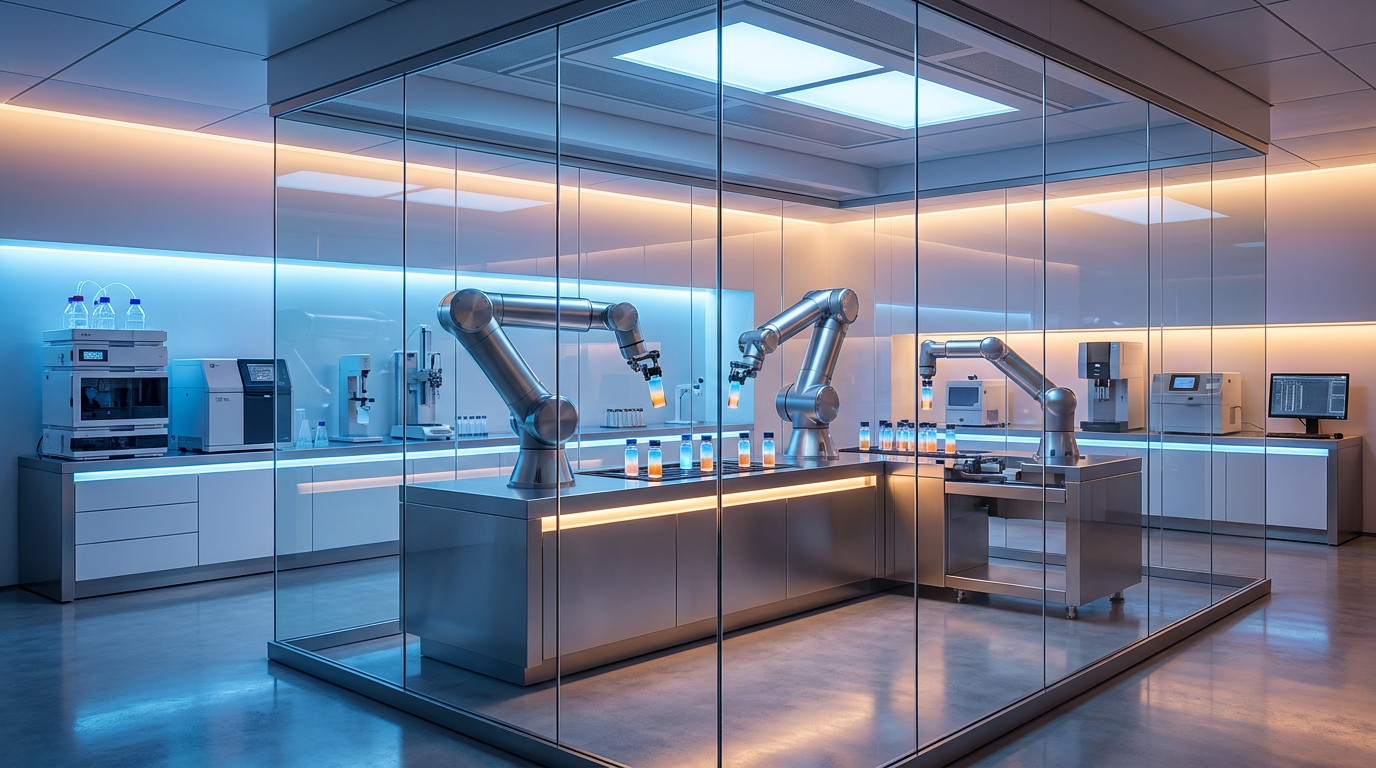
Much like autonomous vehicles navigate roads, these laboratories combine artificial intelligence, robotics, and real-time sensor feedback to conduct research with minimal human intervention. They do not merely follow pre-programmed pipetting instructions; they actively decide which experiment to run next based on the data they just collected.[1][3]
The core mechanism powering an SDL is the "Design-Build-Test-Learn" closed loop. The process begins when an AI model, often powered by large language models and active learning algorithms, generates a hypothesis or proposes a novel chemical synthesis route.[3][4]

Next, the system moves to the build phase. Robotic arms, automated liquid handlers, and modular synthesis carts physically execute the experiment. They mix reagents, control precise temperatures, and synthesize the target material without a human ever touching a flask.[5][6]
The system then automatically characterizes the result using integrated sensors—such as X-ray diffraction machines or mass spectrometers—to test whether the synthesized material possesses the desired properties.[3][4]
Finally, the AI ingests this fresh data to update its internal models. It learns from the success or failure of the experiment to design a smarter, more refined second attempt. This entire cycle can happen in a matter of hours, running continuously overnight and through weekends.[1][7]
The impact is already visible in the race for advanced materials. At the Lawrence Berkeley National Laboratory, an autonomous system named A-Lab recently demonstrated the ability to plan and synthesize novel inorganic powders, proposing multiple reaction pathways and optimizing them on the fly.[3]
Similarly, in June 2026, North Carolina State University launched a dedicated autonomous robotic system specifically engineered to accelerate the discovery and synthesis of liquid-phase materials.[6]

The technology is also moving out of isolated academic silos and into the cloud. In early 2026, Ginkgo Bioworks launched "Cloud Lab," a web-accessible interface connected to a massive infrastructure of over 70 automated instruments in Boston.[5]
The technology is also moving out of isolated academic silos and into the cloud.
Using modular "Reconfigurable Automation Carts," researchers anywhere in the world can submit natural-language protocols to an AI agent. The agent translates those requests into robotic commands, executes the physical biology experiments remotely, and sends the data back to the user.[5]
To understand the landscape, researchers have adopted an autonomy scale similar to the one used for self-driving cars. Most commercial SDLs today operate at Level 2 or 3, meaning they handle closed-loop optimization for highly specific, narrow tasks while humans set the overarching goals and handle exceptions.[5]
True Level 5 autonomy—a generalized robotic laboratory that formulates its own grand scientific challenges and operates entirely without human oversight—does not yet exist, and some researchers question if it is even the right goal.[5][7]

The primary hurdle to reaching higher levels of autonomy is not the robotic hardware, which is already highly capable and precise. The true bottleneck lies in software middleware and data integration.[1][5]
As researchers exploring the future of these systems recently highlighted, managing and interpreting the enormous variety of data produced by different instruments requires robust "data fusion."[1]
Instruments from different manufacturers often speak entirely different digital languages. Creating a standardized ecosystem where an AI can seamlessly ingest and contextualize data from a spectrometer, an electron microscope, and a theoretical simulation simultaneously remains a complex engineering challenge.[1][7]
Furthermore, the goal for many institutions is not to remove humans from the equation entirely. At Boston University, the new AI Materials Science Ecosystem (AIMS-EC) is explicitly designed to couple self-driving labs with human intuition in a shared, community-driven platform.[2]

Researchers argue that while self-driving labs excel at high-throughput optimization and navigating massive datasets, human scientists are still required to define the boundaries of the search space and ask the right fundamental questions.[2][4]
How we got here
2020
Early robotic liquid handlers begin integrating with basic machine learning models for narrow optimization tasks.
2023
Lawrence Berkeley National Laboratory's A-Lab demonstrates autonomous solid-state synthesis of novel inorganic powders.
March 2026
Ginkgo Bioworks launches Cloud Lab, offering web-accessible remote control of 70+ automated laboratory instruments.
June 2026
North Carolina State University launches a dedicated autonomous AI laboratory for liquid-phase materials discovery.
Viewpoints in depth
Automation Advocates
Focus on the speed, scale, and democratization of scientific discovery.
Proponents in the biotechnology and materials science sectors argue that the physical execution of experiments is the primary bottleneck in modern science. By moving to cloud-accessible, highly automated platforms, they believe researchers can test thousands of hypotheses in the time it currently takes to test one. This camp views self-driving labs as the equivalent of cloud computing for the physical world, enabling a democratization where anyone with a web browser can run complex biological or chemical experiments.
Data & Integration Skeptics
Highlight the severe software and standardization bottlenecks holding back true autonomy.
Researchers focused on laboratory informatics caution that the hardware is far ahead of the software. They point out that instruments from different manufacturers often use proprietary, incompatible data formats. For a self-driving lab to achieve Level 4 or 5 autonomy, it requires flawless 'data fusion'—the ability for an AI to seamlessly ingest and contextualize data from a spectrometer, a microscope, and a thermal sensor simultaneously. Until these digital translation issues are solved, true autonomy remains out of reach.
Human-in-the-Loop Proponents
Emphasize that AI should augment, rather than replace, human scientific intuition.
Many academic researchers advocate for a collaborative approach, arguing that while AI excels at navigating massive, high-dimensional datasets, it lacks the fundamental intuition required to ask paradigm-shifting questions. This camp builds systems designed to handle the tedious optimization loops while explicitly requiring human scientists to define the boundaries of the search space. They view the future not as fully autonomous robot scientists, but as 'centaur' teams where human creativity is supercharged by robotic execution.
What we don't know
- How quickly instrument manufacturers will adopt standardized data formats to enable seamless 'plug-and-play' data fusion.
- Whether fully generalized Level 5 autonomous labs can be achieved, or if human boundary-setting will always be required.
- The long-term impact of highly automated cloud labs on the training and employment of entry-level laboratory technicians.
Key terms
- Self-Driving Lab (SDL)
- A research facility where AI systems autonomously design experiments, robotic platforms execute them, and the AI analyzes results to decide the next step.
- Closed-Loop Experimentation
- A scientific process where the results of one automated experiment are immediately fed back into an AI model to design the next experiment without human intervention.
- Active Learning
- A machine learning approach where the algorithm actively queries the system to run specific experiments that will yield the most informative data.
- Data Fusion
- The process of integrating multiple types of data from different laboratory sensors into a single, cohesive dataset that an AI can understand.
Frequently asked
What is a self-driving lab?
It is a laboratory that combines artificial intelligence, robotics, and real-time sensors to autonomously plan, execute, and analyze scientific experiments.
Will these labs replace human scientists?
No. Current systems handle the tedious physical execution and narrow optimization, freeing human scientists to focus on high-level theory, creative problem-solving, and defining the research goals.
What are these labs discovering?
They are primarily being used to accelerate the discovery of new materials, such as clean energy storage components, biodegradable plastics, and novel drug compounds.
Sources
Source coverage
7 outlets
3 viewpoints surfaced







[1]AIP PublishingData & Integration Skeptics
Data integration and data fusion approaches for self-driving labs: A perspective
Read on AIP Publishing →[2]Boston UniversityHuman-in-the-Loop Proponents
Reimagining the Future of Materials Discovery: From Automation to Collaboration
Read on Boston University →[3]Royal Society PublishingAutomation Advocates
Autonomous, 'self-driving' laboratories (SDLs)
Read on Royal Society Publishing →[4]Penn State UniversityHuman-in-the-Loop Proponents
Toward Self-Driving Labs: Automation and AI for the Next Era of Materials Innovation
Read on Penn State University →[5]Q-PillarsAutomation Advocates
Which industries are adopting self-driving labs fastest?
Read on Q-Pillars →[6]InventDailyAutomation Advocates
NC State Launches Autonomous AI Laboratory for Materials
Read on InventDaily →[7]Factlen Editorial TeamHuman-in-the-Loop Proponents
Synthesis by Factlen editorial team
Read on Factlen Editorial Team →

More in ai
See all 6 stories →AI Reasoning
The End of Instant AI: How 'Test-Time Compute' is Teaching Models to Think Before They Speak
6 sources
Neuroprosthetics
How AI and Neural Interfaces Are Rewiring Human Mobility
8 sources
Local AI
How On-Device AI Chatbots Work (And Why They Matter)
6 sources

AI Filmmaking
How Indie Filmmakers Are Using AI Video Generators to Slash VFX Budgets and Rival Studio Productions
6 sources

Every angle. Every day.
Get ai stories with full source coverage and perspective breakdowns delivered to your inbox.