
SpaceX Completes Historic $75 Billion IPO, Valuing Aerospace and AI Giant at Over $2 Trillion
Elon Musk's SpaceX shattered records with the largest initial public offering in history, surging 19% on its trading debut to become one of the world's most valuable public companies.
By Factlen Editorial Team
- Bullish Investors & Retail Traders
- Investors betting on SpaceX as a generational, multi-industry monopoly.
- Value Analysts & Skeptics
- Financial traditionalists warning of a massive speculative bubble.
- Market Structure Strategists
- Experts concerned about the systemic impact of a new mega-cap stock.
What's not represented
- · Competitors in the commercial space launch industry who now face a rival armed with a $75 billion public war chest.
- · Telecommunications providers whose traditional broadband models are increasingly threatened by Starlink's massive capitalization.
Why this matters
SpaceX's record-shattering $75 billion public debut doesn't just mint a new class of millionaires and the world's first trillionaire—it fundamentally reshapes the stock market. By opening its space, satellite internet, and AI empire to everyday investors, the company has created a new mega-cap titan that will immediately impact the performance of index funds and retirement portfolios worldwide.
Key points
- SpaceX raised $75 billion in its initial public offering, surpassing Saudi Aramco to execute the largest stock market debut in global history.
- Shares surged 19% on the first day of trading, pushing the company's market capitalization past $2.1 trillion and making Elon Musk the world's first trillionaire.
- The company's pitch to investors heavily emphasized its diversification, highlighting its Starlink broadband network and newly acquired xAI data center business.
- Despite the historic valuation, value analysts warn that the company remains unprofitable, having posted nearly $5 billion in net losses in 2025.
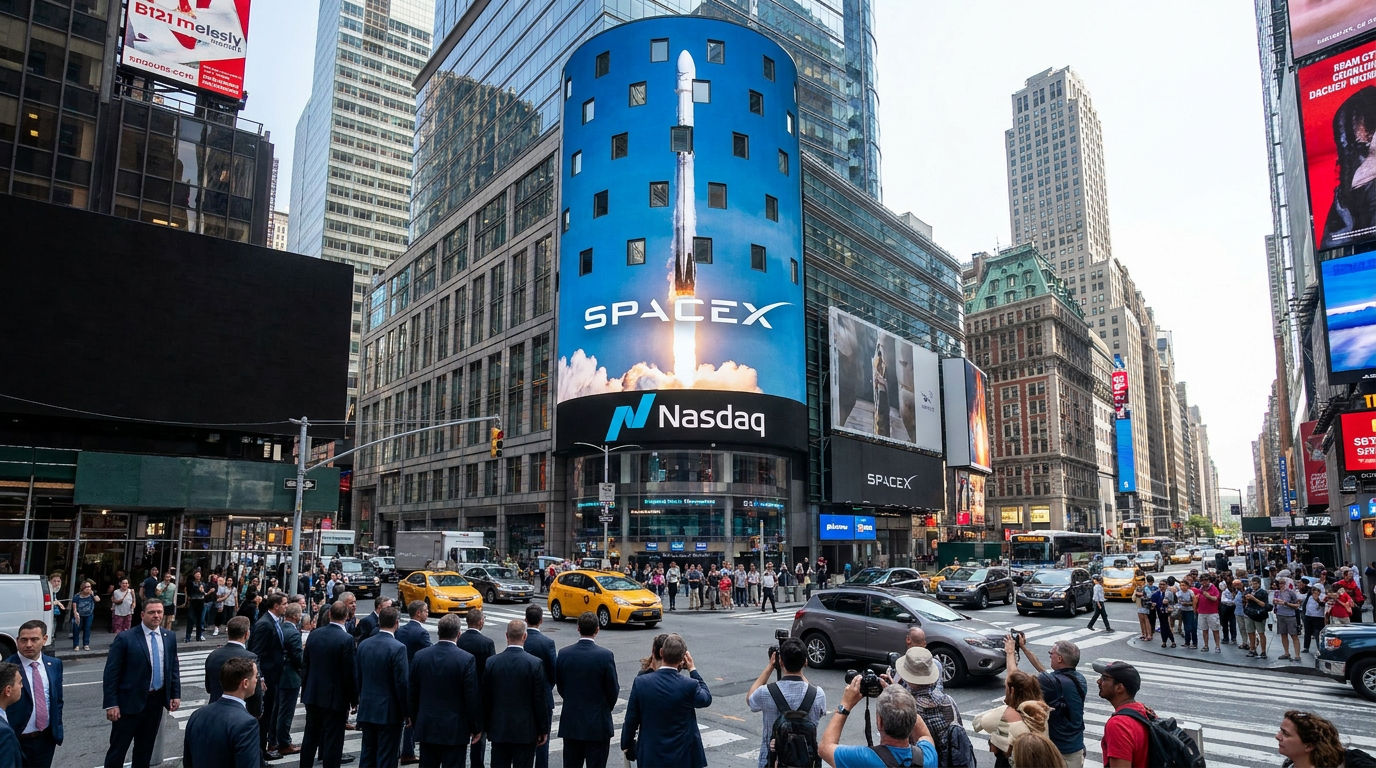
After nearly two and a half decades as a private enterprise, Space Exploration Technologies Corp. has officially entered the public markets, executing the largest initial public offering in global financial history. On June 12, 2026, SpaceX debuted on the Nasdaq exchange under the ticker symbol SPCX, raising a staggering $75 billion and instantly reshaping the hierarchy of the world's most valuable corporations. The offering dwarfed the previous record held by Saudi Aramco's $29 billion debut in 2019, drawing an unprecedented wave of capital from both institutional giants and everyday retail traders. The blockbuster listing arrives after months of intense speculation and confidential filings, marking a definitive shift in strategy for a company that had long resisted the scrutiny of public markets in favor of long-term, capital-intensive development.[4][8]
The market's reception was nothing short of euphoric. SpaceX finalized its offering price at $135 per share—a take-it-or-leave-it proposition that bypassed the traditional pricing range—valuing the aerospace behemoth at $1.77 trillion before the opening bell. When trading commenced just before noon, the stock immediately surged, peaking at over $176 in intraday trading before settling near $161 by the market close. That 19 percent first-day pop propelled SpaceX's market capitalization past the $2.1 trillion threshold, instantly cementing its status as a mega-cap titan alongside the likes of Apple, Microsoft, and Nvidia. The sheer volume of trading overwhelmed typical debut metrics, signaling a ravenous appetite for exposure to the commercial space economy.[4][5]
The historic valuation milestone carried profound implications for the company's leadership and workforce. The first day of trading officially pushed the net worth of founder and CEO Elon Musk past the $1 trillion mark, making him the first individual in modern history to achieve trillionaire status. Musk, who retains a massive equity stake and voting control, addressed employees at the company's headquarters, reflecting on the journey from a small warehouse in El Segundo to a multi-trillion-dollar empire. Beyond the chief executive, the public offering triggered a massive wealth transfer, minting thousands of new millionaires among current and former SpaceX employees who had accumulated stock options during the company's private years.[4][6]

Retail investors played a pivotal role in driving the stock's initial momentum, demonstrating a level of coordination and capital deployment rarely seen in traditional IPOs. Prior to the debut, retail traders placed more than $100 billion in orders, vastly oversubscribing the $15 billion tranche specifically allocated to them. The enthusiasm extended well beyond domestic borders; South Korean retail investors alone snapped up nearly $800 million worth of SpaceX shares on the first day of trading, underscoring the intense global demand for the stock. This retail frenzy was fueled by a combination of brand loyalty, the allure of space exploration, and the promise of participating in a generational technology monopoly.[1][4]
While reusable rockets and Mars colonization dominate the public imagination, SpaceX's pitch to Wall Street relied heavily on the diversification of its business model. The company now operates across three distinct verticals: Space, Connectivity, and Artificial Intelligence. The Space division handles the launch of commercial payloads and government satellites using the Falcon and Starship fleets, representing an estimated $370 billion addressable market. However, the Connectivity segment, powered by the rapidly expanding Starlink satellite constellation, has emerged as the company's primary revenue engine, boasting over 10 million paying subscribers and targeting a $1.6 trillion global telecommunications market.[7][8]
While reusable rockets and Mars colonization dominate the public imagination, SpaceX's pitch to Wall Street relied heavily on the diversification of its business model.
The true catalyst for the $2 trillion valuation, however, was the company's aggressive expansion into the artificial intelligence sector. In February 2026, SpaceX formally acquired Musk's AI startup, xAI, consolidating his technological ventures under a single corporate umbrella. This strategic maneuver transformed SpaceX from an aerospace manufacturer into a foundational AI infrastructure provider. The company now operates massive data centers used to train proprietary models like Grok, while also renting spare computing capacity to industry heavyweights such as Alphabet and Anthropic. Analysts estimate that this AI division unlocks a potential market size of $26.5 trillion, effectively dwarfing the revenue potential of the company's space and broadband operations combined.[5][7][8]
Despite the overwhelming market enthusiasm, a vocal contingent of value analysts and financial strategists are sounding the alarm over the company's sky-high valuation. Critics point out that SpaceX's $2.1 trillion market capitalization is entirely disconnected from its current financial realities. According to pre-IPO disclosures, the company generated $18.7 billion in revenue in 2025 while absorbing nearly $5 billion in net losses. The first quarter of 2026 continued this trend, with the company posting $4.69 billion in revenue against $4.27 billion in losses. For skeptics, these figures represent a dangerous speculative bubble, arguing that the market is pricing in decades of flawless execution and absolute dominance across three highly competitive industries.[5][7][8]

The contrast becomes even starker when SpaceX is compared to its new mega-cap peers. While the aerospace firm now shares a valuation tier with established tech giants, it lacks the fundamental profitability that underpins their market caps. Companies like Alphabet, Apple, and Nvidia consistently produce annual after-tax profits exceeding $100 billion, providing a stable foundation for their multi-trillion-dollar valuations. In contrast, SpaceX remains a capital-intensive, cash-burning enterprise heavily reliant on future projections rather than current earnings. This discrepancy has led some institutional investors to remain on the sidelines, warning that the stock's current price leaves virtually no margin for error in the company's ambitious expansion plans.[5][7]
The speculative nature of the stock was further highlighted as options trading for SpaceX debuted in the days following the IPO. The derivatives market immediately saw a flurry of activity, with strategists noting a wide variation of bets that signaled both extreme optimism and deep apprehension. Options pricing indicated that traders were taking out expensive and dangerous positions, betting on massive price swings in either direction. This volatility in the options market suggests that while the initial public offering was a resounding success in terms of capital raised, the stock's long-term price discovery process will likely be turbulent as the market digests the company's quarterly earnings and operational milestones.[2]
Beyond the immediate trading dynamics, the sheer scale of SpaceX's public debut is beginning to cause structural ripples across the broader financial system. Market strategists have expressed concern about the destabilizing effects of passive investing, warning that the sudden addition of a $2 trillion behemoth to major indices could concentrate risk. As index funds are forced to allocate massive amounts of capital to mirror SpaceX's market weight, it could drain liquidity from smaller equities and further distort the balance of the broader market. This concentration of capital in a handful of mega-cap tech stocks has become a growing systemic concern, and SpaceX's arrival only exacerbates the trend.[3]
Nevertheless, the successful execution of the largest IPO in history has injected a massive dose of confidence into the global financial markets. The ability of the market to absorb a $75 billion offering without triggering a broader liquidity crisis has effectively thawed a previously hesitant IPO landscape. Industry observers anticipate that SpaceX's blockbuster debut will pave the way for other highly anticipated tech and AI listings later in the year, including potential public offerings from competitors like Anthropic and OpenAI. By proving that there is still immense institutional and retail appetite for visionary, high-growth technology companies, SpaceX has reset the baseline for what is possible in public markets.[4][8]

Armed with an unprecedented $75 billion war chest, SpaceX is now positioned to accelerate its most ambitious projects. The influx of capital will directly fund the continued development of the Starship launch system, the rapid expansion of the Starlink satellite network, and the massive data center infrastructure required to scale its artificial intelligence operations. While the debate over its valuation will undoubtedly continue, the company's transition to the public markets marks a watershed moment in industrial history. SpaceX has not only democratized access to the commercial space economy for everyday investors but has also secured the financial foundation necessary to pursue its ultimate goal of making humanity a multi-planetary species.[4][7]
How we got here
February 2026
SpaceX officially acquires Elon Musk's AI startup xAI, consolidating the businesses.
April 1, 2026
SpaceX confidentially submits a draft registration statement to the SEC.
June 11, 2026
The company finalizes its IPO price at a fixed $135 per share.
June 12, 2026
SpaceX begins trading on the Nasdaq under the ticker SPCX, surging 19%.
June 16, 2026
Options trading for SpaceX debuts, marked by high volatility and speculative bets.
Viewpoints in depth
Retail & Institutional Bulls
Investors betting on SpaceX as a generational, multi-industry monopoly.
Bullish investors view SpaceX not just as a rocket manufacturer, but as an unprecedented convergence of space logistics, global telecommunications, and artificial intelligence. By combining the Starlink broadband network with xAI's massive computing infrastructure, advocates argue the company is tapping into a combined addressable market exceeding $28 trillion. For these investors, the $2 trillion valuation is a forward-looking premium for a company that has consistently achieved what critics deemed impossible, from landing reusable orbital boosters to capturing the bulk of global launch mass.
Value Analysts & Skeptics
Financial traditionalists warning of a massive speculative bubble.
Skeptics argue that the euphoria surrounding the IPO has completely detached the stock price from underlying financial fundamentals. They point out that a $2.1 trillion valuation for a company generating $18.7 billion in revenue and burning billions in cash leaves zero margin for error. Value analysts warn that unlike highly profitable mega-caps such as Apple or Alphabet, SpaceX is still heavily reliant on capital-intensive development for unproven systems like Starship. They caution that any operational setbacks or delays in achieving profitability could trigger a severe market correction.
Market Structure Strategists
Experts concerned about the systemic impact of a new mega-cap stock.
Beyond the company's individual prospects, market observers are focused on the mechanical disruptions caused by the $75 billion offering. Strategists warn that injecting a $2 trillion asset into the public markets forces passive index funds to aggressively reallocate capital to match the new weighting. This massive capital drain can destabilize smaller equities and further concentrate market risk into a handful of tech behemoths. Furthermore, the immediate explosion of highly speculative options trading around SPCX indicates that the stock may introduce significant volatility into the broader indices.
What we don't know
- How quickly SpaceX can transition its massive capital-intensive projects, like the Starship launch system, into profitable commercial operations.
- Whether the company's newly acquired xAI division can successfully capture its projected $26.5 trillion addressable market against established rivals like OpenAI and Anthropic.
- How the extreme volatility in early options trading will affect the stock's baseline stability as it is integrated into major passive index funds.
Key terms
- Initial Public Offering (IPO)
- The process by which a private company offers shares of its stock to the public for the first time.
- Market Capitalization
- The total dollar market value of a company's outstanding shares of stock, calculated by multiplying the stock price by the total number of shares.
- Mega-Cap
- A designation for the largest publicly traded companies, typically those with a market capitalization exceeding $200 billion.
- Passive Investing
- An investment strategy that tracks a market index, meaning funds automatically buy shares of companies based on their size in the index.
- Options Trading
- Contracts that give investors the right, but not the obligation, to buy or sell a stock at an agreed-upon price and date, often used for speculative bets.
Frequently asked
How much did SpaceX raise in its IPO?
SpaceX raised $75 billion, making it the largest initial public offering in history, surpassing Saudi Aramco's $29 billion debut.
What is SpaceX's stock ticker symbol?
SpaceX trades on the Nasdaq exchange under the ticker symbol SPCX.
Is SpaceX currently profitable?
No. Despite its massive valuation, SpaceX reported $18.7 billion in revenue in 2025 alongside nearly $5 billion in net losses.
Why did Elon Musk's net worth jump so much?
Musk owns roughly half of SpaceX. When the company's valuation surpassed $2 trillion on the open market, his personal net worth crossed the $1 trillion mark.
What does SpaceX's AI division do?
Following the acquisition of xAI, SpaceX operates massive data centers to train AI models like Grok and rents computing capacity to other tech giants.
Sources
Source coverage
8 outlets
3 viewpoints surfaced







[1]BloombergBullish Investors & Retail Traders
SpaceX Drew $800 Million From Korean Investors on Trading Debut
Read on Bloomberg →[2]CNBCValue Analysts & Skeptics
SpaceX options debut signals 'expensive' and 'dangerous' bets, strategist says
Read on CNBC →The Bad Gnus on SpaceX
Read on Bloomberg Opinion →[4]The GuardianBullish Investors & Retail Traders
SpaceX made the biggest stock market debut in history
Read on The Guardian →[5]CBS NewsMarket Structure Strategists
SpaceX makes blockbuster stock market debut, valuing company at $2.2 trillion
Read on CBS News →[6]Business InsiderBullish Investors & Retail Traders
Elon Musk is now the world's first trillionaire after SpaceX's public debut
Read on Business Insider →[7]The Motley FoolValue Analysts & Skeptics
SpaceX Stock Soared 19% on Its Market Debut. Here's Why I'm Not Buying It.
Read on The Motley Fool →[8]Built InValue Analysts & Skeptics
SpaceX's IPO, Explained
Read on Built In →

More in business
See all 5 stories →GLP-1 Economy
The GLP-1 Companion Economy: How Entrepreneurs Are Building for the Weight-Loss Boom
6 sources

Strait of Hormuz
The Economic Stakes of the US-Iran Peace Deal and the Reopening of the Strait of Hormuz
10 sources

SpaceX IPO
SpaceX Shatters Market Records With $2 Trillion IPO and Unprecedented Options Debut
8 sources
Every angle. Every day.
Get business stories with full source coverage and perspective breakdowns delivered to your inbox.