
SpaceX Shatters Market Records With $2 Trillion IPO and Unprecedented Options Debut
SpaceX has executed the largest initial public offering in history, reaching a $2 trillion valuation while its options trading debut shattered all previous volume records.
By Factlen Editorial Team
- Retail & Growth Investors
- View the IPO as a historic opportunity to democratize access to the space economy and AI infrastructure.
- Derivatives Analysts
- Focus on the unprecedented options volume and the mechanics of retail-driven gamma squeezes.
- Institutional Strategists
- Warn about the dangers of sky-high valuations, extreme volatility, and the destabilization of passive indexes.
What's not represented
- · Competitors in the aerospace sector
- · Regulatory bodies overseeing space and AI
Why this matters
The massive public debut democratizes access to the commercial space and AI economy, giving everyday investors a stake in generational infrastructure. However, its sheer scale and volatility are forcing a structural realignment of global investment portfolios.
Key points
- SpaceX completed the largest IPO in history on June 12, raising $75 billion and achieving a market capitalization over $2 trillion.
- The company's options market debut on June 16 saw over 1.3 million contracts traded, shattering the previous first-day record set by Meta in 2012.
- Retail investors received an unprecedented 30% allocation of the IPO shares, driving massive global demand.
- The aerospace giant recently acquired xAI, positioning the newly public company as a dual-threat in space infrastructure and artificial intelligence.
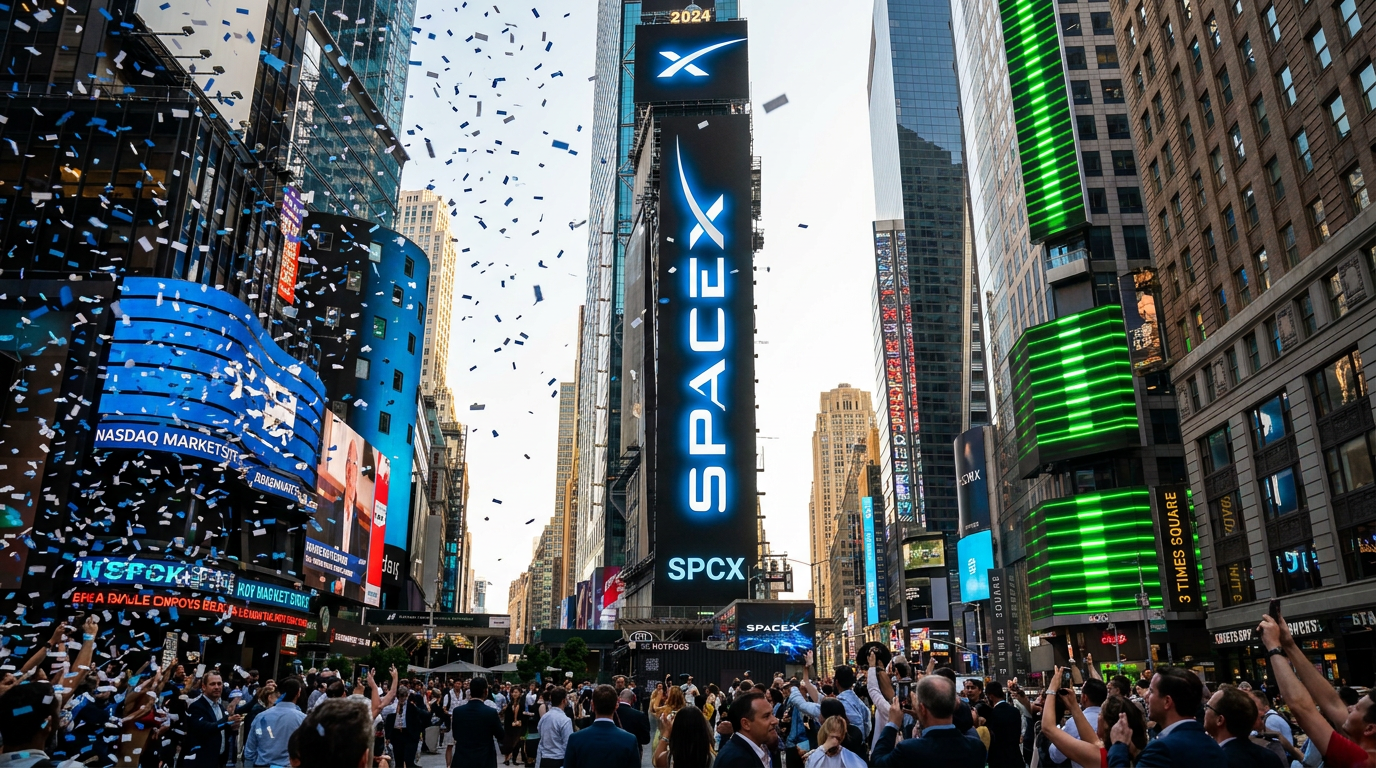
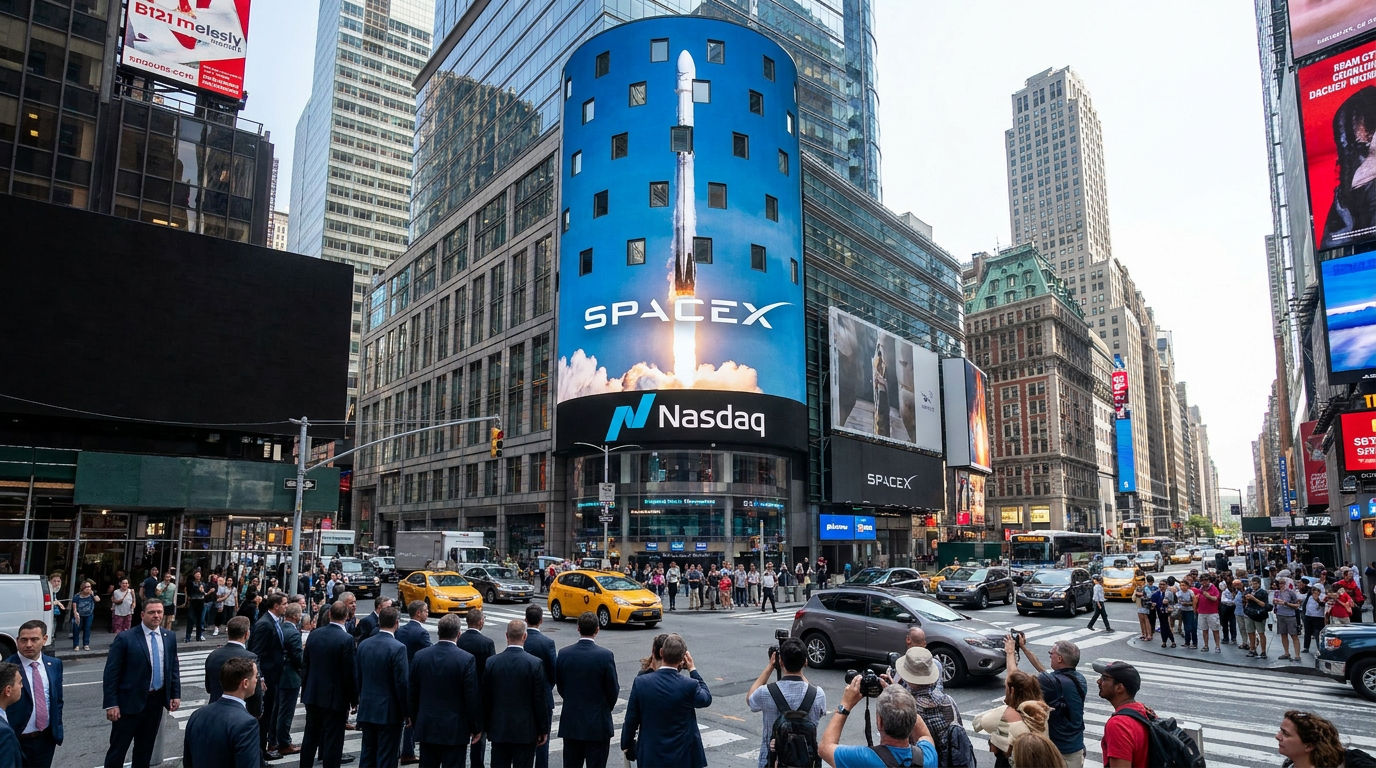
The long-awaited public debut of Space Exploration Technologies Corp. has rewritten the record books of American finance. After years of operating as a private behemoth, SpaceX officially listed on the Nasdaq under the ticker SPCX on June 12, executing the largest initial public offering in history.[5]
The sheer scale of the offering has captivated Wall Street. Priced at $135 per share, the IPO raised a staggering $75 billion and initially valued the aerospace giant at $1.77 trillion. By the end of its first trading day, intense demand pushed the stock up nearly 20% to close above $161, catapulting the company's market capitalization past the $2 trillion mark.[5][6]
The historic listing also triggered a monumental shift in global wealth. With his retained voting control and roughly 50% equity stake, founder Elon Musk officially became the world's first US dollar trillionaire. The offering simultaneously minted thousands of new millionaires among current and former SpaceX employees who held equity in the previously private firm.[5]

But the equity launch was only the first shockwave. On Tuesday, SpaceX options officially debuted on the Cboe Global Markets exchange, and the resulting frenzy shattered every existing derivative market record. Within the first few hours, traders exchanged over 1.3 million contracts, representing more than $2 billion in options premium.[1][4]
To put that volume into perspective, the previous first-day options record was set by Meta in 2012, which saw roughly 365,000 contracts trade hands. SpaceX eclipsed that milestone before the morning trading session had even concluded, with volume peaking at an astonishing 10,000 contracts per minute.[1][4]

The options flow has been overwhelmingly bullish. Call options—which give buyers the right to purchase shares at a higher price—led put options by a ratio of 1.4-to-1. Derivatives strategists note that investors are aggressively chasing upside exposure, utilizing the options market as a lower-cost vehicle to bet on the company's continued ascent.[1]
Call options—which give buyers the right to purchase shares at a higher price—led put options by a ratio of 1.4-to-1.
This unprecedented demand is not confined to institutional players; retail investors have been a driving force behind the SPCX phenomenon. In a highly unusual move for a mega-cap listing, SpaceX allocated up to 30% of its IPO shares to retail investors, vastly exceeding the typical 5% to 10% reserved for non-institutional buyers.[8]
Brokerages lowered the barrier to entry, allowing customers with as little as $2,000 in their accounts to participate in the offering. This democratization of access allowed everyday investors to gain direct exposure to the commercial space economy, reusable rocket technology, and the Starlink satellite internet constellation.[5][8]
The retail enthusiasm extended far beyond American borders. On the stock's first day of trading, South Korean retail investors alone snapped up nearly $800 million worth of SpaceX shares. This massive capital influx underscores the immense global appetite for Musk's ventures, especially among international investors who were largely shut out of the initial IPO allocation.[2]

The company's valuation is also anchored by a massive recent pivot: artificial intelligence. In February 2026, SpaceX acquired Musk's AI startup, xAI, effectively merging orbital infrastructure with cutting-edge computing. The IPO proceeds are heavily earmarked for building space-based data centers to meet the massive computing demands of xAI, transforming SpaceX into a dual-threat aerospace and AI conglomerate.[5]
However, the astronomical valuation has sparked intense debate among financial analysts. Trading at roughly 94 times its 2025 revenue of $18.7 billion, SpaceX's price-to-sales ratio dwarfs the S&P 500 average of 3.7. Market observers warn that the stock is pricing in flawless execution and exponential growth for years to come.[6]

The options market is also flashing warning signs. Some strategists have characterized the aggressive options bets as "expensive" and "dangerous," noting that the implied volatility is exceptionally high. The heavy concentration of call options creates the potential for a "gamma squeeze," where market makers are forced to buy the underlying stock to hedge their positions, driving prices up rapidly but also increasing the risk of a sharp correction.[1][3]
The sudden arrival of a $2 trillion entity is also creating structural ripples across the broader market. Financial commentators have pointed out that SpaceX's massive footprint is "bad news" for passive investing, as the sudden inclusion of such a heavily weighted, highly volatile stock threatens to destabilize major indexes and force massive portfolio rebalancing.[7]
Despite the risks and the eye-watering multiples, the successful listing marks a definitive turning point for the commercial space industry. By opening its doors to public capital, SpaceX has secured the financial runway needed to pursue its most ambitious projects, from the continued deployment of Starship to the eventual goal of Mars colonization.[5]
How we got here
February 2026
SpaceX acquires Elon Musk's artificial intelligence startup, xAI, merging aerospace and AI infrastructure.
April 1, 2026
SpaceX confidentially submits its draft registration statement to the SEC.
June 12, 2026
SpaceX officially debuts on the Nasdaq, raising $75 billion in the largest IPO in history.
June 16, 2026
SpaceX options begin trading, shattering all previous first-day volume records.
Viewpoints in depth
The Retail Bull Case
Everyday investors see SpaceX as a generational wealth-building asset.
For retail investors, the SpaceX IPO represents a rare victory in modern finance. Historically, hyper-growth tech companies have stayed private for so long that the majority of their value appreciation was captured by venture capitalists before the public ever got a chance to buy in. By allocating an unprecedented 30% of shares to retail accounts and lowering the barrier to entry to just $2,000, SpaceX flipped this script. Bulls argue that with the integration of xAI and the continued monopoly on commercial space launch, the company's $2 trillion valuation is merely the floor for a conglomerate that will define the next century of human infrastructure.
The Institutional Warning
Traditional market strategists caution that the stock is priced for perfection and poses systemic risks.
Institutional analysts and passive index managers are viewing the SPCX phenomenon with deep unease. Trading at nearly 100 times its trailing revenue, the stock's valuation leaves zero margin for error in an industry defined by literal rocket explosions and massive capital expenditures. Furthermore, the sheer size of the $2 trillion entity means its eventual inclusion in major indexes like the S&P 500 will force passive funds to buy billions of dollars of the stock regardless of its price. Strategists warn that the heavy concentration of speculative call options is creating artificial price inflation, setting the stage for a violent correction once the initial euphoria fades.
What we don't know
- How the massive influx of public capital will alter SpaceX's timeline for its Mars colonization goals.
- Whether the extreme options market volatility will lead to a sharp correction in the stock's near-term price.
- How quickly major passive indexes will integrate the $2 trillion company into their weightings.
Key terms
- Initial Public Offering (IPO)
- The process by which a private company offers shares of its stock to the public for the first time, allowing it to raise capital from everyday investors.
- Call Option
- A financial contract that gives an investor the right, but not the obligation, to buy a stock at a specific price within a specific time period, typically used to bet that the stock's price will rise.
- Gamma Squeeze
- A rapid increase in a stock's price caused by market makers buying shares to hedge against the massive number of call options they have sold to investors.
- Price-to-Sales (P/S) Ratio
- A valuation metric that compares a company's stock price to its revenues, often used for high-growth companies that are not yet consistently profitable.
- Passive Investing
- An investment strategy that tracks a market index (like the S&P 500) rather than picking individual stocks, which can be disrupted when a massive new company suddenly enters the market.
Frequently asked
When did the SpaceX IPO take place?
SpaceX officially listed its shares on the Nasdaq exchange on June 12, 2026.
What is the ticker symbol for SpaceX?
SpaceX trades on the Nasdaq under the ticker symbol SPCX.
How much did the IPO raise?
The initial public offering raised $75 billion, making it the largest IPO in stock market history.
Why did options trading break records?
SpaceX options debuted on June 16, 2026, and saw over 1.3 million contracts traded in the first few hours, driven by massive retail and institutional speculation. This shattered the previous record set by Meta in 2012.
How does xAI fit into the SpaceX IPO?
SpaceX acquired Elon Musk's artificial intelligence company, xAI, in February 2026. The IPO proceeds will help fund space-based data centers to support xAI's massive computing needs.
Sources
Source coverage
8 outlets
3 viewpoints surfaced







[1]ReutersDerivatives Analysts
SpaceX options debut pulls record demand as investors chase rocket stock
Read on Reuters →[2]BloombergInstitutional Strategists
SpaceX Drew $800 Million From Korean Investors on Trading Debut
Read on Bloomberg →[3]CNBCInstitutional Strategists
SpaceX options debut signals 'expensive' and 'dangerous' bets, strategist says
Read on CNBC →[4]MorningstarDerivatives Analysts
Investors pile into moonshot SpaceX bets as first-day options trading shatters records
Read on Morningstar →[5]ZacksRetail & Growth Investors
SpaceX IPO broke records, raising $75 billion and creating one of the world's most valuable companies
Read on Zacks →[6]The Motley FoolRetail & Growth Investors
SpaceX IPO: What Your $5,000 Investment Could Be Worth
Read on The Motley Fool →The Bad Gnus on SpaceX
Read on Bloomberg Opinion →[8]FidelityRetail & Growth Investors
What is the SpaceX initial public offering (IPO)?
Read on Fidelity →

More in business
See all 5 stories →SpaceX IPO
SpaceX Completes Historic $75 Billion IPO, Valuing Aerospace and AI Giant at Over $2 Trillion
8 sources
Space Economy
How the SpaceX Public Debut is Catalyzing a New Generation of Aerospace Entrepreneurs
7 sources

SpaceX IPO
SpaceX Shatters Records With $75 Billion IPO and Unprecedented Options Trading Debut
8 sources
Every angle. Every day.
Get business stories with full source coverage and perspective breakdowns delivered to your inbox.