
The End of the Drill? How 'Seal and Heal' Dentistry is Rebuilding Teeth
Advances in biomimetic materials like nano-hydroxyapatite and silver diamine fluoride are allowing dentists to regenerate enamel and stop cavities without drilling.

In short
- Dentistry is shifting from a 'drill and fill' model to a minimally invasive 'seal and heal' approach.
- Silver Diamine Fluoride (SDF) is a liquid that permanently stops active cavities without the need for drills or anesthesia.
- SDF leaves a permanent black stain on the decayed area, making it most popular for baby teeth and back molars.
The high-pitched whine of the dental drill is a nearly universal trigger for anxiety. For over a century, the standard medical response to a cavity has been inherently subtractive: a dentist must drill away the decayed biological tissue and fill the resulting crater with a synthetic metal or composite resin. It is an effective mechanical fix, but it permanently weakens the tooth's natural structure.[4]
But a quiet revolution is currently reshaping modern oral healthcare. Driven by rapid advances in biomaterials, the field is shifting away from the traditional "drill and fill" philosophy toward a "seal and heal" paradigm. This minimally invasive approach treats tooth decay not as a mechanical hole to be plugged, but as a biological infection to be managed and a structural deficit to be rebuilt.[2][4]
At the forefront of this regenerative movement are two distinct but highly complementary treatments: Silver Diamine Fluoride (SDF), a liquid that stops active decay in its tracks, and nano-hydroxyapatite (nHAp), a synthetic mineral that rebuilds tooth enamel from the outside in. Together, they are making drill-free dentistry a reality for millions of patients.[1]
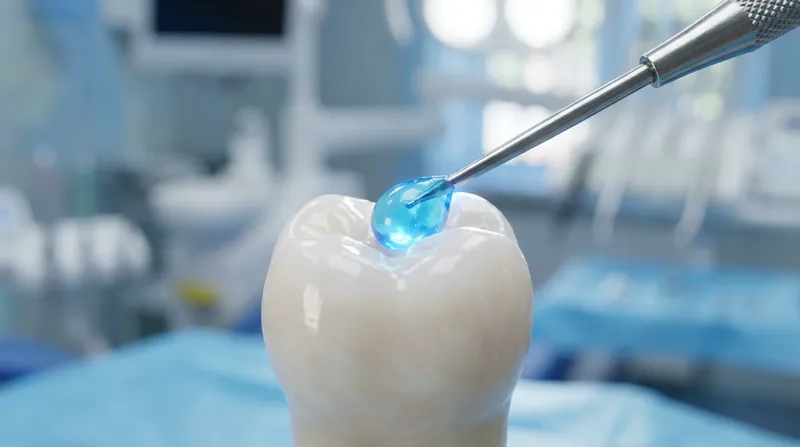
Silver Diamine Fluoride represents one of the most significant departures from traditional restorative dentistry in decades. Originally approved for use in the United States as a desensitizing agent, it has become widely utilized off-label to arrest active cavities. SDF is a clear, odorless liquid that a dentist simply paints directly onto a decayed tooth using a tiny microbrush.
The mechanism relies on a potent triad of chemical ingredients. Silver acts as a powerful antimicrobial agent, breaking down the cell walls of the bacteria responsible for tooth decay and permanently halting their acid production. Simultaneously, the fluoride promotes remineralization, strengthening the underlying dentin and enamel to resist future acid attacks. Finally, ammonia stabilizes the solution, allowing it to penetrate deep into the microscopic tubules of the tooth structure.
The clinical evidence for SDF is remarkably robust. When applied to an active carious lesion, it effectively hardens the decayed area, neutralizing the infection without the need for local anesthesia injections or a drill. This makes it a transformative option for pediatric patients, individuals with severe dental anxiety, and elderly patients with root caries who might struggle to tolerate lengthy restorative procedures.
However, the treatment comes with a stark aesthetic trade-off. As the silver reacts with the bacterial sulfides inside the cavity, it permanently stains the decayed portion of the tooth black. While the surrounding healthy enamel remains completely unchanged, this dark discoloration means SDF is most commonly accepted for use on back molars or primary baby teeth, where the visual impact is less of a concern to the patient.
While SDF is deployed to arrest active decay, the daily prevention and repair of early enamel damage is being revolutionized by nano-hydroxyapatite (nHAp). Originally developed by NASA in the 1970s to help astronauts recover bone and tooth mass lost in zero-gravity environments, nHAp is a synthetic version of the exact calcium and phosphate matrix that makes up 95 percent of human tooth enamel.[1]
Traditional fluoride toothpaste works by integrating into the tooth surface to form fluorapatite, a compound that hardens the tooth and makes it highly resistant to acid. Nano-hydroxyapatite takes a different, biomimetic approach. Because its nanoparticles are chemically identical to natural enamel, they act as a direct building material rather than just a hardening agent.[1][2]
When applied via toothpaste or professional serums, nHAp particles bond to the tooth surface, physically filling in microscopic cracks and demineralized zones caused by acidic foods. This process not only rebuilds the enamel layer but also seals exposed dentin tubules, which are the primary biological cause of acute tooth sensitivity.[1][2]
Clinical trials comparing nHAp to the 70-year gold standard of fluoride have yielded compelling results. Recent studies demonstrate that hydroxyapatite formulations achieve enamel microhardness improvements comparable to traditional fluoride varnishes—often reaching 96 to 98 percent recovery in early lesions—while significantly outperforming fluoride in reducing hypersensitivity.[2][3]
The rise of these biomimetic treatments is fundamentally altering pediatric and special-needs dentistry. For children who are uncooperative or terrified of needles, the ability to brush on a liquid cure rather than administer general anesthesia and drill into a tooth is a profound improvement in the standard of care, drastically reducing medical risks and psychological trauma.[4]
Furthermore, because nano-hydroxyapatite is completely biocompatible and non-toxic if swallowed, it has become a highly sought-after alternative for parents seeking fluoride-free options for toddlers who cannot yet reliably spit out their toothpaste.[1]
Despite the enthusiasm from patients and progressive clinicians, the transition to a purely regenerative model faces hurdles. Fluoride remains the undisputed, heavily researched benchmark for community-level cavity prevention, backed by decades of public health data. Many dental professionals view nHAp not as a replacement for fluoride, but as a powerful adjunct therapy—alternating between the two to maximize both acid resistance and structural repair.[2][4]
There are also lingering questions regarding the long-term standardization of nHAp consumer products. Because particle size dictates efficacy—only particles small enough can penetrate enamel micro-defects—the lack of strict FDA regulation over cosmetic toothpaste formulations means over-the-counter products vary wildly in their actual regenerative power.[1][4]
Ultimately, the integration of SDF and nano-hydroxyapatite signals a broader philosophical shift in oral healthcare. By treating tooth decay as a biological condition to be healed rather than a mechanical failure to be excised, dentistry is moving closer to its ultimate goal: keeping natural teeth vital, intact, and pain-free for a lifetime.[4]
Terms to know
- Silver Diamine Fluoride (SDF)
- A liquid treatment containing silver and fluoride that is painted onto teeth to kill decay-causing bacteria and harden the tooth structure.
- Nano-Hydroxyapatite (nHAp)
- A synthetic, microscopic version of the primary mineral found in human teeth and bones, used to rebuild enamel.
- Remineralization
- The natural or chemically assisted process of restoring lost minerals, like calcium and phosphate, to the tooth enamel.
- Biomimetic Dentistry
- A branch of dentistry focused on preserving intact tooth structure and restoring teeth using materials that mimic natural biology.
- Dentin Tubules
- Microscopic channels in the layer beneath the tooth enamel; when exposed by enamel loss, they cause acute tooth sensitivity.
Questions readers ask
Does Silver Diamine Fluoride treatment hurt?
No. SDF is applied topically with a small brush, requiring no needles, drilling, or local anesthesia, making it completely painless.
Why does SDF turn cavities black?
The silver in the solution reacts with the bacterial sulfides in the decayed portion of the tooth, causing a permanent dark stain. Healthy enamel is not affected.
Is nano-hydroxyapatite safe to swallow?
Yes. Because it is chemically identical to the minerals already present in your bones and teeth, nHAp is biocompatible and non-toxic, making it popular for children's toothpaste.
Can these treatments fix a large cavity?
No. While they can arrest early decay and rebuild microscopic enamel damage, large structural cavities still require traditional fillings or crowns to restore the tooth's shape and mechanical function.
Different angles
Biomimetic Advocates
Dentists focused on preserving natural tooth structure and utilizing regenerative materials.
This camp argues that the traditional 'drill and fill' method is inherently flawed because it removes healthy tooth structure and relies on materials that eventually fail. By utilizing nano-hydroxyapatite to rebuild enamel and SDF to arrest decay, they believe dentistry can become a regenerative medical discipline rather than a surgical one. They point to clinical trials showing nHAp matches fluoride in remineralization while offering superior sensitivity relief, arguing that the future of oral care lies in working with the body's biology rather than cutting it away.
Traditional Practitioners
Clinicians who emphasize the proven, long-term efficacy of fluoride and mechanical restorations.
While acknowledging the benefits of new materials, traditionalists caution against abandoning the 70-year gold standard of fluoride. They argue that fluoride's ability to create fluorapatite—a compound actually more acid-resistant than natural enamel—makes it uniquely suited for cavity prevention. Furthermore, they note that while SDF stops decay, it does not restore the physical shape or mechanical function of a heavily decayed tooth, meaning drills and composite fillings remain essential tools for comprehensive care.
Pediatric & Special Needs Care
Providers focused on reducing trauma and increasing access to care for vulnerable populations.
For this group, the aesthetic drawbacks of SDF are vastly outweighed by its psychological and medical benefits. They highlight that treating severe early childhood caries traditionally requires general anesthesia, which carries inherent medical risks and high costs. The ability to simply paint a liquid onto a cavity transforms dental care for uncooperative children, patients with severe autism, and the elderly, democratizing access to pain-free treatment and keeping vulnerable patients out of the operating room.
- Biomimetic Advocates
- Dentists focused on preserving natural tooth structure and utilizing regenerative materials.
- Traditional Practitioners
- Clinicians who emphasize the proven, 70-year track record of fluoride and physical restorations.
- Pediatric & Special Needs Care
- Providers focused on reducing trauma and increasing access to care for vulnerable populations.
Perspectives this story doesn't cover
- Dental Insurance Providers
- Cosmetic Dentists
Sources
Source coverage
4 outlets
3 viewpoints surfaced




- [1]WebMDPediatric & Special Needs Care
Hydroxyapatite Toothpaste: Benefits and Uses
Read on WebMD → - [2]Alara DentalTraditional Practitioners
Fluoride vs. Hydroxyapatite: A Clinical Comparison
Read on Alara Dental → - [3]Frontiers in Oral HealthBiomimetic Advocates
Efficacy of Nano-Hydroxyapatite in Enamel Remineralization
Read on Frontiers in Oral Health → - [4]Factlen Editorial TeamBiomimetic Advocates
Synthesis by Factlen editorial team
Read on Factlen Editorial Team →

More in Health
See all →Regenerative Dentistry
Protein-Based Gel Mimics Amelogenin to Regenerate Lost Enamel, Offering First Functional Repair for Tooth Decay
2 sources
Dental Tech
Landmark ADA/AAOMR Consensus Recommends Ending Use of Thyroid Shields in Dental X-Rays
4 sources
Genomic Testing
Landmark Phase 3 Trial Shows Genomic Test Safely Spares Two-Thirds of High-Risk Breast Cancer Patients from Chemotherapy
4 sources

Drill-Free Dentistry
The Evidence Pack: How a Painless Liquid is Replacing the Dental Drill
4 sources

Comments
Every angle. Every day.
Get Health stories with full source coverage and perspective breakdowns, free every day.