
The Evidence for Rapamycin: Can a Transplant Drug Extend Human Healthspan?
Rapamycin is the most consistently effective life-extending drug in animal models. Now, the first year-long human trials are revealing what it actually does—and doesn't do—for human aging.
By Factlen Editorial Team
- Geroscience Researchers
- Argue that mTOR inhibition is the most validated mechanism for slowing biological aging across species.
- Clinical Skeptics
- Emphasize the lack of human lifespan data and the unknown long-term risks of off-label use.
- Longevity Optimizers
- Prioritize emerging human data on healthspan metrics and are willing to accept the uncertainty of off-label dosing.
What's not represented
- · Regulatory Agencies
- · Health Insurance Providers
Why this matters
As off-label use of rapamycin surges among longevity enthusiasts, understanding the hard clinical evidence separates biological reality from internet hype, helping patients and doctors make informed decisions about experimental healthspan interventions.
Key points
- Rapamycin is the most consistently effective life-extending drug ever tested in animal models.
- The drug works by inhibiting mTOR, shifting cells from a state of growth to repair and cleanup.
- The 48-week human PEARL trial missed its primary fat-loss endpoint but showed safety and lean mass benefits.
- Low weekly doses appear to rejuvenate immune function rather than suppress it.
- There is currently no clinical evidence that rapamycin extends human lifespan.
Discovered in 1964 in the soil of Easter Island (Rapa Nui), rapamycin spent decades as an immunosuppressant used to prevent kidney transplant rejection. Today, it has transitioned from a niche surgical tool into the most intensely studied molecule in the field of geroscience, the study of the biology of aging.[1][5]
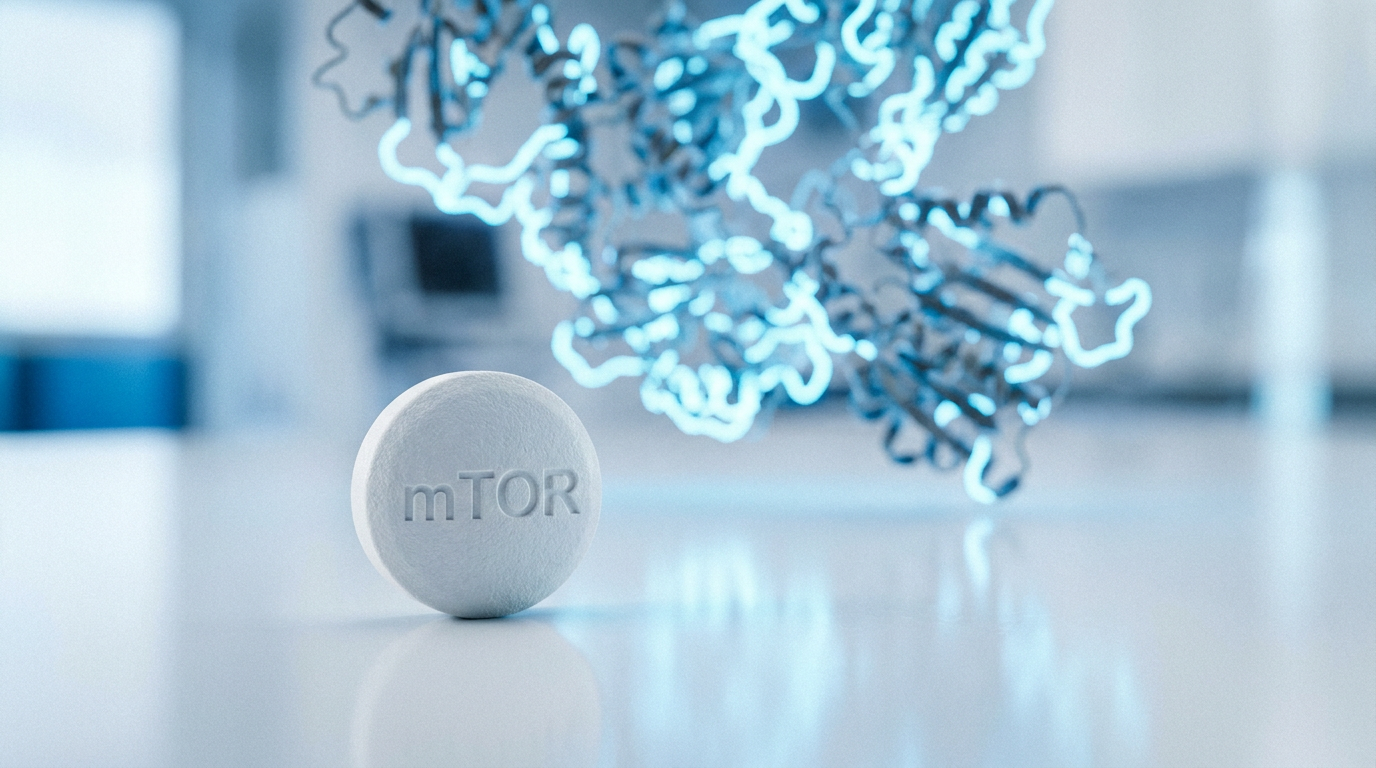
The shift in focus occurred when researchers realized that rapamycin targets a universal biological mechanism: the mechanistic target of rapamycin (mTOR) pathway. mTOR acts as a cellular nutrient sensor. When nutrients are abundant, mTOR signals the cell to grow and divide. When nutrients are scarce, mTOR activity drops, triggering a cellular cleanup process called autophagy.[1][3]
In animal models, the data supporting mTOR inhibition is unequivocal. A landmark 2025 review of the National Institute on Aging's Interventions Testing Program (ITP) confirmed that rapamycin is the most effective life-extending compound ever tested in mammals, outperforming dozens of other candidates.[3]

Across genetically diverse strains of mice, rapamycin consistently extends lifespan by 10% to 25%. Crucially, it remains effective even when administered late in life—the biological equivalent of starting treatment at age 60 in humans. This late-stage efficacy makes it a highly attractive candidate for human translation.[3][5]
Recent studies have pushed these boundaries even further. A 2025 study published in Nature Aging demonstrated that combining rapamycin with trametinib—a drug targeting a distinct growth pathway—extended the lifespan of female mice by nearly 35%, while simultaneously preserving muscle and brain function.[4]

However, mice are not humans, and the translation of longevity drugs has historically been fraught with failure. To bridge this gap, researchers launched the Participatory Evaluation of Aging with Rapamycin for Longevity (PEARL) trial, the first 48-week, randomized, placebo-controlled trial of rapamycin in healthy older adults.[2]
The PEARL results, published in 2025, offered a nuanced picture of the drug's effects. The trial missed its primary endpoint: rapamycin did not significantly reduce visceral fat compared to a placebo over the course of the year.[2][5]
The PEARL results, published in 2025, offered a nuanced picture of the drug's effects.
Despite missing the primary goal, the secondary endpoints provided the first rigorous signals of human benefit. Women taking 10 mg of rapamycin weekly showed statistically significant improvements in lean tissue mass and reductions in self-reported pain. Participants on a 5 mg weekly dose reported significant improvements in general health and emotional well-being.[2]
Most importantly, the PEARL trial established a crucial baseline for safety. Over the 48-week period, adverse events in the rapamycin groups were statistically indistinguishable from the placebo group, suggesting that low, intermittent doses are well-tolerated over a one-year horizon.[2][5]

One of the most counterintuitive findings involves the immune system. At high daily doses, rapamycin suppresses immunity to prevent organ rejection. But at low weekly doses, it appears to actually rejuvenate immune function.[1][7]
A 2026 study in Aging Cell found that low-dose rapamycin significantly reduced p21—a key marker of cellular senescence, or "zombie cells"—in the immune cells of older adults. This builds on older data showing that rapamycin analogs can boost the immune response to influenza vaccines in the elderly by 20%.[5][7]
Despite these promising signals, critical gaps remain. There is currently zero clinical evidence that rapamycin extends human lifespan. Demonstrating such an effect would require tracking thousands of healthy adults for decades, a trial design that is financially and logistically prohibitive for a generic, off-patent drug.[1][6]

Furthermore, the long-term safety of intermittent dosing beyond one year is unknown. While the 48-week PEARL data is reassuring, researchers caution that chronic mTOR inhibition could theoretically lead to insulin resistance or lipid abnormalities over a multi-year period.[1][2]
To address these gaps, a new wave of precision-dosing clinical trials launched in early 2026. These multi-phase studies aim to determine the exact dose required to achieve biological benefits without triggering the metabolic side effects seen at transplant-level doses.[6]
Until those results arrive, rapamycin remains in a fascinating gray area: supported by the strongest animal data in the history of biology, bolstered by early human safety and healthspan signals, but lacking the definitive, long-term human efficacy data required for regulatory approval as a longevity therapeutic.[1][5]
How we got here
1964
Rapamycin is discovered in a soil sample collected from Easter Island.
1999
The FDA approves rapamycin as an immunosuppressant to prevent kidney transplant rejection.
2009
The Interventions Testing Program publishes landmark data showing rapamycin extends lifespan in mice.
2014
A clinical study shows a rapamycin analog improves immune response to flu vaccines in the elderly.
2025
Results from the 48-week PEARL trial are published, providing the first long-term safety data in healthy adults.
Early 2026
New multi-phase clinical trials launch to establish precision dosing for human healthspan.
Viewpoints in depth
Geroscience Researchers
Argue that mTOR inhibition is the most validated mechanism for slowing biological aging.
Researchers in the geroscience field point to the unprecedented reproducibility of rapamycin's lifespan-extending effects across yeast, worms, flies, and mice. They view the transition to human healthspan trials as the logical next step, arguing that the biological conservation of the mTOR pathway makes it highly probable that the fundamental mechanisms of cellular repair seen in animals will translate to humans, even if maximum lifespan extension does not.
Clinical Skeptics
Emphasize the lack of human lifespan data and the unknown long-term risks of off-label use.
Medical skeptics highlight the vast biological distance between mice and humans, noting that many drugs that cure diseases in rodents fail in human trials. They point out that the PEARL trial missed its primary endpoint and warn that the long-term metabolic and immune risks of off-label rapamycin use in healthy adults remain entirely unknown. They advocate for strict adherence to FDA-approved indications until multi-year, Phase 3 trials are completed.
Longevity Optimizers
A growing community of early adopters who believe the risk-reward ratio already favors intervention.
This camp, which includes many telemedicine clinics and biohackers, prioritizes the emerging human data on lean mass, pain reduction, and immune resilience. They argue that waiting 30 years for definitive human lifespan data is a luxury aging patients do not have. By utilizing careful blood monitoring and low, intermittent dosing, they believe the potential healthspan benefits outweigh the theoretical long-term risks.
What we don't know
- Whether rapamycin actually extends maximum human lifespan.
- The long-term safety profile of intermittent dosing beyond a one-year period.
- The optimal weekly dose required to maximize autophagy without triggering metabolic side effects.
Key terms
- Rapamycin
- A drug originally discovered in soil bacteria that inhibits cell growth; used in transplants and currently studied for anti-aging properties.
- mTOR
- The 'mechanistic target of rapamycin,' a central protein complex that acts as a nutrient sensor, telling cells whether to grow or repair themselves.
- Autophagy
- A cellular cleanup process where cells break down and recycle damaged proteins and organelles, often triggered by fasting or mTOR inhibition.
- Healthspan
- The period of a person's life spent in good health, free from chronic diseases and disabilities of aging, as opposed to total lifespan.
- Senescence
- A state where damaged cells stop dividing but refuse to die, secreting inflammatory chemicals that accelerate tissue aging (often called 'zombie cells').
Frequently asked
Does rapamycin extend human lifespan?
There is currently no clinical evidence that rapamycin extends human lifespan. Its proven lifespan benefits are limited to animal models, though human trials show potential for improving 'healthspan' metrics like lean mass and immune function.
Is rapamycin FDA-approved for aging?
No. Rapamycin is FDA-approved for preventing organ transplant rejection and treating certain cancers. All use for longevity or aging is strictly off-label.
What were the results of the PEARL trial?
The 48-week trial found rapamycin was safe at low weekly doses but missed its primary goal of reducing visceral fat. It did show significant improvements in lean tissue mass and pain reduction for women on the highest dose.
What is the difference between daily and weekly dosing?
High daily doses are used in transplant patients to suppress the immune system. Longevity protocols use low, once-weekly doses, which early evidence suggests may actually rejuvenate immune function and trigger cellular cleanup without severe immunosuppression.
Sources
Source coverage
7 outlets
3 viewpoints surfaced







[1]Factlen Editorial TeamClinical Skeptics
Synthesis by Factlen editorial team
Read on Factlen Editorial Team →[2]Aging (Albany NY)Clinical Skeptics
Influence of rapamycin on safety and healthspan metrics after one year: PEARL trial results
Read on Aging (Albany NY) →[3]Journal of GerontologyGeroscience Researchers
Two Decades of the Interventions Testing Program: A Review of Lifespan-Extending Compounds
Read on Journal of Gerontology →[4]Nature AgingGeroscience Researchers
Dual inhibition of mTORC1 and Ras–MEK–ERK pathways extends lifespan and healthspan
Read on Nature Aging →[5]GetHealthspanLongevity Optimizers
Where Rapamycin Stands in Late 2026
Read on GetHealthspan →[6]Fight Aging!Longevity Optimizers
Large rapamycin clinical trial launches to establish precision dosing
Read on Fight Aging! →[7]Aging CellLongevity Optimizers
Low-dose rapamycin reduces p21 in immune cells of older adults
Read on Aging Cell →
More in health
See all 7 stories →Exercise Mimetics
The Science of Exercise Mimetics: How Researchers Are Bottling the Benefits of a Workout
7 sources

Dementia Research
Common Shingles Vaccine Linked to 24% Lower Dementia Risk in Major Study
6 sources

Gut Health
The Gut-Brain Axis: How the Microbiome Influences Mental Health and Cognitive Function
6 sources

Exercise Mimetics
The Science of the 'Exercise Pill': How New Mimetics Trick the Body into Fitness
7 sources

Every angle. Every day.
Get health stories with full source coverage and perspective breakdowns delivered to your inbox.