
How Adaptive AI Tutors Are Reshaping K-12 Math Education
Forty years after researchers identified the massive benefits of one-on-one tutoring, schools are using Socratic AI to deliver personalized pacing at scale. But new data shows that without strict pedagogical guardrails, the technology can harm student learning.
By Factlen Editorial Team
- The EdTech Optimists
- Advocates who view AI as the only scalable solution to educational inequity.
- The Classroom Integrationists
- Teachers and administrators focused on the 'hybrid vigor' model.
- The Pedagogical Skeptics
- Researchers and educators warning about cognitive offloading and dependency.
What's not represented
- · Underfunded school districts lacking device access
- · Student privacy advocates
Why this matters
The traditional classroom model forces teachers to teach to the middle, leaving advanced students bored and struggling students behind. If AI tutors can successfully scale individualized instruction, it could represent the most significant structural shift in public education in a century.
Key points
- Benjamin Bloom's 1984 research showed one-on-one tutoring vastly outperforms traditional classroom instruction.
- Modern AI tutors use Socratic dialogue to guide students through math problems without giving direct answers.
- Early studies show AI tutors produce statistically significant improvements in math performance.
- Unrestricted AI that simply provides answers actively harms student learning and lowers exam scores.
- The most effective classroom model pairs AI for personalized pacing with human teachers for emotional support.
In 1984, educational psychologist Benjamin Bloom identified a phenomenon that would haunt educators for decades: the "Two Sigma Problem." He found that students who received one-on-one tutoring combined with mastery learning performed two standard deviations better than those in traditional classrooms. In practical terms, the average tutored student outperformed 98% of their peers.[1]
The challenge was never whether tutoring worked, but how to pay for it. Providing an individual human tutor for every child in a public school system is economically impossible. For forty years, the two-sigma benchmark remained a theoretical utopia, a frustrating reminder of what education could be if resources were infinite.[5]
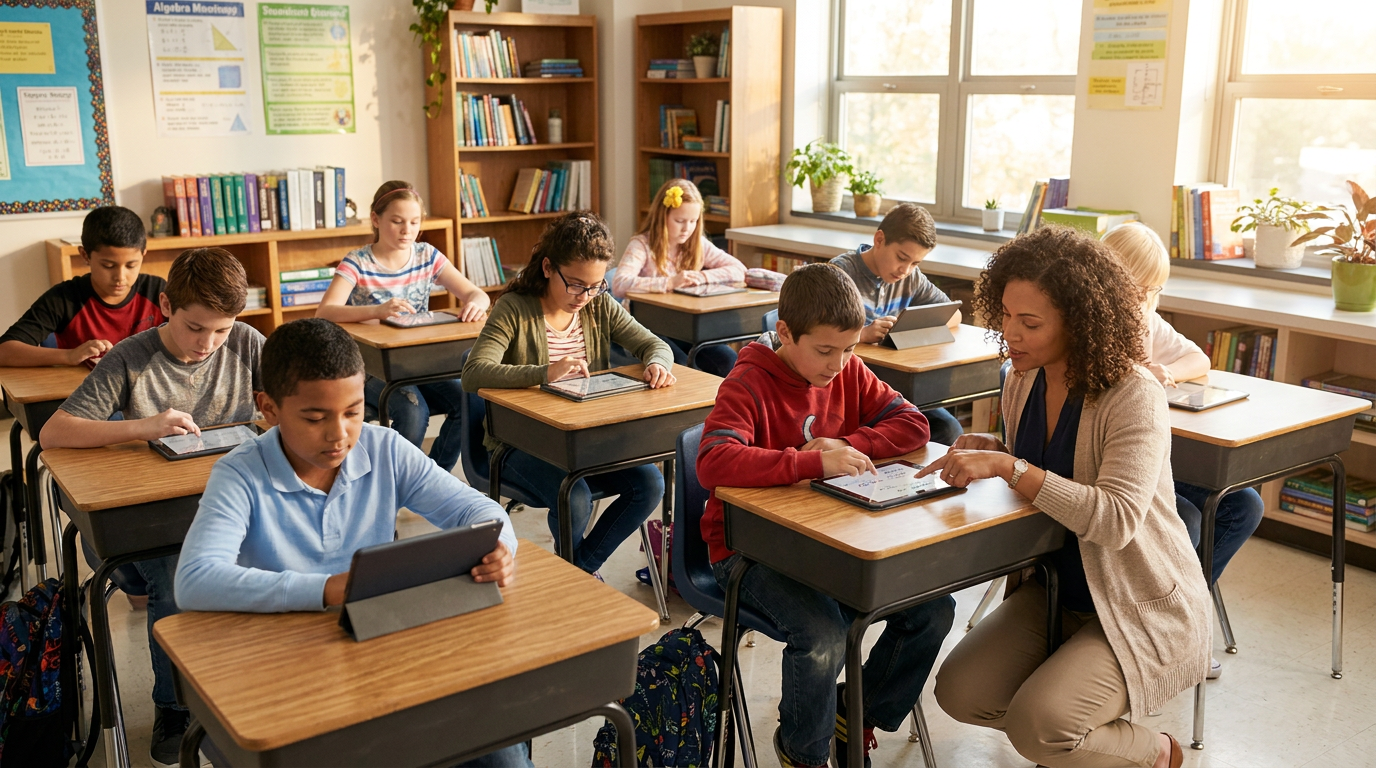
By 2026, the landscape has fundamentally shifted. The integration of large language models into educational technology has transformed static learning software into dynamic, conversational AI tutors. Platforms are now attempting to deliver the benefits of individualized instruction at a fraction of the cost, democratizing access to personalized pacing and providing vital assistive scaffolding for neurodivergent learners.[4][6]

Traditional adaptive learning software simply routed students to easier or harder multiple-choice questions based on their aggregate scores. Modern AI tutors operate differently. They engage in Socratic dialogue, reading a student's step-by-step work in real-time, identifying exactly where a misconception occurs, and asking guiding questions rather than simply providing the correct answer.[2]
Mathematics has become the primary proving ground for these systems because of its structured, rule-based nature. A 2025 Stanford and NBER evaluation of AI tutoring systems found that students using the technology for math showed a 0.2 standard deviation improvement over control groups.[2]
While 0.2 standard deviations falls short of Bloom's 2.0 benchmark, it is highly statistically significant in educational research. Applied across millions of students, a 0.2 shift translates to months of additional learning. Other studies, such as a 2025 Harvard trial comparing AI-tutored sessions against traditional active-learning classes, found that AI-assisted students achieved roughly twice the learning gains in half the time.[1][2][3]
While 0.2 standard deviations falls short of Bloom's 2.0 benchmark, it is highly statistically significant in educational research.
However, the implementation of AI in education carries severe risks if designed poorly. A landmark 2025 field experiment published in the Proceedings of the National Academy of Sciences (PNAS) tested nearly 1,000 high school students using different versions of AI to understand the boundary between learning and cheating.[3]
Students given unrestricted access to a standard AI model during practice sessions saw their homework grades skyrocket by 48%. But when the AI was removed for the final exam, those same students scored 17% worse than a control group that used no AI at all. The standard AI had acted as a crutch, creating dependency rather than genuine comprehension.[3]

In the same PNAS study, a third group of students used a "Socratic-prompted" AI that was strictly forbidden from giving direct answers. These students saw massive gains during practice and maintained their performance on the unassisted final exam. The variable was not the capability of the AI, but the pedagogical guardrails placed upon it.[3]
Building effective guardrails requires constant technical refinement. Developers have found that "response latency"—the time a student waits for the AI to reply—is critical. Reducing an AI tutor's response time by just a few hundred milliseconds significantly increases the likelihood that a student will stay engaged and answer the next question correctly.[2]
Despite the technological leaps, researchers caution against the idea that AI will replace human teachers. According to Self-Determination Theory, successful learning requires three psychological needs: autonomy, competence, and relatedness. AI can provide autonomy through self-pacing and competence through instant feedback, but it cannot provide relatedness.[3]
The feeling of being understood by another human mind remains the relational glue that keeps struggling students from giving up. The Brookings Institution characterizes the optimal future of the classroom as "human-AI hybrid vigor."[3]

In this hybrid model, AI handles the rote mechanics of personalized practice, instant grading, and data tracking. This frees the human teacher from spending hours grading worksheets or delivering one-size-fits-all lectures to a room of students learning at thirty different speeds.[4]
Instead, educators transition into roles more akin to mentors and academic coaches. They read the room, build trust, manage behavioral challenges, and guide collaborative, project-based learning. By delegating the micro-pacing to algorithms, schools are finally inching closer to solving Bloom's forty-year-old problem—not by replacing teachers, but by giving them the tools to reach every student.[3][4][5]
How we got here
1984
Benjamin Bloom publishes his research on the 'Two Sigma Problem,' establishing the gold standard for personalized tutoring.
2023
The release of advanced large language models enables the first generation of conversational, reasoning-capable educational tools.
2024
Platforms like Khan Academy scale AI tutors to hundreds of school districts, shifting from static adaptive learning to generative dialogue.
2025
Major field studies reveal that while Socratic AI improves learning, unrestricted AI answer-generators actively harm student exam performance.
Viewpoints in depth
The EdTech Optimists
Advocates who view AI as the only scalable solution to educational inequity.
This camp argues that the traditional classroom model—one teacher lecturing to thirty students at a median pace—is fundamentally broken. They point out that wealthy families have always bypassed this system by hiring private tutors. By putting a highly capable, infinitely patient AI tutor on every student's device, optimists believe we can finally democratize mastery learning. They acknowledge the technology's current imperfections but argue that a 0.2 standard deviation improvement is still vastly superior to the status quo for under-resourced districts.
The Pedagogical Skeptics
Researchers and educators warning about cognitive offloading and dependency.
Skeptics focus heavily on the PNAS findings, warning that students are naturally incentivized to find the path of least resistance. If an AI system can be manipulated into giving direct answers, it ceases to be a tutor and becomes a sophisticated cheating engine. This camp emphasizes that 'friction' and productive struggle are biologically necessary for memory formation. They advocate for strict regulatory guardrails on educational software, ensuring that AI tools cannot bypass the Socratic method, and warn that over-reliance on screens exacerbates existing crises in student mental health and socialization.
The Classroom Integrationists
Teachers and administrators focused on the 'hybrid vigor' model.
Rather than viewing AI as a replacement for human instruction, this group sees it as a powerful administrative and diagnostic tool. Integrationists argue that AI's highest value is in handling the rote mechanics of teaching: grading, tracking micro-progress, and generating differentiated practice problems. By offloading these tasks, human teachers are freed to do what algorithms cannot: read the emotional state of a room, build trust with a frustrated student, and facilitate complex, collaborative group projects. For this camp, AI is a teacher's assistant, not a teacher.
What we don't know
- Whether the 0.2 standard deviation gains seen in early math trials will scale to more subjective subjects like literature and history.
- How the long-term cognitive development of students who rely heavily on AI tutors from a young age will compare to previous generations.
- Whether underfunded school districts will receive the necessary infrastructure budgets to provide the devices and broadband required for these platforms.
Key terms
- Two Sigma Problem
- A 1984 educational finding that students receiving one-on-one tutoring perform two standard deviations better than those in traditional classrooms.
- Socratic Prompting
- Instructing an AI to guide a user to an answer through a series of questions and hints, rather than providing the solution directly.
- Response Latency
- The fraction of a second it takes for an AI system to reply to a student; lower latency is directly linked to higher student engagement.
- Self-Determination Theory
- A psychological framework suggesting that human motivation requires autonomy, competence, and relatedness—the latter being something AI cannot provide.
Frequently asked
Will AI tutors replace human teachers?
No. Research shows the most effective model is 'hybrid vigor,' where AI handles repetitive practice and pacing, while teachers provide emotional support and complex mentorship.
Does using AI make students lazy?
It depends on the software. Unrestricted AI that gives direct answers harms learning and creates dependency. 'Socratic' AI that only offers hints improves genuine understanding.
Why is math the main focus for AI tutors?
Mathematics is a highly structured, rule-based domain, making it easier for AI models to track step-by-step logic and identify exactly where a student made an error.
Sources
Source coverage
6 outlets
3 viewpoints surfaced






[1]ResearchGateThe Pedagogical Skeptics
Cognitive Computer Tutors: Solving the Two-Sigma Problem
Read on ResearchGate →[2]Khan AcademyThe EdTech Optimists
How Khan Academy Is Building a Better AI Tutor: Our Most Recent Learnings
Read on Khan Academy →[3]MindomaxThe Pedagogical Skeptics
Can AI Replace Human Tutors: The Research on Hybrid Learning
Read on Mindomax →[4]The Hunt InstituteThe Classroom Integrationists
AI Tutoring in Schools: How Personalized Learning Technology is Changing K-12 Education
Read on The Hunt Institute →[5]Factlen Editorial TeamThe Classroom Integrationists
Synthesis by Factlen editorial team
Read on Factlen Editorial Team →[6]EdTech MagazineThe EdTech Optimists
AI Assistive Technology Improves Inclusion in K–12 Environments
Read on EdTech Magazine →
Every angle. Every day.
Get education stories with full source coverage and perspective breakdowns delivered to your inbox.