
Evidence Pack: The Current Science of Detecting AI Deepfakes in the 2026 Elections
As synthetic media grows more sophisticated, researchers and tech platforms are shifting from reactive deepfake detection to cryptographic watermarking to verify authentic content.
By Factlen Editorial Team
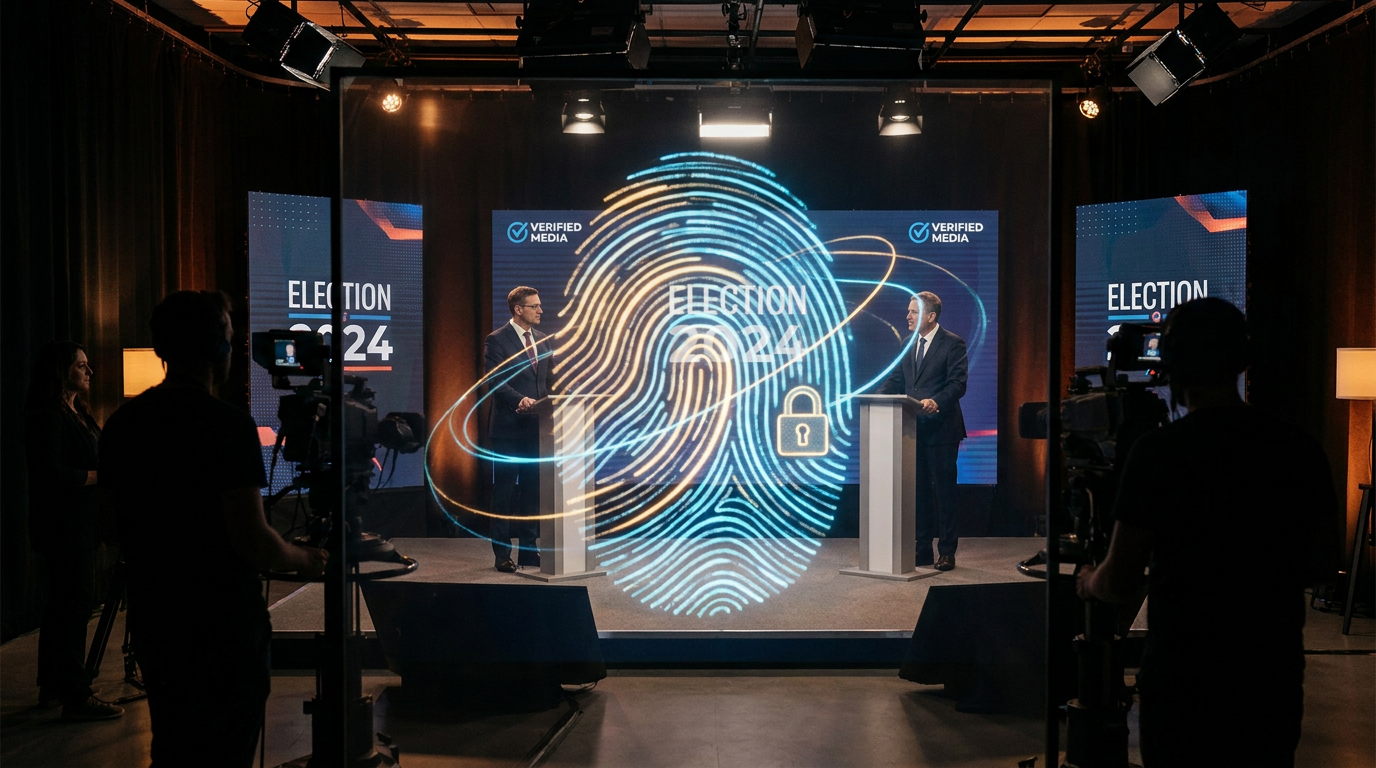
- Provenance Advocates
- Argue that establishing an unbroken chain of cryptographic trust from the camera to the screen is the only way to defeat deepfakes.
- Detection Researchers
- Focus on training advanced machine learning models to identify the subtle pixel and audio anomalies left by generative AI.
- Policy & Voting Advocates
- Emphasize media literacy, regulatory frameworks, and voter awareness over purely technical solutions.
What's not represented
- · Social Media Platform Moderators
- · Open-Source AI Developers
Why this matters
With the 2026 midterms underway, voters can no longer rely on the naked eye to spot manipulated media. Understanding how cryptographic provenance and AI detection actually work empowers citizens to navigate the information ecosystem without falling victim to digital deception.
Key points
- Universal video detection models can now identify synthetic visual media with up to 98.3% accuracy.
- Audio deepfakes remain a critical vulnerability, with human listeners only able to detect them 73% of the time.
- The tech industry is shifting toward C2PA cryptographic provenance, embedding tamper-evident history directly into files at the point of capture.
- While 31 US states have passed laws regulating political deepfakes, the US lacks a unified federal standard.
- Experts advise voters to rely on verified sources and independent fact-checkers rather than attempting DIY deepfake detection.
As the 2026 election cycle accelerates, the digital information ecosystem is facing an unprecedented volume of synthetic media. Early advice for voters—such as looking for mangled hands, misaligned shadows, or unnatural blinking—has been rendered entirely obsolete by the rapid advancement of generative artificial intelligence. Today, highly sophisticated deepfakes can seamlessly mimic the likeness and voice of political candidates, scrambling the public's understanding of truth. In response, the scientific and technological communities have fundamentally shifted their approach. Rather than relying on human intuition, researchers are deploying a combination of advanced algorithmic detection and cryptographic provenance to verify what is real.[3][6]
The core challenge in combating synthetic media is structural: it is an inherently adversarial arms race. Every time a new detection algorithm successfully identifies the subtle artifacts left by an AI generator, the creators of those generative models use that exact detection data to train their systems to avoid leaving those specific traces. This dynamic means that reactive detection tools are perpetually playing catch-up. Consequently, experts warn that voters should not depend exclusively on consumer-facing deepfake detection apps, as their effectiveness waxes and wanes depending on the latest generation of AI models.[2][3]
Despite this arms race, the science of video deepfake detection has reached a remarkable level of technical maturity in institutional settings. Researchers have developed "universal" detection models that analyze media across multiple platforms and formats. These systems do not look for obvious visual errors; instead, they hunt for microscopic irregularities at the pixel level and unnatural motion patterns that human eyes cannot perceive.[6]
In recent benchmark testing, state-of-the-art universal detectors have correctly flagged AI-generated video content with up to 98.3 percent accuracy. This represents a significant leap from previous generations of software, which often struggled to surpass the low 90s and were easily fooled by novel generation techniques. By training exclusively on real talking-face videos rather than trying to memorize the signatures of specific deepfake generators, these new models have achieved unprecedented generalization capabilities, allowing them to catch synthetic video even when it is heavily compressed or altered.[6]

However, while video detection has seen massive breakthroughs, audio deepfakes remain a critical and dangerous blind spot. Voice cloning technology is cheaper, faster, and requires significantly less computational power than video generation. Furthermore, audio lacks the rich contextual and visual cues—such as lighting, physics, and spatial consistency—that make video deepfakes easier for algorithms to catch. Because audio is effectively one-dimensional, highly convincing synthetic speech can be generated from just a few seconds of source material.[1]
The difficulty of detecting audio deepfakes extends to both machines and humans. Studies have shown that human listeners correctly identify deepfake audio with an accuracy of only 73 percent. Even when participants are given financial incentives or specialized training, their overall performance remains suboptimal, particularly when the audio is placed in complex or noisy environments. Consequently, malicious actors increasingly favor audio deepfakes—such as synthetic robocalls impersonating political figures—because they are highly effective at misleading voters and notoriously difficult for fact-checkers to definitively debunk in real-time.[1][6]
The difficulty of detecting audio deepfakes extends to both machines and humans.
The broader scientific consensus in 2026 is that human intuition is no longer a reliable defense against any form of high-quality synthetic media. A landmark 2025 study published in the journal iScience demonstrated that people consistently fail to reliably detect deepfakes, and their political opinions are measurably influenced by this type of disinformation. The study confirmed that neither heightened risk awareness nor financial rewards improved a person's ability to spot a fake, underscoring the urgent need for systemic, technology-driven solutions rather than relying on individual media literacy.[2]
Recognizing the limitations of reactive detection, the technology and media industries have executed a massive pivot toward "provenance"—proactively proving that a piece of media is authentic from the moment it is created. The Coalition for Content Provenance and Authenticity (C2PA) has emerged as the definitive standard for this approach. Rather than guessing if an image is fake after the fact, C2PA embeds a cryptographically signed manifest directly into the digital file. This manifest records the device that captured the media, any software that processed it, and whether generative AI was involved.[5]
The fundamental insight behind C2PA is that it sidesteps the AI arms race entirely. If a photograph or video carries a valid C2PA manifest signed by a hardware-secured camera, the viewer can trust its authenticity without needing to run it through a detection algorithm. By 2026, this standard has seen massive hardware adoption. Major smartphone manufacturers, including Google with the Pixel 10, have integrated C2PA signing directly into their camera firmware. Professional camera brands like Leica, Sony, and Nikon have also adopted the standard, treating cryptographic signing as a baseline requirement for photojournalism.[5]
Despite its immense promise, the provenance approach faces a severe structural vulnerability: the distribution pipeline. The C2PA standard only works if the cryptographic manifest remains attached to the file when it reaches the viewer. Currently, many major social media platforms and messaging apps automatically strip metadata from uploaded files to save space and protect user privacy. When this metadata is stripped, the chain of trust is broken, and a verified, authentic photograph becomes indistinguishable from an unverified or synthetic one.[5]

To bridge this gap, AI developers are increasingly deploying steganographic watermarking—such as Google's SynthID—which embeds imperceptible signals directly into the pixels or audio waves of generated content. Unlike metadata, these watermarks are designed to survive compression, cropping, and platform uploads. While watermarking does not prove a file is authentic, it provides a resilient backup layer that allows platforms to definitively identify and label content that originated from their specific generative AI models.[5]
As the technological solutions mature, the regulatory landscape is also shifting to mandate transparency, though it remains highly fragmented. In the United States, there is still no federal legislation prohibiting or regulating the use of deepfakes in political campaigns. Instead, a patchwork of state laws has emerged. As of early 2026, 31 US states have passed legislation regulating deepfakes in elections, typically requiring clear disclaimers on synthetic political content. However, the penalties and enforcement mechanisms vary wildly from state to state.[2][3]

Internationally, the European Union is taking a much more aggressive and unified approach. Article 50 of the EU AI Act, which takes full effect in August 2026, imposes strict transparency obligations on the providers and deployers of generative AI systems. Under this law, platforms are legally required to mark or disclose certain AI-generated and manipulated content, with non-compliance carrying massive financial penalties. This regulatory pressure is a primary driver behind the rapid adoption of C2PA and watermarking standards by global tech companies.[4]
Ultimately, the defense against political deepfakes in 2026 requires a layered approach. Missing credentials or absent watermarks are not definitive proof that an image is fake, just as a clean scan from a detection tool is not absolute proof that it is real. Reliable verification now combines cryptographic provenance, watermark checks, reverse-image searching, and traditional journalistic source history. For voters, the most effective strategy is to avoid playing amateur detective and instead rely on authoritative context from credible, independent fact-checkers and official election offices.[3][5]
How we got here
2022
The C2PA coalition publishes its first technical specification for embedding provenance metadata into digital files.
2024
The FCC bans the use of AI-generated voices in robocalls following a high-profile deepfake incident in the New Hampshire primary.
Late 2025
Major smartphone manufacturers, including Google, begin integrating hardware-level C2PA signing directly into consumer cameras.
August 2026
Article 50 of the EU AI Act takes effect, legally mandating transparency and disclosure for AI-generated content.
Viewpoints in depth
Provenance Advocates
Argue that establishing an unbroken chain of cryptographic trust is the only scalable solution.
This camp, which includes major camera manufacturers and software giants, believes that the arms race between AI generation and detection is fundamentally unwinnable. They argue that instead of trying to prove a file is fake after it goes viral, the ecosystem must default to proving a file is real at the moment of creation. By embedding hardware-secured cryptographic signatures into media, they aim to create a 'zero-trust' environment where unverified content is automatically treated with skepticism.
Detection Researchers
Focus on training advanced machine learning models to catch synthetic media after the fact.
Computer scientists and forensic analysts emphasize that provenance standards like C2PA will take years to achieve ubiquitous adoption, leaving billions of legacy images and non-compliant devices unprotected. They argue that robust, universal detection models are essential for policing the current internet. By analyzing pixel-level irregularities and unnatural motion patterns, these researchers are building the necessary safety nets for platforms that process massive volumes of unverified user-generated content.
Policy & Voting Advocates
Emphasize media literacy, regulatory frameworks, and voter awareness over purely technical solutions.
Civil rights organizations and election watchdogs warn that over-reliance on technical tools—whether detection algorithms or cryptographic watermarks—creates a false sense of security. They argue that bad actors will always find loopholes, such as analog screen-recording, to bypass digital safeguards. This camp advocates for strict legal penalties for distributing deceptive political content and urges voters to focus on the source of the information rather than trying to forensically analyze the media themselves.
What we don't know
- Whether major social media platforms will universally stop stripping C2PA metadata from user uploads.
- How effectively state-level deepfake laws will be enforced during the final months of the 2026 election cycle.
- If detection algorithms will ever be able to reliably identify highly compressed, short-form audio deepfakes.
Key terms
- C2PA
- The Coalition for Content Provenance and Authenticity, an organization developing open standards to certify the source and history of digital media.
- Cryptographic Manifest
- A secure, tamper-evident digital record embedded in a file that logs how, when, and by what device the media was created.
- Steganographic Watermarking
- The practice of embedding imperceptible signals directly into the pixels or audio waves of a file to identify it as AI-generated.
- Universal Detector
- An advanced AI system designed to identify synthetic manipulation across multiple different formats and platforms simultaneously.
Frequently asked
Can I use free online tools to detect political deepfakes?
Experts advise against relying solely on consumer detection tools, as their accuracy fluctuates and they often struggle with highly compressed media or audio deepfakes.
Why are audio deepfakes harder to catch than video?
Audio lacks visual and spatial context—like lighting or physics—making it easier for AI to synthesize convincingly and harder for algorithms to spot anomalies.
What is C2PA and how does it help?
C2PA is an open standard that embeds tamper-evident cryptographic metadata into media at the point of creation, proving its origin and whether AI was used.
Are political deepfakes illegal in the United States?
There is no federal ban, but 31 states have passed laws regulating their use in elections, typically requiring clear disclaimers on synthetic content.
Sources
Source coverage
6 outlets
3 viewpoints surfaced






[1]PoynterDetection Researchers
The challenge of identifying audio deepfakes
Read on Poynter →[2]TrueScreenPolicy & Voting Advocates
Why fact-checking and AI detection are no longer enough
Read on TrueScreen →[3]Brennan Center for JusticePolicy & Voting Advocates
AI and Elections: What Voters Need to Know
Read on Brennan Center for Justice →[4]arXivPolicy & Voting Advocates
Transparent AI Disclosure Obligations: Who, What, When, Where
Read on arXiv →[5]AI BuzzProvenance Advocates
Digital Provenance & Deepfake Detection in 2026
Read on AI Buzz →[6]Factlen Editorial TeamProvenance Advocates
Synthesis by Factlen editorial team
Read on Factlen Editorial Team →

More in news politics
See all 9 stories →Reparations Law
Justice Department Sues to Halt Evanston's First-in-the-Nation Reparations Program
6 sources
Ukraine War
G7 Leaders Press Trump to Broker Ukraine-Russia Peace Deal at Évian Summit
7 sources

Youth Tech Policy
UK Announces Sweeping Social Media Ban for Under-16s
6 sources

Digital Behavior
Fact-Checking the Filter Bubble: Why the Internet Actually Broadens Our Political Diets
6 sources
Every angle. Every day.
Get news politics stories with full source coverage and perspective breakdowns delivered to your inbox.