
How Scientists Are Using Underwater Speakers and AI to Rewild Coral Reefs
Researchers are broadcasting the sounds of healthy reefs into degraded ocean zones to attract coral larvae, using artificial intelligence to track the ecosystem's recovery.
By Factlen Editorial Team
- Marine Biologists
- Focus on the biological mechanism of phonotaxis and the empirical data showing increased settlement rates for corals and fish.
- Conservation Technologists
- Emphasize the scalability of AI and passive acoustic monitoring as a replacement for slow, expensive visual surveys.
- Global Policy Groups
- Focus on capacity building, cost-effectiveness, and the need to integrate these tools with broader climate action.
What's not represented
- · Local fishing communities
- · Eco-tourism operators
Why this matters
Coral reefs support a quarter of all marine species and a billion human livelihoods, but traditional restoration is slow and expensive. By combining acoustic enrichment with AI monitoring, scientists have unlocked a highly scalable, low-cost method to rapidly accelerate the recovery of these critical ecosystems.
Key points
- Healthy coral reefs produce a loud acoustic signature that attracts drifting larvae.
- Degraded reefs fall silent, creating a negative feedback loop where new life bypasses the area.
- Broadcasting healthy reef sounds through underwater speakers increases coral settlement by up to seven times.
- Artificial intelligence is now being used to analyze thousands of hours of underwater audio to track restoration success.
To human ears, the ocean might seem like a silent expanse, but a healthy coral reef is actually one of the loudest ecosystems on Earth. The underwater environment crackles with the sound of frying bacon—a continuous static generated by thousands of snapping shrimp—layered beneath the low-frequency grunts, purrs, and clicks of feeding fish. This vibrant acoustic environment is more than just background noise; it is a critical biological beacon that signals a thriving habitat.[3]
When a reef is devastated by bleaching events, severe storms, or destructive fishing practices, it loses its resident marine life and falls eerily silent. This silence triggers a devastating negative feedback loop. Without the acoustic cues of a healthy ecosystem, the microscopic larvae of corals and fishes that drift through the open ocean have no way of knowing where to settle. They bypass the degraded reef entirely, leaving the habitat barren and unable to recover on its own.[3][4]
For decades, scientists assumed that coral larvae were passive drifters, entirely at the mercy of ocean currents. However, researchers have discovered that these tiny organisms are equipped with exterior cilia—microscopic hair-like structures—that allow them to actively swim toward specific acoustic frequencies. This phenomenon, known as phonotaxis, means that coral larvae are literally listening for a safe place to call home, drawn to the specific biological frequencies generated by resident crustaceans and fish.[3]

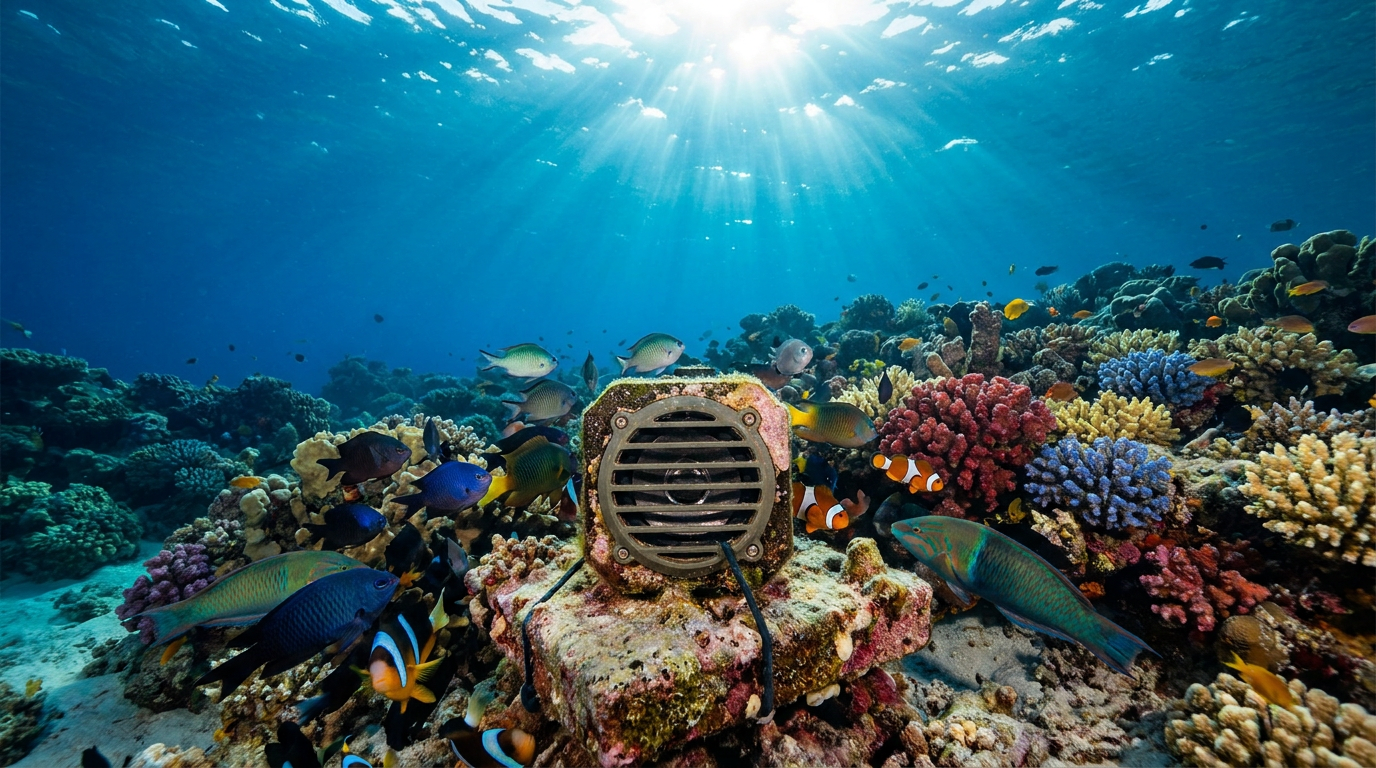
Armed with this knowledge, marine biologists have developed a novel intervention known as acoustic enrichment. By deploying underwater speaker systems, such as the Reef Acoustic Playback System (RAPS), scientists are broadcasting the recorded soundscapes of healthy reefs into degraded, silent zones. The goal is to artificially recreate the acoustic beacon of a thriving ecosystem, tricking drifting larvae into settling on the damaged reef and kickstarting the recovery process.[1][4]
The results of this acoustic trickery have been remarkably successful. In a 2024 study conducted by the Woods Hole Oceanographic Institution, researchers tested the technique on golfball corals. They found that larvae exposed to the sounds of a healthy reef settled at significantly higher rates during their first 36 hours in the water. After this critical window, the larvae became desperate to settle regardless of the acoustic environment, highlighting the importance of immediate acoustic cues during the early stages of larval dispersal.[1]
A parallel field study published in Royal Society Open Science demonstrated the sheer power of this intervention on a broader scale. When researchers deployed solar-powered acoustic playback systems on degraded reefs, they observed that larvae of the brooding coral Porites astreoides settled at rates up to seven times higher than on silent control reefs. The acoustic enrichment proved effective over a considerable area, with settlement rates remaining significantly elevated up to 30 meters away from the underwater speakers.[2]

A parallel field study published in Royal Society Open Science demonstrated the sheer power of this intervention on a broader scale.
The benefits of acoustic enrichment extend far beyond the corals themselves. A landmark study published in Nature Communications revealed that broadcasting healthy reef sounds also dramatically accelerates the recovery of the broader fish community. Over a 40-day acoustic treatment period, researchers recorded a 50 percent increase in juvenile fish species richness and a doubling of overall fish abundance. Because these fish excrete key nutrients and eat algae that would otherwise smother young corals, their return is essential for long-term reef resilience.[6][8]
While acoustic enrichment offers a powerful way to initiate reef recovery, tracking the long-term success of these interventions presents a massive logistical challenge. Traditional monitoring relies on underwater visual census surveys, where highly trained scuba divers manually count fish and measure coral growth. These diver-led surveys are expensive, time-consuming, and limited to brief snapshots of time, making it difficult to scale restoration efforts globally.[7]
To solve this bottleneck, conservationists are turning to Passive Acoustic Monitoring (PAM). Instead of sending divers into the water, researchers deploy low-cost, long-term underwater microphones, such as the open-source HydroMoth. These rugged devices can be zip-tied to the reef and left for months, continuously recording the ecosystem's soundscape at dawn, midday, and dusk. As the reef recovers and biodiversity returns, the volume and complexity of the recorded audio naturally increase.[4][5]

Analyzing thousands of hours of underwater audio manually is impossible, which is where artificial intelligence enters the equation. In Indonesia, the Mars Coral Reef Restoration program successfully trained an AI model to differentiate between the acoustic signatures of healthy and degraded reefs. By feeding the AI thousands of audio samples, the model learned to identify the subtle acoustic markers of recovery, eventually achieving a 92 percent accuracy rate in classifying the health status of newly recorded reef soundscapes.[5]
The application of machine learning in marine acoustics is advancing rapidly. Recent research has demonstrated the effectiveness of using Convolutional Neural Networks (CNNs)—models originally trained on millions of hours of unrelated audio—to perform whole soundscape analysis. Rather than building bespoke detectors for individual fish species, these advanced AI models analyze the entire acoustic profile of the habitat, providing a highly compressed, accurate representation of biodiversity recovery at a fraction of the computational cost.[7]

The combination of acoustic enrichment and AI monitoring is now moving from isolated experiments to global deployment. The Coral Research & Development Accelerator Platform (CORDAP) recently launched a 1.5 million dollar initiative to scale these technologies across the Galápagos, Dominica, and the Cayman Islands. By integrating underwater speakers with continuous AI-driven acoustic monitoring, these projects aim to create a standardized, low-cost toolkit that local conservationists can deploy anywhere in the world.[4][8]
Despite the immense promise of these technologies, researchers caution that acoustic enrichment is not a standalone miracle cure. While sound can attract larvae to a degraded reef, those larvae still require suitable physical substrates to attach to and grow. Furthermore, if the underlying causes of the reef's initial decline—such as poor water quality, severe pollution, or extreme thermal stress from climate change—are not addressed, the newly settled corals will simply die before reaching maturity.[2][8]
Nevertheless, the integration of bioacoustics and artificial intelligence represents a paradigm shift in marine conservation. By learning to speak the acoustic language of the ocean, scientists are no longer just passively protecting what remains; they are actively calling life back to the barren zones. This tech-assisted approach to rewilding offers a scalable, hopeful blueprint for rebuilding the world's most vibrant underwater ecosystems before they are lost forever.[8][9]
How we got here
2010
Researchers first recognize that larval corals exhibit phonotaxis, moving in response to underwater sound.
2019
A landmark study demonstrates that acoustic enrichment doubles fish abundance on degraded reefs.
2021
Conservationists in Indonesia begin using passive acoustic monitoring to track the success of restored reef soundscapes.
March 2024
The Royal Society publishes field data showing acoustic enrichment increases coral settlement by up to seven times.
October 2024
A $1.5 million global initiative launches to deploy acoustic enrichment and AI monitoring across the Caribbean and Galápagos.
Viewpoints in depth
Marine Biologists
Focus on the biological mechanism of phonotaxis and the empirical data showing increased settlement rates.
For marine biologists, acoustic enrichment is a critical tool to break the negative feedback loop of reef degradation. By proving that coral larvae actively swim toward the sounds of snapping shrimp and feeding fish, researchers have validated the use of underwater speakers to artificially recreate the beacon of a thriving ecosystem. They emphasize the empirical data—such as the seven-fold increase in settlement rates—as proof that bioacoustics can give degraded reefs the head start they need to recover.
Conservation Technologists
Focus on the scalability of AI and passive acoustic monitoring to replace slow, expensive visual surveys.
Technologists argue that traditional diver-led visual surveys are too slow, expensive, and localized to meet the scale of the global coral crisis. Instead, they champion the deployment of low-cost hydrophones paired with advanced machine learning models. By training Convolutional Neural Networks on millions of hours of audio, they believe conservationists can continuously and cheaply monitor the health of entire reef systems, providing real-time data on whether restoration interventions are actually working.
Global Policy Groups
Focus on capacity building, cost-effectiveness, and the need to integrate these tools with broader climate action.
International funding bodies and policy groups view acoustic enrichment and AI monitoring as highly scalable, cost-effective solutions that can be deployed by local communities worldwide. However, they caution against viewing technology as a silver bullet. They argue that while speakers can attract larvae, the intervention will ultimately fail if the root causes of reef degradation—such as coastal pollution, overfishing, and ocean warming—are not simultaneously addressed through aggressive policy changes.
What we don't know
- Whether acoustic enrichment is equally effective across all of the hundreds of different coral species.
- How long the acoustic intervention must be maintained before a reef becomes entirely self-sustaining.
- The extent to which rising ocean temperatures might negate the benefits of increased larval settlement.
Key terms
- Acoustic Enrichment
- The practice of broadcasting sounds from a healthy ecosystem into a degraded one to attract wildlife and encourage settlement.
- Phonotaxis
- The movement of an organism in response to a sound source, used by coral larvae to navigate toward suitable habitats.
- Passive Acoustic Monitoring (PAM)
- The use of underwater microphones to record environmental sounds over long periods without disturbing the habitat.
- Soundscape
- The combination of all acoustic resources in an environment, including biological sounds, geophysical sounds, and human-made noise.
- Benthic Community
- The organisms that live on, in, or near the bottom of a body of water, including corals, sponges, and crustaceans.
Frequently asked
Can any sound be used to attract corals?
No. Larvae respond specifically to the low-frequency biological sounds of a healthy reef, such as the crackling of snapping shrimp and the grunts of feeding fish.
Does the underwater speaker need to play forever?
No. Acoustic enrichment is used to kickstart the ecosystem. Once enough marine life settles and matures, the reef begins generating its own natural soundscape.
How far does the sound travel to attract larvae?
Field studies show that coral settlement rates remain significantly elevated up to 30 meters away from the underwater speaker.
Why do degraded reefs go silent in the first place?
When a reef is damaged by bleaching or storms, the resident fish and invertebrates leave or die, eliminating the biological noise that attracts new life.
Sources
Source coverage
9 outlets
3 viewpoints surfaced









[1]Woods Hole Oceanographic InstitutionMarine Biologists
Using successful techniques from an earlier study, acoustic enrichment continues to show promise
Read on Woods Hole Oceanographic Institution →[2]Royal Society Open ScienceMarine Biologists
Soundscape enrichment increases larval settlement rates for the brooding coral Porites astreoides
Read on Royal Society Open Science →[3]Earth.orgGlobal Policy Groups
Acoustic Enrichment: A Novel Approach to Coral Reef Restoration
Read on Earth.org →[4]CORDAPGlobal Policy Groups
Good vibrations: Increasing the capacity of acoustic enrichment applications for larval settlement and restoration
Read on CORDAP →[5]Building CoralConservation Technologists
Using AI to Listen to Coral Reefs
Read on Building Coral →[6]Nature CommunicationsMarine Biologists
Acoustic enrichment can enhance fish community development on degraded coral reef habitat
Read on Nature Communications →[7]bioRxivConservation Technologists
Soundscapes and deep learning enable tracking biodiversity recovery in tropical marine ecosystems
Read on bioRxiv →[8]Seven Seas MediaGlobal Policy Groups
Smart Revival: AI and acoustic technologies for monitoring coral restoration
Read on Seven Seas Media →[9]Factlen Editorial TeamGlobal Policy Groups
Synthesis by Factlen editorial team
Read on Factlen Editorial Team →
Every angle. Every day.
Get environment stories with full source coverage and perspective breakdowns delivered to your inbox.