
Supreme Court Climate Showdown: DOJ Brief Contradicts EPA's Historic Deregulation Rollback
Conservative advocates are warning that a recent Department of Justice brief defending fossil fuel companies at the Supreme Court directly undermines the EPA's recent repeal of greenhouse gas regulations.
By Factlen Editorial Team
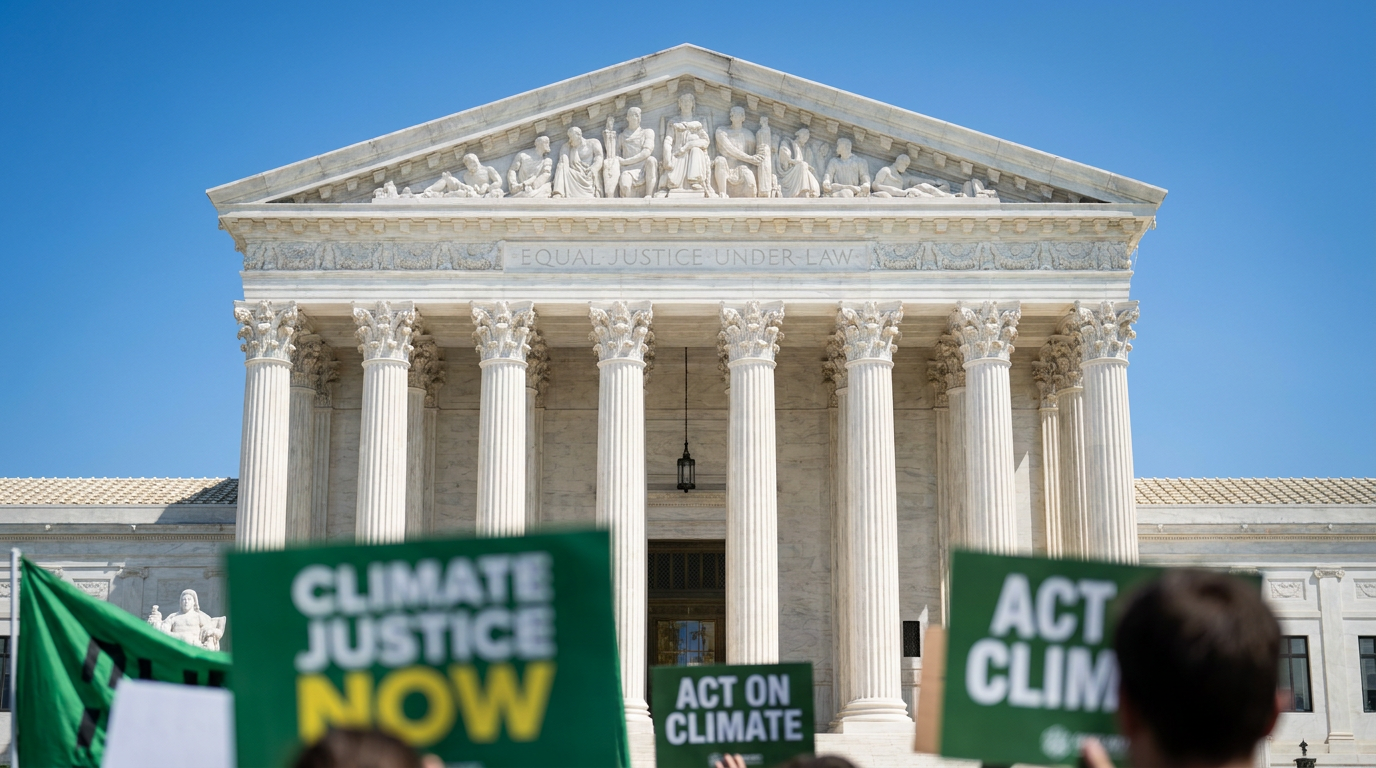
- Deregulation Advocates
- Conservative legal strategists who support the EPA's rollback but fear the DOJ's defense of oil companies will backfire.
- Local Governments & Environmentalists
- Municipalities and green groups fighting to hold fossil fuel companies financially liable for local climate damages.
- Legal & Jurisdictional Analysts
- Legal scholars focused on the complex balance between state police powers and federal preemption.
What's not represented
- · Automakers who must navigate the shifting regulatory landscape for vehicle emissions.
- · Taxpayers in coastal and drought-prone states bearing the immediate financial burden of climate adaptation.
Why this matters
The outcome of this legal tug-of-war will determine whether local taxpayers or fossil fuel companies foot the bill for billions in climate damages, while simultaneously deciding if the federal government retains any power to regulate greenhouse gas emissions.
Key points
- The DOJ filed a Supreme Court brief arguing the Clean Air Act preempts state climate lawsuits because the EPA regulates emissions.
- This directly contradicts the EPA's February rescission of the Endangerment Finding, which claimed the agency lacks authority to regulate greenhouse gases.
- Conservative advocates warn this legal Catch-22 could inadvertently destroy the administration's historic climate deregulation agenda.
- The Supreme Court will hear Suncor Energy v. Boulder County later this year to decide if local climate lawsuits can proceed in state courts.
- The domestic legal chaos casts a shadow over U.S. commitments at the ongoing UN Bonn Climate Conference.
A glaring legal contradiction between the Department of Justice and the Environmental Protection Agency has thrown the administration's sweeping climate deregulation agenda into uncertainty. As the U.S. Supreme Court prepares to hear a landmark climate accountability case later this year, conservative allies are warning that the federal government is sending mixed signals that could inadvertently preserve the very greenhouse gas regulations it just tried to dismantle.[1]
The conflict centers on two major actions taken months apart. In February 2026, the EPA enacted what it called the largest deregulatory action in U.S. history by rescinding the 2009 Greenhouse Gas Endangerment Finding. The agency declared it lacked the statutory authority under the Clean Air Act to regulate climate-warming emissions, subsequently wiping out emissions standards for light and heavy-duty vehicles.[4][7]
But on May 21, the DOJ filed an amicus brief in Suncor Energy v. Boulder County—a high-stakes Supreme Court case that will determine whether local governments can sue fossil fuel companies for climate damages. In its brief, the DOJ argued that the Clean Air Act reserves the authority to regulate greenhouse gas emissions exclusively to the EPA, and therefore state and local lawsuits are preempted by federal law.[1][3]
Right-wing advocates and former transition officials immediately sounded the alarm. Steve Milloy, a senior policy fellow at the Energy and Environment Legal Institute, noted that the DOJ's argument for federal preemption is the "exact opposite" of the EPA's February repeal. If the EPA has no authority to regulate greenhouse gases, legal experts warn, the DOJ cannot use that non-existent authority as a shield to protect oil companies from state litigation.[1][2]

The stakes in Suncor v. Boulder are immense. The City of Boulder and Boulder County originally sued ExxonMobil and Suncor in 2018, seeking to hold the corporations financially responsible for knowingly contributing to climate change while concealing the dangers of their products. Colorado is one of the fastest-warming states, and local taxpayers are facing mounting costs to address extreme weather and infrastructure damage.[3]
Colorado is one of the fastest-warming states, and local taxpayers are facing mounting costs to address extreme weather and infrastructure damage.
Fossil fuel companies have desperately tried to move these cases out of state courts and into federal courts, where they believe the claims will be dismissed under the Clean Air Act. However, a recent watershed of rulings in lower federal courts has consistently prioritized state court retention, rejecting federal removal and allowing state-law claims to proceed locally.[2][3]
The Supreme Court's decision to review the Colorado case marks a critical juncture. Environmental advocates argue that the federal government's contradictory legal filings expose a coordinated, if sloppy, effort to shield the fossil fuel industry from financial liability at all costs. Watchdog groups have recently highlighted extensive, industry-backed campaigns aimed at influencing how federal judges view climate science and environmental law.[3][5]
For the administration, the legal Catch-22 is severe. If the Supreme Court accepts the DOJ's argument that the Clean Air Act preempts state lawsuits because it regulates emissions, it could undermine the legal foundation of the EPA's historic February rollback. If the Court sides with the EPA's new interpretation that the federal government cannot regulate greenhouse gases, it strips away the primary defense shielding oil majors from dozens of multi-billion-dollar lawsuits across the country.[1][2]

The domestic legal chaos is playing out exactly as international negotiators gather in Bonn, Germany, for the UN Climate Change Conference (SB64). The Bonn summit serves as a critical midpoint between COP30 in Brazil and the upcoming COP31 in Turkey, with delegates focused on turning broad political commitments into practical implementation pathways.[6]
A major focus at Bonn is developing an international roadmap to transition away from fossil fuels. However, the U.S. government's internal contradictions over whether it even possesses the legal authority to track, report, or limit climate-heating pollution casts a long shadow over its ability to meet any international pledges.[4][6]

Public health organizations have also condemned the EPA's underlying deregulation, warning that repealing the Endangerment Finding ignores settled science and will make everyday life more risky and expensive for Americans. The EPA, meanwhile, maintains that its rollback will save Americans over $1.3 trillion and make the auto industry globally competitive.[4][7]
Ultimately, the Supreme Court's ruling in late 2026 will do more than decide the fate of Boulder's lawsuit. It will force the judicial branch to untangle the administration's conflicting legal theories, determining whether the federal government can simultaneously disavow its power to regulate the climate while using that same power to block states from seeking their own justice.[1][2][3]
How we got here
2009
The EPA issues the Greenhouse Gas Endangerment Finding, establishing the legal basis for federal climate regulations.
April 2018
The City of Boulder and Boulder County file a climate accountability lawsuit against ExxonMobil and Suncor in state court.
February 2026
The EPA finalizes the rescission of the Endangerment Finding, eliminating federal greenhouse gas emissions standards for vehicles.
May 2026
The DOJ files an amicus brief in Suncor v. Boulder, arguing that the Clean Air Act preempts state climate lawsuits.
June 2026
International delegates gather at the Bonn Climate Conference while conservative advocates sound the alarm over the U.S. legal contradictions.
Viewpoints in depth
Deregulation Advocates
Conservative legal strategists who support the EPA's rollback but fear the DOJ's defense of oil companies will backfire.
This camp strongly supports the EPA's historic rescission of the 2009 Endangerment Finding, arguing that the Clean Air Act was never intended by Congress to regulate global greenhouse gas emissions. However, they are deeply concerned by the DOJ's strategy in state-level climate torts. Figures like Steve Milloy argue that by claiming federal preemption under the Clean Air Act to protect fossil fuel companies from local lawsuits, the DOJ is implicitly validating the very federal regulatory authority the EPA just dismantled. They warn this mixed messaging could lead the Supreme Court to strike down the EPA's deregulation.
Local Governments & Environmentalists
Municipalities and green groups fighting to hold fossil fuel companies financially liable for local climate damages.
For cities like Boulder, Colorado, the impacts of climate change—from extreme heat to infrastructure damage—are already incurring massive local costs. This camp argues that fossil fuel giants knowingly concealed the dangers of their products for decades and should pay for the resulting damages under state nuisance and consumer protection laws. They view the federal government's contradictory legal filings as proof that the administration is less concerned with legal consistency than with shielding the oil and gas industry from accountability at every possible venue.
Legal & Jurisdictional Analysts
Legal scholars focused on the complex balance between state police powers and federal preemption.
Legal observers note that the current wave of climate litigation represents a watershed moment for American environmental law. Lower courts have increasingly favored state court retention, ruling that federal law does not automatically preempt state-level claims regarding deceptive marketing or local damages. Analysts point out that the Supreme Court's upcoming decision in Suncor v. Boulder will have to navigate a labyrinth of procedural rules and statutory interpretations, ultimately deciding whether global issues like climate change can be litigated piecemeal in state courts or if they demand a unified—even if deregulatory—federal approach.
What we don't know
- How the Supreme Court will reconcile the conflicting legal theories presented by different arms of the federal government.
- Whether the EPA's rescission of the Endangerment Finding will survive inevitable challenges in the D.C. Circuit Court of Appeals.
- If local governments will successfully keep their climate accountability lawsuits in state courts, where they believe they have a better chance of winning damages.
Key terms
- Clean Air Act
- A comprehensive federal law that regulates air emissions from stationary and mobile sources to protect public health and the environment.
- Amicus Brief
- A legal document filed in an appellate court case by a non-litigant with a strong interest in the subject matter, intended to influence the court's decision.
- Federal Preemption
- The principle that federal laws take precedence over state laws, often used as a defense to move lawsuits from state to federal courts.
- Subsidiary Bodies (SB64)
- Technical and implementation committees of the UN Framework Convention on Climate Change that meet midway between annual COP summits.
Frequently asked
What is the Endangerment Finding?
The 2009 EPA Endangerment Finding was a scientific determination that greenhouse gases threaten public health and welfare, which legally required the government to regulate emissions under the Clean Air Act. The EPA rescinded this finding in February 2026.
Why are local governments suing fossil fuel companies?
Cities and counties, such as Boulder, Colorado, are suing oil majors in state courts to recover the rising costs of climate change impacts, arguing the companies knowingly deceived the public about the dangers of their products.
What is federal preemption?
Federal preemption is a legal doctrine establishing that federal law supersedes state law when the two conflict. Fossil fuel companies argue that the federal Clean Air Act preempts state-level climate lawsuits.
How does this affect international climate goals?
The domestic legal uncertainty over whether the U.S. government has the authority to regulate emissions complicates international negotiations, such as those currently underway at the Bonn Climate Conference, where countries are drafting roadmaps to transition away from fossil fuels.
Sources
Source coverage
7 outlets
3 viewpoints surfaced







[1]PoliticoDeregulation Advocates
Conservative backers of climate deregulation push worry delayed rulemaking may harm efforts
Read on Politico →[2]Spencer FaneLegal & Jurisdictional Analysts
State and Federal Jurisdiction Over Environmental Litigation Reaches Watershed
Read on Spencer Fane →[3]EarthRights InternationalLocal Governments & Environmentalists
Supreme Court to Review Colorado Climate Accountability Case
Read on EarthRights International →[4]U.S. Environmental Protection AgencyDeregulation Advocates
Final Rule: Rescission of the Greenhouse Gas Endangerment Finding and Motor Vehicle Greenhouse Gas Emission Standards
Read on U.S. Environmental Protection Agency →[5]The GuardianLocal Governments & Environmentalists
The rightwing campaign to control how US judges view the climate crisis
Read on The Guardian →[6]International Institute for Sustainable DevelopmentLegal & Jurisdictional Analysts
Inside Bonn Climate Change Conference 2026
Read on International Institute for Sustainable Development →[7]The BMJLocal Governments & Environmentalists
US repeals key 'endangerment finding' that climate change is a public threat
Read on The BMJ →

More in news politics
See all 5 stories →Media Verification
Evidence Pack: The Current Science of Detecting AI Deepfakes in the 2026 Elections
6 sources

Arbitration Law
Supreme Court Unanimously Strips Forced Arbitration Shield from Last-Mile Delivery Employers
7 sources
Child Nutrition
Fact-Checking the Evidence: Do Universal Free School Meals Actually Work?
8 sources

Every angle. Every day.
Get news politics stories with full source coverage and perspective breakdowns delivered to your inbox.