
Does Ending Single-Family Zoning Actually Lower Housing Costs? The Evidence Pack
A growing body of empirical research from cities like Auckland and Minneapolis suggests that abolishing single-family zoning successfully increases housing supply and stabilizes rents. However, economists debate the speed of these reforms, noting that zoning changes must often be paired with financial incentives to produce truly affordable units.

In short
- Auckland's 2016 zoning reform doubled the number of new dwelling permits per capita within five years.
- The Minneapolis 2040 Plan successfully suppressed rent and home price growth compared to control cities.
- California experienced a massive surge in ADU construction after streamlining the permitting process.
The housing affordability crisis has pushed policymakers across the globe to reconsider the fundamental rules of urban planning. For decades, up to 75 percent of residential land in United States cities has been zoned exclusively for single-family detached homes, effectively banning the construction of duplexes, triplexes, and small apartment buildings.
This regulatory bottleneck has artificially capped the number of homes that can be built in high-demand areas, forcing buyers and renters to compete for a stagnant pool of available housing. As populations have grown and construction has lagged, the resulting scarcity has driven home prices and rents to record highs, locking millions of middle- and low-income earners out of the neighborhoods closest to jobs and transit.
This severe shortage has disproportionately impacted "Missing Middle" housing—the crucial spectrum of homes that bridge the gap between sprawling single-family estates and high-rise condominium towers. In response, a growing coalition of housing advocates, urban planners, and economists has successfully lobbied municipal and state governments to abolish exclusionary zoning. Their core argument is straightforward: by allowing denser, multi-unit development by-right, cities can flood the market with new housing supply, dilute the cost of land across multiple units, and ultimately drive down costs for consumers.
For years, this supply-side theory was hotly debated in city halls without much empirical backing, as large-scale upzoning was exceedingly rare in modern zoning history. But as these sweeping reforms finally move from theory to practice in pioneering cities like Minneapolis, Auckland, and across the entire state of California, housing economists are finally gathering hard data on their real-world efficacy.
The central question driving this new wave of rigorous academic research is no longer ideological, but strictly empirical: Does upzoning actually lower housing costs for everyday residents, or does it simply enrich land speculators and developers while gentrifying existing neighborhoods without providing relief?[4]
The strongest international evidence that zoning reform directly and rapidly stimulates construction comes from Auckland, New Zealand. In 2016, facing a severe housing shortage and skyrocketing prices that ranked among the most unaffordable in the world, the city implemented the sweeping Auckland Unitary Plan.
This landmark policy upzoned approximately three-quarters of the city's residential land, legally allowing medium and high-density housing to be built in neighborhoods that were previously restricted to low-density, single-family homes. The scale of the intervention provided researchers with an unprecedented natural experiment to measure the market's response to deregulation.
Researchers at the University of Auckland utilized a sophisticated synthetic control method to evaluate the policy's impact, comparing the city's actual trajectory to a mathematically weighted average of similar urban areas that did not reform their zoning.
The results of the study were striking: the reform approximately doubled the number of new dwelling permits per capita within just five years of becoming operational. Six years post-reform, Auckland had issued roughly 43,500 more permits than its synthetic counterpart, definitively proving that developers will aggressively build missing-middle housing when legal barriers and bureaucratic friction are removed.
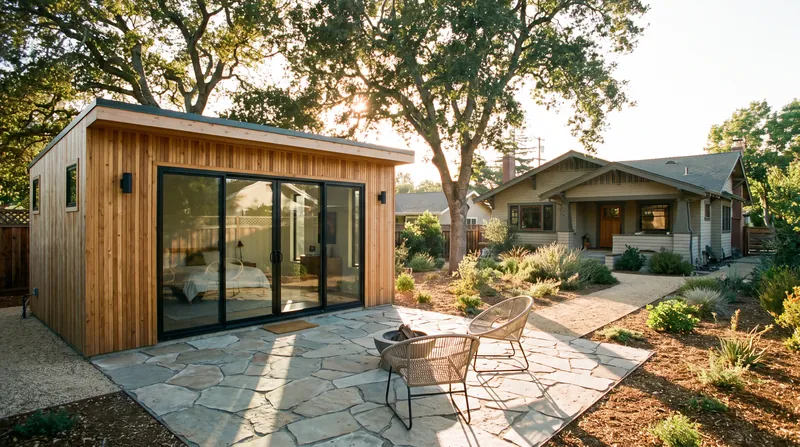
In the United States, California's incremental but aggressive approach to zoning reform has yielded similar supply-side victories. By passing sweeping state-level legislation like Senate Bill 9 and systematically streamlining the approval process for Accessory Dwelling Units (ADUs), the state effectively ended single-family exclusive zoning, stripping local municipalities of their ability to block gentle density. These laws were designed to refocus property rights, allowing everyday homeowners to modify their own parcels without navigating years of costly discretionary review, environmental challenges, and organized neighborhood opposition.
The response from California homeowners was immediate and overwhelming. Following the relaxation of these rules, California experienced the largest single-year increase in ADU construction in its history, with 4,827 more permits issued in 2021 than in 2020. This surge in backyard cottages and garage conversions suggests that ordinary property owners, not just large corporate developers, are eager to add density and generate rental income when the regulatory friction is reduced. The California ADU boom serves as a powerful proof of concept for incremental missing-middle policies.
However, proving that upzoning increases physical housing supply is only half the battle; the ultimate goal of these policies is to restore affordability for the average renter and buyer. Here, the evidence from Minneapolis—which made international headlines in 2018 as the first major U.S. city to eliminate single-family zoning citywide with its ambitious 2040 Plan—provides a crucial and closely watched test case.
The city's explicit goal was to curb runaway housing costs by allowing duplexes and triplexes on every residential lot, testing whether missing-middle housing could actually move the needle on regional inflation.[1]
A comprehensive 2025 study from researchers at Middlebury College analyzed the first five years of the Minneapolis experiment to determine its impact on prices. By comparing the city's housing market to a synthetic control group constructed from 83 donor cities across the country, the researchers found that the zoning reform significantly suppressed the growth of housing costs. The data revealed a stark divergence between the actual city and the counterfactual model, proving that the policy intervention had a measurable cooling effect on the market.[1]
The specific numbers from the Middlebury study highlight the magnitude of the relief. Between 2020 and 2025, rents in the synthetic control version of Minneapolis grew at an annual rate of 5.6 percent, whereas actual rents in the city grew at a highly moderated 1.8 percent.
Furthermore, home prices in the actual city were estimated to be 16 to 34 percent lower than they would have been without the reform. Notably, Minneapolis rents have actually declined in nominal terms since 2017, a remarkable achievement given that most other Midwestern cities experienced rent increases exceeding 30 percent over the exact same period.[1][4]
Despite these localized and highly publicized success stories, the broader academic consensus remains somewhat cautious about the speed and scale of upzoning's impact across different geographies. A major 2024 study published by the Urban Institute analyzed 180 land-use reforms across eight U.S. metropolitan areas to gauge their macroeconomic effect. The researchers concluded that "less restrictive" reforms increased the local housing stock by only 0.8 percent over a three-to-nine-year period, a figure that disappointed many supply-side advocates hoping for an immediate construction boom.[2]
This modest finding suggests that while upzoning works in theory, it is often a slow-moving mechanism that takes years to meaningfully alter a metropolitan area's physical housing stock. The Urban Institute researchers noted that when upzoning occurs in weak-market neighborhoods, little to no new housing actually follows. This highlights a fundamental reality of real estate economics: zoning reform only triggers new construction in areas where market demand already exists and where developers believe they can secure a profitable return on their investment.[2]
The Urban Institute's methodology and conclusions, however, have sparked a fierce and highly technical debate within the housing economics community. The American Enterprise Institute (AEI) Housing Center published a scathing critique of the study, arguing that its reliance on machine-learning analysis of newspaper articles led to severe misclassifications of what actually constituted a "major" reform. The AEI researchers argued that many of the policies analyzed were minor tweaks rather than genuine, by-right upzoning, thereby artificially depressing the measured impact on housing supply.
According to the AEI's independent review and subsequent case studies, simple, by-right zoning reforms can actually expand local housing supply by 1 to 2.5 percent per year—a significantly faster and more impactful rate than the Urban Institute's conservative estimates. The AEI argues that when property owners are granted clear, unambiguous rights to build duplexes or triplexes without facing discretionary review, hostile public hearings, or arbitrary administrative vetoes, the private market responds robustly and rapidly to fill the missing-middle gap.
Yet, even the most optimistic proponents of deregulation acknowledge that zoning reform is not a standalone cure for the multifaceted affordability crisis. The Bipartisan Policy Center highlights that while relaxing land-use restrictions is an absolutely necessary first step, it is often insufficient on its own due to the sheer, escalating cost of modern construction. Simply making it legal to build a triplex does not magically make it cheap to build one, especially in an era of elevated macroeconomic headwinds.[3]
High interest rates, persistent supply chain disruptions, and elevated labor costs mean that even when developers are legally permitted to build missing-middle housing, the project may not pencil out financially. Without complementary policies that lower the cost of financing, streamline permitting fees, or directly subsidize construction, the new units that do manage to get built tend to target the upper end of the market to ensure profitability. This economic reality limits the immediate relief available to the lowest-income renters.[3]
This dynamic is a central concern for equity advocates and urban researchers monitoring the fallout of these policies. Experts at the University of Toronto's School of Cities warn that without specific affordability mandates baked into the zoning changes, missing-middle developments often generate market-rate products that remain entirely out of reach for low-income and marginalized residents. If upzoning merely replaces a two-million-dollar single-family home with three one-million-dollar townhomes, the neighborhood remains exclusive and unaffordable, even as the overall density of the parcel technically increases.
To counter this gentrification risk, progressive cities are increasingly pairing upzoning with aggressive density bonuses. Austin's "Affordability Unlocked" program, for example, offers developers additional density allowances, waived fees, and expedited processing in exchange for dedicating a strict percentage of the new units to low- and moderate-income households. This hybrid approach has successfully produced over 10,000 low-cost units, helping Austin record significantly lower rent increases compared to the rest of Texas and proving that market incentives can be harnessed for public good.
Ultimately, the emerging evidence pack from across the globe paints a highly nuanced picture of zoning reform. Abolishing single-family zoning is clearly not an overnight silver bullet that will immediately slash rents across an entire metropolitan area. The physical realities of construction, financing, and labor mean that it takes years for a change in the legal code to translate into a meaningful shift in the physical housing stock. Expectations of immediate, sweeping price drops are often misplaced, leading to premature declarations of policy failure.[4]
Instead, upzoning functions as a critical, non-negotiable prerequisite for long-term affordability. By legalizing missing-middle housing, cities like Auckland and Minneapolis have definitively proven that they can bend the long-term cost curve, stabilizing prices and preventing the runaway inflation seen in heavily restricted coastal markets. For policymakers, urban planners, and voters looking to solve the generational housing crisis, zoning reform is not the final destination, but it is undeniably the foundation upon which any functional, equitable housing market must be built.[4]
Key terms
- Upzoning
- Changing local zoning codes to allow for higher-density development, such as permitting a triplex on a lot previously restricted to a single-family home.
- Synthetic Control
- A statistical method used by researchers to evaluate policy impacts by comparing the treated city to a mathematically constructed "clone" made from a weighted average of similar, untreated cities.
- By-Right Development
- A project that complies with all zoning codes and can be approved administratively without requiring discretionary public hearings or city council votes.
- Accessory Dwelling Unit (ADU)
- A smaller, independent residential dwelling unit located on the same lot as a standalone single-family home, often called a granny flat or backyard cottage.
Frequently asked
What is "Missing Middle" housing?
It refers to multi-unit housing types—like duplexes, triplexes, townhomes, and courtyard apartments—that fall between detached single-family homes and mid-rise apartment buildings.
Did ending single-family zoning lower prices in Minneapolis?
Yes, research indicates that the Minneapolis 2040 Plan slowed rent growth to 1.8% (compared to 5.6% in control cities) and kept home prices 16% to 34% lower than they would have been without the reform.
Does upzoning work immediately?
No. Studies show that zoning reform is a slow-moving mechanism. It can take five to ten years for the market to finance, permit, and build enough new supply to meaningfully impact regional housing costs.
Can I build an ADU in my backyard?
It depends on your local laws, but many states, including California and Oregon, have recently passed legislation overriding local zoning to allow homeowners to build Accessory Dwelling Units by-right.
Viewpoints in depth
Supply-Side Reformers
Argue that restrictive zoning is the root cause of the housing crisis and that deregulation is the primary solution.
This camp believes that the free market can naturally meet housing demand if government barriers are removed. They point to Auckland and California's ADU boom as definitive proof that reducing regulatory friction immediately unleashes private capital to build more homes. By legalizing the by-right development of missing-middle housing, they argue that cities can dilute land costs and organically lower prices without relying on massive public subsidies.
Comprehensive Policy Advocates
Emphasize that while upzoning is necessary, it is insufficient for achieving true affordability for low-income earners.
Because land, labor, and construction materials are so expensive, this group notes that new missing-middle units often price out at market rates. They advocate for pairing zoning reform with density bonuses, tax exemptions, and direct subsidies. Programs like Austin's 'Affordability Unlocked' are held up as the gold standard, proving that cities must actively mandate affordability rather than hoping supply-side economics will eventually trickle down to the most vulnerable residents.
Neighborhood Preservationists
Oppose blanket upzoning out of concern for neighborhood character, infrastructure strain, and gentrification.
Though less prominent in the empirical economic literature, this camp frequently opposes upzoning at the local municipal level. They argue that abolishing single-family zoning degrades the architectural character of established neighborhoods, strains local parking and utility infrastructure, and enriches developers without guaranteeing that the resulting multi-unit buildings will actually be affordable to existing residents.
- Empirical Researchers
- Focus on measuring the actual impact of reforms using synthetic controls and permit data.
- Supply-Side Reformers
- Argue that removing zoning barriers is the primary mechanism to increase housing stock and lower prices.
- Comprehensive Policy Advocates
- Argue that zoning reform must be paired with subsidies, financing, and affordability mandates to help low-income earners.
Perspectives this story doesn't cover
- Local Municipal Planners
- Construction Labor Unions
Sources
Source coverage
4 outlets
3 viewpoints surfaced




- [1]Middlebury CollegeEmpirical Researchers
The Impact of the Minneapolis 2040 Plan on Housing Costs
Read on Middlebury College → - [2]Urban InstituteEmpirical Researchers
How Much Additional Housing Does Upzoning Produce?
Read on Urban Institute → - [3]Bipartisan Policy CenterComprehensive Policy Advocates
Zoning Reform is Only One Part of the Equation
Read on Bipartisan Policy Center → - [4]Factlen Editorial TeamSupply-Side Reformers
Synthesis by Factlen editorial team
Read on Factlen Editorial Team →
More in Real Estate
See all →Housing Economics
The User Cost of Housing: Why 7.28% Mortgage Rates Have Broken the Rent-Versus-Buy Math
6 sources
Housing Maturation
China's Property Market Officially Enters 'Stock-Dominated Era' as Resale Transactions Surpass 50%
5 sources

Tax Strategy
Why Land Value Must Be Separated From Improvement Value to Calculate Tax Depreciation
8 sources

Pending Home Sales
US Pending Home Sales Edge Up 0.3% in August as Buyers Navigate High Rates
7 sources
Comments
Every angle. Every day.
Get Real Estate stories with full source coverage and perspective breakdowns, free every day.