
Haptic Suits and 'Vibro-DJs' Make Summer Music Festivals Fully Accessible for Deaf Fans
Wearable technology that translates live audio into full-body vibrations is moving from experimental pilots to standard accessibility offerings at major concerts this summer.
By Factlen Editorial Team
- Accessibility Advocates
- View haptic technology as a necessary evolution from basic compliance to true inclusion.
- Haptic Technologists
- Treat physical vibration as a distinct artistic medium rather than a crude substitute for sound.
- Live Entertainment Industry
- Focus on scaling the technology and integrating it seamlessly into massive live events.
- Industry Observers
- Analyze the broader cultural and logistical shifts driving the adoption of inclusive technologies.
What's not represented
- · Independent venue owners who struggle to afford high-tech accessibility accommodations.
- · Deaf fans who prefer traditional ASL interpretation over physical tactile feedback.
Why this matters
For millions of people globally with hearing loss, live music has historically been an exclusionary experience. The rapid scaling of haptic technology transforms concerts from purely auditory events into universally accessible, multi-sensory physical experiences.
Key points
- Haptic suits translate live music into full-body vibrations using up to 24 distinct actuators.
- Specialized 'Vibro-DJs' map different instruments to specific body parts, like kick drums to the lower back.
- Coldplay helped popularize the technology by offering SubPac vests at every show on their world tour.
- Newer 5G-enabled suits also transmit the ambient vibrations of crowd noise, reducing feelings of isolation.
- The technology is moving from experimental pilots to standard accessibility offerings at 2026 summer festivals.
The 2026 summer concert season is officially underway, and alongside the massive speaker arrays and elaborate light shows, a quieter technological revolution is taking center stage. For Deaf and hard-of-hearing fans, live music is no longer just a visual or bass-heavy experience—it is a fully mapped, full-body tactile journey.[8]
What began a few years ago as experimental pilots by a handful of tech-forward artists and accessibility advocates has rapidly scaled into a standard offering at major venues and festivals worldwide. Wearable haptic suits, which translate live audio into distinct physical sensations in real-time, are fundamentally changing how audiences interact with live entertainment.[8]
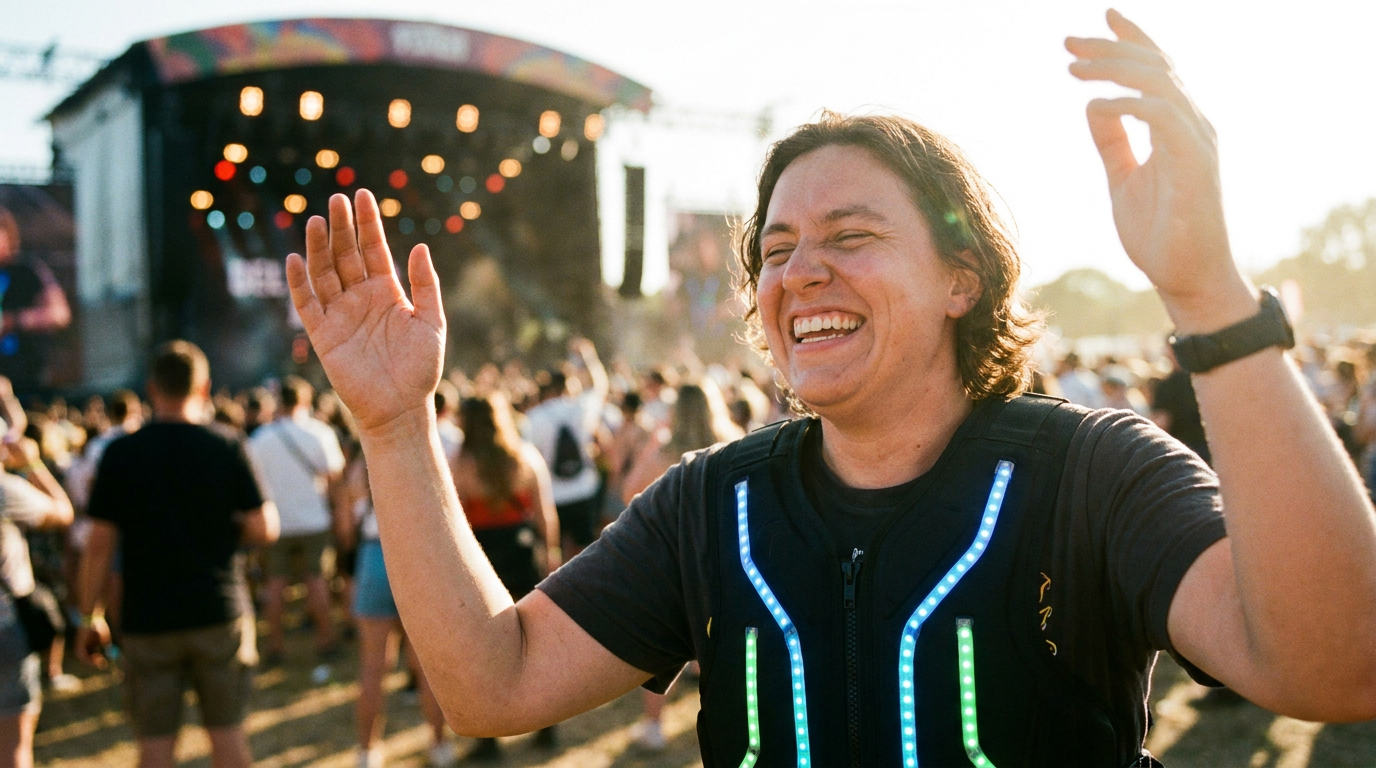
The most prominent hardware ecosystem, developed by the technology incubator Music: Not Impossible, consists of a lightweight harness worn like a backpack, accompanied by specialized wrist and ankle bands. Across this wearable system are 24 distinct vibrating actuators that distribute physical sensations across the wearer's body.[1][4]
The technology relies on far more than a simple rumble pack. At the mixing board, specialized "Vibro-DJs" or haptic audio engineers actively carve out specific frequencies to send to different parts of the body. A heavy kick drum might be mapped as a deep pulse to the lower back, a snare drum to the wrists, and high-pitched vocals to the shoulders.[3][5]

This careful mapping creates what audio experts describe as a "3D-surround experience through vibrations." Because the skin and the ears process sensory input differently, engineers have discovered that frequencies which might sound harsh to the human ear can actually produce deeply compelling and emotional physical vibrations on the body.[1][3]
For decades, the Deaf community has engaged with live music through rudimentary, improvised means. Historically, hard-of-hearing fans would stand barefoot near subwoofers to feel the acoustic resonance through the floorboards, or hold inflated balloons in their hands to capture the vibrations of the soundwaves in the air.[3]
For decades, the Deaf community has engaged with live music through rudimentary, improvised means.
The mainstream push for dedicated haptic technology gained massive momentum during Coldplay's recent record-breaking world tours. Frontman Chris Martin championed the technology after his partner, actress Dakota Johnson, gifted him a SubPac vest—a wearable bass system frequently used by music producers like Finneas O'Connell to feel low-end frequencies in the studio.[2][6]
Recognizing the potential for live audiences, Coldplay began offering SubPac vests and dedicated American Sign Language (ASL) interpreters at every show, allowing fans to sign up for the gear in advance. This high-profile adoption proved the logistical viability of the technology at a stadium scale, forcing the rest of the live entertainment industry to take notice.[2][6]

By the start of the 2026 festival season, international promoters and telecommunications companies had deeply integrated the tech. At major outdoor events, including London's Mighty Hoopla festival, organizers deployed 5G-enabled suits that transmitted not only the artist's performance but also the ambient roar of the crowd.[7]
Capturing the crowd's energy represented a crucial breakthrough for inclusivity. Deaf fans often report feeling isolated when a song ends and the crowd cheers, as they lose the environmental context of the room. By using 5G receptors to feed crowd noise into the suits as real-time vibrations, fans can physically feel the collective energy of the audience around them.[7]
Creators of the technology emphasize that this movement goes beyond basic ADA compliance or standard accommodation—it is an exercise in "radical inclusivity." Hearing fans who have tested the suits alongside Deaf attendees frequently report that the tactile layer fundamentally elevates the performance for them as well, turning a passive listening experience into an immersive physical one.[4][8]

As the hardware becomes lighter, cheaper, and wireless latency drops to near-zero, accessibility advocates hope haptic suits will soon become as ubiquitous as assisted listening devices or wheelchair ramps at venues of all sizes. For a community that has long been told music wasn't meant for them, the message vibrating through the floorboards this summer is clear: music is a universal language, and everyone deserves to feel the beat.[8]
How we got here
1980s
Deaf music fans pioneer tactile listening by standing barefoot near subwoofers and holding balloons to feel vibrations.
2022
Coldplay begins offering SubPac vests and ASL interpreters at every stop of their Music of the Spheres world tour.
2023
Music: Not Impossible deploys its 24-point haptic suits at major cultural events, including classical concerts at Lincoln Center.
Summer 2026
Haptic technology becomes a widely expected accessibility standard at major international music festivals.
Viewpoints in depth
Accessibility Advocates
View haptic technology as a necessary evolution from basic compliance to true inclusion.
For decades, accessibility at live events meant little more than a designated viewing platform and, occasionally, an ASL interpreter. Advocates argue that true inclusion means providing equitable access to the experience of the art itself. By translating sound into touch, haptic suits bridge the sensory gap, allowing Deaf patrons to participate in the communal, physical joy of a concert rather than merely observing it from the outside.
Haptic Engineers & 'Vibro-DJs'
Treat physical vibration as a distinct artistic medium rather than a crude substitute for sound.
Technologists and composers working with haptic suits emphasize that they are not simply plugging a master audio track into a rumble pack. They view the skin as a canvas with its own unique 'appetites' and limitations. A sound that is pleasing to the ear might feel chaotic on the skin, requiring Vibro-DJs to actively mix and carve out frequencies to create a tactile symphony that complements, rather than mimics, the auditory performance.
Live Entertainment Promoters
Balance the high costs of emerging technology with the growing demand for inclusive experiences.
While major acts like Coldplay and massive festivals can absorb the costs of providing dozens of high-tech suits and dedicated haptic engineers, smaller independent venues face logistical and financial hurdles. Promoters are increasingly looking for scalable, plug-and-play solutions that allow them to offer tactile accessibility without requiring a dedicated touring crew to manage the wireless infrastructure.
What we don't know
- How quickly the technology can be scaled down in price to become affordable for small, independent music venues.
- Whether haptic audio mixing will eventually become a standard part of the music production process in recording studios.
Key terms
- Haptic Suit
- A wearable device equipped with actuators that translate audio signals into physical vibrations across the body.
- Vibro-DJ
- An audio engineer who specifically mixes and routes sound frequencies to different parts of a haptic suit in real-time.
- Actuator
- A small mechanical component within the haptic suit that vibrates at specific intensities and frequencies.
- SubPac
- A wearable audio system that transfers low frequencies (bass) directly to the user's body, originally designed for music producers.
Frequently asked
Can hearing people use haptic suits?
Yes. While designed primarily for the Deaf and hard-of-hearing community, hearing fans who use the suits report that the added tactile layer deeply enhances their overall concert experience.
Does the suit just vibrate to the bass?
No. Advanced suits feature up to 24 distinct vibration points, allowing engineers to map different instruments—like vocals, snares, and guitars—to different parts of the body.
Do fans have to pay extra to use the suits?
At major tours and festivals that have adopted the technology, the suits are typically provided free of charge to fans who request them in advance as an accessibility accommodation.
Sources
Source coverage
8 outlets
4 viewpoints surfaced








[1]TIMEAccessibility Advocates
Feeling the Beats
Read on TIME →[2]CBS NewsLive Entertainment Industry
Coldplay aims to promote togetherness for hard-of-hearing fans at concerts
Read on CBS News →[3]Tech XploreHaptic Technologists
Vibrating vests translate music for deaf concertgoers
Read on Tech Xplore →[4]Music: Not ImpossibleHaptic Technologists
Inclusive Music Experiences & Innovation
Read on Music: Not Impossible →[5]WNYC StudiosAccessibility Advocates
Replay: Deaf Concert-Goers Can Feel the Beat
Read on WNYC Studios →[6]UPROXXAccessibility Advocates
Coldplay Is Making Concerts Accessible For Hearing-Impaired Fans
Read on UPROXX →[7]Vodafone UKLive Entertainment Industry
5G haptic suits deliver live experience for deaf music fans
Read on Vodafone UK →[8]Factlen Editorial TeamIndustry Observers
Synthesis by Factlen editorial team
Read on Factlen Editorial Team →
Every angle. Every day.
Get entertainment stories with full source coverage and perspective breakdowns delivered to your inbox.