
European Parliament Approves 'Digital Omnibus', Delaying Key EU AI Act Enforcement to 2027
In a sweeping vote on June 16, the European Parliament formally delayed the enforcement of the EU AI Act's high-risk obligations by 16 months, while introducing an immediate ban on non-consensual AI 'nudifier' apps.
By Factlen Editorial Team
- Enterprise Compliance Advisors
- View the delay as crucial breathing room but warn clients that the new deadlines are final and require immediate engineering work.
- European Policymakers
- Argue the delay is a necessary adjustment to ensure technical standards are ready and to protect European tech competitiveness.
- Regulatory Analysts
- Observe a shift toward deregulation and warn that repeatedly moving the goalposts risks undermining the AI Act's global credibility.
What's not represented
- · Open-source AI developers whose models are subject to the accelerated watermarking deadlines.
- · Civil rights organizations concerned about the 16-month delay in protections against high-risk biometric and law enforcement AI.
Why this matters
The 16-month delay gives enterprises crucial breathing room to build AI compliance programs, but the immediate December 2026 deadline for watermarking means companies deploying generative AI have less than six months to implement machine-readable labels or face removal from the EU market.
Key points
- The European Parliament voted 423-57 to approve the Digital Omnibus, delaying key AI Act rules.
- Annex III high-risk AI systems now have until December 2, 2027, to achieve full compliance.
- AI systems embedded in regulated products (Annex I) are delayed until August 2, 2028.
- Watermarking and transparency rules for generative AI will take effect on December 2, 2026.
- The legislation introduces a strict ban on AI 'nudifier' apps that lack effective safety filters.
- The delay aims to give standards bodies time to finalize technical benchmarks and reduce enterprise compliance burdens.
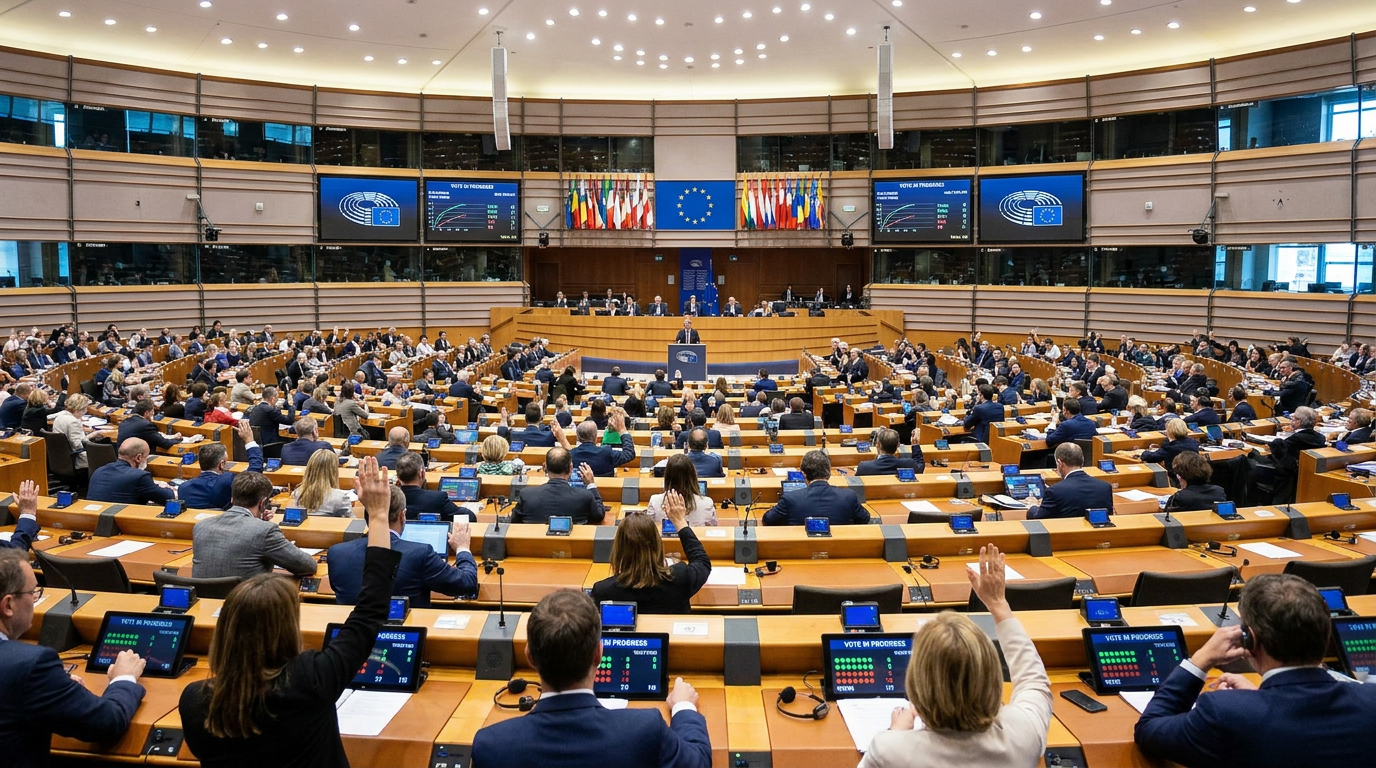
On June 16, 2026, the European Parliament voted decisively to alter the timeline of the world's most comprehensive artificial intelligence law. By a margin of 423 to 57, with 174 abstentions, lawmakers gave final approval to the 'Digital Omnibus on AI,' a legislative package that formally delays the enforcement of the EU AI Act's most stringent obligations. The vote concludes months of fraught negotiations over how to balance the bloc's desire for strict AI safety with the practical realities of enterprise compliance and European tech competitiveness.[1][3][6]
The core claim of the Omnibus is that the original enforcement schedule was technically unworkable. Under the AI Act, which entered into force in August 2024, the rules governing 'high-risk' AI systems were slated to take effect on August 2, 2026. The Omnibus pushes that critical deadline back by 16 months. Standalone high-risk systems—categorized under Annex III of the Act, which includes AI used for recruitment, credit scoring, biometric identification, and law enforcement—must now achieve full compliance by December 2, 2027.[1][2][4][7][8]
For AI systems deeply embedded into physical products, the delay is even longer. Systems classified under Annex I, which function as safety components in heavily regulated goods like medical devices, industrial machinery, and vehicles, have been granted a 24-month extension. These embedded systems will not face the AI Act's high-risk requirements until August 2, 2028. The European Parliament stated that the postponement was necessary to ensure that the required technical standards and support measures are actually in place before companies are legally forced to test against them.[1][2][4][5][6]

The evidence supporting the necessity of the delay became undeniable by late 2025. The European Commission recognized that the drafting of harmonized standards—the specific technical benchmarks that companies use to prove their AI systems are safe—was severely lagging. Without these standards, enterprises would have been forced to guess at compliance, risking massive fines. This prompted the Commission to table the Digital Omnibus proposal in November 2025, initiating a complex 'trilogue' negotiation between the Parliament, the Council, and the Commission.[3][6][7][8]
Those negotiations nearly collapsed in April 2026. The breakdown did not center on whether to delay the rules, but rather on how the AI Act would interlock with existing European sectoral safety laws. Industry groups argued that applying both the AI Act and existing machinery directives to the same product would create an impossible web of overlapping audits. A provisional compromise was finally reached on May 7, 2026, which paved the way for the June 16 parliamentary approval.[2][4][5][6]
To resolve the regulatory overlap, the Omnibus introduces a narrower, more precise definition of what constitutes a 'safety component.' Under the revised text, AI functions that merely assist users or optimize a product's performance will not automatically trigger high-risk obligations, provided their failure does not pose a direct health or safety risk. Furthermore, the legislation clarifies that certain machinery products will only need to comply with sectoral safety rules, rather than facing double jeopardy under both frameworks.[1][5]
While the high-risk obligations have been pushed into 2027 and 2028, the Omnibus does not offer a blanket reprieve for all AI developers. The transparency rules governing generative AI have been placed on a much tighter timeline. Originally, the mandate to clearly label AI-generated content was scheduled for August 2026. The Omnibus compresses the grace period for these rules, establishing a hard enforcement date of December 2, 2026.[1][2][4]

While the high-risk obligations have been pushed into 2027 and 2028, the Omnibus does not offer a blanket reprieve for all AI developers.
By that December 2026 deadline, any company deploying generative AI in the European market must ensure their outputs are identifiable. This requires implementing machine-readable watermarks and metadata embedding for synthetic audio, video, and text. Compliance advisors warn that this leaves engineering teams with less than six months to build, test, and deploy robust detection and labeling capabilities across their consumer-facing products.[1][2][4]
Beyond adjusting timelines, the Omnibus actively expands the AI Act's list of unacceptable risks. The June 16 vote formally amended Article 5 of the Act to introduce a strict ban on 'nudifier' applications. The legislation now explicitly prohibits the placing on the market of AI systems designed to generate child sexual abuse material or non-consensual imagery depicting an identifiable person's intimate parts or sexually explicit activities.[1][2][7]
This prohibition applies to both the providers who build the models and the deployers who use them. The only exception is a safe-harbor provision for systems that incorporate adequate, verifiable technical safeguards to prevent the generation of such material. Companies hosting generative models have until December 2, 2026, to prove their safety filters are effective or face immediate removal from the EU market.[1][4]
The passage of the Omnibus reflects a broader ideological shift within Brussels. Regulatory analysts note that the policy momentum has pivoted from strictly preempting AI harms toward reducing the compliance burden for tech companies. By relaxing the deadlines and simplifying the conformity assessment architecture, European policymakers are attempting to stimulate domestic innovation and prevent an exodus of AI startups to less regulated jurisdictions.[3][8]

However, this deregulation push carries inherent risks for the European Union's global influence. The 'Brussels Effect'—the phenomenon where EU regulations become the de facto global standard because multinational companies prefer to build to a single strict baseline—depends entirely on the AI Act being a credible, binding text. Analysts warn that if the bloc continually delays enforcement whenever the technical hurdles appear too steep, the legislation loses its teeth.[2][3][8]
For enterprise compliance teams, the June 16 vote provides much-needed certainty. Legal advisors are explicitly instructing clients that the 'simplification round is over' and that these new dates are final. The institutions held the line on the core architecture of the Act; the risk-based classification, the conformity assessment regime, and the oversight role of the AI Office remain entirely intact.[2][4][5][7]
The 18-month extension for Annex III systems is not a signal to pause preparations. Enterprises are advised to use this window to conduct comprehensive AI inventories, classify their systems against the risk tiers, and build the data governance trails that regulators will demand in December 2027. As one compliance firm noted, the underlying risk of AI-caused harm has not moved; existing sectoral laws, product liability directives, and the GDPR remain fully in force today.[2][4]
The ultimate success of the Omnibus delay hinges on the European standards bodies. The Commission now has until late 2027 to finalize the harmonized standards and provide clear guidelines on post-market monitoring. If those technical benchmarks are delayed again, the European Parliament may find itself facing the exact same compliance crisis in 2027 that it just voted to avert in 2026.[2][3][8]
How we got here
Aug 2024
The EU AI Act officially enters into force, starting the original 24-month transition clock.
Nov 2025
The European Commission proposes the Digital Omnibus to delay high-risk obligations due to lagging technical standards.
Apr 2026
Trilogue negotiations stall over how the AI Act interlocks with existing sectoral safety laws.
May 2026
A provisional political agreement is reached to delay Annex III and Annex I enforcement dates.
Jun 2026
The European Parliament formally approves the Digital Omnibus, cementing the new 2027 and 2028 deadlines.
Viewpoints in depth
European Policymakers' View
The delay is a necessary adjustment to ensure technical standards are ready and to protect European competitiveness.
Lawmakers argue that enforcing the August 2026 deadline without finalized harmonized standards would have crippled European tech companies. By pushing the high-risk obligations to late 2027 and narrowing the definition of 'safety components,' the EU aims to reduce overlapping regulatory burdens and stimulate domestic AI innovation while maintaining the core architecture of the AI Act.
Enterprise Compliance Advisors' View
The delay offers breathing room, but the new deadlines are final and require immediate action.
Legal and compliance experts warn enterprises not to view the Omnibus as a permanent reprieve. The December 2026 deadline for watermarking generative AI outputs is only months away, requiring significant engineering work. Advisors stress that the 18-month extension for high-risk systems must be used to build robust risk management and data governance frameworks, as the 'simplification round' is now definitively over.
Regulatory Analysts' View
The Omnibus reflects a broader shift toward deregulation that could test the credibility of the 'Brussels Effect.'
Think tanks like Bruegel observe that the policy momentum in Europe has shifted from strictly preempting AI harms to reducing the compliance burden. Analysts note that while the delay prevents a chaotic rollout, repeatedly moving the goalposts risks undermining the AI Act's status as the definitive global standard for artificial intelligence regulation.
What we don't know
- Whether the European standards bodies will actually finalize the necessary harmonized technical standards before the new December 2027 deadline.
- How strictly national market surveillance authorities will enforce the December 2026 watermarking rules on open-source generative models.
- Whether the delay will successfully prevent AI startups from leaving the EU, or if the regulatory burden remains too high.
Key terms
- Digital Omnibus
- A legislative package proposed by the European Commission to simplify the EU's digital regulatory framework and adjust implementation timelines.
- Annex III High-Risk Systems
- Standalone AI systems used in sensitive areas like employment, education, credit scoring, and law enforcement, which face strict compliance rules.
- Annex I High-Risk Systems
- AI systems embedded as safety components in products already regulated by EU sectoral laws, such as medical devices, machinery, and toys.
- Article 50 Transparency
- The requirement that AI-generated content (deepfakes, synthetic text) must be clearly labeled and machine-readable so users know they are interacting with AI.
- Trilogue
- Informal tripartite negotiations between the European Parliament, the Council of the EU, and the European Commission to reach a provisional agreement on legislation.
Frequently asked
Is the EU AI Act completely delayed?
No. Prohibitions and general-purpose AI rules are already in effect. Only the high-risk system obligations and transparency rules were delayed by the Omnibus.
When do AI watermarking rules take effect?
December 2, 2026. Companies deploying generative AI in the EU must implement machine-readable labeling for synthetic content by this date.
What is the new ban on 'nudifier' apps?
The Digital Omnibus amends Article 5 to prohibit AI systems that generate non-consensual intimate imagery or child sexual abuse material without strict preventive safeguards.
What happens to AI used in employment and hiring?
These are classified as Annex III high-risk systems. The deadline for these systems to comply with strict risk management and data quality rules is now December 2, 2027.
Sources
Source coverage
8 outlets
3 viewpoints surfaced






[1]European ParliamentEuropean Policymakers
AI Act: EP approves simplification measures and “nudifier” app ban
Read on European Parliament →[2]VerifyWiseEnterprise Compliance Advisors
EU AI Act omnibus: what changed on 7 May 2026 and what to do about it
Read on VerifyWise →[3]BruegelRegulatory Analysts
The right balance: how to fix European Union artificial intelligence regulation
Read on Bruegel →[4]Modulos AIEnterprise Compliance Advisors
EU AI Act Delayed: The Omnibus Deal Closed on 7 May 2026
Read on Modulos AI →[5]White & Case LLPEnterprise Compliance Advisors
EU agrees Digital Omnibus deal to simplify AI rules
Read on White & Case LLP →[6]Bird & BirdEnterprise Compliance Advisors
Digital Omnibus on AI Trilogue Stalls Ahead of the AI Act Deadline
Read on Bird & Bird →[7]DentonsEnterprise Compliance Advisors
The Digital Omnibus on AI: A short guide to the provisional compromise
Read on Dentons →[8]Factlen Editorial TeamRegulatory Analysts
Synthesis by Factlen editorial team
Read on Factlen Editorial Team →


Every angle. Every day.
Get ai stories with full source coverage and perspective breakdowns delivered to your inbox.