
The Science of Digital Weight: How Electromagnetic Motors Are Replacing Iron
Smart home gyms are using electromagnetic resistance to simulate hundreds of pounds of weight. Biomechanists say the technology doesn't just replicate free weights—it might actually be more efficient.
By Factlen Editorial Team
- Sports Scientists & Biomechanists
- Argue that muscles respond to mechanical tension, not physical mass, making digital resistance highly efficient.
- Home Gym Enthusiasts
- Value the massive space savings, safety features, and convenience of having a full cable machine in a small footprint.
- Traditional Strength Purists
- Maintain that balancing physical iron in three-dimensional space is essential for building real-world stabilizer muscles.
What's not represented
- · Commercial Gym Operators
- · Physical Therapists
Why this matters
For decades, building serious strength at home required dedicating a garage to bulky iron plates and power racks. The maturation of electromagnetic resistance means a complete, heavy-duty gym can now fit in the corner of a living room, fundamentally changing who has access to elite-level strength training.
Key points
- Digital weight uses electromagnetic motors instead of physical iron plates to generate resistance.
- Because it eliminates momentum, digital weight feels up to 26% heavier than traditional free weights.
- Smart machines can dynamically adjust resistance mid-rep, allowing for advanced techniques like heavy eccentric loading.
- AI safety features instantly drop the weight if a user fails a lift, eliminating the need for a spotter.
- Traditionalists argue that physical barbells are still necessary for developing real-world stabilizer muscles.
For generations, the pursuit of physical strength has been inextricably linked to the manipulation of heavy iron. From the rusted dumbbells of old-school bodybuilding gyms to the sprawling power racks of modern athletic facilities, gravity and mass have been the undisputed currencies of muscle growth. But a quiet revolution is taking place in the corners of living rooms and apartments. The iron is disappearing, replaced by sleek, glowing platforms and wall-mounted screens. This is the era of digital weight, a technology that discards physical plates in favor of electromagnetic motors.[6]
At first glance, the concept of "digital weight" sounds like a marketing gimmick—a buzzword designed to sell expensive screens to affluent fitness enthusiasts. Traditional lifters initially scoffed at the idea that a machine weighing less than 100 pounds could provide a genuine strength-training stimulus. Yet, as the technology has matured, the skepticism has begun to evaporate. Today's digital variable resistance machines are capable of generating hundreds of pounds of force, challenging even advanced powerlifters and fundamentally rewriting the rules of home fitness.[6]
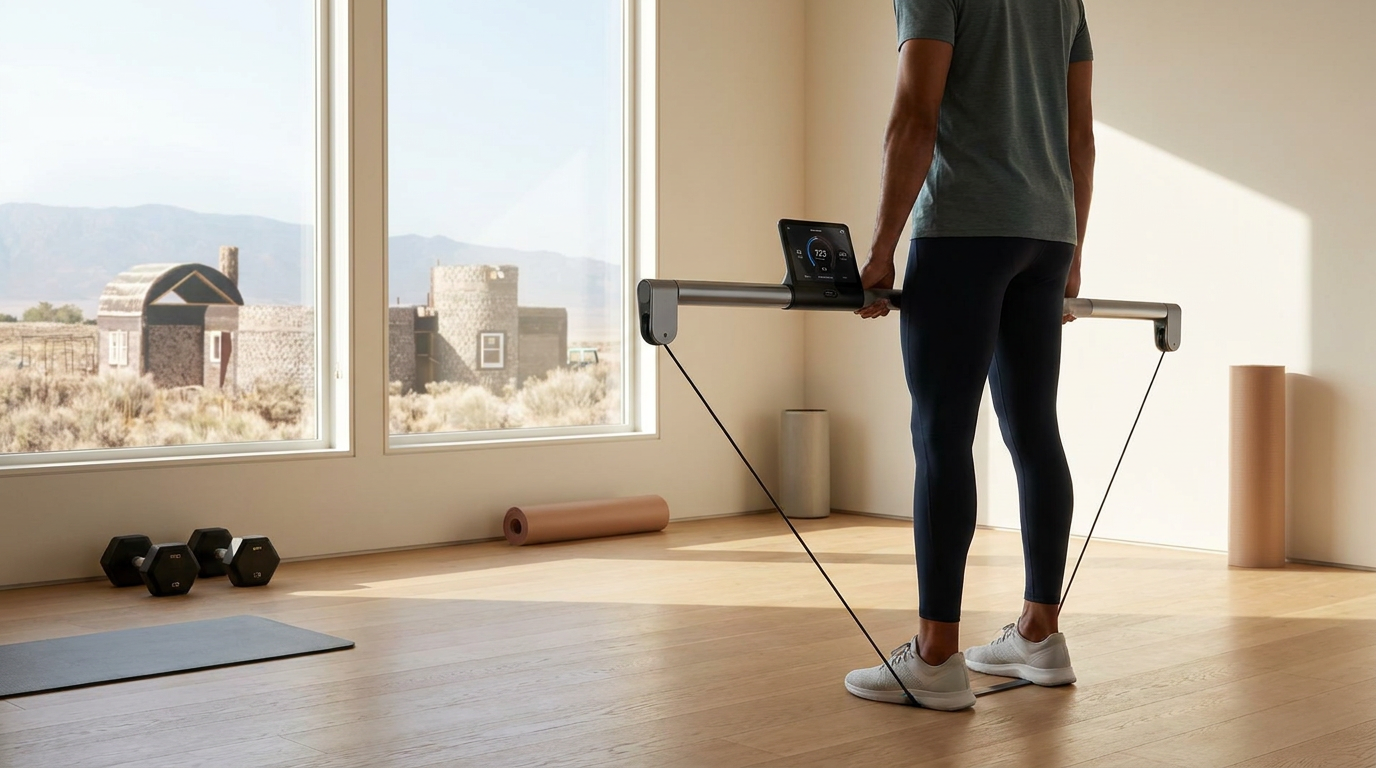
The core mechanism behind this shift is electromagnetic resistance. Inside machines like the Vitruvian Trainer+ or the Tonal wall system, high-torque electric motors are attached to Kevlar cables. When a user pulls on the cable, the motor pulls back. By rapidly adjusting the electrical current flowing through the motor, the machine can instantly increase or decrease the physical resistance felt by the user. There are no weight stacks clanking together and no plates to load; the resistance is generated entirely by the invisible push and pull of electromagnetism.[3][5]
One of the most immediate and jarring realizations for anyone trying digital weight for the first time is that it feels significantly heavier than traditional iron. A user who comfortably curls a 30-pound dumbbell might find themselves struggling to move 20 pounds of digital resistance. This discrepancy is not a calibration error; it is a fundamental difference in physics. Digital weight eliminates the mechanical advantages that humans naturally exploit when lifting physical objects in the real world.[4][8]

When you lift a physical dumbbell, you are fighting gravity. However, once you accelerate that mass upward, inertia takes over. The momentum generated at the bottom of the lift carries the weight through the middle of the movement, momentarily reducing the actual tension required from your muscles. Digital weight, by contrast, has no physical mass and therefore generates zero momentum. If the motor is programmed to deliver 50 pounds of resistance, it delivers exactly 50 pounds of resistance at every single millimeter of the range of motion.[4][7]
This phenomenon was quantified in an independent biomechanics study conducted at High Point University. Researchers compared the perceived exertion and muscle activation of subjects using traditional barbells versus a digital resistance system. The study found that digital weight felt approximately 23 to 26 percent heavier than its free-weight equivalent. A digital load of 200 pounds, the researchers concluded, provided a physiological challenge closer to a 260-pound conventional barbell deadlift.[2]
Crucially, the High Point University study also measured electromyography (EMG) signals to track actual muscle activation. The data revealed that digital resistance achieved the exact same levels of targeted muscle activation as free weights, but at lower absolute loads. Because the tension is constant and unyielding, the muscle fibers are forced to work continuously without the micro-rests afforded by momentum. This increased time under tension is a primary driver of muscular hypertrophy, or growth.[2]
Beyond simply mimicking gravity, electromagnetic motors introduce a concept known as Digital Variable Resistance (DVR). Because the resistance is controlled by software rather than physics, it can be manipulated in real-time. In traditional lifting, you are limited by the weakest point in your range of motion. You can only bench press the amount of weight you are capable of pushing off your chest, even though your triceps could handle significantly more weight at the top of the movement.[1]
Beyond simply mimicking gravity, electromagnetic motors introduce a concept known as Digital Variable Resistance (DVR).
DVR solves this biomechanical bottleneck. Smart machines can track the position of the cable thousands of times per second and dynamically adjust the load. They can seamlessly add a few pounds of resistance as your arms extend into their strongest position, ensuring that the muscle is maximally challenged throughout the entire repetition. This level of precise, intra-repetition load modulation was previously only available in million-dollar sports science laboratories.[1][6]

Perhaps the most profound advantage of digital weight is its ability to exploit eccentric loading. In strength training, the concentric phase is the lifting of the weight, while the eccentric phase is the lowering. Human muscles are naturally up to 40 percent stronger during the eccentric phase. Traditional free weights cannot accommodate this; if you lift 100 pounds, you must lower 100 pounds. Digital machines, however, can automatically add 30 pounds of resistance the moment you begin to lower the weight, maximizing the muscle-tearing stimulus that drives growth.[3][6]
Pushing muscles to their absolute limit at home has historically been a dangerous endeavor. Failing a heavy barbell squat without safety pins or a human spotter can lead to catastrophic injury. Digital machines mitigate this risk through AI-driven safety protocols. The software monitors the speed and trajectory of the cable. If it detects that the user's movement has stalled or that the cable is suddenly dropping, the system instantly cuts the resistance, effectively "spotting" the lifter and allowing them to safely exit the movement.[3][5]
The current landscape of digital strength equipment is dominated by a few distinct form factors. Wall-mounted systems like Tonal focus on guided, coaching-heavy experiences with resistance capping around 200 pounds. Freestanding platform systems like the Vitruvian Trainer+ cater to heavier lifters, offering up to 440 pounds of resistance without requiring permanent wall installation. Other competitors, like Speediance, offer all-in-one folding racks that attempt to blend the digital experience with traditional barbell ergonomics.[3][5][8]
For many consumers, the primary appeal of these systems is not the advanced biomechanics, but the sheer spatial efficiency. A traditional home gym equipped with a power rack, a barbell, hundreds of pounds of plates, and a functional cable crossover machine requires a dedicated garage or basement. Digital weight systems condense that entire commercial-grade utility into a footprint no larger than a yoga mat, democratizing access to heavy strength training for apartment dwellers.[5][8]

Despite the technological leaps, traditional strength purists maintain that iron still holds irreplaceable value. Their primary argument centers on stability and proprioception. When a lifter un-racks a heavy steel barbell, they must balance that weight in three-dimensional space. This act of balancing recruits countless tiny stabilizer muscles throughout the core, hips, and shoulders. Because digital cables dictate a slightly more fixed path of resistance, critics argue they do not train the central nervous system in the same holistic manner.[4][8]
This debate highlights the difference between building muscle size and building real-world functional strength. While a digital cable machine is undeniably efficient at isolating a muscle and forcing it to grow, lifting an awkward, unbalanced physical object—like a sandbag, a kettlebell, or a shifting barbell—prepares the body for the chaotic physical demands of daily life and athletic competition. Many coaches suggest that digital weights are best used as a supplement to, rather than a total replacement for, free-weight training.[4]
There is also the inescapable reality of cost and longevity. A high-quality cast-iron kettlebell or a steel barbell will easily outlive its owner, requiring nothing more than occasional maintenance. Digital weight systems, conversely, are complex electronic appliances with high upfront costs, often paired with mandatory monthly software subscriptions. Like smartphones and laptops, their internal components, touchscreens, and motors have a finite lifespan, raising questions about their long-term value proposition.[4][8]

Nevertheless, the integration of Digital Variable Resistance into mainstream fitness is accelerating. Academic institutions are increasingly using DVR systems to teach sports science, as the data-rich environments allow students to visualize force curves and velocity in real-time. Physical therapists are adopting the technology for rehabilitation, utilizing the precise, momentum-free tension to safely rebuild injured tissue without the risk of sudden load spikes.[1]
The era of digital weight does not spell the end of the iron barbell, but it does mark a permanent expansion of the strength training toolkit. By decoupling resistance from physical mass, electromagnetic motors have solved the problems of momentum, space, and safety that have long plagued home fitness. As the algorithms become smarter and the motors become more powerful, the line between the commercial gym and the living room will continue to blur, making elite-level strength training more accessible than ever before.[6]
How we got here
Pre-2015
Home gyms rely entirely on bulky iron plates, selectorized cable stacks, or elastic resistance bands.
2018
Tonal launches its wall-mounted digital weight system, introducing electromagnetic resistance to the consumer market.
2020
Vitruvian introduces its first floor-based platform, allowing heavy digital lifting without wall installation.
2022
Independent biomechanics studies confirm digital weight yields comparable muscle activation to traditional barbells.
2026
Digital Variable Resistance (DVR) becomes a standard category in sports science education and home fitness.
Viewpoints in depth
Sports Scientists & Biomechanists
Focus on Time Under Tension (TUT) and precise load modulation.
For biomechanists, the value of digital weight lies in its ability to manipulate the strength curve. Traditional free weights are limited by gravity and momentum, meaning a muscle is only maximally challenged at specific points in a lift. Researchers emphasize that electromagnetic motors can dynamically adjust resistance thousands of times per second, keeping the muscle under constant tension. Furthermore, the ability to safely overload the eccentric (lowering) phase of a lift without a human spotter provides a hypertrophic stimulus that is incredibly difficult to replicate safely with iron.
Home Gym Enthusiasts
Focus on the democratization of the cable machine and spatial efficiency.
From a practical standpoint, fitness reviewers and home gym owners view digital resistance as a spatial revolution. A traditional setup capable of heavy squats, cable flyes, and lat pulldowns requires a dedicated garage and thousands of dollars in bulky equipment. Digital platforms condense this utility into a device the size of a snowboard. Enthusiasts also highlight the safety aspect; the AI's ability to instantly drop the weight if a user fails a lift allows people to train to muscular failure at home without the fear of being pinned under a barbell.
Traditional Strength Purists
Focus on the limitations of fixed-path systems and the necessity of stabilizer muscles.
Critics of the digital weight movement argue that strength is not just about isolating a muscle, but about training the central nervous system to balance loads in three-dimensional space. When a lifter un-racks a heavy steel barbell, countless micro-adjustments are made by stabilizer muscles in the core, hips, and shoulders to keep the weight from tipping. Because digital cables dictate a slightly more fixed path and pull from a specific anchor point, purists argue they fail to develop the raw, chaotic, real-world functional strength that comes from wrestling with physical mass.
What we don't know
- How the internal electronic components of these machines will hold up after a decade of heavy, daily use compared to indestructible cast iron.
- Whether the lack of true 3D barbell balancing will lead to stabilizer muscle deficits in athletes who train exclusively on digital platforms.
- If the high subscription costs associated with many smart gyms will eventually be decoupled from the hardware.
Key terms
- Digital Variable Resistance (DVR)
- A technology that uses electromagnetic motors instead of physical iron to generate resistance, allowing the load to change dynamically during a repetition.
- Eccentric Loading
- The phase of an exercise where the muscle lengthens under tension (e.g., lowering the bar in a bench press).
- Time Under Tension (TUT)
- The total duration a muscle is actively working against resistance during a set, which digital weights maximize by eliminating momentum.
- Concentric Phase
- The lifting phase of an exercise where the muscle shortens, such as pulling the weight up during a bicep curl.
Frequently asked
Is digital weight actually heavier than free weights?
Physically, no, but it feels up to 26% heavier because digital motors eliminate the momentum and inertia that normally make the middle of a lift easier.
Can you build as much muscle with digital cables as with barbells?
Yes. Studies show that digital resistance provides equal or greater muscle activation compared to traditional free weights, provided the tension and volume are matched.
What happens if I fail a lift on a digital machine?
Most smart gyms use safety sensors that detect when the bar stops moving or drops suddenly, automatically turning off the resistance to prevent injury.
Do these machines require a monthly subscription?
Most platforms like Tonal and Speediance strongly encourage a monthly subscription for guided classes and advanced AI features, though some offer basic lifting modes without one.
Sources
Source coverage
8 outlets
3 viewpoints surfaced








[1]ResearchGate / Sports Sciences EducationSports Scientists & Biomechanists
Digital Resistance Training and Its Effects on Muscle Development and Physical Fitness
Read on ResearchGate / Sports Sciences Education →[2]High Point University Biomechanics LabSports Scientists & Biomechanists
Muscle activation and perceived weight during exercises performed with digital weight
Read on High Point University Biomechanics Lab →[3]Garage Gym ReviewsHome Gym Enthusiasts
Vitruvian Trainer+ Smart Home Gym Review
Read on Garage Gym Reviews →[4]Connect The WattsTraditional Strength Purists
Free Weights vs Digital Weights - Which is Better?
Read on Connect The Watts →[5]Treadmill Review GuruHome Gym Enthusiasts
Vitruvian Trainer+ Review | Best Compact Smart Home Gym?
Read on Treadmill Review Guru →[6]Factlen Editorial TeamSports Scientists & Biomechanists
Synthesis by Factlen editorial team
Read on Factlen Editorial Team →[7]AEKE Fitness InsightsHome Gym Enthusiasts
Free Weights vs Cables: Best Home Gym for Toning 2026
Read on AEKE Fitness Insights →[8]The YU ObserverTraditional Strength Purists
The Benefits of Digital Weight Machines
Read on The YU Observer →

Every angle. Every day.
Get fitness stories with full source coverage and perspective breakdowns delivered to your inbox.