
How Hawaii's Local Guides Are Leading the Shift to Regenerative Tourism
Through the Mālama Hawaiʻi initiative, visitors are trading traditional sightseeing for voluntourism, working alongside local guides to restore ecosystems and preserve cultural heritage.
By Factlen Editorial Team
- Public Sector & Destination Managers
- Focusing on policy shifts, managing visitor volume, and incentivizing voluntourism.
- Indigenous Cultural Practitioners
- Advocating for true co-governance and the de-commodification of Hawaiian culture.
- Commercial Tourism Operators
- Adapting to the new model by offering regenerative packages, though sometimes criticized for superficial implementation.
- Tourism & Sustainability Researchers
- Measuring the actual impact of the shift and warning against corporate greenwashing.
What's not represented
- · Displaced local residents priced out by tourism real estate
- · Aviation industry representatives regarding long-haul flight emissions
Why this matters
As popular destinations worldwide buckle under the weight of overtourism, Hawaii's experiment offers a blueprint for the future of travel. By shifting the focus from consumption to contribution, the model ensures that tourism dollars actively heal local ecosystems rather than depleting them.
Key points
- Hawaii is transitioning from a mass-market tourism model to regenerative tourism, asking visitors to leave the islands better than they found them.
- The Mālama Hawaiʻi program incentivizes voluntourism by offering free hotel nights and discounts to guests who participate in conservation work.
- Local guides and Native Hawaiian practitioners are taking central roles in managing destination stewardship and educating visitors.
- Academic studies show that regenerative travel initiatives significantly improve local residents' support for the tourism industry.
The breaking point arrived long before the pandemic forced a global pause on travel. By 2019, the Hawaiian archipelago was hosting an unprecedented 10.4 million visitors annually. While this staggering volume generated more than one-fifth of the state's gross domestic product, it placed an unsustainable burden on the islands' fragile natural resources. Beaches were eroding under the foot traffic, freshwater supplies were increasingly strained, and Native Hawaiian culture was routinely commodified for mass consumption. For decades, the global travel industry had operated on a strictly extractive model: visitors arrived, consumed the landscape, and left. The sheer scale of arrivals pushed local infrastructure to its limits, sparking widespread frustration among residents who felt their home was being sacrificed for corporate profit.[3]
Today, a quiet revolution is reshaping how visitors experience the islands, driven by a paradigm known as "regenerative tourism." Unlike traditional sustainable tourism—which merely seeks to minimize harm and maintain the current baseline—regenerative tourism demands that visitors leave a destination measurably better than they found it. It represents a fundamental philosophical shift from "do no harm" to "actively heal." In Hawaii, this means moving beyond eco-friendly hotel linens and carbon offsets to actively restoring the ecological and cultural fabric of the islands. The goal is to create net-positive outcomes that generate multi-capital wealth, encompassing ecological restoration, cultural revival, and community well-being.[3][6]
At the heart of this transformation is the Mālama Hawaiʻi program, an ambitious initiative launched by the Hawaiʻi Tourism Authority in partnership with local nonprofits, hotels, and airlines. In the Hawaiian language, "mālama" translates to caring for, preserving, and protecting. The program invites tourists to step away from crowded resort pools and engage in hands-on stewardship, effectively transforming a standard vacation into an act of community service. By integrating voluntourism directly into the visitor experience, the state hopes to attract a more mindful demographic of travelers who are invested in the long-term survival of the destination.[1][4]
The mechanics of the program are designed to incentivize participation through tangible rewards, creating a direct economic exchange that subsidizes ecological restoration. Visitors who dedicate a portion of their trip to approved volunteer activities can receive significant discounts or a free additional night's stay at participating hotels. The Hawaiʻi Tourism Authority has curated over 350 distinct opportunities across the islands, ranging from clearing invasive plant species in upland forests to restoring ancient stone fishponds along the coast. This structure ensures that the burden of conservation does not fall solely on local residents, but is shared by the millions who travel to enjoy the islands' beauty.[1][2]

Local guides and community stewards serve as the essential bridge in this new model. Rather than simply pointing out scenic vistas or reciting scripted histories, these guides act as cultural ambassadors and ecological educators. For example, at the Pololu Valley overlook on Hawaii Island, dedicated trail stewards manage the daily influx of hikers. They ensure physical safety on the steep trails while educating visitors about the sacred burial sites hidden within the valley's dunes. This proactive stewardship prevents the desecration of culturally significant lands and enriches the visitor's understanding of the space they occupy, transforming a simple hike into a lesson in respect.[2]
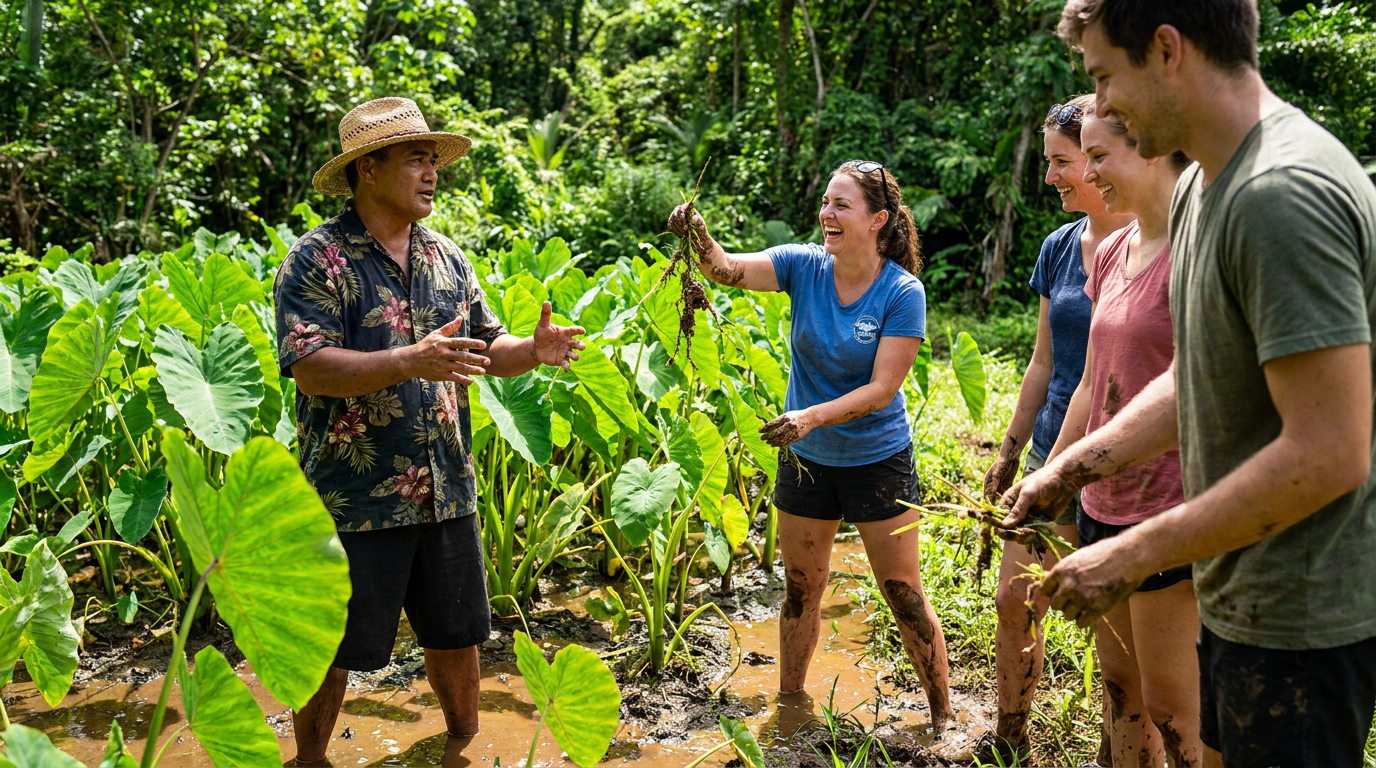
The shift toward regenerative practices is highly visible in the agricultural sector, where visitors are invited to work in traditional taro patches, known as lo'i. Guided by local farmers, tourists learn the meticulous, centuries-old process of cultivating the staple crop that holds profound spiritual significance in Hawaiian culture. Volunteers wade knee-deep into the thick mud to pull invasive weeds that disrupt the native plants' photosynthesis and choke the waterways. The physical labor is intentionally paired with deep cultural education; the act of washing the mud back into the irrigation streams becomes a practical lesson in nutrient cycling and traditional Hawaiian resource management. It demonstrates firsthand how indigenous agricultural practices inherently support ecological balance, offering visitors a visceral connection to the land that a standard sightseeing tour could never provide.[2][7]
Marine conservation offers another critical avenue for regenerative travel, directly addressing the severe degradation of Hawaii's fragile coastal ecosystems. Along the shorelines, visitors collaborate with marine biologists and local conservation groups to conduct extensive beach cleanups, painstakingly removing microplastics, discarded fishing gear, and ocean debris that threaten local wildlife like the endangered Hawaiian monk seal and green sea turtles. At select luxury resorts, the commitment goes even deeper; guests can participate in hands-on coral reef restoration by planting and tagging their own coral fragments on the property's house reef. This creates a living, growing legacy that visitors can return to monitor in subsequent years, fostering a long-term emotional and ecological connection to the destination while actively rebuilding the foundational architecture of the ocean.[5][7]
Marine conservation offers another critical avenue for regenerative travel, directly addressing the severe degradation of Hawaii's fragile coastal ecosystems.
The impact of these initiatives extends far beyond environmental metrics; it fundamentally alters the social friction between residents and tourists. Academic research conducted at the University of Hawaiʻi suggests that regenerative travel significantly enhances local support for the tourism industry. When residents witness visitors actively contributing to the preservation of their home—sweating in the taro fields or hauling debris off the beaches—the resentment bred by overtourism begins to dissipate. It is replaced by a sense of shared stewardship, proving that tourism can be a unifying force when it is rooted in mutual respect and tangible contribution.[8]

Furthermore, the integration of Native Hawaiian, or Kānaka Maoli, knowledge is central to the authenticity and success of the regenerative model. For decades, the mass tourism industry marginalized indigenous voices, reducing complex cultural traditions to superficial hotel lobby entertainment. The current shift seeks to rectify this by placing Kānaka Maoli practitioners at the forefront of destination management. By centering indigenous co-governance, the state ensures that cultural revival is prioritized alongside ecological restoration, allowing the people whose ancestors first navigated to the islands to dictate how their home is shared with the world.[3][4]
However, the transition from a high-volume, mass-market destination to a truly regenerative model is fraught with structural and economic challenges. Implementing these principles across a mature, deeply entrenched tourism infrastructure requires more than just clever marketing campaigns or a handful of volunteer days; it demands a fundamental rewiring of how the entire industry operates. While the public sector and local nonprofits are eager to embrace the shift, the sheer scale of Hawaii's tourism economy—which supports thousands of jobs and massive real estate investments—means that systemic change is inherently slow. The friction between quarterly profit motives of multinational hospitality corporations and the strict ecological limits of an isolated island chain remains a constant, formidable hurdle that destination managers must navigate daily.[3][6]
Academic analyses of the Waikīkī beachfront hotel corridor reveal a complex and sometimes contradictory reality on the ground. While public-sector actors and indigenous practitioners are successfully piloting participatory, supply-driven innovations, some massive for-profit operators remain entrenched in extractive, demand-driven models. Researchers warn of the growing risk of "greenwashing," a phenomenon where massive hotel chains rebrand minor experiential add-ons as "regenerative" while maintaining the exact same high-consumption infrastructures that caused the initial ecological strain. True regeneration requires structural sacrifice, not just a new coat of marketing paint.[3]

The central tension lies in the sheer scale of the enterprise. Can a destination that relies on millions of annual visitors flying across the Pacific Ocean truly achieve net-positive ecological outcomes? Skeptics argue that the massive carbon footprint of long-haul aviation inherently offsets the localized benefits of a morning spent planting native trees. Yet, proponents counter that the educational value of the experience creates a powerful ripple effect. When visitors return home with a transformed mindset, they are more likely to advocate for sustainable practices and mālama their own local communities, extending the program's impact globally.[3][6]
To ensure accountability and combat the looming threat of greenwashing, organizations like the Sustainable Tourism Association of Hawaiʻi have implemented rigorous, third-party certification programs for local tour operators. Guides must undergo extensive, ongoing training in cultural sensitivity, historical accuracy, and environmental stewardship. Furthermore, certified businesses must submit to regular operational audits and appoint dedicated sustainability coordinators to maintain their credentials. This systemic oversight ensures that the regenerative label is backed by verifiable, on-the-ground action rather than empty corporate rhetoric. It gives conscientious travelers a reliable, transparent way to identify and financially support operators who are genuinely committed to the islands' long-term well-being, effectively routing tourist dollars away from extractive businesses.[6]
The success or failure of Hawaii's ambitious experiment is being closely watched by destination management organizations worldwide. From the crowded canals of Venice to the congested streets of Kyoto, cities suffocating under the weight of their own popularity are desperately searching for viable alternatives to the mass-tourism model. If Hawaii can successfully recalibrate its massive hospitality industry to prioritize community wealth and ecological health over sheer visitor volume, it will provide a crucial, scalable proof of concept for the entire global travel sector.[6]
Ultimately, the shift toward regenerative tourism is a stark acknowledgment that the travel industry cannot survive if it destroys the very assets it sells. By empowering local guides to lead the way and inviting visitors to actively participate in the healing of the landscape, Hawaii is redefining what it means to take a vacation. It is an invitation to become a temporary local—a steward of the land who leaves behind a legacy of care and connection, rather than a footprint of consumption.[1][6]
How we got here
1970s–2010s
Hawaii relies on a high-volume mass tourism model, leading to severe ecological strain and cultural commodification.
2019
Visitor arrivals hit a record peak of 10.4 million, prompting intense local pushback against overtourism.
2020
The global pandemic halts travel, giving Hawaii's ecosystems a temporary reprieve and sparking a strategic reset.
Fall 2020
The Hawaiʻi Tourism Authority launches the Mālama Hawaiʻi program to incentivize voluntourism.
2023–2024
Academic studies highlight the success of community-led regenerative efforts while warning against corporate greenwashing.
Viewpoints in depth
Indigenous Cultural Practitioners
Advocating for true co-governance and the de-commodification of Hawaiian culture.
For Kānaka Maoli (Native Hawaiian) leaders, regenerative tourism is fundamentally about reclaiming the narrative. They argue that for decades, the tourism industry extracted wealth while reducing complex indigenous traditions to superficial entertainment. This camp pushes for multi-capital definitions of wealth—where cultural revival and ecological health are valued as highly as corporate revenue—and demands that indigenous voices have veto power over how their ancestral lands are marketed, utilized, and shared with outsiders.
Commercial Tourism Operators
Balancing the new mandate for ecological stewardship with the demands of luxury travelers.
Hotels, airlines, and large tour operators recognize that the 2019 breaking point of overtourism threatened their core product. By participating in the Mālama Hawaiʻi program, they aim to attract a more mindful, higher-spending demographic. However, this camp often favors demand-driven, incremental changes—such as offering optional volunteer days or eco-friendly room amenities—while resisting calls to drastically reduce overall visitor capacity or fundamentally alter their high-volume business models.
Sustainability Researchers
Analyzing the empirical impact of the regenerative shift and warning against corporate greenwashing.
Academic researchers studying the transition acknowledge the genuine progress made by local nonprofits and trail stewards, but remain skeptical of the industry's broader claims. They point out that true regeneration requires structural sacrifice. This camp emphasizes the need for rigorous, third-party certification to ensure that multinational corporations aren't simply rebranding existing, extractive add-ons as 'regenerative' without changing the underlying infrastructure that strains local resources.
What we don't know
- Whether massive multinational hotel chains will fully adopt structural regenerative practices or simply use the terminology for greenwashing.
- If the localized ecological benefits of voluntourism can genuinely offset the massive carbon footprint generated by long-haul flights to the islands.
Key terms
- Mālama
- A foundational Hawaiian value that means to care for, preserve, protect, and nurture the earth and each other.
- Regenerative Tourism
- A travel model that aims to leave a destination measurably better than it was found, actively restoring ecological and cultural health.
- Kānaka Maoli
- The Native Hawaiian people, whose indigenous knowledge is increasingly central to the state's new tourism management strategies.
- Lo'i
- A traditional Hawaiian irrigated terrace used primarily for cultivating taro, a staple crop of immense cultural significance.
- Voluntourism
- A form of travel in which tourists participate in voluntary labor, typically for environmental conservation or community charities.
Frequently asked
What is the difference between sustainable and regenerative tourism?
Sustainable tourism aims to minimize harm and maintain the current environmental baseline. Regenerative tourism goes a step further, requiring visitors to actively improve and heal the destination they visit.
How do I participate in the Mālama Hawaiʻi program?
Travelers can book volunteer experiences through the official GoHawaii website or directly through participating hotels and airlines, which offer over 350 distinct opportunities across the islands.
Do I really get a free hotel night for volunteering?
Yes. Many participating hotels offer a free additional night's stay or significant room discounts to guests who complete an approved voluntourism activity during their trip.
What kind of volunteer activities are available?
Activities range from beach cleanups and coral reef planting to working in traditional taro patches, clearing invasive forest species, and restoring ancient stone fishponds.
Sources
Source coverage
8 outlets
4 viewpoints surfaced







[1]Hawaii Tourism AuthorityPublic Sector & Destination Managers
Mālama Hawaiʻi: The most rewarding trip is one that gives back
Read on Hawaii Tourism Authority →[2]TravelAge WestCommercial Tourism Operators
How Will the Malama Hawaii Tourism Strategy Impact Travel to Hawaii?
Read on TravelAge West →[3]Taylor & FrancisIndigenous Cultural Practitioners
Hawai'i is shifting toward regenerative tourism, yet extractive logics persist
Read on Taylor & Francis →[4]KHON2 NewsPublic Sector & Destination Managers
Hawaii Tourism Authority, Malama Campaign
Read on KHON2 News →[5]Luxury Travel MagazineCommercial Tourism Operators
Doing is believing: regenerative travel experiences
Read on Luxury Travel Magazine →[6]Factlen Editorial TeamTourism & Sustainability Researchers
Synthesis by Factlen editorial team
Read on Factlen Editorial Team →[7]Kanu HawaiiPublic Sector & Destination Managers
Mālama Hawai'i Partnership for Organizations
Read on Kanu Hawaii →[8]ScholarSpace (University of Hawaiʻi)Indigenous Cultural Practitioners
Regenerative Tourism in Hawai'i: Finding Solutions for a Better Future
Read on ScholarSpace (University of Hawaiʻi) →
Every angle. Every day.
Get travel stories with full source coverage and perspective breakdowns delivered to your inbox.