
How AI Voice Translation is Breaking the Podcast Language Barrier
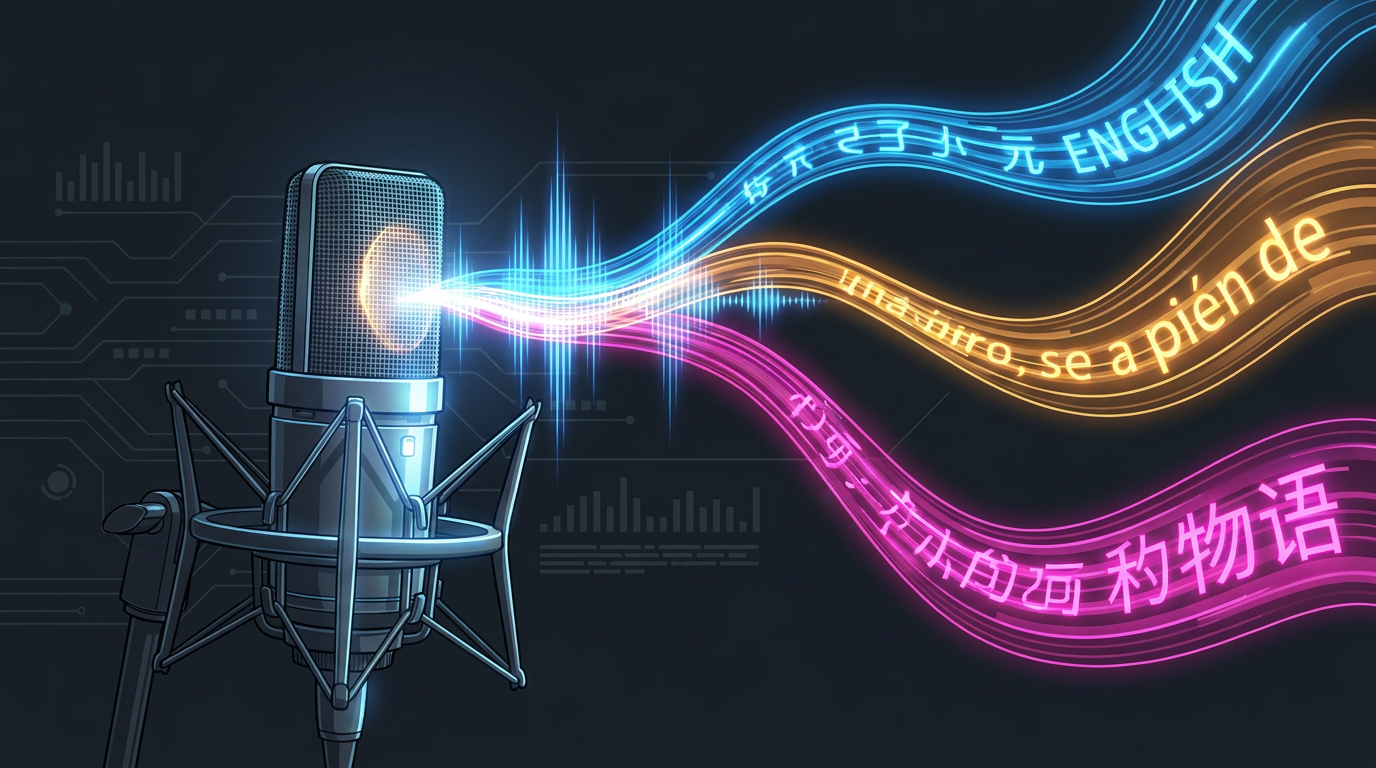
New artificial intelligence tools are allowing podcasters to seamlessly translate their episodes into dozens of languages while preserving their exact voice and emotional delivery.
By Factlen Editorial Team
- Global Audio Creators
- Independent podcasters and media companies who view AI dubbing as an unprecedented growth lever.
- AI Audio Developers
- The engineers focused on achieving perfect prosody and cross-language consistency.
- Localization Skeptics
- Critics who argue that automated translation misses the human soul and cultural nuance of audio.
What's not represented
- · Professional Voice Actors
- · Non-English Native Listeners
Why this matters
Language barriers have historically siloed audio content by geography. By automating high-fidelity translation, AI is transforming podcasts into a truly global medium, allowing listeners everywhere to access the world's best educational and entertainment audio in their native tongue.
Key points
- AI voice translation allows podcasters to dub episodes into multiple languages while retaining their original vocal tone.
- The technology relies on a three-step process: diarization, neural translation, and prosody-aware voice cloning.
- Production costs for AI dubbing have collapsed since 2025, making the tools accessible to independent creators.
- Top platforms now support over 30 languages with cross-language voice consistency.
- The technology still struggles to accurately translate comedy, sarcasm, and deep cultural nuances.
Imagine listening to your favorite English-speaking podcaster, but they are speaking fluent Japanese, Spanish, or Hindi—with their exact vocal tone, pacing, and emotional inflection. For years, breaking the language barrier in audio meant hiring expensive voice actors to dub over the original track, a clunky process that stripped away the host's unique personality.
That paradigm has shattered. In 2026, artificial intelligence voice translation has matured from a robotic novelty into a broadcast-grade production tool. The technology allows creators to seamlessly translate their episodes into dozens of languages while preserving their exact voice and emotional delivery, fundamentally changing how global ideas spread.[7]
The shift began gaining mainstream traction when Spotify launched a pilot program leveraging OpenAI's voice generation technology. The streaming giant partnered with top-tier hosts like Lex Fridman, Dax Shepard, and Steven Bartlett to translate their English episodes into Spanish, French, and German.[1][6]
The goal was to create a listening experience that sounded more personal and natural than traditional dubbing. By matching the creator's own voice, the platform aimed to give listeners around the world the power to discover new podcasters in an authentic way. The results were uncanny, proving that synthetic audio could maintain the intimacy that makes podcasting so popular.[1][6]
To understand how this works, it helps to break down the mechanism behind modern AI dubbing. The process begins with advanced speech-to-text transcription. The AI analyzes the raw audio file and generates a highly accurate transcript, utilizing a technique called speaker diarization. Diarization identifies exactly who is speaking and when, separating overlapping voices and labeling the text accordingly.[2]

Once the text is structured, neural machine translation takes over. Unlike older translation software that simply swapped words verbatim, modern neural networks understand context and conversational idioms. The system translates the transcript into the target language while attempting to match the length of the original phrasing, ensuring the final audio will sync naturally with the pacing of the episode.[7]
The final and most crucial step is voice generation. The AI uses a cloned model of the original speaker's voice and maps the translated text onto it. The major breakthrough that made this viable in recent years was the mastery of "prosody"—the natural rise, fall, and rhythm of human speech. Older text-to-speech models sounded robotic because they lacked prosody; today's models adjust intonation based on the context of the sentence.[2][4]
The AI uses a cloned model of the original speaker's voice and maps the translated text onto it.
The market for this technology has exploded. Companies like ElevenLabs have become industry heavyweights, raising massive funding rounds—including a $180 million Series C in early 2025 that pushed its valuation past $3 billion. Their dubbing tools now support over 30 languages, allowing a single English audio file to be localized for a global audience in minutes.[2][3]
The adoption extends beyond dedicated podcast apps. YouTube, a massive hub for video podcasts, has officially deployed automated multilingual dubbing for hundreds of thousands of channels. Creators can now automatically dub their recorded English audio into languages like Hindi, Indonesian, Japanese, and Portuguese, expanding their reach to billions of non-English speakers.[3]
A major driver of this rapid adoption is the collapse in production costs. In early 2025, generating high-quality AI audio cost roughly $0.30 per minute. By 2026, increased compute efficiency and market competition drove that price down to between $0.04 and $0.08 per minute on several platforms.[5]

This price drop democratized the technology. What was once an experimental luxury for massive media companies is now viable for independent podcasters producing weekly content. A solo creator can now produce a multilingual podcast empire from a single microphone, paying only for the characters generated rather than hourly rates for voice actors.[4][5]
Furthermore, cross-language voice consistency has become the new industry standard. In the early days of voice cloning, an AI might generate a slightly different-sounding voice for each language. Today, top platforms maintain a speaker's exact vocal identity across multiple languages, ensuring that a host's "brand" sounds identical whether they are speaking Arabic, Swedish, or Mandarin.[5]
Despite the rapid advancements, the technology is not without limitations. Industry reviewers note that AI dubbing still struggles significantly with comedy and sarcasm. Humor relies on micro-timing, subtle delivery nuances, and cultural context that algorithms cannot yet replicate. For personality-driven entertainment, the human voice remains undefeated.[4]
There is also the challenge of cultural translation. While the AI can translate the literal words and mimic the voice perfectly, cultural idioms and the "essence" of a conversation can sometimes be lost in transit. Skeptics point out that a joke or an ad read that lands perfectly in American English might fall flat or confuse a listener in Japan, regardless of how natural the voice sounds.[6]

Nevertheless, the trajectory is clear. As prosody models continue to refine emotional range and latency drops, synthetic dubbing will become an invisible layer of the internet. For educational content, interviews, and storytelling, the default state of audio is rapidly becoming language-agnostic.[7]
The podcasting medium was built on the intimate connection between a host's voice and a listener's ear. By preserving that voice while stripping away the language barrier, AI translation is not replacing the human element—it is amplifying it, allowing a single conversation to resonate across the globe.[7]
How we got here
Late 2023
Spotify pilots AI voice translation with OpenAI, translating top English podcasts into Spanish, French, and German.
September 2024
Google releases NotebookLM, introducing synthetic podcast generation to the mainstream.
Early 2025
ElevenLabs raises a $180 million Series C, valuing the AI audio company at over $3 billion.
Mid 2025
YouTube officially deploys automated multilingual dubbing for hundreds of thousands of creator channels.
2026
The cost of AI dubbing collapses to under $0.10 per minute, making the technology accessible to independent creators.
Viewpoints in depth
Global Audio Creators
Independent podcasters and media companies looking to expand their reach.
For creators, AI dubbing represents an unprecedented growth lever. Historically, localizing a podcast required hiring a team of translators and voice actors, a cost only massive studios could bear. With AI, a solo creator recording in their bedroom can instantly distribute their show to Spanish, Hindi, and Japanese markets. They view the technology not as a replacement for human creativity, but as a distribution multiplier that democratizes global audience access.
AI Audio Developers
The engineers and companies building the voice generation models.
Developers are focused on crossing the 'uncanny valley' of synthetic audio. Their primary metric for success is prosody—ensuring the AI understands when to whisper, when to sound excited, and how to naturally pause for breath. They argue that by maintaining cross-language voice consistency, they are preserving the creator's authentic brand identity, making the technology a seamless extension of the host rather than a disruptive overlay.
Localization Skeptics
Critics who argue that automated translation misses the human soul of audio.
Skeptics, including some traditional localization experts, caution that perfect pronunciation does not equal perfect communication. They point out that podcasts are deeply intimate and culturally specific. A sarcastic remark, a culturally localized joke, or the subtle emotional weight of a personal story often gets flattened by algorithms. They argue that while AI is excellent for informational content, personality-driven entertainment still requires human cultural translation.
What we don't know
- How audiences will ultimately react to long-form synthetic audio once the novelty wears off.
- Whether platforms will require mandatory labeling for AI-dubbed content to prevent deepfake confusion.
Key terms
- Prosody
- The rhythm, stress, and intonation of speech that gives it emotional meaning and natural flow.
- Voice Cloning
- AI technology that uses a short audio sample to generate a synthetic replica of a specific person's voice.
- Diarization
- The process of partitioning an audio stream to identify exactly who is speaking and when.
- Neural Machine Translation
- An advanced translation method that uses artificial neural networks to understand context and produce natural phrasing, rather than just swapping words.
Frequently asked
Can AI translate a podcast in real-time?
Not yet for high-fidelity voice cloning. The system requires processing time to analyze the full sentence context to ensure accurate translation and natural emotional delivery (prosody).
Does the translated voice sound robotic?
No. Modern AI models focus heavily on prosody—the natural rhythm, stress, and intonation of human speech—making the synthetic audio sound remarkably lifelike.
Do creators have to pay extra for each language?
Generally, no. Most platforms charge based on the total minutes or characters generated, meaning switching between multiple languages costs the same as generating audio in just one.
Sources
Source coverage
7 outlets
3 viewpoints surfaced







[1]Spotify NewsroomAI Audio Developers
Spotify Pilots Voice Translation for Podcasts
Read on Spotify Newsroom →[2]ElevenLabsAI Audio Developers
AI Dubbing and Voice Translation
Read on ElevenLabs →[3]SlatorLocalization Skeptics
AI Dubbing Market and Podcast Translation Trends
Read on Slator →[4]Creators Must HaveGlobal Audio Creators
ElevenLabs Multilingual Voiceover Capabilities
Read on Creators Must Have →[5]Fish AudioAI Audio Developers
The AI Dubbing Market in 2026
Read on Fish Audio →[6]MashableGlobal Audio Creators
Spotify's AI voice translation translates podcasts into different languages
Read on Mashable →[7]Factlen Editorial Team
Synthesis by Factlen editorial team
Read on Factlen Editorial Team →

Every angle. Every day.
Get entertainment stories with full source coverage and perspective breakdowns delivered to your inbox.