
Ice vs. Heat: The Cellular Science of Muscle Recovery
While cold plunges have dominated fitness trends, cellular research reveals that post-workout ice baths can actually blunt muscle growth. Heat therapy, conversely, activates proteins that accelerate tissue repair.
By Factlen Editorial Team
- Cellular Physiologists
- Focus on the molecular pathways of muscle adaptation and warn against blunting acute inflammation.
- Endurance & Team Athletes
- Value cold therapy for its rapid analgesic effects, allowing for high-frequency performance.
- Strength & Hypertrophy Coaches
- Advocate for heat therapy and strict separation of cold exposure from lifting sessions.
- Sports Rehabilitation Specialists
- Emphasize contrast therapy and timing, using temperature as a targeted tool for specific injury phases.
- Factlen Editorial Synthesis
- Synthesizing the evidence to provide actionable, goal-oriented recovery protocols.
What's not represented
- · Casual gym-goers who use temperature therapy purely for mental health benefits rather than physical adaptation.
- · Manufacturers of cold plunge and sauna equipment whose marketing often outpaces clinical research.
Why this matters
Millions of athletes and fitness enthusiasts use cold plunges to recover from workouts, unaware that timing their ice bath incorrectly could be erasing up to a third of their muscle gains. Understanding the cellular mechanisms of temperature therapy allows you to match your recovery protocol to your specific fitness goals.
Key points
- Cold water immersion causes vasoconstriction, which effectively flushes metabolic waste and reduces immediate muscle soreness.
- Using an ice bath immediately after resistance training blunts the mTOR pathway, potentially reducing muscle growth by up to a third.
- Heat therapy promotes vasodilation, increasing blood flow and delivering vital oxygen and nutrients to damaged muscle tissue.
- Sauna use activates Heat Shock Proteins, which act as a cellular repair crew to rebuild muscle fibers and support long-term adaptation.
The modern fitness landscape is awash in temperature extremes, with recovery protocols becoming just as intense as the workouts themselves. From backyard cold plunges filled with floating ice to high-tech infrared saunas, athletes and casual gym-goers alike are increasingly turning to thermal stress to accelerate their recovery. Social media is flooded with influencers touting the life-changing benefits of daily ice baths, while boutique recovery centers offer contrast therapy memberships to the masses. But as these modalities move from professional locker rooms to everyday garages, a critical scientific nuance has been lost in translation. The prevailing wisdom among the general public suggests that any reduction in inflammation is universally beneficial for recovery, treating soreness as an enemy to be eradicated at all costs.[7]
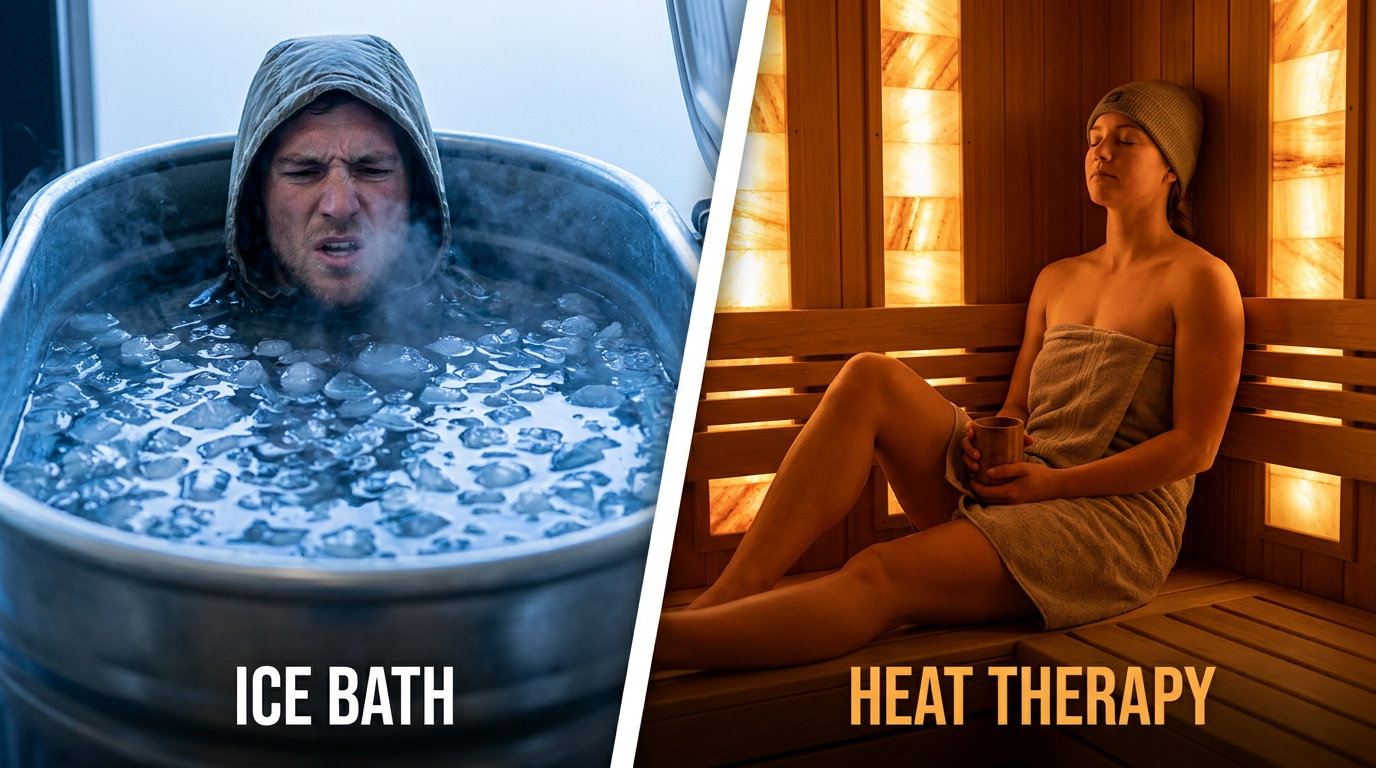
However, cellular biologists and sports scientists have discovered that ice and heat trigger fundamentally different physiological cascades—and using the wrong one at the wrong time can actively sabotage your training goals. The cold water immersion craze is driven by its undeniable immediate effects on the human body. Submerging the body in ten to fifteen-degree Celsius water causes rapid vasoconstriction, a process where blood vessels clamp down and restrict blood flow to the extremities to preserve core temperature. This mechanism is highly effective at flushing out metabolic waste products and numbing the micro-tears associated with Delayed Onset Muscle Soreness, commonly known as DOMS. For an athlete seeking immediate pain relief after a grueling session, the ice bath delivers a powerful, undeniable physiological reset.[3][4]
Yet, this exact numbing mechanism is precisely what makes cold water immersion problematic for long-term muscle growth and strength adaptation. When you lift heavy weights or engage in intense resistance training, you create mechanical tension and microscopic tissue damage. This damage triggers acute inflammation, which is often demonized in wellness circles. While chronic, low-grade inflammation is indeed detrimental to overall health, acute localized inflammation is the essential biological signal that tells your body to repair and rebuild muscle fibers larger and stronger than they were before. By plunging into ice water immediately after a resistance training session, you effectively extinguish this necessary inflammatory fire before it can do its job.[1][5]

Clinical biopsies and long-term studies reveal the severe cellular cost of this blunting effect. Research published by the National Institutes of Health demonstrates that cold water immersion significantly reduces the activation of the mTOR pathway—the primary molecular driver of muscle protein synthesis. Furthermore, the cold shock delays the activity of satellite cells, which are specialized stem cells responsible for donating their nuclei to muscle fibers for long-term growth. In practical terms, athletes who routinely use ice baths immediately after lifting weights can see their muscle hypertrophy blunted by up to a third compared to those who use active recovery or simply rest at room temperature. You are not necessarily losing muscle, but you are leaving a massive portion of your potential gains in the cold water.[1][2]
Heat therapy, on the other hand, operates through the exact opposite mechanism: vasodilation. Whether experienced through a traditional Finnish sauna heated to eighty degrees Celsius or an infrared cabin that penetrates deeper into the tissue, heat exposure causes blood vessels to widen significantly. This dramatically increases blood flow to fatigued muscles, essentially upgrading your circulatory system from a garden hose to a fire hose. This enhanced circulation acts as a nutrient highway, delivering vital oxygen, amino acids, and glucose to damaged tissues while simultaneously clearing out lactate and other metabolic byproducts that accumulate during high-intensity exercise.[4][6]
Heat therapy, on the other hand, operates through the exact opposite mechanism: vasodilation.
Beyond simple blood flow, heat therapy triggers a profound and highly beneficial molecular response: the activation of Heat Shock Proteins, or HSPs. These specialized proteins act as a cellular repair crew that is deployed whenever the body experiences thermal stress. Once activated, Heat Shock Proteins work to protect cells from further damage, refold misfolded proteins, and accelerate the repair of damaged muscle fibers. This means that while cold therapy merely masks the pain of muscle damage, heat therapy actively participates in the structural rebuilding of the tissue.[3][6]

Furthermore, the physiological journey of a sauna session extends beyond the heat itself. The post-sauna cooling period promotes a vital shift in the autonomic nervous system. While the heat initially acts as a stressor that raises the heart rate, the subsequent cool-down drives the body toward parasympathetic dominance—the "rest and digest" state. This neurological shift lowers circulating levels of cortisol, the body's primary stress hormone, and facilitates the deep, systemic recovery required for both physical adaptation and central nervous system repair. Athletes frequently report significantly improved sleep architecture on the days they incorporate post-training heat therapy.[6][7]
So, how should an athlete or fitness enthusiast navigate these thermal tools to maximize their results? The answer lies in identifying the specific goal of the training session and the timeline for the next performance. For endurance athletes, CrossFit competitors, or team-sport players in the middle of a multi-day tournament, cold water immersion remains an unparalleled tool. When the primary objective is to reduce perceived fatigue, minimize joint swelling, and perform at a high level again within twenty-four hours, the immediate anti-inflammatory and analgesic benefits of ice far outweigh the blunted long-term tissue adaptation.[3][5]
However, for bodybuilders, powerlifters, or anyone whose primary goal is building muscle mass, increasing strength, or changing their body composition, post-workout cold plunges should be strictly avoided. If you still wish to utilize cold therapy for its mental resilience benefits or systemic metabolic effects, sports scientists recommend separating the ice bath from the lifting session by at least six to eight hours, or ideally placing it on an active recovery day. This temporal separation allows the acute inflammatory signal to peak and initiate the muscle protein synthesis cascade before the cold exposure shuts it down.[4][5]

For those looking to maximize the benefits of both extremes, contrast therapy offers a compelling middle ground. By alternating between hot and cold environments—such as three minutes in a sauna followed by one minute in a cold plunge—athletes can create a powerful "pumping" effect in their vascular system. The rapid cycling between vasodilation and vasoconstriction acts like a physical pump for the circulatory and lymphatic systems, accelerating the clearance of metabolic waste without permanently shutting down the inflammatory pathways required for growth.[4][7]
It is also crucial to remember that temperature therapies are supplementary tools, not replacements for the foundational pillars of recovery. No amount of time in a sauna or ice bath can compensate for chronic sleep deprivation, inadequate protein intake, or poorly managed training volume. Thermal stress should be viewed as the final optimization layer applied over a solid foundation of nutrition and rest. When used correctly, however, manipulating your body's thermal environment is one of the most powerful, scientifically validated ways to dictate how your cells respond to the stress of exercise.[6][7]
Heat therapy, conversely, pairs perfectly with hypertrophy and strength training. A post-workout sauna session not only avoids blunting the crucial inflammatory signal but actively supports the tissue repair process through enhanced circulation and the activation of Heat Shock Proteins. Ultimately, recovery is not a one-size-fits-all equation that can be solved by following the latest social media trend. By understanding the distinct cellular mechanisms of vasoconstriction and vasodilation, you can weaponize temperature to support—rather than suppress—your hard-earned physical adaptations.[6][7]
How we got here
Ancient Greece & Rome
Early documented use of alternating hot and cold baths for health, hygiene, and physical recovery.
1960s-1980s
Ice baths become standard protocol in professional sports locker rooms for acute injury and pain management.
2010s
Cold water immersion explodes in mainstream fitness culture, popularized by extreme athletes and wellness influencers.
2015-2020
Cellular biopsies begin revealing that immediate post-workout cold exposure blunts the mTOR pathway and muscle protein synthesis.
2024-2026
Sports science consensus shifts toward periodized temperature therapy, matching heat or cold to specific training goals.
Viewpoints in depth
Cellular Physiologists' view
Focus on the molecular pathways of muscle adaptation and warn against blunting acute inflammation.
Cellular biologists view the post-workout window as a delicate cascade of chemical signals. When mechanical tension damages muscle fibers, the resulting acute inflammation is not an error—it is the trigger for the mTOR pathway and satellite cell activation. From this perspective, using cold water immersion to artificially suppress that inflammation is counterproductive for anyone trying to build tissue. They point to muscle biopsies showing that cold exposure significantly downregulates the very proteins responsible for long-term hypertrophy.
Strength & Hypertrophy Coaches' view
Advocate for heat therapy and strict separation of cold exposure from lifting sessions to maximize muscle protein synthesis.
For coaches whose primary metric is muscle mass and force production, the ice bath is viewed with extreme caution. They emphasize that while cold plunges build mental resilience, they actively interfere with the biological goal of lifting weights. Instead, these coaches program heat therapy—such as post-workout saunas—to enhance vasodilation and nutrient delivery without extinguishing the inflammatory signal. If their athletes must use cold therapy, they mandate a separation of at least six to eight hours from the training session.
Endurance & Team Athletes' view
Value cold therapy for its rapid analgesic effects, allowing for high-frequency performance where systemic recovery outweighs localized muscle growth.
In the world of endurance sports and multi-day tournaments, the priorities shift entirely. A marathon runner or a soccer player in a playoff series is less concerned with maximizing muscle cross-sectional area and more concerned with clearing metabolic waste and reducing joint pain to perform again tomorrow. For these athletes, the vasoconstriction provided by cold water immersion is an invaluable tool. The blunting of long-term hypertrophy is considered an acceptable trade-off for the immediate restoration of neuromuscular function and perceived readiness.
What we don't know
- Whether the blunting effect of cold water immersion on muscle growth applies equally to older adults or female athletes, as most clinical biopsies have been performed on young men.
- The exact minimum temperature and duration threshold required to trigger Heat Shock Proteins in various demographics.
- How long-term adaptation to contrast therapy compares to isolated heat or cold exposure over a multi-year training cycle.
Key terms
- Vasoconstriction
- The narrowing of blood vessels, typically in response to cold, which restricts blood flow to the extremities and reduces swelling.
- Vasodilation
- The widening of blood vessels, typically in response to heat, which increases blood flow and nutrient delivery to tissues.
- Heat Shock Proteins (HSPs)
- Specialized proteins produced by cells in response to thermal stress that help repair damaged proteins and protect cells from further injury.
- mTOR Pathway
- A critical cellular signaling pathway that serves as the primary driver for muscle protein synthesis and tissue growth.
- Delayed Onset Muscle Soreness (DOMS)
- The muscle pain and stiffness that typically develops 12 to 24 hours after strenuous or unfamiliar exercise.
- Satellite Cells
- Specialized stem cells in skeletal muscle that activate in response to injury or exercise to repair and grow muscle fibers.
Frequently asked
Does taking an ice bath kill my muscle gains?
It does not completely stop muscle growth, but studies show taking an ice bath immediately after resistance training can blunt hypertrophy by up to a third by suppressing the necessary inflammatory signals.
Should I use a sauna before or after my workout?
Using a sauna after your workout is ideal for recovery. The heat promotes vasodilation and activates Heat Shock Proteins, which help repair the muscle damage caused during your training session.
How long should I wait after lifting to take an ice bath?
If your goal is building muscle, sports scientists recommend waiting at least six to eight hours after lifting, or saving the cold plunge for a dedicated active recovery day.
What is contrast therapy?
Contrast therapy involves alternating between hot and cold environments, such as a sauna and an ice bath. This creates a pumping effect in the blood vessels, accelerating the clearance of metabolic waste.
Sources
Source coverage
7 outlets
5 viewpoints surfaced







[1]National Institutes of HealthCellular Physiologists
Cold water immersion attenuates anabolic signaling and skeletal muscle fiber hypertrophy
Read on National Institutes of Health →[2]Frontiers in PhysiologyCellular Physiologists
Effects of Post-exercise Cold Water Immersion on Muscle Hypertrophic Adaptations
Read on Frontiers in Physiology →[3]Brigham HealthEndurance & Team Athletes
Cryotherapy vs. Thermotherapy: Similar But Unique Roles in Muscle Recovery
Read on Brigham Health →[4]True Sports Physical TherapySports Rehabilitation Specialists
Evaluating Hot vs Cold Therapy for Athletic Recovery
Read on True Sports Physical Therapy →[5]Outwork NutritionStrength & Hypertrophy Coaches
Do Ice Baths Kill Your Gains? The Science of Cold Water Immersion
Read on Outwork Nutrition →[6]OPW HealthSports Rehabilitation Specialists
Heat Therapy in Modern Recovery Science: Mechanisms and Benefits
Read on OPW Health →[7]Factlen Editorial TeamFactlen Editorial Synthesis
Synthesis by Factlen editorial team
Read on Factlen Editorial Team →
Every angle. Every day.
Get fitness stories with full source coverage and perspective breakdowns delivered to your inbox.