
Arctic Ocean Crosses Irreversible Chemical Tipping Point, Starving Marine Food Web
Widespread sea ice loss has triggered a permanent regime shift in the Arctic Ocean, depleting a crucial nutrient and threatening the entire marine ecosystem.
By Factlen Editorial Team
- Climate Scientists & Biogeochemists
- Focus on the irreversible chemical threshold crossed in the Arctic Ocean and the loss of its carbon sink capacity.
- Marine Ecologists
- Emphasize the immediate collapse of the phytoplankton population and the starvation of the polar food web.
- Downstream Stakeholders
- Warn of the cascading economic and food-security impacts on Indigenous communities and North Atlantic fisheries.
What's not represented
- · Representatives from North Atlantic commercial fishing fleets facing potential yield declines.
- · Direct testimonies from Inuit hunters observing changes in seal and marine mammal populations.
Why this matters
The Arctic Ocean has permanently lost a massive portion of its foundational nutrients, triggering a collapse at the base of the marine food chain. This irreversible shift not only threatens polar bears, seals, and Indigenous communities, but will likely reduce commercial fishing yields in the North Atlantic and cripple the ocean's ability to absorb human carbon emissions.
Key points
- The Arctic Ocean has crossed a permanent chemical threshold, shifting from a light-limited to a nitrate-limited ecosystem.
- Melting sea ice allows more sunlight to reach the seafloor, supercharging bacteria that convert usable nitrate into nitrogen gas.
- Average nitrate concentrations in water exiting the Arctic have plummeted by nearly half since 2009.
- The nutrient loss threatens the entire food chain, from microscopic plankton to polar bears and commercial fisheries.
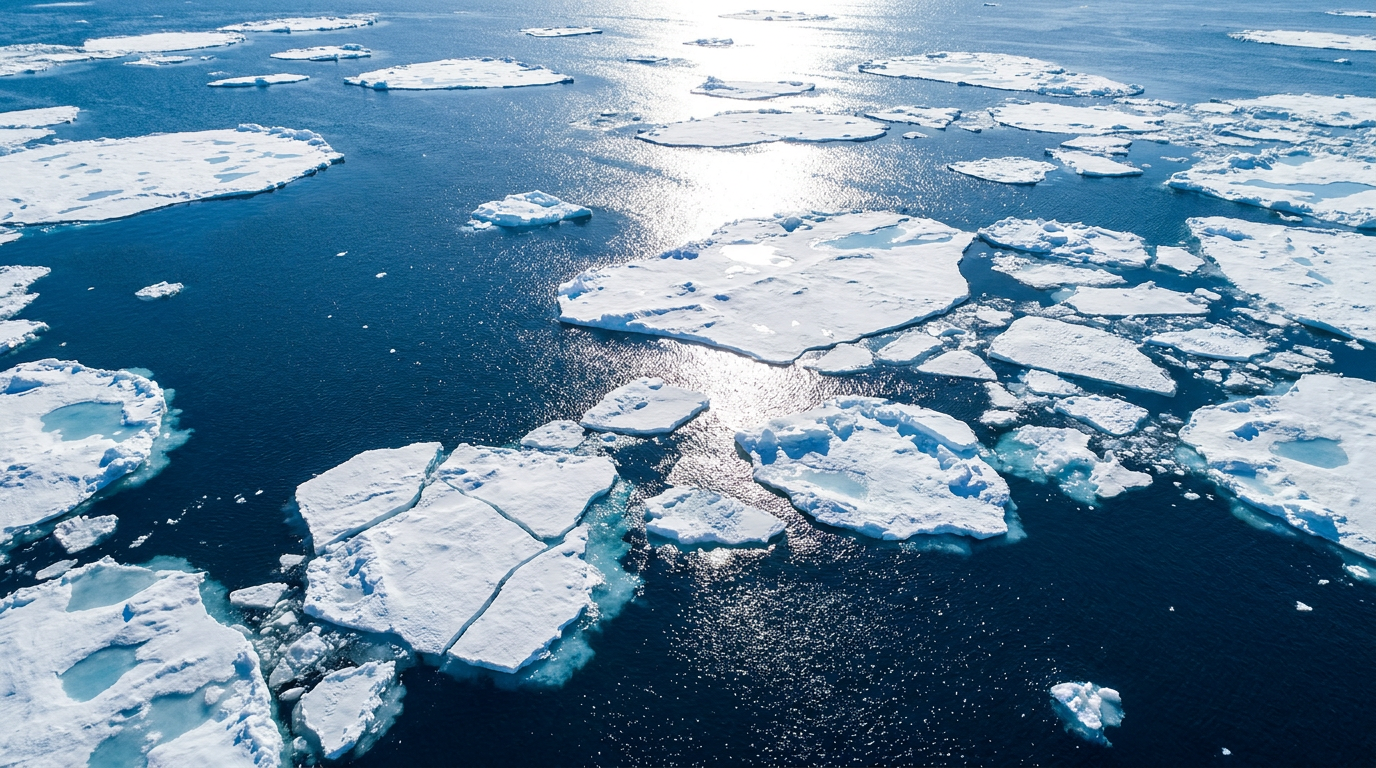
The Arctic Ocean has crossed an irreversible chemical threshold, fundamentally altering its food web and crippling its capacity to store carbon. For decades, the visible loss of sea ice has served as the most prominent indicator of global warming in the far north. However, a new comprehensive analysis reveals that the warming climate has triggered a far more insidious collapse beneath the surface. The region's marine ecosystem has permanently lost a massive portion of its foundational nutrients, starving the food chain from the bottom up. This regime shift, which researchers believe occurred more than a decade ago, rewrites our understanding of how polar ecosystems respond to rising temperatures.[1][2][5]
The mechanism driving this collapse was previously misunderstood by the broader scientific community. For years, climate models and marine biologists assumed that melting sea ice would simply allow more sunlight to penetrate the dark Arctic waters. This influx of light was expected to supercharge the growth of phytoplankton—the microscopic, plant-like organisms that form the absolute base of the marine food chain. During the early stages of ice loss, observations in several Arctic regions supported this theory, as more open water increased light availability and expanded photosynthesis.[3][4]
Initially, this held true, and the Arctic saw massive, unprecedented blooms of phytoplankton. But a new study published in the journal Communications Earth & Environment reveals a hidden, devastating consequence of this prolonged sunlight exposure. The extra light reaching the shallow continental shelves—which make up nearly half of the entire Arctic Ocean—has accelerated a bacterial process known as benthic denitrification. This process is actively stripping the water of the very nutrients required to sustain life.[2][3]
Under these increasingly sunlit and warming conditions, specialized bacteria residing on the seafloor are rapidly consuming nitrate, a crucial and finite nutrient. Through benthic denitrification, these microbes convert the usable nitrate into nitrogen gas. Because the vast majority of marine plankton cannot absorb nitrogen gas directly from the water, this chemical conversion permanently removes usable nutrients from the marine food web, allowing the gas to simply bubble up and escape into the atmosphere.[3][5]

The scale of this nutrient drain is staggering and unprecedented in the modern climate record. In the Chukchi Sea and the East Siberian shelf alone, investigators estimate that approximately 12 teragrams of nitrogen are removed from the ecosystem annually. This massive depletion offsets a substantial portion of the fresh nutrients entering the Arctic Ocean from the Pacific Ocean, effectively starving the ecosystem from the bottom up before the water can even circulate across the pole.[1][3]
To quantify this shift, researchers from the University of Edinburgh analyzed more than two decades of rigorous water sampling data. They focused their efforts on the Fram Strait, the primary oceanic gateway located between Greenland and Svalbard, through which Arctic waters flow outward into the North Atlantic. By tracking the chemical signature of the water leaving the Arctic, the team was able to reconstruct the internal dynamics of the entire polar basin.[2][4]
The data revealed a stark, undeniable regime shift that occurred around the year 2009. Prior to that tipping point, the average nitrate concentration in the Polar Surface Water was measured at a healthy 3.1 micromoles. This baseline provided ample fuel for the spring and summer phytoplankton blooms that historically sustained the region's diverse marine life.[3][4]
After 2009, that average plummeted dramatically to just 1.7 micromoles, with baseline values now regularly approaching zero in certain regions. According to Marta Santos-García, a doctoral student of Arctic marine biogeochemistry and the study's lead author, the Arctic Ocean has fundamentally shifted from a system limited primarily by light to one strictly limited by nitrate availability.[2][4]

After 2009, that average plummeted dramatically to just 1.7 micromoles, with baseline values now regularly approaching zero in certain regions.
This severe depletion means that even with abundant, uninterrupted summer sunlight, phytoplankton can no longer sustain their historical growth rates. The base of the food web is actively shrinking because the microscopic plants simply do not have the chemical building blocks required to multiply. "The Arctic Ocean appears to have shifted from a system mainly limited by light to one increasingly limited by nitrate availability," Santos-García explained, noting the far-reaching consequences for the entire ecosystem.[2][4]
The consequences of this microscopic starvation cascade violently upward through the food chain. A less productive phytoplankton population means significantly less food for zooplankton, the tiny animals that graze on them. This, in turn, starves the small schooling fish, which then impacts the seabirds and marine mammals—including seals, walruses, and polar bears—that rely on dense fish populations to survive the harsh polar winters.[1][4]
Beyond the immediate ecological tragedy, this collapse poses a direct and existential threat to human communities across the far north. The Inuit and other Indigenous groups rely heavily on these marine ecosystems for subsistence hunting and fishing. A shrinking food web directly translates to fewer seals and whales, threatening local food security, cultural practices, and the traditional economies of communities that have thrived in the Arctic for millennia.[1][5]
Furthermore, the loss of phytoplankton severely reduces the Arctic Ocean's capacity to act as a global carbon sink. These microscopic plants play a critical role in capturing atmospheric carbon dioxide through the process of photosynthesis. When they die, their carbon-rich cells sink to the ocean floor, effectively dragging human emissions out of the atmosphere and sequestering them in the deep ocean for centuries.[2][4]
Without a robust phytoplankton population, the Arctic Ocean will absorb significantly less carbon dioxide, leaving more greenhouse gases in the atmosphere to accelerate global warming. This creates a dangerous feedback loop: warming melts the ice, which triggers the bacteria to destroy the nitrate, which kills the phytoplankton, which leaves more carbon in the air to cause further warming.[3][5]
The researchers warn that this chemical shift is likely irreversible under current climate conditions. The threshold has been definitively crossed, and the denitrifying bacteria are now deeply entrenched in the ecosystem's nutrient cycle. Because the system has physically changed, simply lowering carbon emissions today will not immediately restore the lost nitrate to the polar basin.[2][3]

"Even if sea ice were to increase temporarily, the Arctic nutrient system responds over much longer timescales," Santos-García noted. She explained that short-term ice recovery—perhaps due to a particularly cold winter or a temporary shift in weather patterns—would not rapidly replenish the lost nitrate inventories, which may take centuries to naturally recover.[2]
The downstream effects of this tipping point are also becoming a major concern for international economists and policymakers. As nutrient-depleted water flows out of the Fram Strait and into the broader ocean, it could severely impact commercial fisheries in the North Atlantic. These fisheries, which provide a significant portion of the world's seafood, rely heavily on Arctic nutrient exports to sustain their own local food webs.[1][2]
If the water arriving from the Arctic is stripped of its nitrogen, the North Atlantic could see a corresponding drop in its own phytoplankton production. Industry analysts are now scrambling to model how this Arctic deficit might translate into reduced yields for cod, haddock, and other commercially vital species in the coming decades.[1][5]
Ultimately, this evidence pack underscores a terrifying reality of modern climate change: the impacts of global warming extend far beyond the visible, physical loss of surface ice. By fundamentally rewriting the sub-surface chemistry of the world's oceans, climate change is dismantling ecosystems from the molecular level up, creating permanent shifts that humanity will have to navigate for generations.[3][5]
How we got here
1998–2008
Arctic Ocean nitrate concentrations in Polar Surface Water average 3.1 micromoles.
2009
The Arctic ecosystem crosses a tipping point as widespread sea ice loss accelerates benthic denitrification.
2010–2023
Nitrate levels in the Fram Strait plummet to an average of 1.7 micromoles, fundamentally altering the food web.
May 2026
Researchers publish findings confirming the Arctic has permanently shifted to a nitrate-limited system.
Viewpoints in depth
Marine Biogeochemists
Focus on the irreversible chemical threshold crossed in the Arctic Ocean.
Researchers emphasize that the transition from a light-limited to a nitrate-limited ecosystem represents a permanent regime shift. Because the bacterial denitrification process removes nitrogen entirely from the marine food web by converting it to gas, the nutrient loss cannot be easily reversed even if sea ice were to temporarily recover.
Arctic Indigenous Communities
Highlight the immediate threat to subsistence hunting and local food security.
For Inuit and other Northern communities, the shrinking of the marine food web is an existential threat. A reduction in phytoplankton directly translates to fewer fish, seals, and polar bears—species that form the foundation of Indigenous diets, cultural practices, and local economies in the Arctic.
Commercial Fisheries
Warn of the downstream economic impacts in the North Atlantic.
Industry analysts and marine ecologists are closely monitoring the water flowing out of the Fram Strait. Because the North Atlantic relies on nutrient-rich currents from the Arctic to sustain its own fish populations, the depletion of Arctic nitrate could lead to reduced yields for major commercial fishing operations in the coming decades.
What we don't know
- The exact timeline and severity of the downstream impacts on North Atlantic commercial fisheries.
- How specific species of zooplankton and fish will adapt to the altered, nitrate-limited food web.
- The precise reduction in the Arctic Ocean's overall carbon sequestration capacity due to the loss of phytoplankton.
Key terms
- Benthic denitrification
- A process where seafloor bacteria convert usable nitrate into nitrogen gas, permanently removing it from the marine ecosystem.
- Phytoplankton
- Microscopic, plant-like organisms that form the base of the marine food web and capture atmospheric carbon dioxide.
- Fram Strait
- The ocean passage between Greenland and Svalbard, serving as the primary gateway for water flowing from the Arctic into the Atlantic.
- Regime shift
- A large, abrupt, and persistent change in the structure and function of an ecosystem.
Frequently asked
Why is the loss of Arctic sea ice reducing nutrients?
Melting ice allows more sunlight to reach the shallow seafloor, which supercharges bacteria that consume nitrate and convert it into unusable nitrogen gas.
Can the Arctic Ocean recover if the ice comes back?
Scientists say the shift is likely irreversible under current conditions. The nutrient system operates on very long timescales, so a short-term return of sea ice wouldn't quickly replenish the lost nitrate.
How does this affect animals like polar bears?
Less nitrate means less phytoplankton, which starves the entire food chain from the bottom up, ultimately reducing the food supply for fish, seals, and polar bears.
Will this impact areas outside the Arctic?
Yes. Nutrient-depleted water flows out of the Arctic into the North Atlantic, which could negatively affect commercial fisheries that rely on those nutrient exports.
Sources
Source coverage
5 outlets
3 viewpoints surfaced





[1]New ScientistMarine Ecologists
Arctic Ocean reaches tipping point that could be dire for marine life
Read on New Scientist →[2]Live ScienceMarine Ecologists
The Arctic Ocean has crossed a tipping point that is wreaking havoc on the region's food chain
Read on Live Science →[3]Communications Earth & EnvironmentClimate Scientists & Biogeochemists
Irreversible shift in Arctic Ocean nutrient dynamics driven by sea ice loss
Read on Communications Earth & Environment →[4]University of EdinburghClimate Scientists & Biogeochemists
Arctic Ocean ecosystem passed a tipping point around 2009
Read on University of Edinburgh →[5]Factlen Editorial TeamDownstream Stakeholders
Synthesis by Factlen editorial team
Read on Factlen Editorial Team →

More in science
See all 6 stories →Quantum Physics
A Quantum State That Lasts Forever: The Science of Time Crystals
0 sources

Neural Implants
Brain Implant Allows Man With ALS to Speak and Work Independently From Home
0 sources

Brain-Computer Interfaces
Brain Implant Enables ALS Patient to Speak and Work Independently at Home for Two Years
0 sources
Cognitive Longevity
The Science of SuperAgers: How Some 80-Year-Olds Maintain the Brains of 50-Year-Olds
0 sources

Every angle. Every day.
Get science stories with full source coverage and perspective breakdowns delivered to your inbox.