
Brain Implant Allows Man With ALS to Speak and Work Independently From Home
A groundbreaking brain-computer interface has enabled a man with severe paralysis to communicate with 99% accuracy for nearly two years without researcher supervision.
By Factlen Editorial Team
- Clinical Researchers
- Focuses on the scientific milestone of autonomous at-home use and the massive neural dataset collected.
- Patient Advocates
- Highlights the restoration of autonomy, the ability to return to work, and the emotional impact of natural communication.
- Neurotechnology Developers
- Emphasizes the hardware longevity, decoding algorithms, and the pathway to commercializing intracortical implants.
What's not represented
- · Medical Insurance Providers
- · Regulatory Agencies (FDA)
Why this matters
For decades, brain-computer interfaces have been confined to highly controlled research labs. This breakthrough proves that severe paralysis does not have to mean a loss of autonomy, opening the door for practical, daily-use neural implants that restore communication, employment, and independence.
Key points
- A 47-year-old man with ALS used a brain implant to communicate independently at home for nearly two years.
- The system translates attempted speech into text and a synthesized voice at 56 words per minute with 99% accuracy.
- Unlike previous brain-computer interfaces, this system does not require researchers to be present during use.
- The technology allowed the participant to return to full-time work and converse naturally with his family.
For individuals diagnosed with amyotrophic lateral sclerosis (ALS), the progressive loss of motor function often culminates in a devastating loss of speech. While experimental brain-computer interfaces (BCIs) have offered glimpses of restored communication, they have historically remained tethered to highly controlled laboratory environments. Now, a landmark clinical study has shattered that barrier. Casey Harrell, a 47-year-old man with ALS, has successfully used an implanted BCI to speak and operate a computer independently from his home for nearly two years.[1][6]
The significance of this development lies in the transition from proof-of-concept to practical daily utility. Previously, BCI systems required a team of technicians to be physically present to calibrate the equipment, adjust algorithms, and monitor the hardware. The evidence published in Nature Medicine demonstrates that Harrell operated the system without on-site researcher assistance for more than 3,800 hours over a 22.6-month period, marking the longest sustained demonstration of an independent speech BCI to date.[1][3]
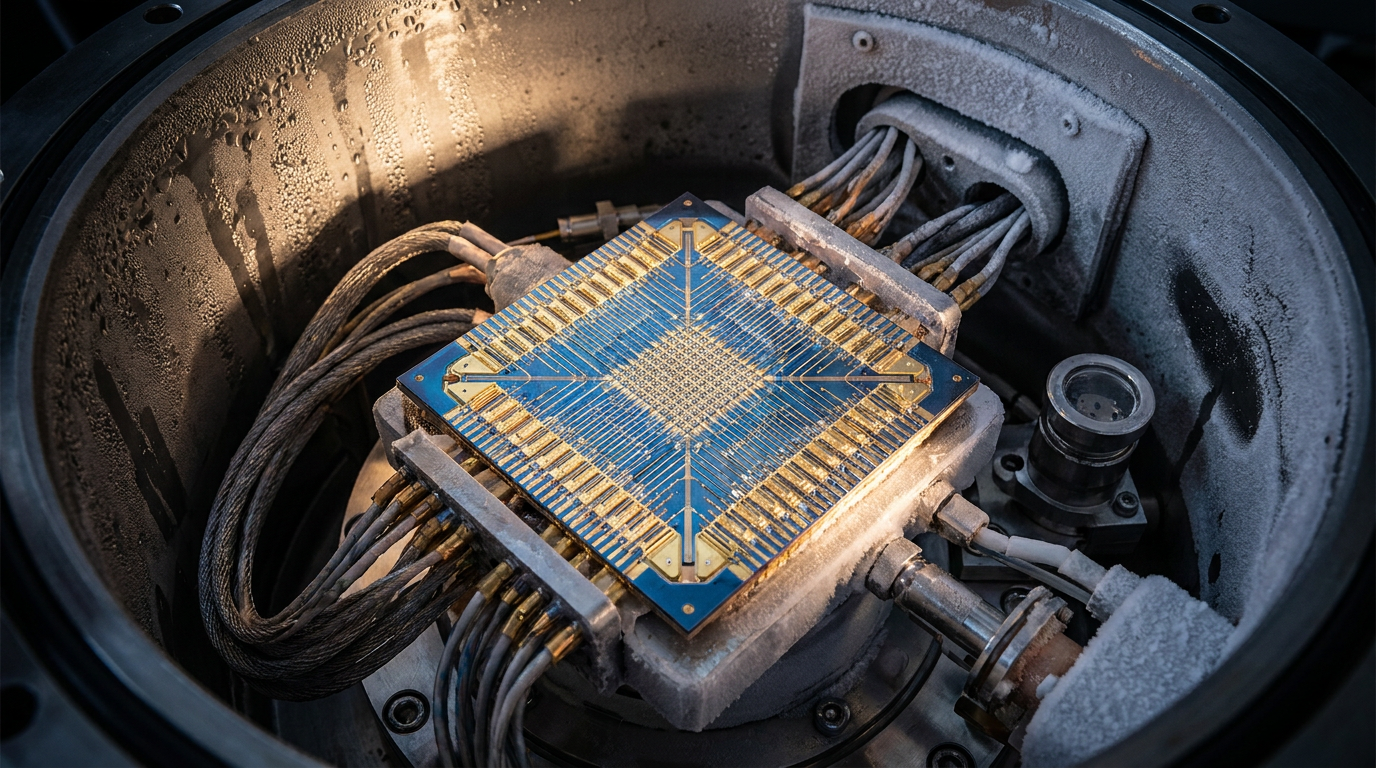
The clinical mechanism relies on highly invasive but precise hardware. In 2023, neurosurgeons implanted four microelectrode arrays into Harrell's left precentral gyrus, the specific region of the motor cortex responsible for coordinating the physical movements of speech. These arrays contain 256 microscopic electrodes that penetrate the brain tissue to record the electrical firing of individual neurons.[1][5]
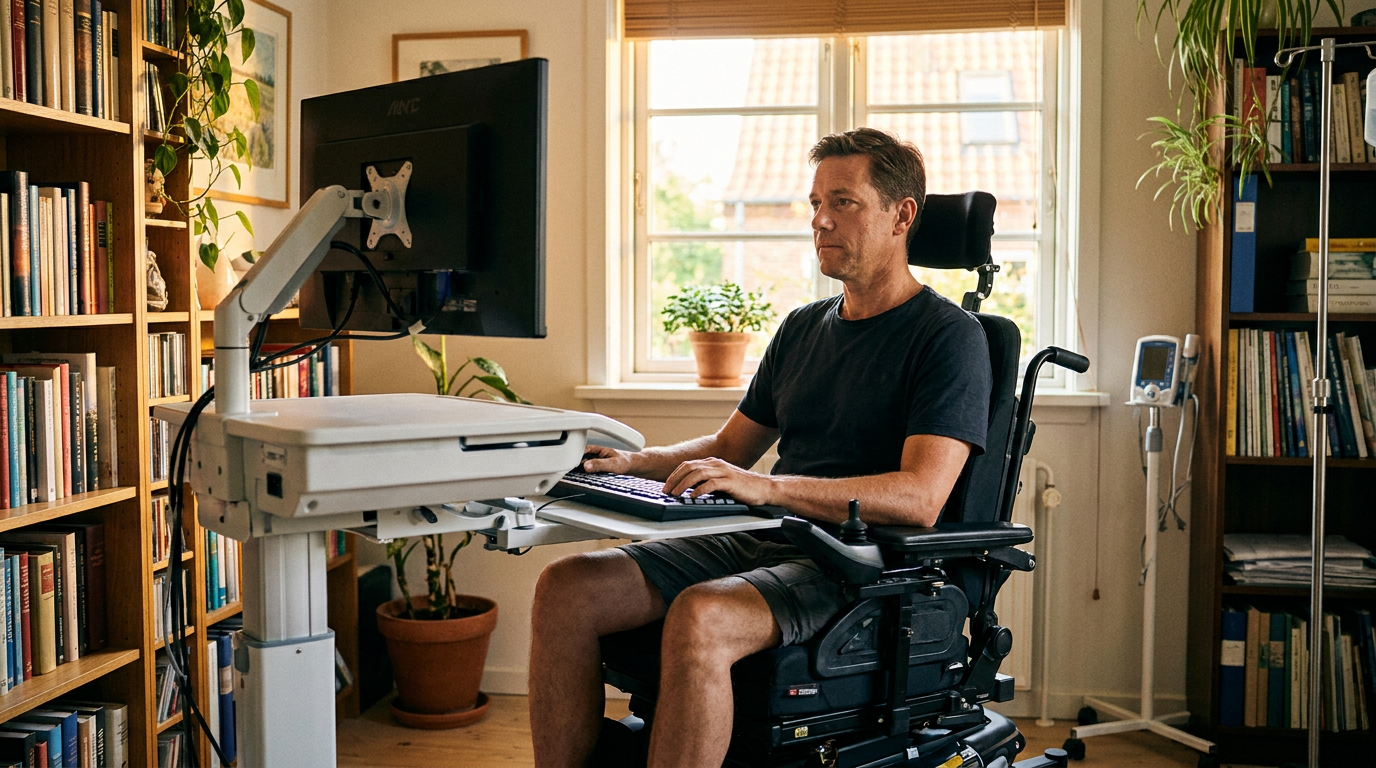
As Harrell attempts to silently mouth words, the electrodes capture the neural intention before it reaches his paralyzed muscles. This raw electrical data is transmitted through a wired connection embedded in his skull to a local computing system mounted on a mobile cart in his home. The hardware setup, while currently requiring a physical tether, provides the high-resolution data necessary for real-time decoding.[4][5]

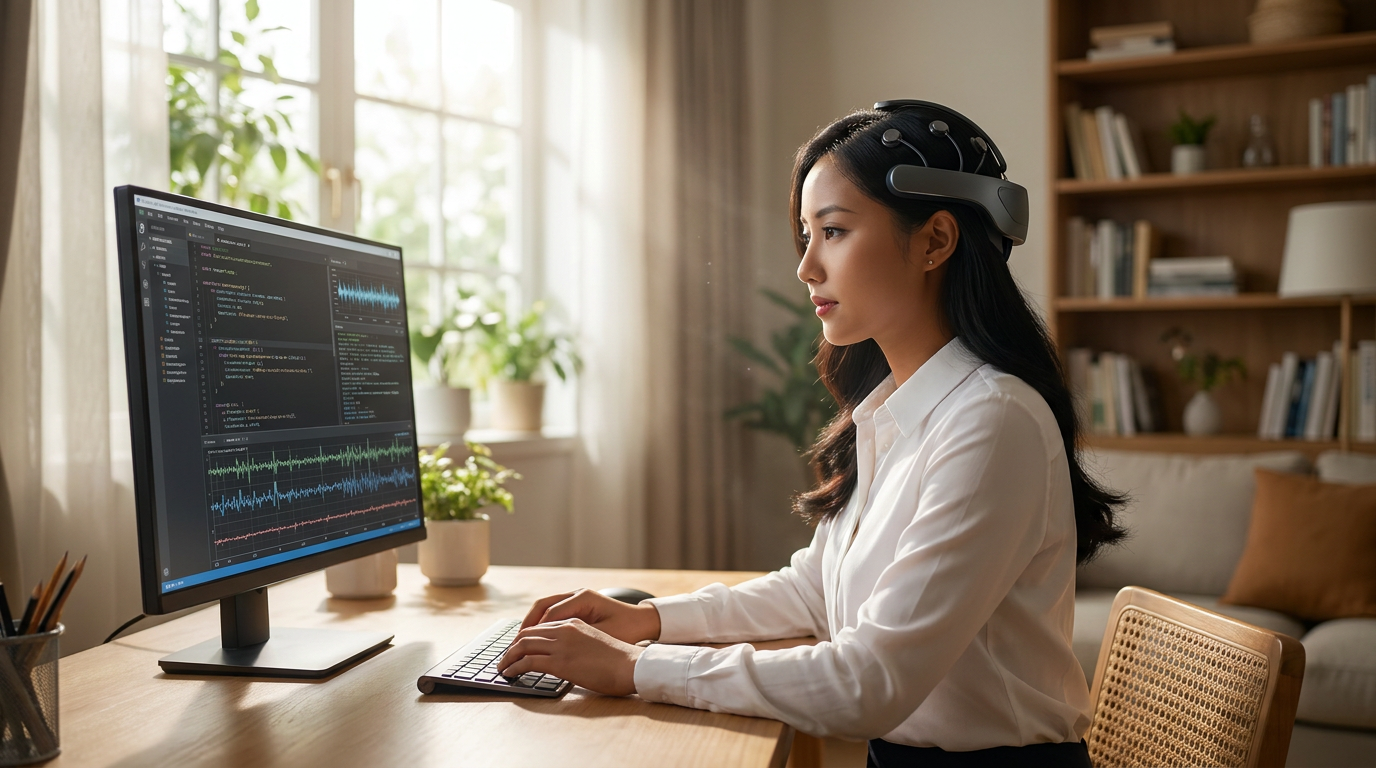
The translation from neural static to coherent speech is powered by a proprietary software platform called BRAND, developed by researchers at UC Davis. The system utilizes advanced machine learning algorithms to analyze the brain signals and predict English-language phonemes—the distinct sounds that make up words. By mapping these phonemes in real-time, the software constructs full sentences on a screen.[2][4]
To restore a sense of personal identity, the system does not rely on a generic robotic output. Instead, the decoded text is read aloud using a synthesized voice that was meticulously modeled after Harrell's own pre-ALS voice. This audio conversion happens with minimal latency, allowing Harrell to participate in dynamic, multi-person conversations without the disruptive delays that plagued earlier iterations of the technology.[4][6]
To restore a sense of personal identity, the system does not rely on a generic robotic output.
The clinical data supporting the system's efficacy is exceptionally strong. In structured testing utilizing a vocabulary of more than 125,000 words, the BCI achieved a word accuracy rate exceeding 99 percent. This near-perfect translation rate is a critical threshold for user adoption, as frequent errors in predictive text can quickly lead to user frustration and abandonment of assistive devices.[1][4]
Speed is another critical metric where the UC Davis system excels. Harrell is able to communicate at an average rate of 56 words per minute. While this is roughly half the speed of typical human speech, it is vastly superior to traditional eye-tracking communication devices, enabling a flow of conversation that feels natural to both the user and the listener. Over the course of the study, Harrell produced nearly 2 million words.[1][3]

The practical impact of this technology extends far beyond basic needs communication. The movement BCI component allows Harrell to control a computer cursor with his thoughts, granting him full access to digital platforms. Armed with this capability, Harrell has been able to return to full-time work as an environmental advocate, independently managing emails, drafting documents, and navigating the internet.[3][4]
The psychological and emotional benefits documented in the study are profound. Harrell reported that the system allowed him to reclaim his role in his family, noting the specific joy of having his young daughter hear a voice that sounds like his own. The ability to initiate conversations, interject, and express complex thoughts has fundamentally altered his daily quality of life.[2][3]
Beyond the immediate benefits to the patient, the trial has generated an unprecedented scientific asset. The 3,800 hours of continuous brain recording constitute the largest individual neural dataset with single-neuron resolution ever collected. Neuroscientists plan to leverage this massive archive to deepen their understanding of how the human brain encodes the complex motor sequences required for speech.[2][4]

Despite the overwhelming success of this single-patient trial, transparent uncertainties remain regarding the long-term viability of the hardware. A well-documented challenge in neural prosthetics is the brain's natural immune response, which can cause scar tissue to form around the implanted electrodes over time. This scarring can gradually degrade the quality of the neural signals, potentially requiring recalibration or eventual hardware replacement.[3][5]
Furthermore, the current system requires highly specialized neurosurgery and a cumbersome external computing cart, limiting its immediate scalability to the broader ALS population. While alternative approaches utilizing AI voice conversion exist for patients who retain some vocal ability, the intracortical BCI remains the only viable option for those with severe tetraparesis and dysarthria.[4][5]

The research team, operating under the broader BrainGate2 clinical trial, is actively recruiting additional participants to validate these findings across a larger cohort. If the reliability demonstrated by Harrell can be replicated, this technology stands to fundamentally redefine the boundaries of severe paralysis, transforming intracortical BCIs from experimental curiosities into standard-of-care medical devices.[1][6]
How we got here
2023
Casey Harrell undergoes neurosurgery to implant four microelectrode arrays into his motor cortex.
2023 - 2025
Harrell uses the BCI system independently at home for 3,800 hours, producing nearly 2 million words.
June 15, 2026
The clinical results are published in Nature Medicine, marking the longest sustained demonstration of an independent speech BCI.
Viewpoints in depth
Clinical Researchers' view
Focuses on the scientific milestone of autonomous at-home use and the massive neural dataset collected.
For clinical researchers, the true triumph of this study is the untethering of the technology from the laboratory. By proving that a patient can operate a complex intracortical BCI without a team of engineers constantly recalibrating the software, researchers have crossed a critical threshold toward commercial viability. Furthermore, the 3,800 hours of single-neuron resolution data collected during this trial is viewed as a scientific goldmine, offering unprecedented insights into how the human brain encodes the complex motor sequences required for speech.
Patient Advocates' view
Highlights the restoration of autonomy, the ability to return to work, and the emotional impact of natural communication.
Patient advocacy groups emphasize the profound human element of this breakthrough. For decades, an ALS diagnosis meant an inevitable loss of agency and a transition to purely palliative care. This technology shifts the paradigm by proving that severe physical paralysis does not have to equal a loss of autonomy. Advocates point to Harrell's ability to return to full-time employment and his capacity to interject naturally in family conversations as proof that BCIs can restore a patient's fundamental sense of identity.
Neurotechnology Developers' view
Emphasizes the hardware longevity, decoding algorithms, and the pathway to commercializing intracortical implants.
Engineers and developers in the neurotechnology sector are focused on the hardware and software mechanics that made this possible. The success of the BRAND machine learning algorithm in maintaining 99% accuracy over two years proves that software can adapt to subtle changes in neural signals. However, developers acknowledge that significant hurdles remain, particularly the need to miniaturize the external computing cart into a fully implantable or wearable system, and the ongoing challenge of mitigating glial scarring around the electrodes to ensure decades-long functionality.
What we don't know
- How long the microelectrode arrays will continue to function before the brain's natural immune response degrades the signal quality.
- When this technology will be miniaturized enough to eliminate the need for an external computing cart.
- The exact timeline for when intracortical BCIs might receive full FDA approval for widespread commercial availability.
Key terms
- Amyotrophic Lateral Sclerosis (ALS)
- A progressive neurological disease that destroys nerve cells and causes disability, often leading to a complete loss of muscle control and speech.
- Brain-Computer Interface (BCI)
- A system that records electrical activity directly from the brain and translates it into digital commands to control external devices.
- Precentral Gyrus
- A specific ridge on the surface of the brain's frontal lobe that is responsible for executing voluntary motor movements, including speech.
- Phonemes
- The distinct units of sound in a specified language that distinguish one word from another.
- Microelectrode Array
- A tiny implantable device containing multiple microscopic sensors used to record the electrical signals of individual neurons.
Frequently asked
Does the patient need to speak out loud for the device to work?
No. The patient only needs to silently attempt to mouth the words. The implant reads the brain's motor commands before they reach the paralyzed muscles.
Can the patient use the device without a doctor present?
Yes. This is the major breakthrough of the study. The patient used the system independently at home for nearly two years without researchers needing to be in the room.
Does the computer voice sound like a robot?
No. The software uses a synthesized voice that was specifically trained on audio recordings of the patient's voice from before he lost his ability to speak.
Is this technology available to the public yet?
Not yet. The system is still part of the ongoing BrainGate2 clinical trial and requires highly specialized neurosurgery, but this success is a major step toward commercial availability.
Sources
Source coverage
7 outlets
3 viewpoints surfaced





[1]Nature MedicineClinical Researchers
Long-term independent use of an intracortical brain–computer interface for speech and cursor control
Read on Nature Medicine →[2]UC DavisClinical Researchers
Brain-computer interface enables independent, accurate communication for man living with ALS
Read on UC Davis →[3]MIT Technology ReviewPatient Advocates
This man with ALS is the first power user of a brain implant that lets him speak
Read on MIT Technology Review →[4]The Next WebNeurotechnology Developers
UC Davis brain implant lets ALS patient speak with 99% accuracy and work full time
Read on The Next Web →[5]PsyPostPatient Advocates
Unprecedented brain implant allows paralyzed man to completely control his computer and “speak” independently
Read on PsyPost →At-home brain implant gives man with motor neuron disease his daily life back
Read on Nature →[7]Medical XpressNeurotechnology Developers
Brain-computer interface enables independent, accurate communication for man living with ALS
Read on Medical Xpress →
Every angle. Every day.
Get science stories with full source coverage and perspective breakdowns delivered to your inbox.