
Does Ranked-Choice Voting Fix Toxic Politics? The Evidence, Explained
Ranked-choice voting is sweeping the nation with promises of reducing polarization and increasing civility. A deep dive into the data reveals a nuanced reality of changed campaign incentives, persistent two-party dominance, and new administrative hurdles.
By Factlen Editorial Team
- Reform Advocates
- Argue that RCV incentivizes consensus-building, reduces toxic campaigning, and ensures majority support.
- Election Administrators
- Focus on the practical challenges of ballot design, voter education, and the time required to tabulate results accurately.
- System Skeptics
- Argue that RCV over-promises on civility, complicates the voting process, and artificially depresses turnout via exhausted ballots.
- Academic Researchers
- Provide neutral empirical analysis on how RCV impacts different demographic groups and campaign strategies.
What's not represented
- · Third-party candidates who argue RCV is the only way to break the two-party duopoly.
- · Voters in traditional plurality states who feel unrepresented by extreme candidates.
Why this matters
As ranked-choice voting expands to more states and municipalities, it fundamentally alters how campaigns are run and how winners are chosen. Understanding the actual data behind RCV—beyond the utopian promises and partisan fearmongering—is essential for voters navigating this new era of American elections.
Key points
- Ranked-choice voting (RCV) requires candidates to secure a majority of active ballots to win, eliminating the traditional 'spoiler effect'.
- Survey data shows voters in RCV cities perceive less negative campaigning, as candidates seek second-choice votes from rivals' supporters.
- The reform prevents the severe turnout drop-off seen in traditional delayed runoffs, though it does not drastically increase overall baseline turnout.
- Administrative complexities mean RCV results often take days to tabulate, requiring significant voter education and patience.
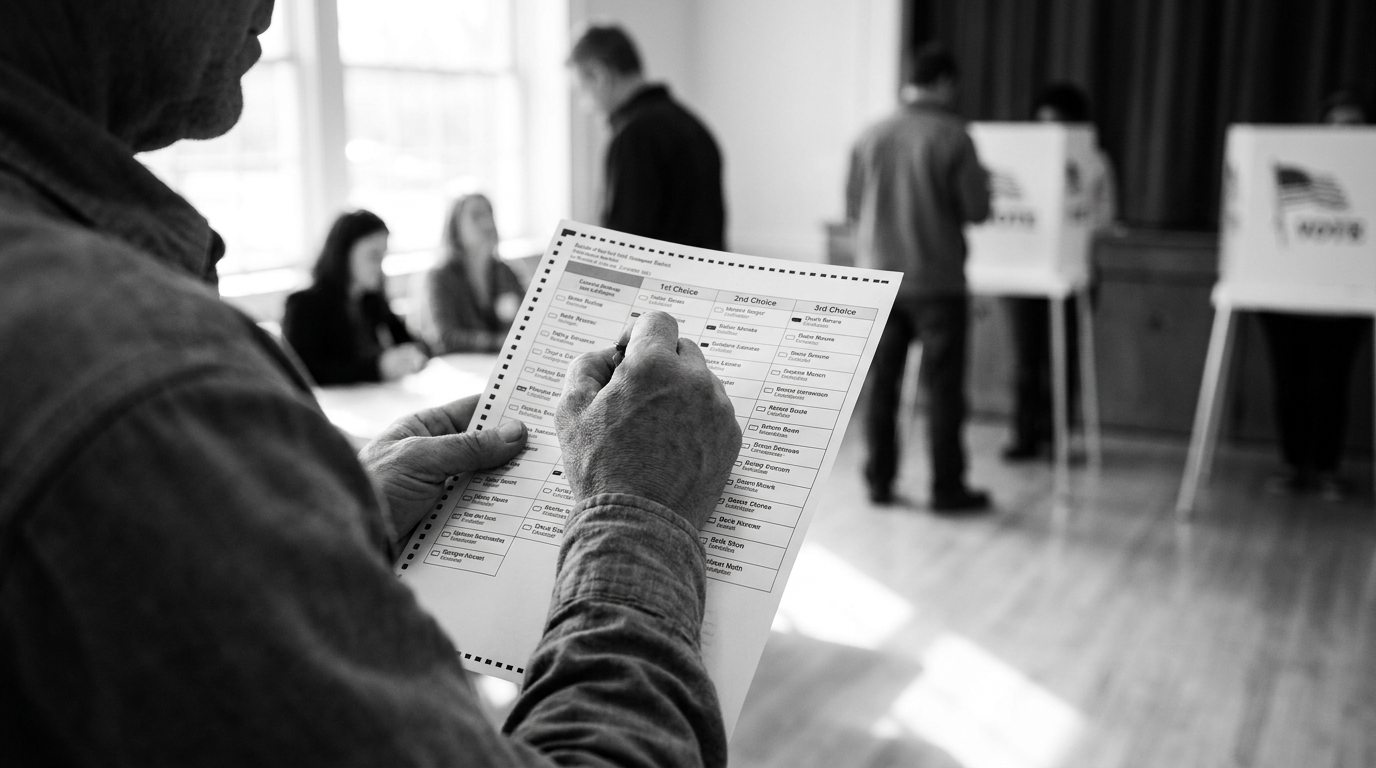
As American political polarization reaches historic highs, a mechanical tweak to the ballot box is rapidly gaining traction as a potential cure. Ranked-choice voting (RCV) has expanded from a handful of progressive municipalities to statewide implementation in Maine and Alaska, with dozens of other cities adopting the system by 2026.[7]
The core promise of RCV is tantalizingly simple: by allowing voters to rank candidates in order of preference, the system claims to eliminate the "spoiler effect," guarantee majority support for the winner, and force candidates to appeal to a broader swath of the electorate.[1]
In a traditional plurality election, the candidate with the most votes wins, even if they secure only 30 percent of the total. Under RCV, if no candidate breaks the 50 percent threshold, the lowest vote-getter is eliminated. Ballots cast for that candidate are then instantly transferred to those voters' second choices, a process that repeats until a majority winner emerges.[2]

But as the reform scales nationally, political scientists and data analysts are rigorously testing the utopian claims made by its advocates. The resulting evidence paints a nuanced picture: RCV is a functional, tested electoral system, but it is not a magic wand for the deep-seated ailments of American democracy.[6][7]
The most prominent claim tested by researchers is that RCV reduces negative campaigning and fosters political civility. The theoretical incentive is clear: candidates cannot afford to alienate their opponents' supporters, because they desperately need to be listed as those voters' second or third choice.[3]
Survey data provides strong backing for this theory. Research highlighted by the American Bar Association and FairVote indicates that voters in RCV cities consistently report perceiving less candidate criticism and fewer negative attacks compared to voters in cities using traditional plurality rules. In New York City's mayoral primaries, candidates have even cross-endorsed each other, resulting in 74 percent of voters successfully ranking the ultimate winner in their top three choices.[1][3]
However, academic reviews caution against declaring the death of the attack ad. A comprehensive review by the Center for the Study of Politics and Governance at the University of Minnesota found that while candidate-to-candidate civility may improve, overall campaign negativity often remains unchanged. In Maine's highly competitive 2018 congressional races, negative advertising actually increased, largely driven by outside political action committees that operate independently of the candidates' strategic need for second-choice votes.[6]

However, academic reviews caution against declaring the death of the attack ad.
A second major battleground in the RCV data is voter turnout and engagement. Advocates argue that by eliminating the fear of "wasting" a vote on a third-party candidate, RCV brings more disillusioned citizens to the polls.[1]
The evidence here is mixed but holds bright spots for specific demographics. Studies have shown a statistically significant nine-percentage-point increase in youth voter turnout in cities utilizing RCV, a bump researchers attribute to candidates conducting wider, more inclusive canvassing operations. Furthermore, RCV entirely eliminates the severe drop-off in voter participation that plagues traditional, delayed runoff elections by consolidating the process into a single day.[1][2]
Yet, skeptics point to a phenomenon known as "ballot exhaustion" as a hidden drag on voter enfranchisement. If a voter chooses to rank only one candidate, and that candidate is eliminated in the early rounds of tabulation, their ballot becomes "exhausted" and does not factor into the final head-to-head tally.[4][6]
In some highly contested races, the exhausted ballot rate has approached 10 percent. When Senator Tom Cotton criticized Alaska's system by claiming 60 percent of voters were "disenfranchised," fact-checkers at PolitiFact rated the claim "Mostly False," noting that voters voluntarily chose not to rank a second option. Still, the reality remains that the final winner in an RCV election often secures a majority of the remaining ballots, not necessarily a majority of all ballots originally cast.[4][7]

The third pillar of the RCV debate centers on its ability to reduce partisan polarization and break the two-party duopoly. By allowing voters to rank independent or moderate candidates first without risking a victory for their least preferred outcome, RCV theoretically paves the way for a more diverse ideological landscape.[1][3]
Alaska's unique model—pairing an open, top-four primary with an RCV general election—successfully produced a bipartisan governing coalition and rewarded candidates who appealed to the political center. However, isolated successes have not yet translated into a national trend.[4][7]
The University of Minnesota review found little empirical support for the idea that RCV systematically decreases polarization. In Maine's 2020 elections, despite the freedom to rank alternatives, independent and third-party candidates still captured only 6.6 percent of the vote, demonstrating that the gravitational pull of the two major parties remains incredibly strong regardless of ballot design.[6]
Beyond the political theory, election administrators are raising practical concerns about the sheer logistics of the system. The Bipartisan Policy Center warns that while voters generally find the ranking process easy to understand, the backend tabulation is vastly more complex.[2]

Because RCV requires all ballots to be centralized before the round-by-round elimination can begin, results are rarely available on election night. In an era of heightened skepticism regarding election integrity, administrators caution that the days-long wait for final RCV tabulations can create a vacuum ripe for misinformation and conspiracy theories.[2][7]
Ultimately, the expanding body of evidence suggests that ranked-choice voting is a meaningful administrative upgrade that ensures winners possess broad, if sometimes secondary, support. It alters campaign incentives and empowers voters to express their true preferences. But as the data clearly shows, no ballot design can single-handedly engineer civility or dismantle the structural polarization of the American electorate.[1][6][7]
How we got here
2004
San Francisco becomes the first major US city to implement ranked-choice voting for municipal elections.
2018
Maine becomes the first state to use RCV for federal congressional elections.
2020
Alaska voters approve a ballot measure combining a top-four open primary with an RCV general election.
2025
New York City records its highest mayoral primary turnout since 1989 using the RCV system.
Viewpoints in depth
Reform Advocates' view
RCV is a necessary mechanical fix to break the cycle of toxic, zero-sum politics.
Advocates point to survey data showing voters feel less alienated in RCV elections. Because candidates need second-choice votes to survive elimination rounds, they are financially and strategically disincentivized from running scorched-earth attack ads against their rivals. Furthermore, by eliminating the 'spoiler effect,' advocates argue RCV frees voters to support third-party candidates without inadvertently helping their least favorite politician win.
System Skeptics' view
RCV over-promises on its benefits while introducing new layers of voter disenfranchisement.
Skeptics argue the reform fails to deliver on its loftiest promises. They point to data showing that third-party candidates still rarely win, and that negative campaigning simply shifts from the candidates themselves to outside PACs. Most critically, they highlight 'exhausted ballots'—where voters who only rank a single eliminated candidate have their ballots discarded before the final round, meaning the ultimate winner often lacks a true mandate from the entire electorate.
Election Administrators' view
The theoretical benefits of RCV must be weighed against the severe logistical strain it places on local governments.
For the officials actually running elections, RCV introduces massive backend complexity. Tabulating ranked ballots requires centralized data and multiple rounds of counting, making election-night results nearly impossible. Administrators warn that in a highly polarized environment, the days-long delay required to accurately calculate RCV winners can breed public suspicion and conspiracy theories, offsetting the system's intended benefits.
What we don't know
- Whether the localized civility benefits of RCV can scale to highly polarized, national-level presidential campaigns.
- The long-term impact of RCV on the viability of third-party candidates, who currently still struggle to win despite the new ballot format.
- How the 'exhausted ballot' rate will change as the American electorate becomes more accustomed to ranking multiple candidates.
Key terms
- Ranked-Choice Voting (RCV)
- An electoral system where voters rank candidates by preference, and instant runoffs are used to ensure the winner has majority support.
- Plurality Voting
- The traditional US election system where the candidate with the most votes wins, even if they receive less than 50 percent of the total.
- Exhausted Ballot
- A ballot that does not factor into the final round of an RCV election because the voter only ranked candidates who were already eliminated.
- Spoiler Effect
- A phenomenon in plurality elections where a third-party candidate draws votes away from a major candidate with similar views, inadvertently helping their mutual opponent win.
Frequently asked
What happens if I only rank one candidate?
Your vote will count for that candidate in the first round. If they are eliminated, your ballot becomes 'exhausted' and will not transfer to anyone else in subsequent rounds.
Does ranked-choice voting favor one political party?
No. Evidence shows RCV does not inherently favor Democrats or Republicans; rather, it tends to favor consensus candidates who can appeal to the political center of their specific electorate.
Why do RCV results take so long to count?
Because RCV requires multiple rounds of elimination and vote transferring, local precincts must send all ballot data to a central location before the final tabulation can begin, which often takes several days.
Sources
Source coverage
7 outlets
4 viewpoints surfaced







[1]American Bar AssociationReform Advocates
Can Ranked Choice Voting Enhance American Democracy?
Read on American Bar Association →[2]Bipartisan Policy CenterElection Administrators
Election Administration Implications of Ranked Choice Voting
Read on Bipartisan Policy Center →[3]FairVoteReform Advocates
Here's the evidence supporting ranked choice voting
Read on FairVote →[4]PolitiFactElection Administrators
Fact-checking Tom Cotton claims about ranked-choice voting in Alaska
Read on PolitiFact →[5]Social Science QuarterlyAcademic Researchers
Is Ranked-Choice Voting Associated With Turnout Across Race/Ethnic Groups?
Read on Social Science Quarterly →[6]Center for the Study of Politics and GovernanceSystem Skeptics
Ranked Choice Voting: A Review of the Evidence
Read on Center for the Study of Politics and Governance →[7]Factlen Editorial TeamAcademic Researchers
Synthesis by Factlen editorial team
Read on Factlen Editorial Team →
More in news politics
See all 6 stories →Senate Race
Mike Collins Wins Georgia Republican Senate Runoff, Setting Up Matchup With Jon Ossoff
0 sources
West Bank Control
Israel Seizes Civil Authority Over Hebron Holy Sites in Major West Bank Shift
0 sources

US-Iran Relations
US and Iran Sign Memorandum of Understanding to End War and Reopen Strait of Hormuz
0 sources

Middle East War
Trump Rebukes Netanyahu Over Lebanon as Israel Defies Terms of U.S.-Iran Peace Deal
0 sources
Every angle. Every day.
Get news politics stories with full source coverage and perspective breakdowns delivered to your inbox.