
Steam Deck OLED vs. ASUS ROG Ally X: Which Premium Handheld is Right for You?
A comprehensive side-by-side comparison of the two leading handheld gaming PCs, weighing the Steam Deck's console-like efficiency against the ROG Ally X's raw Windows power.
By Factlen Editorial Team
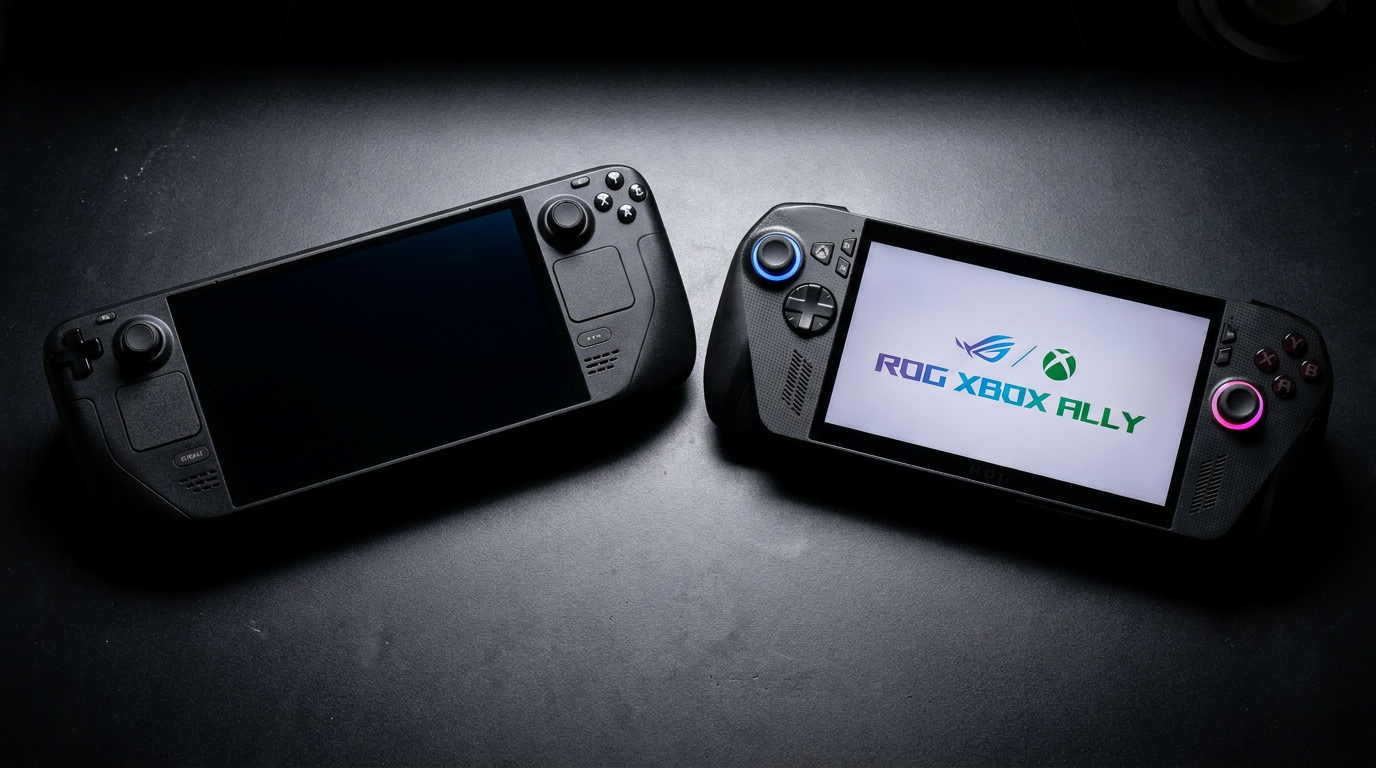
- Console Purists
- Values seamless user experience, battery efficiency, and plug-and-play reliability over raw hardware power.
- Performance Enthusiasts
- Prioritizes maximum frame rates, high-resolution displays, and the freedom to play any PC game regardless of the launcher.
- Value Analysts
- Focuses on the price-to-performance ratio and the total cost of ownership for portable gaming hardware.
What's not represented
- · Game Developers optimizing for fixed hardware
- · Budget-conscious gamers relying on older hardware
Why this matters
As the handheld PC market matures, choosing the right device dictates not just how your games look, but whether you can access your existing libraries and subscription services. Dropping $500 to $800 on a portable console requires understanding the strict trade-offs between seamless software efficiency and raw, uncompromised Windows performance.
Key points
- The Steam Deck OLED offers a seamless, console-like experience with exceptional battery life for $549.
- The ASUS ROG Ally X provides raw Windows 11 power, 24GB of RAM, and a 1080p display for $799.
- SteamOS prevents native access to Xbox Game Pass and games requiring kernel-level anti-cheat software.
- The Ally X's massive 80Wh battery is offset by the higher power demands of Windows 11 and its Z1 Extreme chip.
- Choose the Steam Deck for plug-and-play simplicity, or the Ally X for maximum performance and platform freedom.
The handheld gaming PC market has reached a golden era in 2026, transforming from a niche hobbyist category into a mainstream staple. At the pinnacle of this portable revolution sit two undisputed heavyweights: Valve’s Steam Deck OLED and the ASUS ROG Ally X. While both devices promise to untether players from their desktop rigs, they represent fundamentally different philosophies regarding what a portable computer should be. Choosing between them is no longer a simple matter of comparing spec sheets; it requires a deep dive into how you play, where you play, and what kind of software friction you are willing to tolerate.
This side-by-side trade-off analysis examines the two market leaders across performance, battery life, software experience, and total value. At $549 for the 512GB model, the Steam Deck OLED serves as the accessible, console-like benchmark that popularized the category. In contrast, the $799 ASUS ROG Ally X demands a premium price for raw, unbridled Windows-based power and high-end internals. Understanding the distinct advantages and compromises of each system is essential for making an informed investment in portable gaming, as neither device is universally perfect for every type of player.[6]
The argument for the Steam Deck OLED centers entirely on its seamless user experience and unparalleled power efficiency. Valve’s custom Linux-based SteamOS operates exactly like a traditional gaming console. Users press the power button, select a title from their library, and immediately begin playing without navigating desktop environments or updating background drivers. This zero-friction approach eliminates the traditional headaches associated with PC gaming, creating a plug-and-play ecosystem that simply works out of the box.[4]
The evidence supporting the Steam Deck’s dominance lies in its battery optimization and display technology. Equipped with a 50-watt-hour battery and a strict 15-watt thermal design power limit, the device extracts maximum playtime from every charge. Real-world testing demonstrates this efficiency clearly: in less demanding titles like Portal 2, the Steam Deck OLED can push nearly six hours of continuous gameplay. Furthermore, the 7.4-inch HDR OLED display delivers inky blacks and vibrant colors that consume significantly less power than traditional LCD panels, making games look spectacular while preserving battery life.[1][6]

The argument against the Steam Deck OLED focuses on its closed ecosystem and hardware ceiling. Because SteamOS is built on Linux, it cannot natively run titles that rely on aggressive Windows-level anti-cheat software, entirely locking players out of massive multiplayer hits like Valorant, Fortnite, and Call of Duty. Additionally, its custom AMD Zen 2 processor and 16GB of RAM are beginning to show their age against the most demanding modern releases, forcing players to accept 720p resolutions and lower graphical presets to maintain playable frame rates.[5]
Conversely, the argument for the ASUS ROG Ally X focuses on raw, uncompromised performance and total platform freedom. Powered by the AMD Ryzen Z1 Extreme processor and a massive 24GB of high-speed LPDDR5X RAM, the Ally X is effectively a high-end gaming laptop condensed into a handheld chassis. Because it runs a full version of Windows 11, users are not restricted to the Steam storefront. They can seamlessly install Xbox Game Pass, the Epic Games Store, Battle.net, and any anti-cheat software required for competitive multiplayer titles.[2][3]
The evidence for the Ally X’s performance leap is quantified in its frame rates and display capabilities. The device features a 7-inch, 1080p IPS display with a 120Hz variable refresh rate, ensuring that gameplay remains buttery smooth even when frame rates fluctuate. When pushed into its 30-watt Turbo mode, the Ally X can run demanding titles like Cyberpunk 2077 at 46 frames per second, leaving the Steam Deck trailing at roughly 28 frames per second under similar loads. The extra 8GB of RAM over the Steam Deck also virtually eliminates stuttering in memory-heavy open-world games.[1][5]

The evidence for the Ally X’s performance leap is quantified in its frame rates and display capabilities.
The argument against the ROG Ally X stems from the inherent clunkiness of Windows 11 on a 7-inch touchscreen and its aggressive power consumption. While ASUS has doubled the battery capacity to a staggering 80 watt-hours, the overhead of running a desktop operating system means that battery drains rapidly. In heavy AAA titles, both the Ally X and the Steam Deck will die in roughly two to two-and-a-half hours. Furthermore, Windows sleep mode remains notoriously unreliable, occasionally causing games to crash upon waking—a stark contrast to the Steam Deck’s flawless suspend-and-resume feature.[6]
Beyond the core processing power, connectivity and storage expansion play a crucial role in the long-term viability of these devices. The ROG Ally X features dual USB-C ports, including one Thunderbolt-compatible connection, allowing users to charge the device while simultaneously outputting video to AR glasses or an external monitor without requiring a bulky dock. Both systems offer easily accessible M.2 SSD slots for users who wish to upgrade their internal storage, though the Ally X utilizes the more common 2280 size drive, making high-capacity upgrades significantly cheaper and easier to source than the Steam Deck’s smaller 2230 drives.[2]
Thermal management and audio quality further separate the two handhelds during intense gaming sessions. The ROG Ally X utilizes a dual-fan cooling system with an additional exhaust vent that keeps the device remarkably quiet and cool to the touch, even when pushing 30 watts of power. Meanwhile, the Steam Deck OLED relies on a single, highly optimized fan that rarely spins up to distracting volumes thanks to the efficiency of the SteamOS. Both devices feature exceptional front-firing stereo speakers, but the Ally X delivers slightly richer bass and spatial audio separation, enhancing the immersion when playing without headphones.[1]
Ultimately, the decision comes down to matching the hardware to your specific gaming lifestyle. The Steam Deck OLED fits well when you want a frictionless, console-like experience that requires zero troubleshooting. It is the ideal choice if your entire gaming library already lives on Steam, if you prioritize long battery life for indie games during extended travel, and if you prefer the striking visual contrast of an OLED screen. At $549, it remains the undisputed champion of value in the handheld space.[6]

However, the Steam Deck OLED does not fit when your gaming habits revolve around subscription services like PC Game Pass or the Epic Games Store, as installing these requires frustrating workarounds. It is also the wrong choice if your primary games are competitive multiplayer shooters like Valorant that utilize kernel-level anti-cheat software, or if you demand the highest possible frame rates and refuse to compromise on visual fidelity in the latest AAA blockbusters.[5][6]
On the other side of the spectrum, the ASUS ROG Ally X fits well when you demand the absolute maximum performance available in a portable form factor. It is the perfect device for gamers who want one machine to play everything across all PC launchers, who value a 1080p 120Hz display for smooth motion, and who do not mind spending $799 for premium internal components like 24GB of RAM and an 80-watt-hour battery.[3][5]
Conversely, the ASUS ROG Ally X does not fit when you are on a strict budget or if you despise tinkering with software. If the thought of updating Windows drivers, navigating desktop pop-ups with a joystick, or dealing with inconsistent sleep modes sounds exhausting, the Ally X will likely cause frustration. It is a device built for PC enthusiasts who view a little software friction as a fair trade for total platform freedom.[6]

Ultimately, the competition between Valve and ASUS has pushed the entire industry forward. Whether you choose the frictionless elegance of the Steam Deck OLED or the brute-force versatility of the ROG Ally X, the real victory is that PC gaming is no longer confined to a desk. The choice simply comes down to whether you want a device that acts like a console, or one that acts like a computer.
How we got here
February 2022
Valve releases the original LCD Steam Deck, proving the viability of the modern handheld PC gaming market.
June 2023
ASUS launches the original ROG Ally, introducing Windows 11 and the powerful Z1 Extreme chip to the handheld space.
November 2023
Valve releases the Steam Deck OLED, featuring a vastly improved HDR display, better battery life, and refined thermals.
July 2024
ASUS releases the ROG Ally X, doubling the battery capacity and increasing the RAM to address the original model's shortcomings.
Viewpoints in depth
The Console Purist's View
Advocating for the Steam Deck's frictionless ecosystem.
For gamers who treat their handheld as a secondary device to a main PC or console, the Steam Deck OLED is the ultimate companion. This camp argues that Windows 11 is fundamentally unsuited for a 7-inch touchscreen, pointing to the frequent need to use the touchscreen to close background apps or update drivers. They value the ability to suspend a game instantly and resume it days later without a crash—a feature SteamOS handles flawlessly. To them, the OLED screen's infinite contrast and the system's incredible battery life in indie games far outweigh the inability to play the latest AAA titles at maximum settings.
The Performance Enthusiast's View
Championing the ROG Ally X's raw power and platform freedom.
Enthusiasts argue that a PC should act like a PC, regardless of its form factor. This viewpoint champions the ROG Ally X because it refuses to compromise on compatibility. By running Windows 11, the device grants access to Xbox Game Pass, the Epic Games Store, and crucial anti-cheat software required for games like Call of Duty and Valorant. They point to the 24GB of RAM and the Z1 Extreme processor as necessary future-proofing, arguing that the $250 premium is a small price to pay for a device that can genuinely replace a budget gaming laptop while delivering 120Hz variable refresh rate smoothness.
What we don't know
- How upcoming next-generation APUs from AMD and Intel will shift the balance of power in late 2026.
- Whether Valve will eventually release a native dual-boot wizard to make installing Windows on the Steam Deck easier.
- How Microsoft's promised 'Handheld Mode' for Windows 11 will ultimately improve the ROG Ally X's user interface.
Key terms
- SteamOS
- A Linux-based operating system developed by Valve, designed specifically to provide a console-like, controller-friendly interface for PC games.
- TDP (Thermal Design Power)
- The maximum amount of heat generated by a computer chip that the cooling system is designed to dissipate, often used as a proxy for how much electrical power the device consumes.
- VRR (Variable Refresh Rate)
- A display technology that synchronizes the screen's refresh rate with the game's frame rate, eliminating screen tearing and making gameplay look smoother.
- APU (Accelerated Processing Unit)
- A single computer chip designed by AMD that combines both the central processor (CPU) and the graphics processor (GPU) into one unit.
Frequently asked
Can the Steam Deck OLED play Xbox Game Pass games?
Not natively. Because it runs on Linux-based SteamOS, you cannot install the native Xbox app. You can, however, stream Game Pass titles via Xbox Cloud Gaming using a web browser.
Does the ROG Ally X have an OLED screen?
No, the ROG Ally X features a 7-inch IPS LCD screen. While it lacks the deep blacks of an OLED, it offers a higher 1080p resolution and a faster 120Hz variable refresh rate.
Which handheld has better battery life?
The Steam Deck OLED generally provides longer battery life, especially in lighter indie games, due to its highly efficient SteamOS. However, in heavy AAA games, both devices last roughly two to three hours.
Can I upgrade the storage on these handhelds?
Yes, both devices allow users to upgrade the internal SSD. The ROG Ally X uses the standard 2280 M.2 size, which is generally cheaper and easier to find than the Steam Deck's smaller 2230 M.2 drives.
Sources
Source coverage
6 outlets
3 viewpoints surfaced






[1]Rock Paper ShotgunConsole Purists
Asus ROG Ally X vs Steam Deck OLED: Which portable gaming PC is best?
Read on Rock Paper Shotgun →[2]Tom's GuidePerformance Enthusiasts
Asus ROG Ally X vs Steam Deck OLED: Which handheld wins?
Read on Tom's Guide →[3]Pocket TacticsValue Analysts
Asus ROG Ally X vs Steam Deck OLED: which is the better gaming handheld?
Read on Pocket Tactics →[4]PC GamerConsole Purists
The best handheld PCs
Read on PC Gamer →[5]Pocket-lintPerformance Enthusiasts
I swapped my Steam Deck OLED for the ROG Ally X
Read on Pocket-lint →[6]Switchblade GamingValue Analysts
Best handheld gaming PC 2026 buyer guide
Read on Switchblade Gaming →
Every angle. Every day.
Get gaming esports stories with full source coverage and perspective breakdowns delivered to your inbox.