
US Community Solar Surpasses 10-Gigawatt Milestone as Sector Rebounds
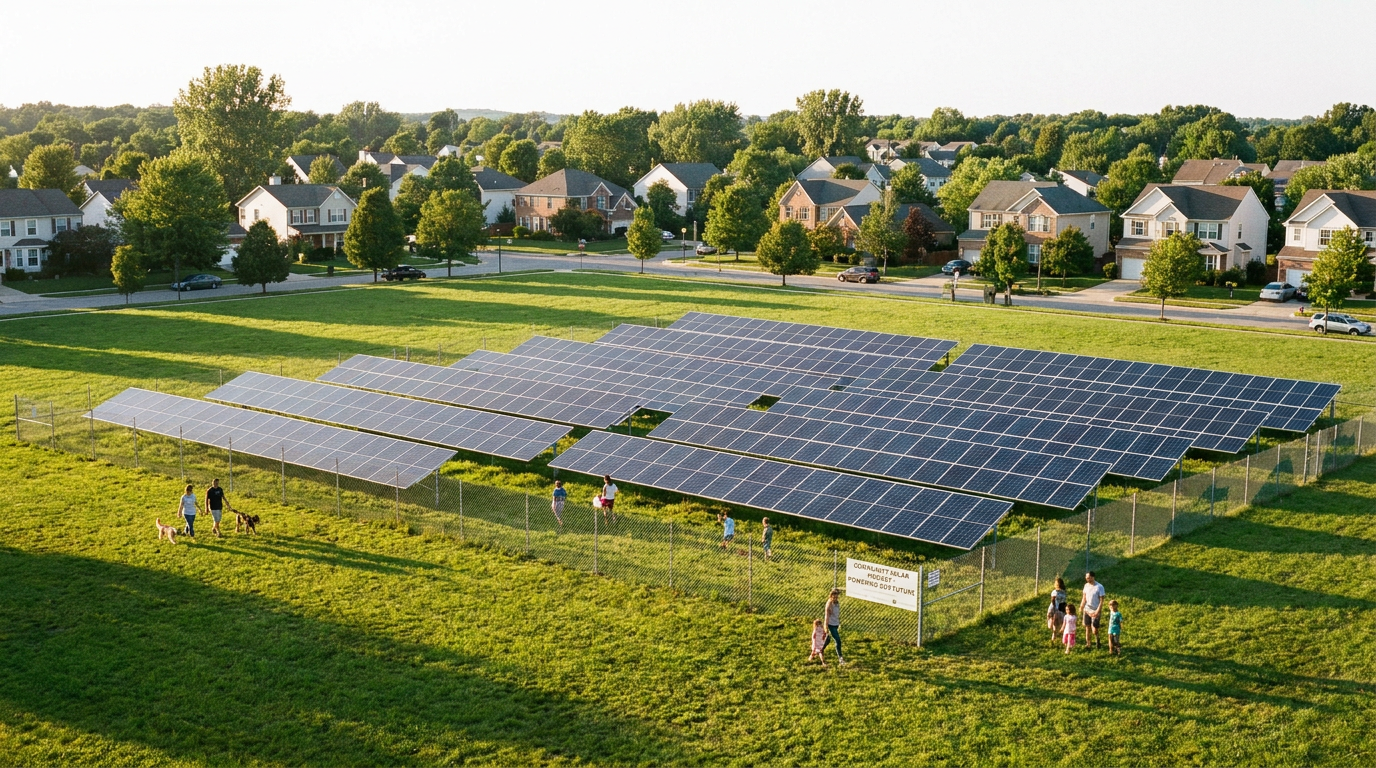
The US community solar sector has officially crossed 10 gigawatts of cumulative capacity, expanding renewable energy access to renters and low-income households.
By Factlen Editorial Team
- Clean Energy Advocates
- View community solar as a vital tool for democratizing the grid and expanding renewable access to renters and low-income households.
- Market Analysts
- Focus on the economic viability of the sector, tracking interconnection bottlenecks, tax credit deadlines, and subscriber acquisition costs.
- State Regulators & Utilities
- Prioritize grid reliability, local job creation, and ensuring that disadvantaged communities receive tangible bill savings.
What's not represented
- · Traditional fossil fuel utilities
- · Non-participating ratepayers
Why this matters
Community solar allows people who rent their homes, live in apartments, or cannot afford rooftop panels to access clean energy and lower their utility bills. Surpassing this milestone proves that decentralized, community-owned power is becoming a viable alternative to traditional utility monopolies.
Key points
- The US community solar sector has officially surpassed 10 gigawatts of cumulative installed capacity.
- Following a 25% contraction in 2025, the market is projected to rebound with 12% growth in 2026.
- Developers are currently managing a massive 8 GW pipeline, racing to meet federal tax credit deadlines.
- California regulators recently completed new equity-focused projects that provide a 20% discount to low-income households.
The US community solar sector has officially surpassed 10 gigawatts (GW) of cumulative installed capacity, marking a historic milestone for a model designed to democratize access to renewable energy.[1][2]
The achievement, detailed in a joint report by energy analytics firm Wood Mackenzie and the Coalition for Community Solar Access (CCSA), comes as the industry rebounds from a challenging period of market consolidation.[1][7]
Unlike traditional rooftop solar, which requires homeownership and significant upfront capital, community solar allows multiple customers to subscribe to a shared local facility. Subscribers receive credits on their utility bills for their portion of the power generated, opening the door for apartment dwellers, renters, and low-to-moderate-income households.[2][7]
The 10 GW threshold represents enough capacity to power millions of homes and signifies the sector's resilience amid complex federal policy shifts and grid interconnection backlogs.[1][3]

While the market experienced a 25% contraction in 2025—driven largely by slowdowns in mature, early-adopter markets like New York and Maine—analysts project a strong 12% growth rate for 2026.[1][4]
This near-term rebound is anchored by capacity additions in Illinois and the Mid-Atlantic region, alongside a massive national development pipeline. Currently, more than 8 GW of projects are in development, with nearly a third already under construction.[2][7]
Developers are racing to build out their pipelines as efficiently as possible to meet strict placed-in-service deadlines required to secure the federal Investment Tax Credit (ITC) before it phases out in 2030.[1][2]
With traditional hubs reaching saturation, the industry's long-term expansion depends heavily on emerging state markets. Advocates are pushing for new legislation in states like Ohio, Pennsylvania, and Michigan, which could unlock up to 1.5 GW of additional capacity if programs are approved.[2][7]

With traditional hubs reaching saturation, the industry's long-term expansion depends heavily on emerging state markets.
Simultaneously, utilities are increasingly prioritizing "community-scale" resources—projects up to 20 megawatts in size that connect directly to the distribution grid. These smaller installations can be deployed much faster than massive utility-scale farms and help improve local grid reliability when paired with battery storage.[1][2]
In California, the push for equitable clean energy access is yielding tangible results on the ground. The California Public Utilities Commission (CPUC) recently celebrated the completion of new community solar projects in Oakland and Carson, developed in partnership with Ava Community Energy and Prologis.[6]
These competitively procured projects operate under the state's Disadvantaged Communities Green Tariff program, providing income-qualified customers with 100% renewable electricity at a 20% discount. When combined with other assistance programs, participating households can see their monthly electricity bills reduced by as much as 50%.[6]

Beyond direct bill savings, local initiatives are integrating workforce development into their solar rollouts. Ava Community Energy's programs include green job training, allowing local residents to gain hands-on experience in solar installation and maintenance.[6]
Despite the optimism surrounding the 10 GW milestone, structural challenges remain. Subscriber acquisition costs, particularly for low-to-moderate-income households, are still high at roughly $100 per kilowatt.[2][7]
However, wider adoption of consolidated utility billing and improved digital marketing tools helped drive average acquisition costs down by 12% last year, a trend analysts expect to continue. The subscription management landscape is also consolidating rapidly, with just four major entities now managing 55% of all operational community solar capacity in the US.[1][7]
For clean energy advocates, the 10 GW threshold stands as a vital proof of concept. It demonstrates that decentralized, community-owned power is not just a niche alternative, but a scalable structural shift in how neighborhoods interact with the grid—moving everyday residents from passive consumers to active participants in the energy transition.[3][5]
How we got here
2023-2024
Community solar expands rapidly in early-adopter states like New York and Maine.
2025
The sector experiences a 25% contraction due to market saturation and interconnection delays.
Late 2025
Cumulative US community solar capacity officially crosses the 10-gigawatt threshold.
April 2026
Wood Mackenzie and CCSA release data confirming the milestone and projecting a 12% rebound for the year.
June 2026
California regulators celebrate new equity-focused community solar projects in Oakland and Carson.
Viewpoints in depth
Expanding Access and Equity
Advocates view community solar as a vital tool for democratizing the grid.
Clean energy advocates emphasize that traditional rooftop solar has historically been restricted to homeowners with good credit and suitable roofs. Community solar breaks down these barriers by allowing renters, apartment dwellers, and low-income families to subscribe to local arrays. Organizations like the Coalition for Community Solar Access argue that the 10 GW milestone proves decentralized power is a scalable solution that directly benefits communities rather than just utility monopolies.
Navigating Policy and Bottlenecks
Market analysts focus on the economic and regulatory hurdles facing developers.
While the 10 GW milestone is significant, analysts at firms like Wood Mackenzie point out that the industry's growth is increasingly complicated by grid interconnection backlogs and looming policy deadlines. Developers are sitting on an 8 GW pipeline but face a ticking clock to get projects built before the federal Investment Tax Credit phases out in 2030. Furthermore, subscriber acquisition costs remain stubbornly high for low-to-moderate-income households, forcing the industry to rely on consolidated billing and digital tools to maintain margins.
Grid Reliability and Local Savings
State regulators prioritize the tangible benefits of community-scale resources.
For state utility commissions, community solar is less about national milestones and more about local grid resilience and ratepayer relief. Regulators note that mid-sized, community-scale projects (up to 20 MW) can be deployed much faster than massive utility-scale farms. By connecting directly to the distribution grid, these projects help alleviate local strain during peak demand. Additionally, programs like California's Disadvantaged Communities Green Tariff ensure that the financial benefits of these installations flow directly to the neighborhoods that host them.
What we don't know
- Whether emerging state markets like Ohio and Pennsylvania will pass the necessary legislation to unlock the projected 1.5 GW of new capacity.
- How the expiration of the federal Investment Tax Credit in 2030 will ultimately impact the financial viability of future community solar pipelines.
Key terms
- Community solar
- A local solar power plant whose electricity is shared by more than one household, allowing subscribers to receive credit on their electricity bills.
- Investment Tax Credit (ITC)
- A federal tax incentive that allows individuals and businesses to deduct a percentage of the cost of installing a solar energy system from their federal taxes.
- Community-scale resources
- Mid-sized solar projects, typically up to 20 megawatts, that connect directly to the local distribution grid rather than the high-voltage transmission system.
- Disadvantaged Communities Green Tariff (DAC-GT)
- A California program that provides income-qualified residential customers with 100% renewable energy at a discounted rate.
Frequently asked
What is community solar?
Community solar allows multiple customers to subscribe to a shared local solar facility. Subscribers receive credits on their electricity bills for their share of the energy produced, eliminating the need for personal rooftop panels.
Why did community solar installations drop in 2025?
The sector experienced a 25% contraction in 2025 primarily due to market saturation and slowdowns in early-adopter states like New York and Maine, compounded by grid interconnection delays.
How does community solar help low-income households?
Through specific state programs, income-qualified households can subscribe to community solar projects at a discounted rate, often reducing their monthly electricity bills by 20% to 50%.
What happens when the federal tax credit expires in 2030?
The planned phaseout of the federal Investment Tax Credit (ITC) in 2030 is pushing developers to accelerate construction now. Post-2030, the industry will rely more heavily on state-level legislation and falling equipment costs to remain competitive.
Sources
Source coverage
7 outlets
3 viewpoints surfaced






[1]PV MagazineMarket Analysts
U.S. community solar passes 10 GW milestone despite market contraction
Read on PV Magazine →[2]ElectrekMarket Analysts
US community solar just hit 10 GW – but growth is getting complicated
Read on Electrek →[3]PV TechClean Energy Advocates
US community solar capacity passes 10GW despite 2025 slowdown
Read on PV Tech →[4]Review EnergyMarket Analysts
US community solar hits 10 GW as installations decline in key markets
Read on Review Energy →[5]Energy ChangemakersClean Energy Advocates
Home Solar Forecast Bullish Post 2026
Read on Energy Changemakers →[6]California Public Utilities CommissionState Regulators & Utilities
CPUC Community Solar Programs Continue Delivering Customer Savings
Read on California Public Utilities Commission →[7]Wood MackenzieMarket Analysts
US community solar surpasses 10 GW milestone in 2025 despite tightening market conditions
Read on Wood Mackenzie →
Every angle. Every day.
Get community stories with full source coverage and perspective breakdowns delivered to your inbox.