
The High-Tech Race to Replace Badminton's Goose Feathers
As the cost of natural feathers skyrockets and animal welfare concerns mount, badminton is turning to advanced synthetic shuttlecocks. New aerodynamic materials are finally mimicking the unique physics of feathers, promising a cheaper and more sustainable future for the sport.
By Factlen Editorial Team
- Grassroots Players
- Amateur clubs and recreational players facing severe financial barriers.
- Elite Traditionalists
- Professional players who prioritize the precise aerodynamic feel of natural feathers.
- Sustainability Advocates
- Campaigners pushing to eliminate animal cruelty and environmental waste from the sport.
- Governing Bodies
- The BWF's data-driven approach to phasing in new technology.
What's not represented
- · Duck and goose farmers in China facing declining demand
Why this matters
The rising cost of traditional feather shuttlecocks is pricing recreational players out of the world's fastest racket sport. A successful transition to durable synthetics will democratize access to badminton while eliminating the need to harvest feathers from millions of live birds annually.
Key points
- The BWF has approved advanced synthetic shuttlecocks for official trials in lower-tier international tournaments in 2026.
- A decline in duck and goose farming has caused the price of premium feather shuttlecocks to nearly triple since 2023.
- New synthetic models use Polyamide 12 and carbon composites to mimic the steep aerodynamic deceleration of natural feathers.
- Widespread adoption of synthetics could reduce shuttlecock usage by 25 percent, lowering costs and environmental waste.
The sound of a perfect badminton smash is unmistakable—a sharp, explosive crack that sends the shuttlecock hurtling over the net at speeds exceeding 200 miles per hour. But the projectile at the center of the world's fastest racket sport is facing an existential crisis. For over a century, the elite game has relied entirely on natural goose and duck feathers. Now, a combination of skyrocketing costs, supply chain shortages, and animal welfare concerns is forcing the sport to engineer a high-tech alternative.[7]
A traditional professional shuttlecock is a delicate marvel of natural engineering. It requires exactly 16 premium feathers, meticulously selected from either the left or right wing of a goose or duck to ensure a uniform spin in the air. Because each bird only yields a handful of suitable "knife feathers," it takes multiple birds to produce a single shuttlecock. This makes the manufacturing process incredibly resource-intensive, highly manual, and difficult to scale to meet the demands of a rapidly growing global sport.[2][4]
This reliance on livestock has collided with modern economic realities. China, which manufactures the vast majority of the world's feather shuttlecocks, has seen a steady decline in duck and goose farming over the past five years as agricultural trends shift. As raw material supplies dwindle, the cost of premium feather shuttlecocks has surged dramatically. Industry data shows that some popular models have nearly tripled in price since 2023. This intense economic pressure is forcing manufacturers to look beyond traditional agriculture and invest heavily in materials science to find a viable, long-term solution.[7]

For recreational clubs and amateur players, this sudden price hike is devastating. Badminton is inherently a high-attrition sport; a single competitive match between skilled players can easily destroy half a dozen feather shuttlecocks as the delicate spines snap under the force of repeated smashes. As the financial barrier to entry rises, the sport risks pricing out the very grassroots communities that fuel its global popularity. Local clubs are increasingly forced to raise membership fees, increase tournament entry costs, or ration their shuttlecock usage, which ultimately stifles the growth of the game at the community level.[7]
Simultaneously, animal rights organizations have intensified their scrutiny of the sport's supply chain. Campaigns like the "Duck Off Project" have highlighted the ethical issues surrounding feather harvesting, arguing that the mass production of disposable sporting equipment cannot justify the reliance on animal products. Activists point out that the sheer volume of feathers required globally contributes to an industry where birds are often subjected to cruel practices. These organizations are aggressively pushing governing bodies to mandate cruelty-free alternatives, arguing that a transition to synthetic materials is necessary to align the sport with modern ethical and environmental standards.[4]
Enter the advanced synthetic shuttlecock. While cheap nylon or plastic "birdies" have existed for decades in backyards and school gymnasiums, they have never been viable for professional play. The challenge lies in the unique, highly complex aerodynamics of natural feathers, which physicists and engineers have spent years trying to replicate in wind tunnels. Bridging the gap between a durable backyard toy and a precision piece of elite sporting equipment requires cutting-edge materials science, as the synthetic alternative must perfectly mimic the weight, balance, and flight trajectory that professional players have relied on for generations.[7]
Badminton is fundamentally a "high drag" game, governed by unique aerodynamic principles. When a professional player executes a powerful jump smash, the shuttlecock must travel incredibly fast off the racket—often exceeding the speed of a Formula 1 car—but then decelerate steeply and suddenly so it drops safely within the court boundaries. Natural feathers excel at this specific task; their overlapping micro-structures create immense aerodynamic drag at high speeds while maintaining their rigid shape. This steep deceleration curve is what allows players to execute precise drop shots and powerful smashes with a predictable, highly controllable flight path.[6]
Badminton is fundamentally a "high drag" game, governed by unique aerodynamic principles.
Traditional nylon shuttlecocks completely fail this crucial physics test. Under the extreme force of a professional smash, the flexible plastic skirt deforms and collapses inward. This structural failure makes the shuttlecock significantly more streamlined, which drastically reduces its aerodynamic drag coefficient at high speeds. As a result, a smashed nylon shuttlecock does not decelerate properly; it flies too fast and sails far past the baseline. This lack of drag ruins the geometry and strategic depth of the game, making it impossible for elite players to rely on the precise court positioning that defines top-tier badminton.[6]
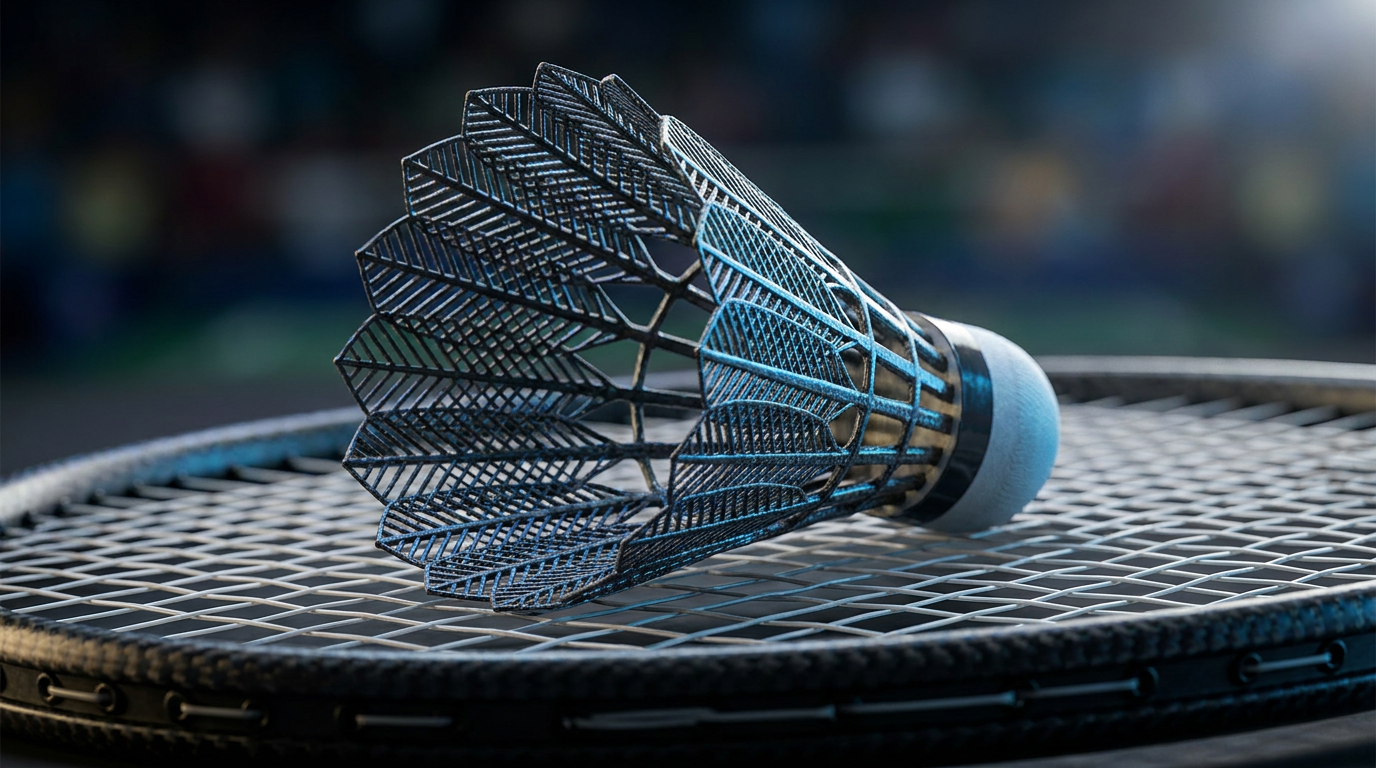
To solve this aerodynamic puzzle, sporting goods manufacturers have turned to advanced polymers and carbon-fiber composites. Modern synthetic prototypes use high-performance materials like Polyamide 12 (PA12) to mimic the stiff, resilient spine of a natural feather. This rigid backbone is paired with lattice-like synthetic vanes that are engineered to catch the air exactly like natural plumage. These high-tech materials are specifically designed to withstand immense physical force without deforming, ensuring that the drag coefficient remains stable even when the shuttlecock is struck at maximum velocity by a professional athlete.[2][7]
The Badminton World Federation (BWF) has recognized that the long-term future of the sport depends heavily on these material innovations. After years of closed-door testing and prototype development, the BWF recently approved two advanced synthetic models—the Victor New Carbon Sonic Max and the Yonex Crosswind 70—for official use in selected lower-tier international events. By introducing these synthetic shuttlecocks into Grade 3 and Junior tournaments in 2026, the governing body has marked a significant milestone in the sport's technological evolution, signaling a clear intent to move away from natural feathers.[2]

This 2026 trial phase is meticulously designed to gather crucial performance data from players, technical officials, and tournament organizers in real-world competitive environments. Rather than forcing an immediate global switch, the BWF is using these lower-tier events as a testing ground to identify any remaining flaws in the synthetic designs. The ultimate goal is to fine-tune the technology based on direct athlete feedback until the synthetic shuttlecocks are completely indistinguishable from feathers, paving the way for their eventual adoption at the highest levels of the sport, including the World Championships and the Olympic Games.[2]
Independent wind tunnel tests and two-dimensional flight simulations reveal that the performance gap is closing rapidly, though slight aerodynamic differences remain. Recent scientific studies indicate that the new synthetics perfectly replicate the crucial "flip phenomenon"—the rapid 180-degree turn the shuttlecock makes immediately after being struck by the racket, which stabilizes its flight. However, researchers have noted that despite this stability, the synthetic materials still experience marginally less air resistance than natural waterfowl feathers, altering the deceleration profile just enough to be noticed by highly sensitive professional players.[3][5]
In practical terms, this slight reduction in drag means that a synthetic shuttlecock struck at maximum velocity might travel about 7.8 percent further than a traditional feather one. For amateur players, this difference is largely negligible, but for elite athletes whose muscle memory is calibrated to the millimeter, it represents a significant shift. Professionals transitioning to synthetic shuttlecocks will need to make subtle adjustments to their swing power, racket tension, and court positioning to compensate for this extra carry and ensure their baseline clears do not sail out of bounds.[5]
Despite these minor aerodynamic hurdles, the economic and environmental math is overwhelmingly in favor of the transition. Field tests have shown that advanced synthetic shuttlecocks can last up to twice as long as their feathered counterparts, successfully resisting the fraying, bending, and snapping that routinely ruins natural feathers during a match. The BWF estimates that widespread adoption could reduce overall shuttlecock usage by at least 25 percent per tournament. This increased durability promises to slash operational costs for tournament organizers while significantly reducing the volume of plastic and biological waste sent to landfills.[1]

As materials science continues to iterate on these designs, the century-old era of the natural feather shuttlecock appears to be entering its twilight. The ongoing trials represent a critical bridge between the sport's rich heritage and its high-tech future. By fully embracing synthetic innovation, badminton is poised to become significantly more affordable, environmentally sustainable, and globally accessible. This transition will ultimately ensure the sport's continued growth for the next century, democratizing access for millions of new players without sacrificing the breathtaking speed and precision that make it so thrilling to watch.[7]
How we got here
2020
The BWF announces its long-term sustainability plan to begin adopting non-animal shuttlecocks.
2021
The first Yonex synthetic shuttlecock is officially approved for use in BWF-sanctioned international tournaments.
2023
A sharp decline in duck and goose farming in China triggers a massive spike in the retail price of premium feather shuttlecocks.
April 2026
The BWF approves two advanced synthetic models for official trials in Grade 3 and Junior International tournaments.
Viewpoints in depth
Elite Traditionalists
Professional players who prioritize the precise aerodynamic feel of natural feathers.
For players competing at the highest levels, muscle memory is calibrated to the millimeter. Traditionalists argue that natural feathers provide an irreplaceable aerodynamic drag that allows for steep, sudden deceleration—a critical component for executing precise drop shots and keeping high-speed smashes within the court lines. They express concern that even minor deviations in flight trajectory, such as the slight extra carry observed in synthetic prototypes, could fundamentally alter the geometry and strategy of elite badminton.
Sustainability Advocates
Campaigners pushing to eliminate animal cruelty and environmental waste from the sport.
Organizations like the Duck Off Project argue that the mass production of disposable sporting equipment cannot justify the reliance on animal products. They highlight the ethical concerns of harvesting feathers from millions of live ducks and geese annually, noting that only a few specific feathers per bird are usable. Furthermore, advocates point out that traditional shuttlecocks have a massive environmental footprint due to their short lifespan, urging governing bodies to mandate cruelty-free, recyclable synthetic alternatives immediately.
Grassroots Players
Amateur clubs and recreational players facing severe financial barriers.
At the local club level, badminton is a high-attrition sport where a single competitive match can destroy half a dozen shuttlecocks. With the cost of premium feathers nearly tripling in recent years, many grassroots organizations are struggling to stay afloat. For these players, the transition to durable synthetics is not just an ethical preference but an economic necessity to prevent the sport from becoming prohibitively expensive for the general public.
Governing Bodies
The BWF's data-driven approach to phasing in new technology.
The Badminton World Federation is attempting to thread the needle between preserving the sport's elite standards and ensuring its long-term viability. By authorizing synthetic shuttlecocks for lower-tier international events, the BWF is taking a cautious, data-driven approach. They aim to collect extensive feedback from players and technical officials to refine the technology, ensuring that when synthetics eventually reach the Olympics, they are completely indistinguishable from traditional feathers.
What we don't know
- When the BWF will officially approve synthetic shuttlecocks for top-tier events like the World Championships or the Olympics.
- Whether elite players will fully accept the slight aerodynamic differences, such as the 7.8 percent increase in flight distance.
- How traditional feather manufacturers will adapt their business models as the sport transitions to synthetic materials.
Key terms
- Drag Coefficient
- A scientific measurement of how much resistance an object faces as it moves through the air, crucial for a shuttlecock's ability to decelerate rapidly.
- Reynolds Number
- A metric used in fluid dynamics to predict flow patterns; in badminton, it helps explain how air flows around the shuttlecock at high smash speeds.
- Flip Phenomenon
- The rapid 180-degree turn a shuttlecock makes immediately after being struck by a racket, which stabilizes its flight path.
- Polyamide 12 (PA12)
- A high-performance, lightweight synthetic polymer used in new shuttlecock prototypes to mimic the stiff, resilient spine of a natural feather.
Frequently asked
Why can't professional players just use plastic shuttlecocks?
Traditional plastic or nylon shuttlecocks deform under the extreme force of a professional smash. This reduces their aerodynamic drag, causing them to fly too fast and land out of bounds.
How many feathers are used in a standard shuttlecock?
A traditional shuttlecock requires exactly 16 premium feathers, which must be sourced from either the left or right wing of a goose or duck to ensure a uniform spin.
Are synthetic shuttlecocks currently used in the Olympics?
Not yet. The Badminton World Federation is currently trialing advanced synthetic models in lower-tier international tournaments to gather data before approving them for elite events like the Olympics.
Do synthetic shuttlecocks feel different to play with?
While advanced synthetics closely mimic feathers, recent aerodynamic studies suggest they experience slightly less air resistance, meaning they can travel marginally further when smashed at high speeds.
Sources
Source coverage
7 outlets
4 viewpoints surfaced






[1]Badminton World FederationGoverning Bodies
BWF Begins Adoption of Synthetic Feather Shuttlecock for Long-term Sustainability
Read on Badminton World Federation →[2]DD NewsGoverning Bodies
BWF clears synthetic shuttlecocks for select tournaments
Read on DD News →[3]MDPI
Comparison of Aerodynamic Characteristics of Feather and Synthetic Shuttlecocks
Read on MDPI →[4]Plant Based NewsSustainability Advocates
A Future Of Badminton Without Feathers? The Campaign To End Animal Cruelty In The Sport
Read on Plant Based News →[5]ResearchGate
Aerodynamic characteristics of synthetic-feather shuttlecocks
Read on ResearchGate →[6]World Badminton
Aerodynamic properties of badminton shuttlecocks
Read on World Badminton →[7]Factlen Editorial Team
Synthesis by Factlen editorial team
Read on Factlen Editorial Team →

More in sports
See all 9 stories →NBA Finals
New York Knicks Capture First NBA Title in 53 Years, Drawing Record Viewership
0 sources
Injury
IFSC World Cup Injury Report: Top Climbers Return to the Wall After Grueling Recoveries
0 sources
Standings
Historic Wins by Sanders and Tri Ramadani Shake Up the 2026 World Climbing Series Standings
0 sources
Sports Science
The Longevity Protocol: How Sports Science is Extending Esports Careers Past Age 25
0 sources
Every angle. Every day.
Get sports stories with full source coverage and perspective breakdowns delivered to your inbox.