
How Creatine Evolved From a Bodybuilding Staple to a Brain-Health Essential
Once relegated to weight rooms, creatine monohydrate is now backed by emerging research as a powerful tool for cognitive function, memory retention, and neurological health.
By Factlen Editorial Team
- Longevity & Cognitive Researchers
- View creatine primarily as a cellular energy buffer that can protect against age-related metabolic decline in the brain.
- Sports Nutritionists
- Focus on creatine's established physical benefits and its crossover into mental stamina and fatigue resistance.
- Cautious Clinicians
- Acknowledge the safety and potential of creatine but emphasize the need for larger, brain-specific randomized trials before universal prescription.
What's not represented
- · Supplement Industry Regulators
- · Plant-Based Dietitians
Why this matters
As populations age and cognitive demands increase, accessible, low-cost, and heavily researched interventions like creatine offer a practical way to support brain energy and potentially delay cognitive decline.
Key points
- Creatine is shifting from a bodybuilding supplement to a recognized cognitive health tool.
- The brain uses 20% of the body's energy, relying heavily on ATP for complex tasks.
- Creatine helps rapidly regenerate ATP, acting as an energy buffer during mental fatigue.
- Studies show it improves working memory and executive function, especially during sleep deprivation.
- Vegetarians and older adults often see the most significant cognitive benefits from supplementation.
- A daily dose of 3 to 5 grams of creatine monohydrate is considered safe and effective.
For decades, the supplement aisle was sharply divided. On one side sat the multivitamins and fish oils, marketed toward general wellness and longevity. On the other sat massive, neon-labeled tubs of powder promising explosive muscle growth and athletic dominance. But as consumer interest shifts from purely physical aesthetics to extending cognitive health span, the lines between these aisles have blurred. A broader demographic is now seeking evidence-based tools to maintain mental sharpness, leading to a profound shift in how traditional supplements are utilized.[1]
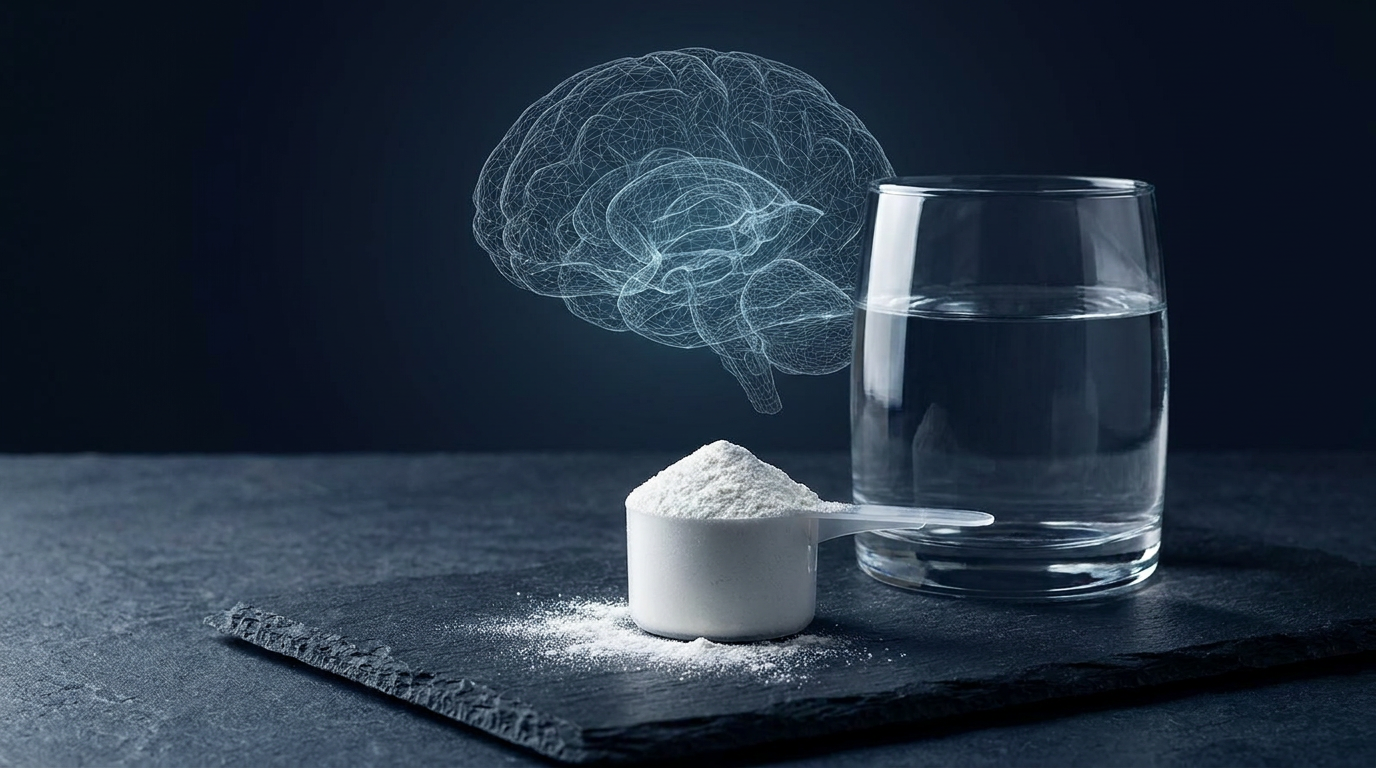
At the center of this shift is creatine monohydrate. Long dismissed by the general public as a niche product for bodybuilders and elite sprinters, creatine is currently undergoing a massive scientific and cultural rebrand. It is no longer just a tool for adding an extra plate to a barbell; it is increasingly recognized as a fundamental compound for cellular energy management, particularly in the body's most energy-demanding organ: the brain.[2][7]
To understand why a muscle supplement is being embraced by neurologists and longevity researchers, one must look at the biological mechanism of energy production. The human brain accounts for roughly two percent of total body weight, yet it consumes a staggering twenty percent of the body's resting energy. Every thought, memory retrieval, and sensory processing event requires a constant, uninterrupted supply of cellular fuel.[3][6]
That cellular fuel is a molecule called adenosine triphosphate, or ATP. When a cell needs energy, it breaks off a phosphate group from ATP, turning it into adenosine diphosphate (ADP). The problem is that cells can only store a very limited amount of ATP at any given moment. During periods of high demand—whether that is sprinting down a track or engaging in intense, focused cognitive work—ATP stores are rapidly depleted.[3][4]
This is where creatine enters the equation. Creatine is naturally produced in the liver and kidneys and stored primarily in skeletal muscle, but a crucial portion is also stored in the brain. It exists in the body as phosphocreatine, which acts as a rapid-response energy reserve. When ATP is depleted and turns into ADP, phosphocreatine swoops in to donate its phosphate group, instantly regenerating ATP and keeping the cellular engine running without missing a beat.[4][6]

While the body produces its own creatine, and omnivores consume it through red meat and fish, research shows that natural stores are rarely fully saturated. By supplementing with creatine monohydrate, individuals can increase their intramuscular and cerebral phosphocreatine stores by up to twenty percent. In the brain, this expanded energy buffer translates directly to improved performance under stress.[2][3]
The cognitive benefits of creatine supplementation become most apparent when the brain is metabolically challenged. One of the most robust areas of research involves sleep deprivation. Multiple clinical trials have demonstrated that when subjects are deprived of sleep, those who have supplemented with creatine maintain significantly better executive function, working memory, and reaction times compared to those given a placebo. The supplement effectively provides the exhausted brain with an alternative energy reservoir.[4][5]

Beyond sleep deprivation, creatine has shown promise in enhancing working memory and intelligence test scores in healthy adults. Working memory—the ability to hold and manipulate information over short periods—is highly ATP-dependent. By ensuring a steady supply of ATP during complex problem-solving tasks, creatine helps prevent the mental fatigue that typically degrades cognitive performance during prolonged concentration.[5][6]
Beyond sleep deprivation, creatine has shown promise in enhancing working memory and intelligence test scores in healthy adults.
The implications for aging populations are particularly profound. As humans age, natural creatine synthesis declines, and cerebral energy metabolism becomes less efficient. This metabolic slowdown is a recognized hallmark of age-related cognitive decline. Recent meta-analyses focusing on older adults have found that creatine supplementation, especially when combined with resistance training, yields significant improvements in spatial memory and long-term memory recall.[8]

Neurologists are also exploring creatine's potential as a neuroprotective agent. Because many neurodegenerative conditions, such as Parkinson's and Huntington's disease, involve mitochondrial dysfunction and cellular energy failure, researchers hypothesize that boosting phosphocreatine stores could help buffer neurons against metabolic stress. While clinical trials in this specific area are still in the early stages and have shown mixed results, the underlying biochemical logic remains a major focus of ongoing study.[4][6]
Another emerging application is in the realm of traumatic brain injury and concussion recovery. Following a concussion, the brain experiences a massive, chaotic release of neurotransmitters, leading to an acute energy crisis as cells struggle to restore balance. Preliminary studies suggest that having elevated brain creatine levels prior to an impact, or supplementing immediately after, may help mitigate this energy deficit and support faster neurological recovery.[4][5]
It is worth noting that not everyone responds to creatine supplementation equally. Because dietary creatine is found exclusively in animal products, vegetarians and vegans typically have significantly lower baseline levels of tissue creatine. Consequently, plant-based eaters often experience the most dramatic cognitive and physical improvements when they begin supplementing, as they are filling a much larger physiological deficit.[2][3]
Despite its growing popularity, lingering myths about creatine's safety continue to circulate, largely hangovers from its early days in bodybuilding culture. The most persistent misconception is that creatine damages the kidneys. However, with over thirty years of rigorous clinical data and more than thirty thousand published studies, the scientific consensus is clear: creatine monohydrate is exceptionally safe for healthy individuals, with no evidence of renal impairment at standard dosages.[3][7]
Another common myth is that creatine causes hair loss, a fear stemming from a single, small 2009 study that showed a slight increase in DHT (a hormone linked to hair loss) in rugby players. Dozens of subsequent, larger trials have failed to replicate this finding, and dermatologists and endocrinologists now widely agree that creatine does not cause baldness.[4][5]
For those looking to harness these cognitive benefits, the protocol is remarkably simple and inexpensive. Experts universally recommend creatine monohydrate, the most studied and cost-effective form of the supplement. A daily dose of three to five grams is sufficient to fully saturate brain and muscle stores over the course of a month. The historic practice of 'loading'—taking twenty grams a day for a week to saturate stores quickly—is unnecessary and often leads to mild gastrointestinal distress.[2][3]

While the enthusiasm surrounding creatine is high, cautious clinicians emphasize that it is not a magic pill for cognitive enhancement. It will not cure dementia, nor will it turn an average student into a genius. Its primary function is to optimize the biological hardware that is already there, ensuring that the brain has the raw energy it needs to perform at its natural peak, particularly under conditions of stress or fatigue.[6]
The scientific community is now calling for larger, long-term randomized controlled trials specifically designed to measure brain-centric outcomes, rather than relying on secondary data from sports science studies. Researchers want to determine the optimal dosing strategies specifically for neurological health, as the brain's blood-brain barrier makes it slightly more resistant to creatine uptake than skeletal muscle.[4][8]
Ultimately, the evolution of creatine from a muscle-building niche to a mainstream cognitive staple represents a broader maturation in how we approach human performance. By moving past the stigma of sports supplements and focusing on fundamental cellular biology, millions of people now have access to a safe, thoroughly researched, and highly effective tool for protecting and enhancing their most vital organ.[1][7]
How we got here
1832
French scientist Michel Eugène Chevreul first discovers and extracts creatine from skeletal muscle.
1992
Creatine gains mainstream attention after British track and field athletes use it during the Barcelona Olympics.
Early 2000s
Researchers begin publishing early data on creatine's role in neurological conditions and brain energy metabolism.
2018
Major meta-analyses confirm creatine's efficacy in improving working memory and intelligence test scores in healthy individuals.
2024-2026
Creatine sees a massive surge in popularity among longevity enthusiasts and biohackers specifically for cognitive preservation.
Viewpoints in depth
Longevity & Cognitive Researchers
View creatine primarily as a cellular energy buffer that can protect against age-related metabolic decline in the brain.
For researchers focused on aging, the brain is essentially an engine that slowly loses its ability to process fuel efficiently over time. This camp argues that age-related cognitive decline is fundamentally an energy crisis at the cellular level. By supplementing with creatine, they believe individuals can artificially expand their brain's phosphocreatine reserves, providing a crucial buffer against this metabolic slowdown. They point to emerging data showing improved spatial memory in older adults and advocate for creatine as a foundational, low-cost intervention for extending cognitive health span.
Sports Nutritionists
Focus on creatine's established physical benefits and its crossover into mental stamina and fatigue resistance.
Sports scientists have understood creatine's mechanism for decades, primarily viewing it through the lens of muscular output and recovery. However, this camp is increasingly interested in the intersection of physical and mental fatigue. They argue that in high-stakes environments—whether a championship game or a grueling physical shift—cognitive fatigue often precedes muscular failure. By maintaining cerebral ATP levels, sports nutritionists emphasize that creatine helps athletes maintain reaction times, decision-making speed, and focus under extreme physical duress.
Cautious Clinicians
Acknowledge the safety and potential of creatine but emphasize the need for larger, brain-specific randomized trials before universal prescription.
While generally supportive of creatine's safety profile, conservative medical professionals warn against treating it as a panacea for brain health. This camp highlights that the blood-brain barrier makes the brain much more resistant to creatine uptake than skeletal muscle, meaning standard physical dosing protocols might not be optimal for neurological benefits. They argue that while the data on sleep deprivation and vegetarian responders is strong, there is still insufficient evidence from large-scale, multi-year randomized controlled trials to definitively prove that creatine prevents long-term neurodegenerative diseases like Alzheimer's.
What we don't know
- The exact optimal dosing protocol specifically required to maximize brain saturation, as opposed to muscle saturation.
- Whether long-term creatine supplementation definitively alters the trajectory of neurodegenerative diseases like Alzheimer's or Parkinson's.
- The precise degree to which baseline dietary intake (e.g., heavy meat eaters) blunts the cognitive benefits of supplementation.
Key terms
- ATP (Adenosine Triphosphate)
- The primary molecule that stores and transfers energy within cells, essential for all brain and muscle function.
- Phosphocreatine
- The stored form of creatine in the body, which acts as a rapid energy reserve to instantly regenerate depleted ATP.
- Blood-Brain Barrier
- A highly selective semipermeable border that prevents circulating blood from freely crossing into the extracellular fluid of the central nervous system.
- Executive Function
- A set of mental skills that include working memory, flexible thinking, and self-control, which are highly dependent on cellular energy.
Frequently asked
Does creatine cause kidney damage?
No. Over 30 years of research confirms that standard doses of creatine monohydrate are entirely safe for the kidneys in healthy individuals.
Do I need to do a 'loading phase'?
No. While taking 20 grams a day for a week saturates muscles faster, taking a standard 3 to 5 grams daily will achieve the same full saturation within about a month without gastrointestinal discomfort.
Will creatine cause hair loss?
Current scientific consensus says no. The rumor stems from a single 2009 study that has not been replicated in dozens of subsequent, larger trials.
Which type of creatine is best for the brain?
Creatine monohydrate is the most extensively studied, proven, and cost-effective form for both physical and cognitive benefits.
Sources
Source coverage
8 outlets
3 viewpoints surfaced








[1]STAT NewsCautious Clinicians
How supplement use changed over decades
Read on STAT News →[2]The New York TimesLongevity & Cognitive Researchers
Creatine Is No Longer Just for Muscle
Read on The New York Times →[3]National Institutes of HealthCautious Clinicians
Creatine Dietary Supplement Fact Sheet
Read on National Institutes of Health →[4]Journal of the International Society of Sports NutritionSports Nutritionists
Creatine Supplementation and Brain Health: A Comprehensive Review
Read on Journal of the International Society of Sports Nutrition →[5]The Washington PostSports Nutritionists
Can a popular bodybuilding supplement boost your memory?
Read on The Washington Post →[6]Harvard Health PublishingCautious Clinicians
The cognitive benefits of creatine
Read on Harvard Health Publishing →[7]WiredLongevity & Cognitive Researchers
The Biohacking World's Pivot to Old-School Supplements
Read on Wired →[8]Frontiers in Aging NeuroscienceLongevity & Cognitive Researchers
Effects of creatine on cognitive function in older adults: A meta-analysis
Read on Frontiers in Aging Neuroscience →

More in health
See all 5 stories →Bilingual Brain
Bilingual Brains Rely on a Single 'Grammatical Engine' for All Languages, Study Finds
0 sources
Clinical Guidelines
Exercise Cements Status as First-Line Treatment for Depression in Landmark Review
0 sources

Mind-Body Medicine
Tai Chi's Medical Renaissance: How 'Meditation in Motion' is Outperforming Standard Exercise
0 sources

Every angle. Every day.
Get health stories with full source coverage and perspective breakdowns delivered to your inbox.