
Nyjah Huston Vows to Return to Skateboarding Following Second Major Crash of 2026
Olympic medalist Nyjah Huston is recovering from a fractured jaw and lacerated kidney sustained in a late-May crash, his second catastrophic injury of the year. Despite the severe setbacks, the 31-year-old remains determined to return to competitive street skateboarding.
By Factlen Editorial Team
- Professional Skateboarders
- View extreme physical risk as an inherent and accepted part of the skateboarding lifestyle.
- Sports Medicine Professionals
- Focus on the medical realities of trauma and the necessity of strict, unhurried recovery protocols.
- Safety Advocates
- Argue for a cultural shift toward normalizing protective gear to mitigate catastrophic injuries.
What's not represented
- · Sponsors and Endorsement Brands
- · Young Amateur Skateboarders
Why this matters
Huston's transparency about his back-to-back severe injuries highlights the extreme physical toll of modern street skateboarding. His resilient mindset offers a raw look at the psychological drive required to compete at the sport's highest level, serving as both an inspiration and a cautionary tale for younger athletes.
Key points
- Nyjah Huston suffered a fractured jaw, cheekbone, and lacerated kidney in a late-May skateboarding crash.
- The incident marks his second major hospitalization of 2026, following a skull fracture sustained in January.
- Despite the severe trauma, Huston remains positive and intends to continue pushing the limits of street skateboarding.
- The back-to-back injuries have reignited debates over the lack of protective helmets in professional street skating culture.
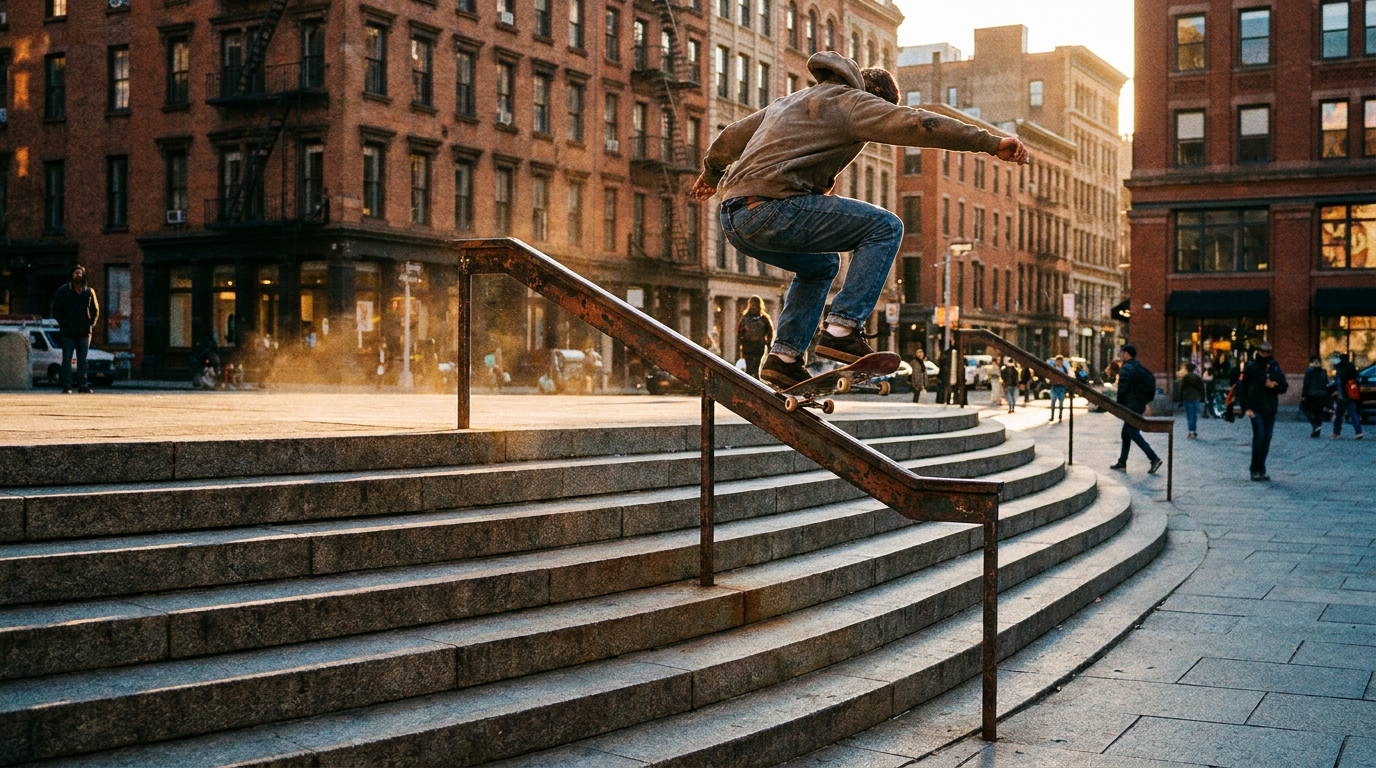
Olympic bronze medalist and 15-time X Games champion Nyjah Huston is facing another grueling rehabilitation process following his second catastrophic crash of 2026. The 31-year-old American skateboarder suffered a fractured jaw, a fractured cheekbone, and a lacerated kidney during a severe fall in late May. Despite the extensive physical trauma and the back-to-back hospitalizations, Huston remains resolute in his commitment to the sport, publicly vowing to return to his board and continuing to target a competitive run at the 2028 Los Angeles Olympics.[1][4]
The late-May crash arrived just as Huston appeared to be moving past a devastating start to the year. On January 5, while attempting a complex trick on a massive handrail in Tempe, Arizona, Huston lost his balance and fell from the top of the obstacle directly onto his head. That initial impact left him with a fractured skull and a fractured eye socket, alongside severe symptoms including memory loss and vomiting that required close neurological monitoring by emergency medical staff.[2][3]
For months following the January incident, Huston documented his rigorous rehabilitation process, noting to fans and media that his recovery rate had actually surpassed his own expectations. He dedicated himself to physical therapy and mental conditioning to overcome the trauma of the skull fracture. Just a day before announcing his second major crash, an in-depth interview aired in which the skateboarder discussed his renewed appreciation for life, his grounding routines, and his eagerness to push the physical limits of street skating once again.[2][5]
Unfortunately, the inherent dangers of those physical limits quickly materialized in the worst possible way. While attempting a nosegrind on another large rail, Huston was pitched forward, taking the brunt of the impact directly to his face and torso. The resulting facial fractures to his jaw and cheekbone were accompanied by a lacerated kidney—an internal injury that Huston described as a uniquely brutal new experience in a career already defined by heavy physical tolls and countless surgical interventions.[1]

From a medical perspective, this sequence of injuries highlights the extreme forces involved in modern street skateboarding. While sports medicine specialists note that wrist, forearm, and ankle sprains make up the vast majority of standard skateboarding injuries, falls from large urban obstacles frequently result in high-velocity blunt force trauma. The combination of cranial fractures, facial breaks, and internal organ damage places Huston's recent crashes at the most severe end of the sports injury spectrum, requiring highly specialized emergency care and extended recovery timelines.[6]
From a medical perspective, this sequence of injuries highlights the extreme forces involved in modern street skateboarding.
The psychological component of returning to the sport after such profound trauma is equally complex and heavily studied. Research into the mindset of injured skateboarders indicates that the perceived benefits of the sport—including identity formation, community connection, and the thrill of personal progression—often heavily outweigh the fear of re-injury. For elite professionals who have dedicated their entire lives to mastering the board, the drive to land a groundbreaking trick frequently overrides the basic human instinct for self-preservation.[7]
Huston's own public commentary reflects this exact psychological framework perfectly. Speaking to his followers shortly after his release from the hospital, he acknowledged the heavy physical cost but remained entirely unapologetic about his choices. He stated that the injuries are simply a price he has to pay to live the life he wants and fulfill his purpose on the board. Huston emphasized that the immense satisfaction of successfully filming new video clips makes the inevitable suffering and hospital visits worthwhile.[1]
The back-to-back hospitalizations have inevitably reignited the perennial and often heated debate surrounding protective gear in street skateboarding. Unlike vert or park skating disciplines, where helmets and heavy pads are common and often mandated by competition rules, street skating culture has historically rejected protective equipment. The discipline favors a raw, unprotected aesthetic that emphasizes freedom of movement and personal style, a tradition that frequently clashes with the recommendations of sports medicine professionals who treat the resulting catastrophic injuries.[6]

Fans and safety advocates frequently flood social media with pleas for top professionals to wear helmets, arguing that their massive influence could shift the culture and protect younger generations of skaters. However, many street skaters counter that standard helmets offer limited protection for the specific types of falls common in their discipline. Huston himself addressed the debate directly, pointing out that because his recent impacts were directly to his face and jaw, only a full-face motocross helmet would have genuinely mitigated the damage.[1][3]
For now, the decorated athlete is focused entirely on the immediate task of healing his battered body. While the lacerated kidney requires strict rest to prevent further internal bleeding, and his facial fractures may take weeks to fully stabilize, Huston has reported that he is already up and moving around his home. The exact timeline for his return to competitive events, such as the Street League Skateboarding tour or the X Games, remains uncertain as his medical team monitors his progress.[1][4]
Ultimately, Huston's transparency provides a stark, unfiltered look at the reality of professional action sports. Behind the polished video parts, lucrative sponsorships, and Olympic podiums lies a brutal physical reality that demands constant sacrifice and an incredibly high threshold for pain. Yet, for athletes operating at the absolute pinnacle of their discipline, the willingness to endure that reality, recover from devastating setbacks, and push past the fear is precisely what separates them from the rest of the world, cementing their legacy in the history of the sport.[5][7]

How we got here
Jan 5, 2026
Huston suffers a fractured skull and eye socket while skating a handrail in Tempe, Arizona.
May 27, 2026
Huston discusses his faster-than-expected recovery and Olympic ambitions on a Forbes podcast.
May 28, 2026
Huston announces he has suffered a second major crash, fracturing his jaw and lacerating a kidney.
Early June 2026
Recovering in Laguna Beach, Huston posts an update stating he is up, moving, and eager to return to the board.
Viewpoints in depth
Professional Skateboarders
Viewing severe injuries as an accepted risk of pushing the sport's boundaries.
For elite street skaters, catastrophic falls are widely considered an inevitable cost of doing business. The culture of the sport praises resilience and the willingness to 'pay the price' for landing a groundbreaking trick. Athletes at this level often view their injuries not as reasons to quit, but as temporary hurdles, maintaining that the lifestyle and the pursuit of progression far outweigh the physical dangers.
Sports Medicine Professionals
Emphasizing structured recovery and the long-term dangers of repeated trauma.
Medical experts look at the rising severity of street skateboarding injuries with significant concern. While broken bones and lacerations can heal, repeated impacts to the head and face carry the risk of cumulative neurological damage. Sports medicine advocates stress the importance of adequate recovery time, warning that rushing back to the board prematurely drastically increases the likelihood of compounding injuries.
Safety Advocates
Pushing for a cultural shift toward protective gear in street skating.
Safety advocates and a growing segment of fans argue that the street skateboarding community needs to normalize the use of helmets and pads. They point out that while the sport's aesthetic has historically rejected protective gear as 'uncool,' the sheer scale of modern obstacles—like 20-stair handrails—makes the traditional bare-headed approach unnecessarily reckless, especially given the influence top professionals have on younger skaters.
What we don't know
- An exact timeline for Huston's return to competitive events like Street League Skateboarding has not been established.
- It remains unclear if his facial fractures will require surgical intervention or if they will heal naturally.
Key terms
- Street Skateboarding
- A discipline of skateboarding focused on performing tricks on urban obstacles like stairs, handrails, and ledges.
- Nosegrind
- A skateboarding trick where the skater balances and slides on the front truck (axle) of the skateboard along an obstacle.
- Lacerated Kidney
- A severe internal injury involving a tear to the kidney tissue, typically caused by blunt force trauma to the abdomen or lower back.
Frequently asked
What injuries did Nyjah Huston suffer in 2026?
In January, he fractured his skull and eye socket. In late May, he suffered a fractured jaw, fractured cheekbone, and a lacerated kidney.
Is Nyjah Huston retiring from skateboarding?
No. Despite his severe injuries, Huston has explicitly stated he intends to continue skating and is aiming to compete in the 2028 Los Angeles Olympics.
Why don't street skateboarders wear helmets?
Street skateboarding culture has historically favored an unprotected aesthetic. Additionally, skaters note that many severe street falls result in direct facial impacts, which standard skate helmets do not cover.
Sources
Source coverage
7 outlets
3 viewpoints surfaced






[1]Olympics.comProfessional Skateboarders
Nyjah Huston suffers fractured jaw, cheekbone and lacerated kidney in second major crash of 2026
Read on Olympics.com →Nyjah Huston opens up on brutal crash: 'It could be so much worse'
Read on Olympics.com →[3]TMZ SportsSafety Advocates
Nyjah Huston Fractures Skull, Eye Socket After Rail Trick Gone Bad
Read on TMZ Sports →[4]The Japan TimesSafety Advocates
Nyjah Huston suffers fractured skull and eye socket in skating crash
Read on The Japan Times →[5]ForbesProfessional Skateboarders
Nyjah Huston On Injury, Recovery And Chasing Another Olympic Run
Read on Forbes →[6]University of Utah HealthSports Medicine Professionals
Skateboarding Injuries: Prevention and Recovery
Read on University of Utah Health →[7]ResearchGateSports Medicine Professionals
Returning to sport after injury: Skateboarding
Read on ResearchGate →

More in sports
See all 7 stories →Standings
Germany Commands League of Nations Standings as Farrington Defends World No. 1 Ranking
0 sources

Pro Leagues
The $500 Million Bet on Women's Pro Volleyball
0 sources
Injury
Deanna Stellato-Dudek Makes Historic Olympic Debut at 42 After Terrifying Head Injury
0 sources
Standings
ISU Announces 2026-2027 Grand Prix Assignments, Setting the Stage for the Post-Olympic Race to Chongqing
0 sources
Every angle. Every day.
Get sports stories with full source coverage and perspective breakdowns delivered to your inbox.