
Global Skateboarding Standings Shake Up as LA 2028 Olympic Qualification Officially Opens
A historic week at the World Skateboarding Tour in Rome and a fierce Street League season have set a new benchmark for the sport as the two-year points race to the Los Angeles Games begins.
By Factlen Editorial Team
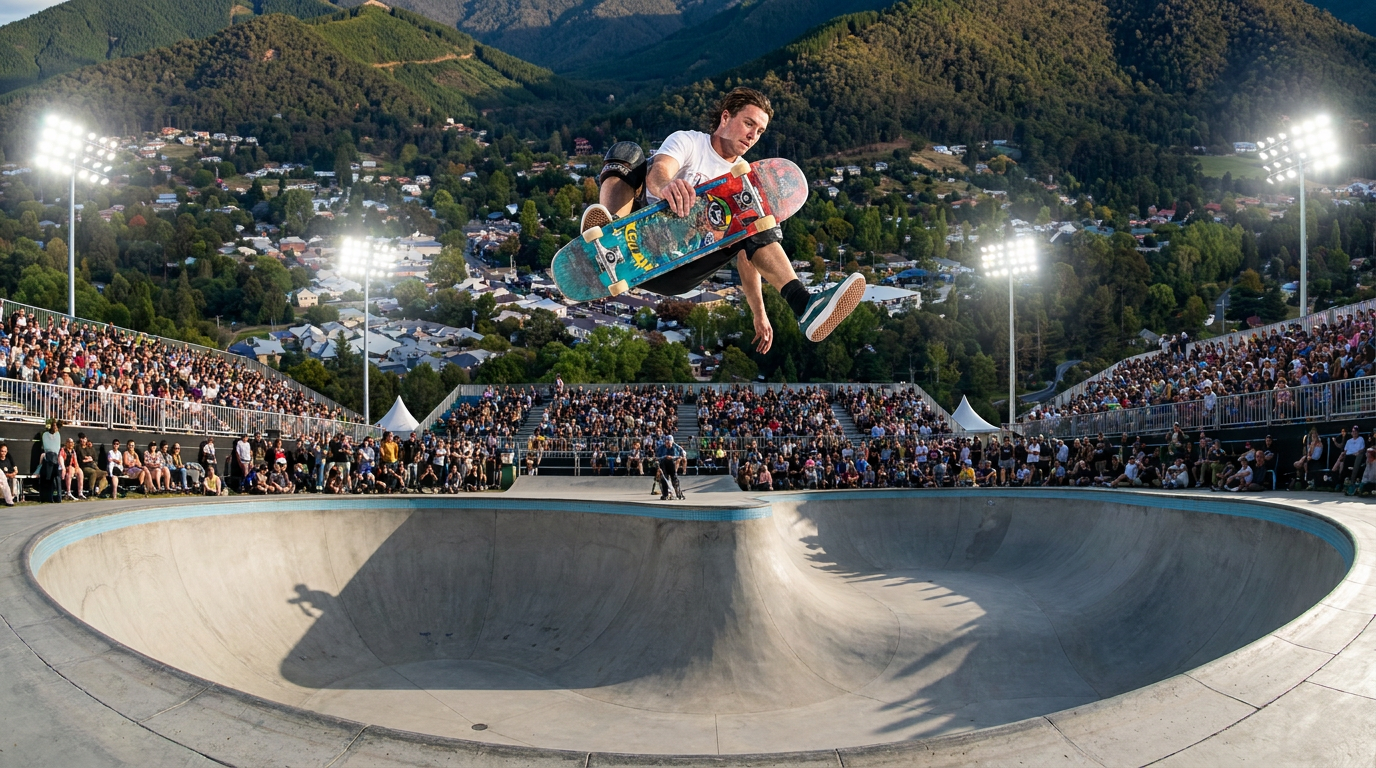
- The Japanese Vanguard
- Focused on pushing the absolute limits of technical perfection and scoring boundaries to maintain global dominance.
- International Challengers
- Skaters from Brazil, Australia, and the US aiming to disrupt Japan's dominance through high-amplitude tricks and consistent podium finishes.
- Olympic Strategists
- Coaches and federations focused on navigating the grueling two-year points race and managing the strict three-athlete-per-nation quota.
What's not represented
- · Grassroots skatepark communities
- · Independent deck and apparel sponsors
Why this matters
The opening of the Olympic qualification window transforms every major skateboarding event from a standalone contest into a high-stakes points race. For fans and athletes, the next two years will feature the most intense, mathematically driven competition the sport has ever seen.
Key points
- Phase 1 of the LA 2028 Olympic qualification period officially opened on June 11, 2026.
- Mizuho Hasegawa set a new Women's Park world record with a 96.33 at the WST Rome event.
- Issei Sakurai won the Men's Park division in Rome with a massive 94.98.
- Ginwoo Onodera leads the SLS Men's standings after landing seven consecutive 9.0+ scores in Sydney.
- Rayssa Leal and Chloe Covell are locked in a tight race atop the SLS Women's standings.
The road to the 2028 Los Angeles Olympics has officially begun, and the global skateboarding landscape is already experiencing a seismic shift. On June 11, 2026, Phase 1 of the Olympic qualification period formally opened, transforming the sport's premier competitions into a high-stakes mathematical race. Athletes are now racking up crucial points across World Skate sanctioned events and the Street League Skateboarding (SLS) tour, with the ultimate goal of securing one of the coveted 22 Olympic spots per discipline. The opening week of this cycle has immediately demonstrated that the standard for a podium finish has skyrocketed, driven by a wave of teenage prodigies who are rewriting the sport's record books.[1][4]
The most dramatic evidence of this progression unfolded at the World Skateboarding Tour (WST) Park World Cup in Rome, which concluded in mid-June. The event served as the first major battleground for Olympic points, and the scoring reached unprecedented heights. In the Women's Park final, 15-year-old Japanese phenomenon Mizuho Hasegawa delivered a flawless 45-second run that earned a 96.33—the highest score ever recorded in Women's Park history on the WST. The historic run was necessary to fend off Great Britain's Sky Brown, who posted a massive 90.55, and Japan's Cocona Hiraki, who took third with an 85.35.[1][2]
The Men's Park division in Rome mirrored that intensity, culminating in what commentators described as the highest standard of skating ever witnessed in the discipline. Issei Sakurai, who entered the contest ranked 20th in the world, shocked the field by landing a 94.98 in his final run. His performance featured massive 540s and highly technical powerslides, allowing him to edge out Spain's Egoitz Bijueska (93.45) and Brazil's Gui Khury (93.02). By the end of the third run, every skater entering the final "Golden Run" had banked a score higher than 90 points, a first in WST history.[1][2]

While the Park skaters battled in Italy, the Street discipline has been dominated by the ongoing 2026 Street League Skateboarding (SLS) Championship Tour. The SLS standings are currently headlined by 16-year-old Ginwoo Onodera of Japan, who sits atop the Men's Arena leaderboard after a historic start to the season. At the Sydney stop earlier this year, Onodera achieved something never before seen in SLS history: he scored a 9.0 or higher on all seven of his attempts in a single final. His flawless technical execution earned him the victory over a stacked field that included Julian Agliardi and Giovanni Vianna, setting a daunting pace for the rest of the tour.[3][4][5]
While the Park skaters battled in Italy, the Street discipline has been dominated by the ongoing 2026 Street League Skateboarding (SLS) Championship Tour.
The Women's SLS standings are proving to be a fiercely contested international rivalry. Brazil's Rayssa Leal currently leads the Arena standings, having secured a crucial victory at the season opener in Sydney. However, Australia's Chloe Covell is applying immense pressure, having claimed the top spot at the Los Angeles stop in April. The two superstars are closely trailed by a deep roster of Japanese talent, including Liz Akama and Coco Yoshizawa, ensuring that the race for the 2026 SLS Super Crown will likely come down to the final events of the year.[3][4]

The current standings highlight a broader geopolitical shift within competitive skateboarding: the overwhelming dominance of the Japanese federations. Across both Park and Street disciplines, Japanese skaters are not just winning; they are fundamentally raising the technical floor required to compete. In Rome, Japanese athletes occupied three of the top five spots in Women's Park, while Onodera's SLS performance showcased a level of consistency that Western skaters are now scrambling to match. This depth presents a unique challenge for Japan's Olympic strategists, as the LA28 rules strictly limit each nation to a maximum of three athletes per discipline.[1][4]
For international challengers, the strategy is shifting from pure progression to calculated consistency. Skaters like Australia's Keegan Palmer and Arisa Trew, along with the American contingent led by Tom Schaar and Minna Stess, are focusing on banking reliable top-tier finishes to maintain their global rankings. The Olympic Qualifying System (OQS) is notoriously unforgiving; Phase 1 runs through March 2028, after which only the top 44 athletes per discipline will advance to the final qualifying series. A single injury or a string of missed finals during this two-year window can derail an entire Olympic campaign.[2][4]

As the summer progresses, the focus will briefly shift to the upcoming X Games, which recently announced the launch of a team-based X Games League (XGL) to complement the traditional individual contests. While the XGL introduces a new financial and structural dynamic to the sport, the underlying reality remains unchanged: every trick, every run, and every podium finish is now being heavily scrutinized through the lens of the LA28 standings. For the athletes, the pressure is immense, but for fans of skateboarding, this mathematical arms race is producing the most spectacular and technically advanced contests the sport has ever seen.[4][6]
How we got here
February 2026
Ginwoo Onodera and Rayssa Leal win the SLS season openers in Sydney, setting the early pace for the street standings.
April 2026
Chloe Covell claims victory at the SLS Los Angeles stop, tightening the women's leaderboard.
June 11, 2026
Phase 1 of the official Olympic Qualifying System for the LA 2028 Games begins.
June 16, 2026
Mizuho Hasegawa and Issei Sakurai post historic scores to win the WST Park World Cup in Rome.
Viewpoints in depth
The Japanese Vanguard
Focused on pushing the absolute limits of technical perfection and scoring boundaries to maintain global dominance.
For the Japanese federations and their athletes, the current era of skateboarding is defined by relentless progression. Skaters like Mizuho Hasegawa and Ginwoo Onodera are not just aiming to win; they are actively trying to break the mathematical limits of the judging scales. By consistently landing highly technical tricks and linking them together flawlessly, they force the rest of the world to attempt riskier maneuvers just to stay within striking distance. However, this depth of talent creates an internal bottleneck, as many world-class Japanese skaters will be left home due to the strict three-athlete Olympic quota.
International Challengers
Skaters from Brazil, Australia, and the US aiming to disrupt Japan's dominance through high-amplitude tricks and consistent podium finishes.
The international field views the Japanese dominance as a benchmark to surpass rather than an insurmountable wall. Skaters like Australia's Chloe Covell and Brazil's Rayssa Leal have proven they can go toe-to-toe with the best in the world by combining technical street skating with immense competitive poise. For nations with deep skateboarding histories like the United States and Brazil, the strategy relies on banking consistent top-tier finishes across the grueling two-year qualification period, ensuring their top athletes survive the initial cut down to 44 skaters.
Olympic Strategists
Coaches and federations focused on navigating the grueling two-year points race and managing the strict three-athlete-per-nation quota.
Behind the scenes, national federations are treating the road to LA28 as a complex logistical and mathematical puzzle. The Olympic Qualifying System rewards athletes who can peak at the right moments while avoiding the injuries that frequently plague action sports. Strategists must decide which WST and SLS events to prioritize, balancing the need for ranking points against the physical toll of constant international travel. For these planners, a bronze medal at a heavily weighted contest is often more valuable than risking injury for a gold at a minor stop.
What we don't know
- Whether the newly announced X Games League (XGL) will conflict with or complement the Olympic qualification schedule.
- How the intense physical demands of the two-year points race will impact athlete injury rates leading up to LA28.
Key terms
- WST
- World Skateboarding Tour, the official series of events sanctioned by World Skate that award points toward Olympic qualification.
- SLS
- Street League Skateboarding, the premier professional street skateboarding competition series globally.
- OQS
- Olympic Qualifier Series, the final phase of the qualification process where the top 44 ranked skaters compete for the final 22 Olympic spots.
Frequently asked
When does Olympic qualification for LA 2028 end?
Phase 1 of the qualification period runs until March 2028. After that, the top 44 athletes per discipline will compete in the Olympic Qualifier Series (OQS) ending in June 2028.
Who holds the record for the highest Women's Park score?
Japan's 15-year-old Mizuho Hasegawa set the record in June 2026 at the WST Rome event with a score of 96.33.
How many skaters can each country send to the Olympics?
Under the current Olympic Qualifying System rules, each nation is strictly limited to a maximum of three athletes per discipline (Street and Park) per gender.
Sources
Source coverage
6 outlets
3 viewpoints surfaced





[1]World SkateThe Japanese Vanguard
WST World Cup Rome Park 2026: Final Results
Read on World Skate →[2]OlympicsThe Japanese Vanguard
WST Park World Cup Rome 2026: All results and scores
Read on Olympics →[3]Street League SkateboardingInternational Challengers
Two Stops Down in the 2026 SLS Season Standings
Read on Street League Skateboarding →[4]BoardridersOlympic Strategists
A closer look at SLS 2026 and the road to LA 2028
Read on Boardriders →[5]The BoardrInternational Challengers
Contest Results: Street League Sydney Men's
Read on The Boardr →[6]X GamesOlympic Strategists
X Games League Officially Launches in 2026
Read on X Games →
More in sports
See all 10 stories →LA28 Olympics
How T20 Cricket is Preparing for its 2028 Olympic Debut in Los Angeles
0 sources
Injury
French Fencing Star Ysaora Thibus Returns to the Piste After Knee Surgery and Legal Exoneration
0 sources
Standings
Race to the Top: Final FIE Fencing Standings Set the Stage for the 2026 Hong Kong World Championships
0 sources
Injury
Equestrian Injury Report: Simon Delestre Sidelined, Tim Price Completes Miraculous Return
0 sources
Every angle. Every day.
Get sports stories with full source coverage and perspective breakdowns delivered to your inbox.