
The Error Correction Breakthrough Making Quantum Computers Reliable
In a major milestone for computing, researchers have successfully demonstrated "below-threshold" quantum error correction, proving that quantum systems can finally fix their own errors faster than they accumulate.
By Factlen Editorial Team
- Quantum Hardware Engineers
- Focus on the physical layer, prioritizing improvements in coherence times, gate fidelity, and scaling the number of physical qubits on a single chip.
- Algorithmic Theorists
- Argue that software breakthroughs in more efficient error-correction codes are just as critical as hardware for reaching fault tolerance.
- Enterprise Adopters
- View quantum computers as specialized accelerators to be integrated into existing hybrid cloud workflows for chemistry and logistics.
- Cryptography Experts
- Warn that the accelerated timeline for fault-tolerant quantum computers makes the transition to post-quantum encryption an urgent security priority.
What's not represented
- · Classical Supercomputing Advocates
- · Geopolitical Strategists
Why this matters
For decades, the fragility of quantum hardware prevented the technology from solving real-world problems. By proving that quantum computers can reliably correct their own errors, the industry has cleared the final fundamental hurdle toward machines that will revolutionize drug discovery, materials science, and cryptography.
Key points
- Quantum computers have historically been limited by the extreme fragility of physical qubits.
- Error correction solves this by grouping many physical qubits into one stable logical qubit.
- In 2026, researchers proved that adding more physical qubits now successfully reduces overall error rates.
- Google and Atom Computing demonstrated this breakthrough on completely different hardware architectures.
- IBM plans to deliver a system with 200 logical qubits capable of 100 million gates by 2029.
- This milestone shifts quantum computing from a physics experiment to a scalable engineering discipline.
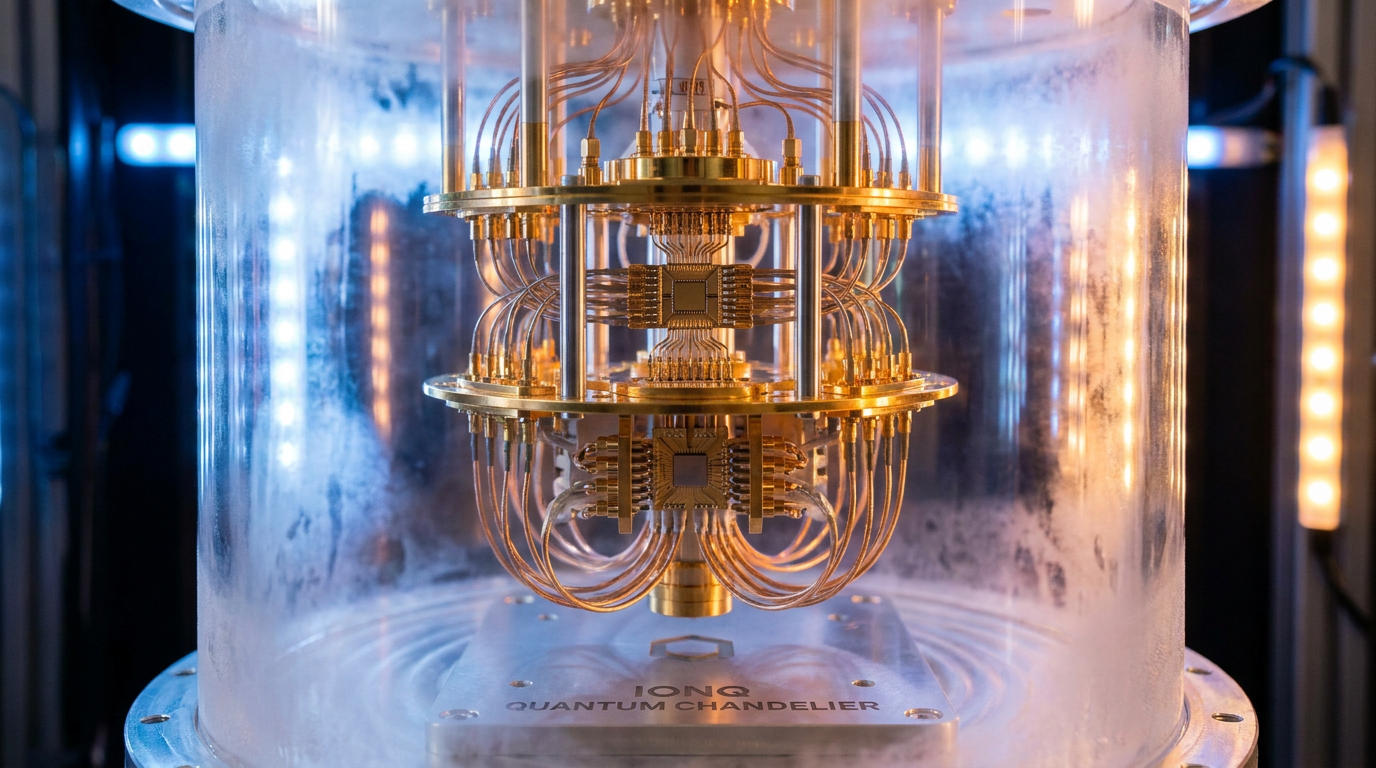
For decades, the promise of quantum computing has been bottlenecked by a single, infuriating problem: the extreme fragility of quantum bits, or qubits. Unlike classical bits, which sit reliably at 0 or 1, qubits exist in delicate states of superposition that can be shattered by a stray photon, a slight temperature fluctuation, or even cosmic rays.[3]
This fragility, known as decoherence, meant that early quantum computers were essentially racing against the clock. They had to complete their calculations before the qubits lost their state and the data dissolved into random noise, severely limiting the depth and complexity of the algorithms they could run.[4]
The theoretical solution has always been quantum error correction—a method of grouping many unstable "physical qubits" together to form a single, highly stable "logical qubit." By encoding information across a redundant grid, the system can detect and fix errors without directly measuring, and thus destroying, the delicate quantum state.[3]
However, for years, this approach faced a cruel paradox. The hardware required to monitor and correct errors was itself so noisy that adding more physical qubits to a system actually introduced more errors than the algorithms could fix. The cure was worse than the disease.[5]

In 2026, the industry finally broke this paradox. Multiple organizations have now demonstrated what physicists call "below-threshold" or "sub-threshold" error correction at scale, marking a historic turning point for the technology.[4]
Below-threshold error correction means that a quantum system has become clean and precise enough that adding more physical qubits to a logical qubit exponentially decreases the overall error rate. The system actually improves as it scales.[5]
Google's Willow processor, a 105-qubit superconducting chip, provided one of the most striking demonstrations of this phenomenon. By increasing the size of their surface-code lattice, Google showed that logical error rates decreased by a factor of roughly 2.14x with each step up in scale.[4]
This achievement proved that the theoretical scaling curves of fault-tolerant quantum computing actually work in physical hardware. The system successfully performed a benchmark calculation in five minutes that would take a classical supercomputer over a decade to complete.[5]

This achievement proved that the theoretical scaling curves of fault-tolerant quantum computing actually work in physical hardware.
But the breakthrough isn't limited to a single type of hardware. Atom Computing recently achieved a parallel milestone using a completely different architecture: neutral atoms suspended in a vacuum by lasers.[2]
Atom's system demonstrated continuous, active error correction where the logical memory actually outlived the physical qubits themselves. While the physical atoms had a lifespan of about 10 to 15 seconds, the logical information persisted for up to 225 seconds.[2]
This means the computation survived longer than its underlying hardware components, proving that the system was actively detecting and correcting faults, and even replenishing atoms, while the program was running.[2]
Meanwhile, Microsoft has been pursuing a third path with its Majorana 1 chip, utilizing topological qubits. These exotic particles are designed to be inherently resistant to noise at the hardware level, potentially reducing the massive overhead required for traditional error correction.[3]
IBM is also aggressively scaling its fault-tolerant architecture. The company recently detailed its path to the "Starling" system, which aims to deliver 200 logical qubits capable of executing 100 million quantum gates by 2029.[1]

To achieve this, IBM is deploying new "bivariate bicycle codes"—highly efficient error-correction algorithms that require fewer physical qubits to create a stable logical qubit, paired with real-time decoding hardware.[1]
The transition from noisy, experimental devices to fault-tolerant logical qubits marks the moment quantum computing shifts from a physics research project into a scalable engineering discipline.[4]
With reliable logical qubits, researchers can begin running deep, complex algorithms without the system crashing. This is the prerequisite for simulating molecular structures, optimizing global logistics, and discovering new battery materials.[5]
For industries like pharmaceuticals and aerospace, the timeline to "quantum advantage"—the point where quantum computers solve commercially valuable problems cheaper and faster than classical supercomputers—is now rapidly accelerating.[1]
While thousands of logical qubits will be needed to fully unlock the technology's potential, the 2026 breakthroughs confirm that the hardest fundamental barrier has been crossed. The path forward is no longer about proving the physics; it is about scaling the engineering.[6]

How we got here
Pre-2025
Quantum computers are limited to "NISQ" (Noisy Intermediate-Scale Quantum) devices, where error rates prevent deep calculations.
Late 2025
Google demonstrates below-threshold error correction on its 105-qubit Willow chip.
Early 2026
Atom Computing demonstrates continuous error correction on neutral atoms, with logical memory outliving physical qubits.
Mid 2026
IBM details its roadmap to the Starling system, targeting 200 logical qubits by 2029 using new bivariate bicycle codes.
Viewpoints in depth
Quantum Hardware Engineers
Focus on the physical layer, prioritizing improvements in coherence times, gate fidelity, and scaling the number of physical qubits on a single chip.
For hardware engineers, the below-threshold milestone is a validation of years spent refining the physical environment of qubits. Whether working with ultra-cold superconducting circuits, laser-trapped neutral atoms, or topological materials, their primary goal is to reduce the base error rate of the hardware itself. They argue that while error correction is necessary, it is highly resource-intensive; therefore, building better physical qubits reduces the massive overhead required to create a single logical qubit, making commercial systems viable much sooner.
Algorithmic Theorists
Argue that software breakthroughs in more efficient error-correction codes are just as critical as hardware for reaching fault tolerance.
Theorists emphasize that hardware alone cannot solve the decoherence problem. They focus on developing advanced mathematical frameworks, such as surface codes and the newly introduced bivariate bicycle codes, which require fewer physical qubits to encode a logical qubit. By optimizing the software layer and the real-time decoding algorithms, they believe the industry can achieve fault tolerance on smaller, near-term hardware rather than waiting for million-qubit processors.
Enterprise Adopters
View quantum computers as specialized accelerators to be integrated into existing hybrid cloud workflows for chemistry and logistics.
Corporate IT leaders and industrial researchers are less concerned with the underlying physics and more focused on practical ROI. They view fault-tolerant quantum computers as specialized co-processors that will work alongside classical supercomputers and GPUs. Their priority is developing hybrid algorithms where classical systems handle data processing and quantum systems are called upon solely to crack specific, highly complex bottlenecks, such as simulating molecular interactions for new drugs or optimizing global supply chains.
Cryptography Experts
Warn that the accelerated timeline for fault-tolerant quantum computers makes the transition to post-quantum encryption an urgent security priority.
Security professionals view the rapid progress in logical qubits with a sense of urgency. A sufficiently large fault-tolerant quantum computer will be capable of running Shor's algorithm, which can break the RSA encryption that secures the modern internet. With hardware milestones arriving ahead of historical schedules, these experts argue that governments and corporations must immediately migrate to post-quantum cryptographic standards to protect sensitive data from "harvest now, decrypt later" attacks.
What we don't know
- Which hardware architecture (superconducting, neutral atom, or topological) will ultimately prove the most cost-effective to scale to millions of qubits.
- Exactly how much physical overhead will be required to maintain logical qubits as systems scale to commercial sizes.
- Whether unforeseen engineering bottlenecks, such as cooling capacity or control-wiring density, will slow the timeline to thousands of logical qubits.
Key terms
- Qubit
- The basic unit of quantum information, capable of existing in multiple states simultaneously, unlike classical bits which are strictly 0 or 1.
- Decoherence
- The process by which a quantum system loses its delicate quantum state due to interaction with its environment, resulting in calculation errors.
- Fault Tolerance
- The ability of a computing system to continue operating reliably even when individual components fail or produce errors.
- Surface Code
- A popular quantum error-correction algorithm that arranges physical qubits in a 2D grid to detect and correct errors without measuring (and thus destroying) the quantum data.
- Quantum Advantage
- The threshold at which a quantum computer can solve a commercially useful problem significantly faster, cheaper, or more efficiently than the best classical supercomputers.
Frequently asked
What is a physical qubit?
A physical qubit is the actual hardware component—like a superconducting circuit or a trapped atom—used to store quantum information. They are highly sensitive to environmental noise.
What is a logical qubit?
A logical qubit is a highly stable, "virtual" qubit created by grouping many physical qubits together and using error-correction algorithms to detect and fix faults in real-time.
What does "below-threshold" mean?
It is the tipping point where the quantum hardware is reliable enough that adding more physical qubits to the error-correction system actually decreases the overall error rate, rather than adding more noise.
Will quantum computers replace my laptop?
No. Quantum computers are highly specialized machines designed to solve specific complex problems (like molecular simulation) that classical computers cannot handle. They will work alongside traditional computers, not replace them.
Sources
Source coverage
6 outlets
4 viewpoints surfaced






[1]IBM QuantumAlgorithmic Theorists
Realizing large-scale, fault-tolerant quantum computing
Read on IBM Quantum →[2]Atom ComputingQuantum Hardware Engineers
A Sub-Threshold Quantum Error Correction Result
Read on Atom Computing →[3]SpinQuantaEnterprise Adopters
Qubit Quantum Computing: 2026 Breakthroughs
Read on SpinQuanta →[4]BQPSimEnterprise Adopters
The five defining breakthroughs of 2026 and what each means for industry
Read on BQPSim →[5]CyberNativeQuantum Hardware Engineers
Google's Willow chip achieving below threshold error correction
Read on CyberNative →[6]Factlen Editorial TeamCryptography Experts
Synthesis by Factlen editorial team
Read on Factlen Editorial Team →
Every angle. Every day.
Get technology stories with full source coverage and perspective breakdowns delivered to your inbox.