
Tai Chi's Medical Renaissance: How 'Meditation in Motion' is Outperforming Standard Exercise
Recent clinical trials reveal that Tai Chi can outperform vigorous aerobic exercise in lowering blood pressure and actively slow cognitive decline. The ancient martial art is increasingly being prescribed as a targeted, evidence-based medical intervention.
By Factlen Editorial Team
- Clinical Researchers
- Focus on empirical data, randomized controlled trials, and measurable physiological outcomes like blood pressure and BDNF levels.
- Public Health Advocates
- Emphasize accessibility, low-impact exercise options, and scalable interventions for aging populations.
- Mainstream Medical Journalists
- Translate clinical findings into actionable lifestyle advice for the general public.
- Integrative Medicine Specialists
- View Tai Chi as a holistic mind-body practice that bridges traditional wisdom with modern neurobiology.
What's not represented
- · Fitness Industry Professionals
- · Health Insurance Providers
Why this matters
As rates of hypertension and cognitive decline rise globally, accessible and low-cost interventions are critical. Tai Chi offers a scientifically validated, low-impact alternative for individuals who may struggle with traditional vigorous exercise.
Key points
- A 12-month clinical trial found Tai Chi lowered systolic blood pressure by 7.01 mm Hg, outperforming aerobic exercise.
- Cognitively enhanced Tai Chi, which adds mental puzzles to physical movements, significantly improved memory in older adults.
- The practice activates the parasympathetic nervous system, reducing stress-induced blood vessel constriction.
- Tai Chi increases the expression of BDNF, a protein essential for the growth of new brain cells.
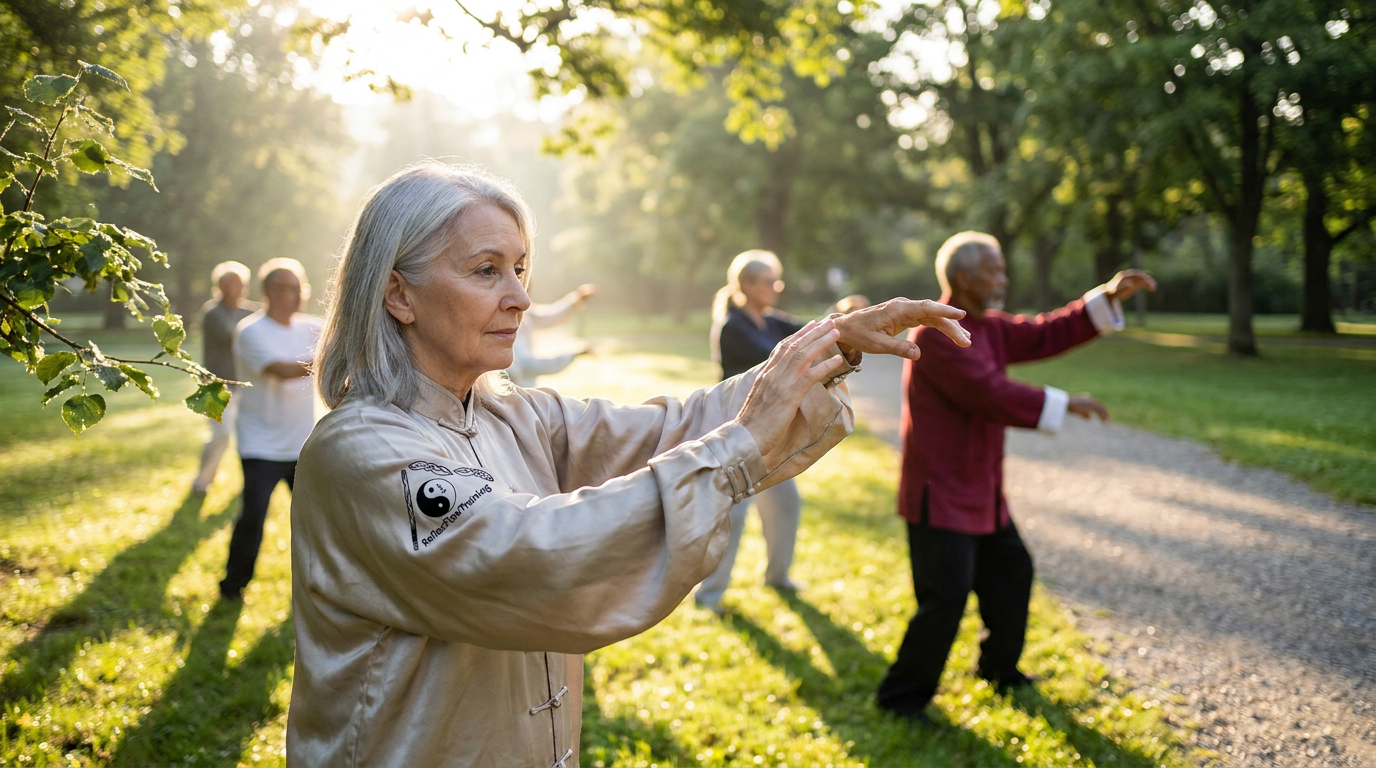
The image of Tai Chi—slow, graceful movements often practiced by older adults in city parks—has long been associated with general wellness and tranquility. But in recent years, this ancient Chinese martial art has quietly undergone a rigorous medical re-evaluation.
Moving beyond vague notions of "vitality," modern clinical trials are putting Tai Chi head-to-head against standard medical interventions and conventional exercise. The results are surprising cardiologists and neurologists alike.
Rather than just a gentle alternative for those who cannot jog, Tai Chi is emerging as a highly targeted therapy. Recent data suggests it can outperform vigorous aerobic exercise in specific cardiovascular metrics and actively slow cognitive decline.
The most striking evidence comes from a landmark randomized clinical trial published in JAMA Network Open, which challenged the conventional wisdom surrounding blood pressure management.[1]
For decades, the gold standard for lowering blood pressure has been moderate-to-vigorous aerobic exercise—activities that get the heart pumping, like brisk walking, cycling, or stair climbing.
Researchers in Beijing tracked 342 adults with prehypertension over a 12-month period. Half were assigned to a supervised aerobic exercise program, while the other half practiced Tai Chi. Both groups exercised for one hour, four times a week.[1][5][6]
After a year, the Tai Chi group saw an average systolic blood pressure drop of 7.01 mm Hg, significantly outperforming the 4.61 mm Hg drop in the aerobic group.[1][4][5]
Furthermore, nearly 22 percent of the Tai Chi practitioners saw their blood pressure return to a completely normal range, compared to just under 16 percent of the aerobic group.[1][5]

How does a slow-motion exercise outperform heart-pumping aerobics in cardiovascular health? The answer lies in the nervous system.
How does a slow-motion exercise outperform heart-pumping aerobics in cardiovascular health?
Tai Chi acts as a powerful trigger for the parasympathetic nervous system—the body's "rest and digest" network. By combining deep, controlled breathing with mindful movement, it dampens the sympathetic "fight or flight" response, which chronically constricts blood vessels in stressed individuals.[4][8]
Beyond the heart, researchers are increasingly focused on Tai Chi's impact on the brain, particularly in aging populations facing memory loss.
An NIH-funded study published in the Annals of Internal Medicine explored this by testing a "cognitively enhanced" version of Tai Chi on 304 older adults with mild cognitive impairment.[2]
While traditional Tai Chi requires memorizing complex movement sequences—which itself is a cognitive workout—the enhanced version added simultaneous mental challenges, such as spelling words backward while moving.[2]

The results were profound. Over six months, the traditional Tai Chi group improved their cognitive test scores by 1.5 points. The cognitively enhanced group boosted their scores by nearly three points, significantly outpacing a control group that only performed stretching.[2]
The mechanism behind this cognitive boost is becoming clearer at a molecular level. A 2025 study in Frontiers in Aging Neuroscience found that 24 weeks of Tai Chi practice increased the serum expression of Brain-Derived Neurotrophic Factor (BDNF).[3]
BDNF is a crucial protein that acts like fertilizer for the brain, encouraging the growth of new neurons and synapses, particularly in areas related to memory and executive function.[3][8]

The physical mechanics of Tai Chi also offer unique benefits that traditional exercise lacks. The continuous shifting of body weight from one leg to the other, combined with flexed postures, builds lower-body strength and improves proprioception—the body's awareness of its position in space.
This makes it one of the most effective interventions for fall prevention in older adults, while also providing enough weight-bearing resistance to help maintain bone density and counter osteoporosis.[7]
Despite the overwhelmingly positive data, researchers caution that Tai Chi is not a complete replacement for all other forms of exercise. Aerobic activity remains crucial for maximizing overall cardiovascular endurance and lung capacity.[4]
However, the medical consensus is shifting. Once viewed as a niche alternative therapy, Tai Chi is now being prescribed as a primary, evidence-based intervention—a testament to the enduring power of "meditation in motion."[8]
How we got here
9th-13th Century
Tai Chi originates in China as a martial art and philosophical practice rooted in Taoism.
Late 20th Century
Western medical researchers begin studying Tai Chi's effects on balance and fall prevention in older adults.
October 2023
An NIH-funded study demonstrates that cognitively enhanced Tai Chi significantly improves memory in adults with mild cognitive impairment.
February 2024
A landmark JAMA Network Open trial reveals Tai Chi outperforms vigorous aerobic exercise in lowering blood pressure.
March 2025
Research in Frontiers in Aging Neuroscience links Tai Chi practice to increased levels of BDNF, a crucial brain-fertilizing protein.
Viewpoints in depth
Clinical Researchers
Focus on empirical data, randomized controlled trials, and measurable physiological outcomes like blood pressure and BDNF levels.
For decades, clinical researchers viewed Tai Chi as a supplementary wellness activity rather than a primary medical intervention. However, recent randomized controlled trials have shifted this paradigm. By isolating specific biomarkers—such as serum BDNF levels and ambulatory blood pressure—researchers have proven that slow, mindful movement triggers distinct physiological changes that vigorous exercise does not. This camp emphasizes the need for precise 'dosing' guidelines to maximize these clinical benefits.
Public Health Advocates
Emphasize accessibility, low-impact exercise options, and scalable interventions for aging populations.
Public health experts champion Tai Chi because it solves a critical compliance problem in preventative medicine. While many older adults or those with joint pain cannot safely perform high-impact aerobics, almost anyone can participate in Tai Chi. Because it requires no special equipment and can be performed in community settings or even seated, advocates view it as a highly scalable, low-cost tool to combat the dual epidemics of hypertension and age-related cognitive decline.
Integrative Medicine Specialists
View Tai Chi as a holistic mind-body practice that bridges traditional wisdom with modern neurobiology.
Integrative specialists argue that the power of Tai Chi lies precisely in its combination of physical movement and mental focus. They point out that separating the 'exercise' from the 'meditation' misses the point; it is the active engagement of the parasympathetic nervous system during movement that yields the unique cardiovascular and cognitive benefits. For this camp, the recent clinical data is simply modern science catching up to centuries of traditional Chinese medical theory.
What we don't know
- The exact 'dosing' of Tai Chi required for optimal benefits—whether shorter, daily sessions are more effective than longer, less frequent ones.
- How the benefits of Tai Chi compare across different demographic groups, as many of the largest studies have been conducted primarily in China.
- The long-term durability of the cognitive improvements seen in Mild Cognitive Impairment patients after they stop practicing.
Key terms
- Prehypertension
- Blood pressure that is higher than normal but not yet in the range of clinical high blood pressure.
- Parasympathetic Nervous System
- The part of the autonomic nervous system that slows the heart rate, relaxes blood vessels, and promotes a state of calm.
- Brain-Derived Neurotrophic Factor (BDNF)
- A protein that promotes the survival and growth of neurons, playing a key role in memory and learning.
- Mild Cognitive Impairment (MCI)
- An early stage of memory loss or other cognitive ability loss in individuals who maintain the ability to independently perform most activities of daily living.
- Proprioception
- The body's ability to sense its movement, action, and location, which is crucial for balance and fall prevention.
Frequently asked
Is Tai Chi better than aerobic exercise?
For lowering blood pressure in prehypertensive individuals, recent studies show Tai Chi is more effective. However, aerobic exercise remains important for overall cardiovascular endurance.
What is 'cognitively enhanced' Tai Chi?
It is a modified version of Tai Chi that adds simultaneous mental challenges, such as spelling words backward, to the physical movements to boost brain health.
How does Tai Chi lower blood pressure?
It activates the parasympathetic nervous system (the 'rest and digest' response), which helps relax blood vessels and reduce stress-induced hypertension.
Can anyone practice Tai Chi?
Yes, it is a low-impact, adaptable exercise that can be performed standing or seated, making it accessible for people of all ages and fitness levels.
Sources
Source coverage
8 outlets
4 viewpoints surfaced








[1]JAMA Network OpenClinical Researchers
Effect of Tai Chi vs Aerobic Exercise on Blood Pressure in Patients With Prehypertension
Read on JAMA Network Open →[2]National Institutes of Health (NIH)Clinical Researchers
Tai chi, especially an enhanced version, may improve cognition in older adults with memory
Read on National Institutes of Health (NIH) →[3]Frontiers in Aging NeuroscienceClinical Researchers
Effects of Tai Chi on Cognitive Function and BDNF in Mild Cognitive Impairment
Read on Frontiers in Aging Neuroscience →[4]Harvard Health PublishingPublic Health Advocates
Tai chi beats aerobics for lowering blood pressure
Read on Harvard Health Publishing →[5]The Washington PostMainstream Medical Journalists
Tai chi outperforms aerobics in lowering blood pressure, study finds
Read on The Washington Post →[6]NPRMainstream Medical Journalists
Tai chi, a slow-moving martial art, beats aerobic exercise for lowering blood pressure
Read on NPR →[7]McMaster Optimal Aging PortalPublic Health Advocates
3 evidence-based benefits of tai chi
Read on McMaster Optimal Aging Portal →[8]Factlen Editorial TeamIntegrative Medicine Specialists
Synthesis by Factlen editorial team
Read on Factlen Editorial Team →



Every angle. Every day.
Get health stories with full source coverage and perspective breakdowns delivered to your inbox.