
The Evidence on Sleep Trackers: How Accurate Are the Apple Watch, Oura Ring, and Whoop?
Peer-reviewed validation studies reveal that top consumer wearables are exceptionally accurate at tracking total sleep time, but struggle to reliably measure deep and REM sleep stages.
By Factlen Editorial Team
- Clinical Sleep Researchers
- Medical professionals emphasize the gap between consumer estimates and diagnostic reality.
- Wearable Manufacturers
- Tech companies argue that longitudinal data beats a single night in a lab.
- Quantified Self Advocates
- Power users focus on behavioral trends rather than absolute clinical accuracy.
What's not represented
- · Patients with diagnosed sleep disorders
Why this matters
Millions of people base their daily routines, exercise intensity, and anxiety levels on the sleep scores generated by their wearables. Understanding where these devices are medically accurate—and where they are merely guessing—empowers users to make smarter health decisions without falling into data-driven anxiety.
Key points
- Consumer wearables are highly accurate at detecting total sleep time and basic sleep-versus-wake states.
- Accuracy drops significantly when devices attempt to classify specific stages like REM and deep sleep.
- Finger-based smart rings currently show slightly higher sleep staging accuracy than wrist-based smartwatches.
- Algorithms are trained on healthy adults and lose accuracy when used by individuals with sleep disorders.
- Experts recommend using wearable data to track long-term behavioral trends rather than obsessing over nightly scores.
Millions of people wake up every morning and immediately check their wrist or finger to see how they slept. Devices like the Apple Watch, Oura Ring, and Whoop 4.0 assign a nightly "sleep score," breaking down the night into precise minutes of light, deep, and REM sleep. These metrics influence how people exercise, eat, and perceive their own energy levels throughout the day. But how much of that data is grounded in medical reality, and how much is algorithmic guesswork? As consumer sleep tracking transitions from a niche hobby to a mainstream health pillar, researchers have begun rigorously testing these devices against clinical standards. The results reveal a fascinating split: the hardware on your nightstand is exceptionally accurate at answering some questions, and surprisingly flawed at answering others.[7]
To evaluate the true accuracy of consumer sleep trackers, scientists compare them against polysomnography (PSG)—the undisputed gold standard in sleep medicine. During a PSG study, a patient sleeps in a clinical lab while wired to an array of medical equipment. Electrodes on the scalp measure brain waves (EEG), while other sensors track eye movement, muscle tension, and respiratory effort. Consumer wearables, by contrast, must guess what the brain is doing without ever measuring it. They rely entirely on accelerometers to detect movement and optical photoplethysmography (PPG) sensors to track heart rate and blood oxygen. By feeding this cardiovascular and movement data into machine-learning models, the devices attempt to reverse-engineer the complex neurological stages of sleep.[1][3][4][6][7]
The peer-reviewed evidence shows that wearables are exceptionally good at one foundational task: telling whether you are asleep or awake. Across multiple 2024 and 2025 multicenter validation studies, devices from Apple, Oura, and Fitbit consistently demonstrated a sensitivity of 95% or higher for basic sleep-versus-wake detection. If you want to know whether you slept for six hours or eight hours, the hardware on your wrist is highly reliable. In most clinical trials, the total sleep time estimated by top-tier consumer devices lands within 15 to 30 minutes of the clinical PSG reference. For the average person trying to maintain a consistent seven-hour sleep schedule, this level of accuracy is more than sufficient to drive meaningful behavioral changes.[1][4][6][7]

However, the scientific evidence weakens significantly when these devices attempt to classify specific sleep architecture. Distinguishing between light sleep, deep (slow-wave) sleep, and REM sleep is notoriously difficult without direct access to brain wave data. In a rigorous 2024 study conducted at Brigham and Women’s Hospital, the accuracy for four-stage sleep classification dropped to between 50% and 86%, depending on the specific device and the sleep stage being measured. While the algorithms can detect the elevated heart rate variability associated with REM sleep or the steady vitals of deep sleep, they frequently misclassify the transitional periods between these stages.[1][2][6][7]
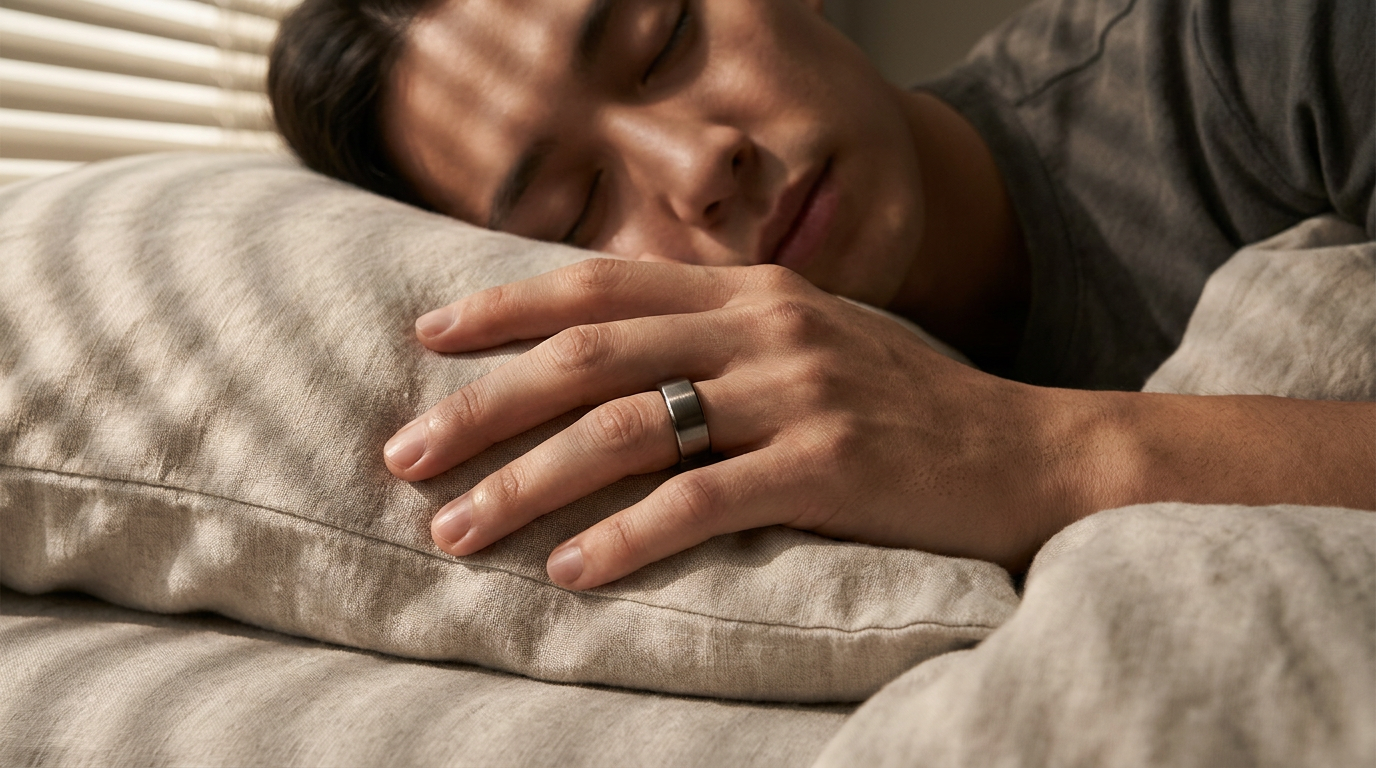
Among consumer devices, the Oura Ring Gen 3 currently holds the strongest published data for sleep staging accuracy. In head-to-head inpatient trials, the Oura Ring achieved a sleep staging sensitivity of roughly 76% to 79.5%, outperforming wrist-based competitors. Researchers note that the finger is an ideal anatomical location for optical heart-rate sensors, providing a clearer cardiovascular signal with less movement artifact than the wrist. A comprehensive 2025 meta-analysis of six different studies confirmed that Oura's measurements for total sleep time and sleep efficiency showed no statistically significant difference from clinical actigraphy, cementing its status as a highly capable consumer tool.[1][2][5]

Among consumer devices, the Oura Ring Gen 3 currently holds the strongest published data for sleep staging accuracy.
It is worth noting, however, that the Brigham and Women's study was funded by Oura Health, a common practice in wearable validation that warrants standard scientific caution. Independent studies, such as a 2025 trial from the University of Antwerp which tested six devices without manufacturer funding, found that all consumer trackers share a conservative algorithmic bias. When faced with ambiguous physiological signals, the devices frequently misclassify brief awakenings, deep sleep, and REM as generic "light sleep." This means that if your app tells you that you suffered from a lack of deep sleep, it may simply be a limitation of the optical sensor rather than a true physiological deficit.[4][5][7]
The Apple Watch Series 8 and newer models—running watchOS 9 through 11—show their own distinct staging patterns. While Apple's sleep-wake detection is near-perfect, boasting a 97.9% sensitivity in validation sets, its deep sleep tracking is notably less precise. Clinical comparisons reveal the Apple Watch correctly identifies deep sleep about 62% of the time, often confusing it for "core" or light sleep. As a result, Apple Watch users may frequently see their deep sleep numbers underestimated compared to a clinical baseline. Apple has continuously updated its foundation models using data from the Apple Heart and Movement Study, but the inherent limitations of wrist-based accelerometry remain.[1][3]
Whoop 4.0, a screenless tracker highly popular among professional athletes, takes a slightly different philosophical approach to nocturnal monitoring. While its stage classification accuracy hovers around 66% to 69%—placing it in the middle of the premium consumer pack—the device excels at measuring nocturnal Heart Rate Variability (HRV) and resting heart rate. For many users and performance coaches, these cardiovascular recovery metrics are actually more actionable indicators of physical readiness than the estimated ratio of REM to deep sleep. Whoop's algorithms prioritize the overall strain-to-recovery balance, using sleep data primarily as a vehicle to calculate how hard an athlete should push themselves the following day. By focusing on the autonomic nervous system's response to rest, Whoop bypasses some of the inherent limitations of sleep staging.[4][5][7]

There is a major clinical caveat to all of this validation data that consumers must understand: these algorithms are trained on, and validated in, healthy adults with relatively normal sleep patterns. When researchers test consumer rings and watches on populations with sleep apnea, insomnia, restless leg syndrome, or other clinical sleep disorders, the accuracy plummets significantly. For instance, the devices often interpret the quiet, motionless wakefulness of an insomniac as light sleep, drastically overestimating their total rest and providing a false sense of security. Similarly, the highly fragmented sleep architecture caused by severe sleep apnea can thoroughly confuse the staging algorithms, rendering the REM and deep sleep estimates highly unreliable for those patients.[1][4][5][6]
Ultimately, the scientific consensus suggests users should treat consumer sleep trackers as macro-trend monitors rather than clinical diagnostic tools. The exact percentage of REM sleep your app reports on any given Tuesday is likely flawed, and obsessing over a low sleep score can ironically cause enough anxiety to disrupt the next night's rest—a phenomenon sleep doctors have dubbed "orthosomnia." However, the longitudinal data these devices provide is incredibly powerful. If your wearable shows your resting heart rate dropping and your total sleep time steadily increasing over a month of avoiding late-night alcohol or sticking to a consistent bedtime, that trend is highly accurate and medically valuable. The true power of consumer sleep tracking lies not in the perfection of a single night's data, but in the behavioral changes the technology inspires over time.[4][6][7]
Viewpoints in depth
Clinical Sleep Researchers
Medical professionals emphasize the gap between consumer estimates and diagnostic reality.
Sleep medicine experts frequently warn against 'orthosomnia'—an unhealthy obsession with achieving perfect sleep scores based on flawed wearable data. While researchers acknowledge that devices like the Apple Watch and Oura Ring are excellent at detecting basic sleep duration, they stress that optical sensors cannot measure brain waves. Therefore, any claims about precise REM or deep sleep minutes should be treated as educated algorithmic guesses rather than medical facts. They strongly caution against using consumer devices to self-diagnose conditions like sleep apnea or insomnia.
Wearable Manufacturers
Tech companies argue that longitudinal data beats a single night in a lab.
Manufacturers point out that polysomnography (PSG), while highly accurate, is an artificial environment. Sleeping in a lab covered in wires often results in the 'first-night effect,' where the patient's sleep is unnaturally disrupted. Wearable makers argue that tracking a user's sleep in their own bed over hundreds of nights provides a much more valuable baseline for personal health. By continuously refining their machine-learning models with massive datasets, companies believe their devices are democratizing sleep science and driving positive behavioral changes at scale.
Quantified Self Advocates
Power users focus on behavioral trends rather than absolute clinical accuracy.
For athletes and biohackers, the exact minute-by-minute accuracy of a sleep stage is less important than the directional trend. If a Whoop strap or Oura Ring consistently shows that late-night meals or alcohol consumption depresses Heart Rate Variability (HRV) and reduces overall sleep quality, the device has done its job. This camp views wearables as behavioral compasses—tools that provide immediate, actionable feedback on lifestyle choices, regardless of whether the underlying REM estimation perfectly matches an EEG machine.
What we don't know
- How much proprietary sleep algorithms differ from one another, as companies rarely publish their exact machine-learning models.
- Whether future consumer devices will be able to accurately measure brain waves (EEG) without requiring intrusive clinical equipment.
Key terms
- Polysomnography (PSG)
- The clinical gold standard for sleep testing, using electrodes to measure brain waves, eye movement, and muscle activity.
- Photoplethysmography (PPG)
- An optical sensor technology used in smartwatches and rings to measure heart rate by illuminating the skin and measuring changes in light absorption.
- Sleep Architecture
- The structural organization of sleep, typically divided into cycles of light sleep, deep (slow-wave) sleep, and REM sleep.
- Heart Rate Variability (HRV)
- The measure of the variation in time between each heartbeat, used by wearables as a key indicator of physical recovery and nervous system balance.
Frequently asked
Which consumer sleep tracker is the most accurate?
According to peer-reviewed validation studies, the Oura Ring Gen 3 currently has the highest published accuracy for sleep staging, though all devices fall short of clinical polysomnography.
Can my Apple Watch accurately measure deep sleep?
The Apple Watch is excellent at detecting total sleep time, but studies show it only correctly identifies deep sleep about 62% of the time, often underestimating it.
Can a smart ring or watch diagnose sleep apnea?
No. While devices can track blood oxygen drops that may indicate an issue, they cannot diagnose sleep apnea. Their accuracy actually drops significantly in people with sleep disorders.
Sources
Source coverage
7 outlets
3 viewpoints surfaced







[1]Sensors JournalClinical Sleep Researchers
Accuracy of Three Commercial Wearable Devices for Sleep Tracking in Healthy Adults
Read on Sensors Journal →[2]National Institutes of HealthClinical Sleep Researchers
Meta‐Analysis of Oura Ring Versus Polysomnography
Read on National Institutes of Health →[3]AppleWearable Manufacturers
Apple Watch Sleep Feature Validation
Read on Apple →[4]The Curated WeeklyQuantified Self Advocates
How accurate are consumer sleep trackers, really?
Read on The Curated Weekly →[5]CentraLive HealthQuantified Self Advocates
Ring vs. Watch for Sleep Monitoring: A Practical Comparison
Read on CentraLive Health →[6]JMIR mHealth and uHealthClinical Sleep Researchers
Accuracy of 11 Wearable, Nearable, and Airable Consumer Sleep Trackers
Read on JMIR mHealth and uHealth →[7]Factlen Editorial TeamWearable Manufacturers
Synthesis by Factlen editorial team
Read on Factlen Editorial Team →
Every angle. Every day.
Get shopping stories with full source coverage and perspective breakdowns delivered to your inbox.