
OLED vs. Mini-LED in 2026: How to Choose the Right Display for Your Room
The gap between OLED and Mini-LED technology has narrowed significantly, shifting the buying decision from pure picture quality to room lighting and daily workflow.
By Factlen Editorial Team
- Cinematic Purists
- Prioritize perfect black levels, infinite contrast, and instant pixel response for dark-room viewing and gaming.
- Bright-Room Power Users
- Value sustained peak brightness, immunity to burn-in, and sharp text clarity for productivity and daytime viewing.
- Value-Conscious Buyers
- Focus on the price-to-performance ratio, favoring technologies that offer large screens and high brightness without the premium markup.
What's not represented
- · Micro-LED Early Adopters
- · Professional Color Graders
Why this matters
Choosing the wrong display technology can result in a washed-out picture in a bright room or frustrating burn-in on a work monitor. Understanding the specific strengths of OLED and Mini-LED ensures you invest in a screen that perfectly matches your lighting environment and daily habits.
Key points
- OLED panels offer perfect black levels and instant response times by turning off individual pixels.
- Mini-LED displays use thousands of dimming zones to achieve massive peak brightness without burn-in risk.
- OLED is the superior choice for dark rooms, cinematic viewing, and competitive gaming.
- Mini-LED excels in bright, sunlit rooms and for heavy productivity workflows with static UI elements.
- The gap between the two technologies has narrowed significantly, making the choice dependent on environment rather than pure quality.
The premium display market in 2026 is defined by a two-horse race that has never been tighter. For years, consumers upgrading their televisions or desktop monitors faced a clear hierarchy: pay a massive premium for OLED's perfect blacks, or settle for the compromises of traditional LCDs. Today, that hierarchy has collapsed into a genuine rivalry. The maturation of Mini-LED technology and the advent of high-brightness Tandem OLEDs have transformed the buying decision from a question of budget into a question of lifestyle.[5]
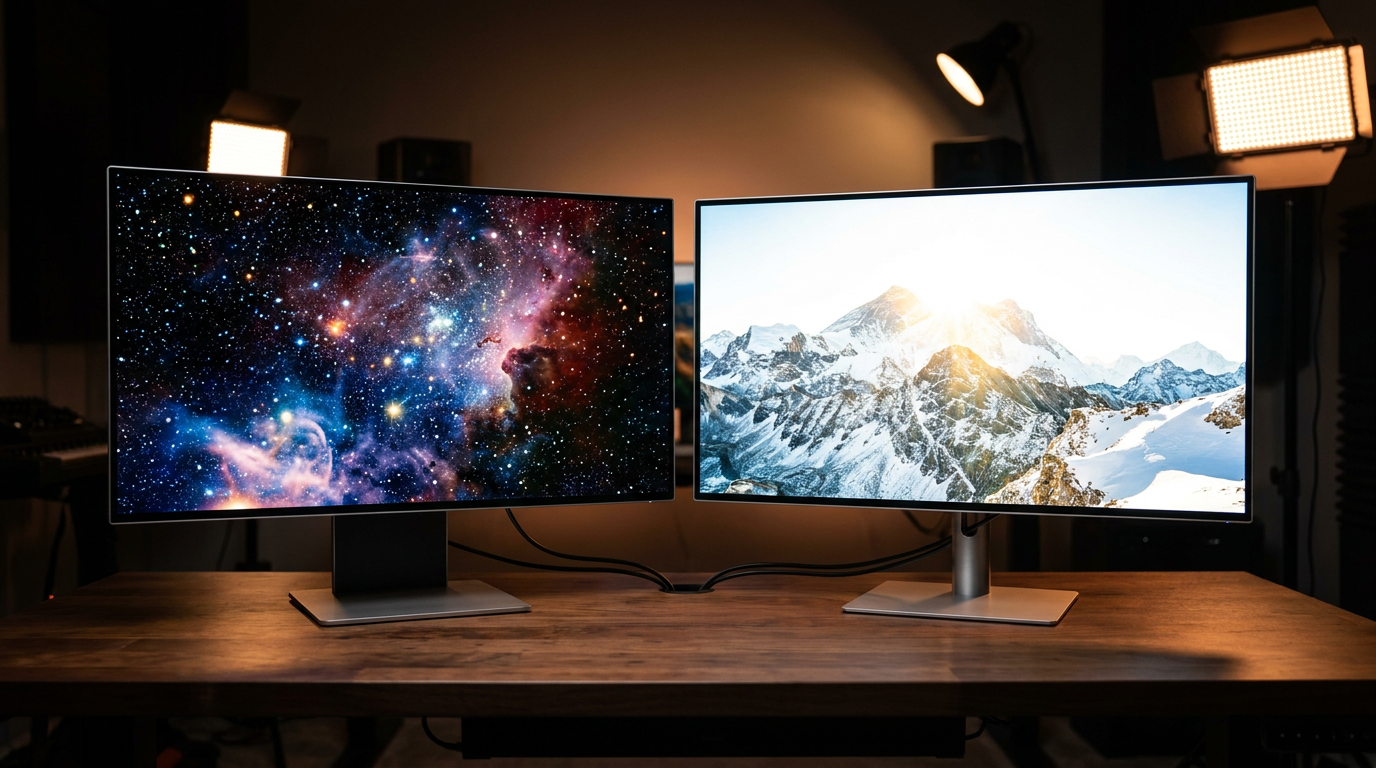
To understand the trade-offs, one must look at how the screens generate light. OLED (Organic Light-Emitting Diode) panels are self-emissive. Every single pixel produces its own light and color, meaning a 4K OLED has over 8 million independent light sources that can turn off completely to achieve absolute, perfect black. Mini-LED, conversely, relies on an LCD panel illuminated by a backlight. Instead of a few dozen large LEDs, it uses thousands of microscopic LEDs grouped into local dimming zones that brighten or dim based on the image on screen.[1][3]
The case for OLED rests entirely on precision. Because Mini-LEDs must illuminate zones rather than individual pixels, they inherently suffer from blooming—a faint halo of light bleeding around bright objects on dark backgrounds, such as white subtitles over a black cinematic letterbox. OLED panels suffer zero blooming. Testing by independent reviewers consistently demonstrates that OLEDs maintain perfect black uniformity, delivering a level of depth and micro-contrast that makes dark, atmospheric movies and games look incredibly lifelike.[1][5]

OLED also dominates in motion clarity. The organic pixels can change state in as little as 0.1 milliseconds. For competitive gamers playing fast-paced titles at 144Hz or 240Hz, this near-instantaneous response time eliminates the motion blur and ghosting that can plague even the fastest Mini-LED panels. When tracking fast-moving objects across the screen, the crispness of an OLED panel remains unmatched.[2][4]
However, the case against OLED—and the primary argument for Mini-LED—centers on sheer, unadulterated brightness. While 2026's Tandem OLEDs can hit impressive peak highlights of 1,500 to 2,000 nits in small windows, they cannot sustain that brightness across the entire screen. To protect the organic compounds from overheating, OLEDs use an Automatic Brightness Limiter (ABL) that aggressively dims the display when showing large, bright scenes, such as a snow-covered landscape or a full-screen white web browser.[2][4]
However, the case against OLED—and the primary argument for Mini-LED—centers on sheer, unadulterated brightness.
Mini-LED faces no such restrictions. A premium Mini-LED panel can sustain blindingly high full-screen brightness without breaking a sweat. For consumers placing a TV in a sun-drenched living room, or professionals working in bright offices, Mini-LED cuts through ambient glare effortlessly. Reviewers note that in bright rooms, the perceived contrast of a Mini-LED often exceeds that of an OLED, as the OLED's perfect blacks are washed out by room reflections while its highlights are throttled by ABL.[2][3][4]

Then there is the specter of burn-in. Because OLED pixels degrade as they emit light, displaying static elements—like a news channel ticker, a Windows taskbar, or a persistent gaming HUD—for thousands of hours can cause permanent image retention. While 2026 mitigation technologies have made this incredibly rare for varied viewing, long-term 10,000-hour stress tests confirm that heavy, static productivity workloads still carry a cumulative risk. Mini-LED, utilizing an inorganic backlight, is entirely immune to burn-in, offering a stress-free experience for users who leave their screens on all day.[2][4][6]
Color performance and text clarity also reveal subtle trade-offs. Modern Mini-LEDs frequently utilize Quantum Dot layers, allowing them to push massive color volume at high brightness levels—making HDR explosions and bright skies look intensely vibrant. Furthermore, Mini-LED monitors typically use standard RGB subpixel layouts, rendering crisp, clean text. Many OLEDs use non-standard subpixel structures that can introduce slight color fringing around text, making them less ideal for heavy reading or coding.[3][4]
Ultimately, the choice in 2026 requires buyers to abandon the idea of a single best technology and instead evaluate their specific environment. The guidance is clear: OLED fits perfectly when the display will live in a light-controlled or dark room, and when the primary use cases are cinematic movie watching and fast-paced gaming. If you crave perfect blacks and instant response times, and are willing to manage static content, OLED remains the pinnacle of visual fidelity.[1][3][5]

Conversely, Mini-LED is the definitive choice for bright environments, mixed-use productivity, and anxiety-free longevity. It fits perfectly when you need a display to double as a work monitor with static UI elements, or when your living room has large windows that let in the afternoon sun. By delivering 90% of OLED's dark-room performance while offering vastly superior brightness and durability, Mini-LED has evolved from a compromise into a powerhouse in its own right.[2][3][4][5][6]
How we got here
Early 2010s
OLED technology enters the premium consumer TV market, establishing a new standard for black levels and contrast.
2019
Mini-LED technology is introduced as a high-end alternative to standard LCDs, drastically increasing local dimming zones.
2022
QD-OLED (Quantum Dot OLED) launches, improving OLED color volume and peak brightness.
2024
Mini-LED zone counts push past 5,000 in flagship models, significantly reducing blooming artifacts.
2026
Tandem OLED and ultra-high-zone Mini-LEDs reach price parity in the premium monitor space, forcing consumers to choose based on use-case.
Viewpoints in depth
Cinematic Purists
Advocates for OLED's unmatched contrast and pixel response.
For home theater enthusiasts and competitive gamers playing in controlled, dark environments, OLED remains the undisputed champion. Because each pixel generates its own light and can turn off completely, OLED panels achieve infinite contrast and perfect black uniformity without the 'haloing' or 'blooming' artifacts that plague backlit displays. Furthermore, the near-instantaneous pixel response times (often under 0.1 milliseconds) eliminate motion blur, providing a level of clarity in fast-paced games that even the most advanced Mini-LEDs cannot replicate.
Bright-Room Power Users
Advocates for Mini-LED's sustained brightness and durability.
Users who work or play in sunlit rooms, or those who use their displays for heavy productivity, strongly favor Mini-LED. The technology's ability to sustain full-screen brightness well above 1,000 nits ensures the image never washes out under ambient glare. More importantly, the inorganic nature of the LED backlight completely eliminates the risk of permanent burn-in. For workflows involving static UI elements—like video editing timelines, spreadsheets, or persistent gaming HUDs—Mini-LED offers a stress-free experience without the need to hide taskbars or run pixel-refresh cycles.
What we don't know
- How long the new generation of Tandem OLED panels will truly last under real-world, multi-year productivity workloads.
- Whether upcoming micro-LED technology will become affordable enough to replace both OLED and Mini-LED before the end of the decade.
Key terms
- Local Dimming Zones
- Specific areas of a Mini-LED backlight that can dim or turn off independently to improve contrast and black levels.
- Blooming (Haloing)
- A visual artifact where light bleeds from a bright object into the surrounding dark areas of the screen, common on backlit displays.
- Self-Emissive Pixels
- Pixels that generate their own light and color independently, allowing them to turn off completely for perfect blacks.
- Burn-in
- Permanent image retention caused by uneven wear of organic pixels after displaying static elements for prolonged periods.
- Nits
- A unit of measurement for screen brightness; higher numbers indicate a brighter display.
Frequently asked
Does Mini-LED still have blooming in 2026?
Yes, but it is vastly reduced. High-end 2026 Mini-LEDs use thousands of dimming zones and advanced algorithms to minimize the 'halo' effect around bright objects on dark backgrounds, though it is still visible off-angle or in extreme high-contrast scenes.
Is OLED burn-in still a real risk?
While modern mitigations like pixel shifting and automatic brightness limiting have drastically reduced the risk, cumulative burn-in is still possible after thousands of hours of displaying static, bright elements like taskbars or news tickers.
Which is better for reading text?
Mini-LED is generally better for text clarity. Many OLED panels use non-standard subpixel layouts that can cause slight color fringing around text, whereas Mini-LEDs use standard RGB layouts that render text sharply.
What is Tandem OLED?
Tandem OLED stacks multiple organic light-emitting layers together. This allows the panel to achieve higher peak brightness while reducing the strain on individual pixels, thereby extending the panel's lifespan.
Sources
Source coverage
6 outlets
3 viewpoints surfaced






[1]RTINGSCinematic Purists
OLED vs Mini LED: Which Panel Technology Is Better?
Read on RTINGS →[2]KTCBright-Room Power Users
Tandem OLED vs. Mini-LED: Choosing the Best HDR Panel in 2026
Read on KTC →[3]Pixel PrimeValue-Conscious Buyers
LED vs QLED vs OLED vs Mini LED - The REAL Winner in 2026
Read on Pixel Prime →[4]Reddit r/MonitorsBright-Room Power Users
OLED vs Mini LED brightness burn in 2026
Read on Reddit r/Monitors →[5]Factlen Editorial TeamCinematic Purists
Synthesis by Factlen editorial team
Read on Factlen Editorial Team →[6]Consumer ReportsValue-Conscious Buyers
OLED vs. Mini-LED: Which TV Tech Should You Buy?
Read on Consumer Reports →

Every angle. Every day.
Get shopping stories with full source coverage and perspective breakdowns delivered to your inbox.