
The European Night Train Renaissance Accelerates With Major New Routes in 2026
Driven by climate consciousness and a desire for slow travel, Europe's sleeper train network is undergoing a massive expansion in 2026. New routes connecting Paris, Berlin, and Milan are offering travelers a sustainable, highly anticipated alternative to short-haul flights.
By Factlen Editorial Team
- Sustainable Travel Advocates
- Argue that night trains are the most critical tool for decarbonizing long-distance European travel.
- Rail Operators & Cooperatives
- Focus on the logistical and commercial realities of launching routes and modernizing cabins to meet demand.
- Transport Policy Reformers
- Highlight the unfair economic advantages enjoyed by the aviation sector and demand legislative leveling.
What's not represented
- · Budget Airline Executives
- · Local Tourism Boards
Why this matters
Transportation accounts for a massive share of global carbon emissions, with short-haul flights being particularly damaging. The revival of the European night train network provides a viable, comfortable alternative that allows travelers to drastically reduce their carbon footprint without sacrificing their vacations.
Key points
- The European night train network is expanding rapidly in 2026, driven by climate consciousness and a shift away from short-haul flights.
- The Belgian-Dutch cooperative European Sleeper is reviving the iconic Paris-to-Berlin overnight route starting in March 2026.
- Studies show that traveling by electric night train produces up to 28 times fewer greenhouse gas emissions than flying the same route.
- Despite high consumer demand, night trains struggle to compete with budget airline prices due to high track access tolls and untaxed aviation fuel.
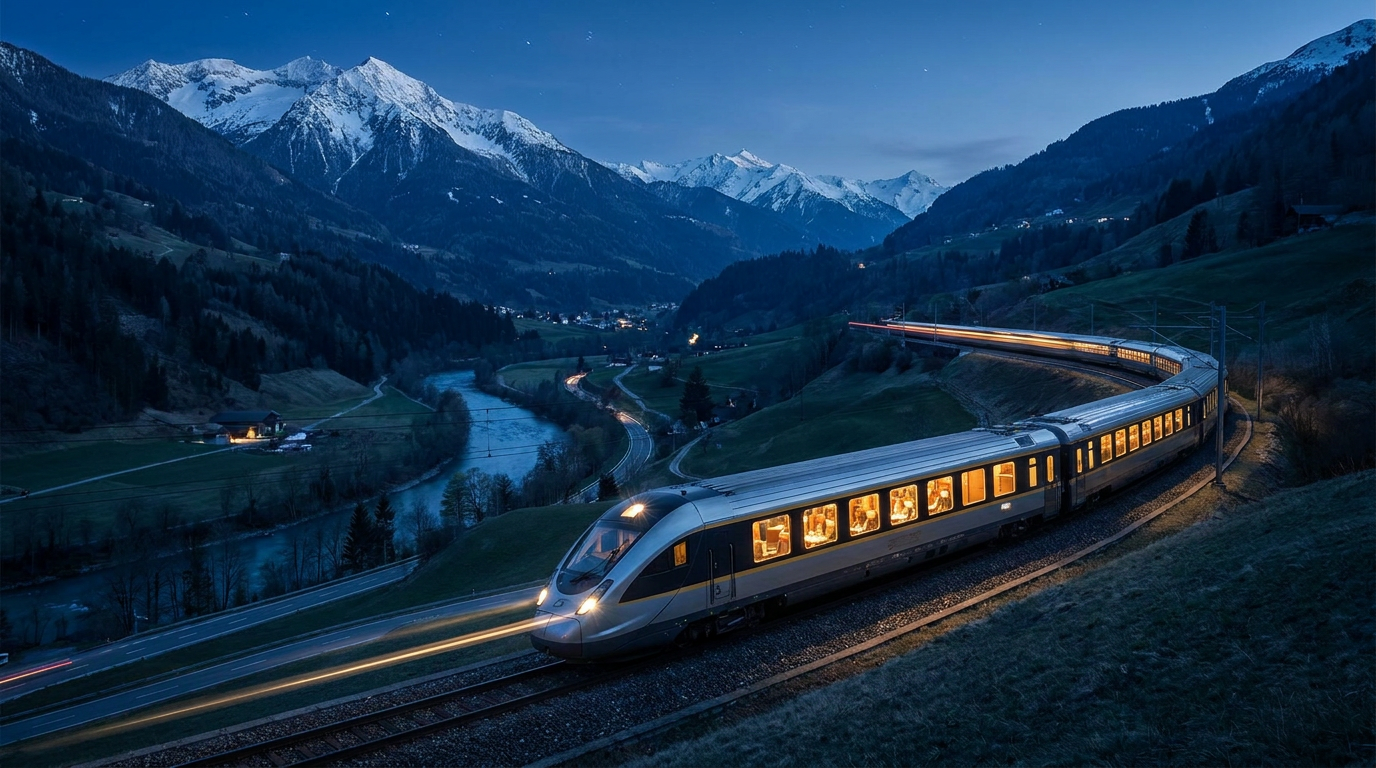
The romanticized era of European sleeper trains—once thought to be a permanent casualty of the budget airline boom—is experiencing a massive, modern revival. Across the continent, travelers are increasingly trading crowded airport terminals and cramped airplane seats for the rhythmic hum of overnight rail. What began as a niche movement a few years ago has blossomed into a full-scale transportation shift by 2026.[1][3]
This is not merely a nostalgic return to the past, but a forward-looking evolution driven by climate consciousness and a growing desire for "slow travel." In 2026, the European night train network is expanding at a pace not seen in decades, with operators launching highly anticipated routes that connect major capitals while passengers sleep comfortably in high-tech cabins.[2][4]
One of the most significant milestones of 2026 is the rescue and revival of the iconic Paris-to-Berlin overnight route. Originally slated for cancellation due to funding disputes and the withdrawal of previous operators, the route was taken over by the Belgian-Dutch rail cooperative European Sleeper and officially relaunches in March 2026.[1][2]
The revived Paris-Berlin service will accommodate up to 700 passengers per journey, running three times a week and offering a seamless, city-center to city-center connection. For rail enthusiasts and weekend travelers alike, the ability to fall asleep in France and wake up for breakfast in Germany represents the ultimate convenience, bypassing the grueling logistics of early-morning airport transfers.[1][2]

But the expansion does not stop at the German border. European Sleeper is also preparing to launch a brand-new route connecting Brussels and Amsterdam to Milan by late 2026. This ambitious southward expansion will finally link northern Europe with popular Mediterranean holiday destinations, stopping in picturesque Swiss cities like Bern and Italian lakeside towns along the way.[1][3]
Other operators are equally aggressive in their 2026 rollouts. The Swiss Federal Railways (SBB), in partnership with Germany's RDC, is launching a 16-hour overnight service in April 2026 that sweeps from Basel, Switzerland, through Copenhagen, and terminates in Malmö, Sweden, opening up a vital new artery into Scandinavia.[1]
Meanwhile, Central and Eastern Europe are seeing their own connectivity boom. Poland's PKP Intercity is expanding its seasonal Adriatic Express, which connects Warsaw to Croatia's coast, while new daytime and overnight linkages are tightening the web between Prague, Munich, and the Baltic Sea, making cross-border exploration easier than ever.[7]
The driving force behind this multibillion-euro rail renaissance is primarily environmental. As the realities of climate change become impossible to ignore, a growing demographic of travelers is actively seeking alternatives to short-haul aviation, which is notoriously carbon-intensive.[3][5]
The driving force behind this multibillion-euro rail renaissance is primarily environmental.
The emissions math heavily favors the tracks. According to comprehensive studies by environmental groups, traveling by night train produces up to 28 times less greenhouse gas emissions than flying the exact same route. When compared to driving, electric trains emit roughly 17 times less carbon dioxide per passenger kilometer.[5][6]

Because the vast majority of Europe's rail network is electrified, and the continent's energy grid is steadily transitioning to renewable sources, the environmental footprint of train travel continues to shrink every year. For distances between 500 and 1,500 kilometers, rail advocates argue that night trains are the only sustainable transport mechanism that does not sacrifice entire days to travel.[8]
Consumer behavior is shifting rapidly to match the data. Surveys indicate that nearly 70% of respondents in major European nations are willing to take night trains, and a significant portion will accept travel times exceeding five hours if it means avoiding a flight. This "flight shame" phenomenon, particularly among younger generations, has provided rail operators with a surging, guaranteed customer base.[3][5]
Despite the booming demand, the night train industry still faces steep structural and economic hurdles. Passengers frequently note that sleeper train tickets can be significantly more expensive than budget airline fares. This price disparity is not due to operational inefficiency, but rather a lack of a level playing field in European transport policy.[3][8]
Train operators are burdened by heavy track access charges—essentially tolls paid to national infrastructure managers for using the rails—which can account for 20% to 30% of a night train's operating costs. Furthermore, cross-border trains must navigate a fragmented patchwork of different national signaling systems, voltage standards, and language requirements that complicate international routes.[6][8]

In stark contrast, the aviation industry enjoys massive historical subsidies, most notably the fact that airline fuel remains largely untaxed across the globe. Transport policy reformers argue that until governments correct this imbalance, night trains will struggle to compete on price alone, relying instead on passengers willing to pay a premium for sustainability and comfort.[5][8]
To justify that premium, operators are radically overhauling the passenger experience. The cramped, shared couchettes of the 20th century are making way for high-tech, privacy-focused accommodations. Austria's state railway, ÖBB, has led the charge by investing hundreds of millions of euros into a new generation of "Nightjet" carriages that redefine rail luxury.[4]
These modern Nightjets feature innovative "mini-cabins"—individual, pod-like sleeping slots designed specifically for solo travelers who want privacy without paying for a full en-suite room. For those with larger budgets, the new trains offer luxury private compartments with integrated showers, free Wi-Fi, and digital temperature controls, rivaling boutique hotels.[4]

The appeal of the modern sleeper train is also about reclaiming time. Business travelers and tourists alike are realizing that a 14-hour overnight train journey is often more efficient than a two-hour flight. When factoring in the time spent traveling to remote airports, navigating security lines, and paying for an extra night in a hotel, the night train doubles as both transportation and accommodation.[8]
As 2026 unfolds, the European rail map is being dynamically redrawn. While challenges remain in standardizing cross-border ticketing and lowering infrastructure costs, the momentum is undeniable. For a growing number of Europeans, the journey is no longer just an obstacle to be flown over—it is a restful, sustainable, and highly anticipated part of the adventure itself.[2][4][5]
How we got here
Late 20th Century
European night trains enter a long period of decline as low-cost budget airlines dominate the travel market.
2023
Austria's ÖBB introduces its new-generation Nightjet trains, sparking a continent-wide renaissance in sleeper travel.
May 2023
The cooperative European Sleeper launches its inaugural overnight route connecting Brussels and Berlin.
March 2026
European Sleeper officially relaunches the iconic Paris-to-Berlin overnight route after it was nearly canceled.
Late 2026
Anticipated launch of new southward routes, including a highly anticipated sleeper service connecting Brussels to Milan.
Viewpoints in depth
Sustainable Travel Advocates
Argue that night trains are the most critical tool for decarbonizing long-distance European travel.
This camp, heavily supported by environmental NGOs and climate scientists, points to the stark emissions math: trains emit up to 28 times less CO2 than planes. They argue that the concept of "flight shame" is a necessary cultural shift, and that consumers must be willing to trade the raw speed of aviation for the ecological necessity of rail. For these advocates, every short-haul flight replaced by a sleeper train is a tangible victory for the Paris Agreement targets.
Rail Operators & Cooperatives
Focus on the logistical and commercial realities of scaling up a neglected industry.
Companies like European Sleeper and state operators like ÖBB emphasize the massive capital investment required to build new rolling stock and launch routes. They view the current boom as proof of consumer demand, but caution that scaling up takes years due to manufacturing backlogs for specialized sleeper carriages. Their primary goal is modernizing the passenger experience—moving away from cramped, shared couchettes toward private, high-tech cabins that can attract business travelers and affluent tourists.
Transport Policy Reformers
Highlight the unfair economic advantages enjoyed by the aviation sector and demand legislative leveling.
Policy experts and rail lobbyists argue that the current pricing structure is fundamentally broken. They point out that train operators must pay steep track access charges (tolls) to use national railways, which eat up to 30% of their revenue. Meanwhile, the aviation industry benefits from untaxed kerosene and heavily subsidized regional airports. This camp insists that until governments tax aviation fuel and lower rail tolls, night trains will remain an expensive premium product rather than a universally accessible public good.
What we don't know
- Whether the European Union will eventually implement a bloc-wide tax on aviation fuel to level the pricing playing field between planes and trains.
- How quickly train manufacturers can deliver the backlogged orders for new sleeper carriages required to meet the surging consumer demand.
Key terms
- Track access charges
- Tolls paid by train operators to national infrastructure managers for the right to run trains on their rail networks.
- Couchette
- A basic sleeping compartment on a train, typically featuring fold-down bunks shared by four to six passengers.
- European Sleeper
- A Belgian-Dutch rail cooperative founded to bring back overnight train routes, operating services like the Brussels-Berlin-Prague line.
- Rolling stock
- The collective term for the locomotives, carriages, and wagons used by a railway network.
Frequently asked
Are night trains cheaper than flying?
Not always. Because airlines do not pay tax on jet fuel and train operators must pay high track tolls, budget flights are often cheaper. However, night trains save passengers the cost of a hotel room for the night.
How much CO2 does a night train save?
Studies show that traveling by electric night train produces up to 28 times less greenhouse gas emissions per passenger than taking a short-haul flight.
Do I have to share a cabin with strangers?
No. While shared couchettes are still available for budget travelers, modern sleeper trains increasingly offer private 'mini-cabins' for solo travelers and en-suite compartments for couples.
What new routes are launching in 2026?
Major new routes include the revived Paris-to-Berlin service, a new connection from Brussels to Milan, and a route linking Basel, Switzerland to Malmö, Sweden.
Sources
Source coverage
8 outlets
3 viewpoints surfaced








[1]ForbesRail Operators & Cooperatives
These 4 European Night Trains Are Debuting In 2026
Read on Forbes →[2]Time OutTransport Policy Reformers
The best European sleeper trains to ride in 2026
Read on Time Out →[3]Yahoo NewsSustainable Travel Advocates
New European sleeper train routes are offering tourists an alternative to short-haul flights
Read on Yahoo News →[4]National GeographicTransport Policy Reformers
7 of the best European sleeper trains for 2026
Read on National Geographic →[5]NRI DigitalSustainable Travel Advocates
Why are night trains the best option for transport?
Read on NRI Digital →[6]Back-on-TrackSustainable Travel Advocates
The Global Warming Reduction Potential of Night-Trains
Read on Back-on-Track →[7]InterrailRail Operators & Cooperatives
10+ exciting rail updates to experience in 2026
Read on Interrail →[8]Trains for EuropeTransport Policy Reformers
Why night trains make sense
Read on Trains for Europe →
Every angle. Every day.
Get world stories with full source coverage and perspective breakdowns delivered to your inbox.