
Historic Wins by Sanders and Tri Ramadani Shake Up the 2026 World Climbing Series Standings
American Annie Sanders and Indonesian Putra Tri Ramadani have rewritten the record books midway through the 2026 World Climbing Series, while the Para Climbing circuit sees unprecedented global participation.
By Factlen Editorial Team
- American Climbing Advocates
- Celebrating Annie Sanders' historic double and the rise of the next generation of US climbers.
- Indonesian National Team
- Viewing Tri Ramadani's gold as a paradigm shift that proves Indonesia can dominate beyond Speed climbing.
- Para Climbing Community
- Highlighting the record-breaking participation in Innsbruck and the growing visibility of adaptive climbing.
- Neutral Competition Analysts
- Focusing on the overall standings, the impact of the 2026 rebrand, and the fierce rivalries across disciplines.
What's not represented
- · European Climbing Federations adjusting to the loss of their traditional dominance in technical disciplines.
Why this matters
The 2026 season marks a paradigm shift in competitive climbing. Long-standing national monopolies are falling as a new generation of versatile athletes proves that gold medals in Lead and Boulder are now up for grabs globally.
Key points
- Annie Sanders became the third woman in history to win both Boulder and Lead at a single World Series event.
- Putra Tri Ramadani secured Indonesia's first-ever gold medal in a non-Speed discipline by winning the Men's Lead final.
- The Para Climbing event in Innsbruck set an all-time participation record with 298 athletes from 31 nations.
- The 2026 season marks the debut of the 'World Climbing Series' branding, replacing the IFSC World Cup moniker.
- The 19-event global circuit will conclude in October with a final showdown in Santiago, Chile.
The international sport climbing landscape is undergoing a dramatic transformation midway through the 2026 season. Following the rebranding of the International Federation of Sport Climbing (IFSC) World Cup to the streamlined "World Climbing Series," the circuit has delivered a string of historic breakthroughs that are completely reshaping the global standings.[1][6]
Nowhere was this shift more evident than at the early-June tour stop in Prague, Czechia. Over five days of intense competition on Štvanice Island, the sport's rising stars dismantled established hierarchies, proving that the race for the overall 2026 trophies will be one of the most fiercely contested in recent memory.[3]
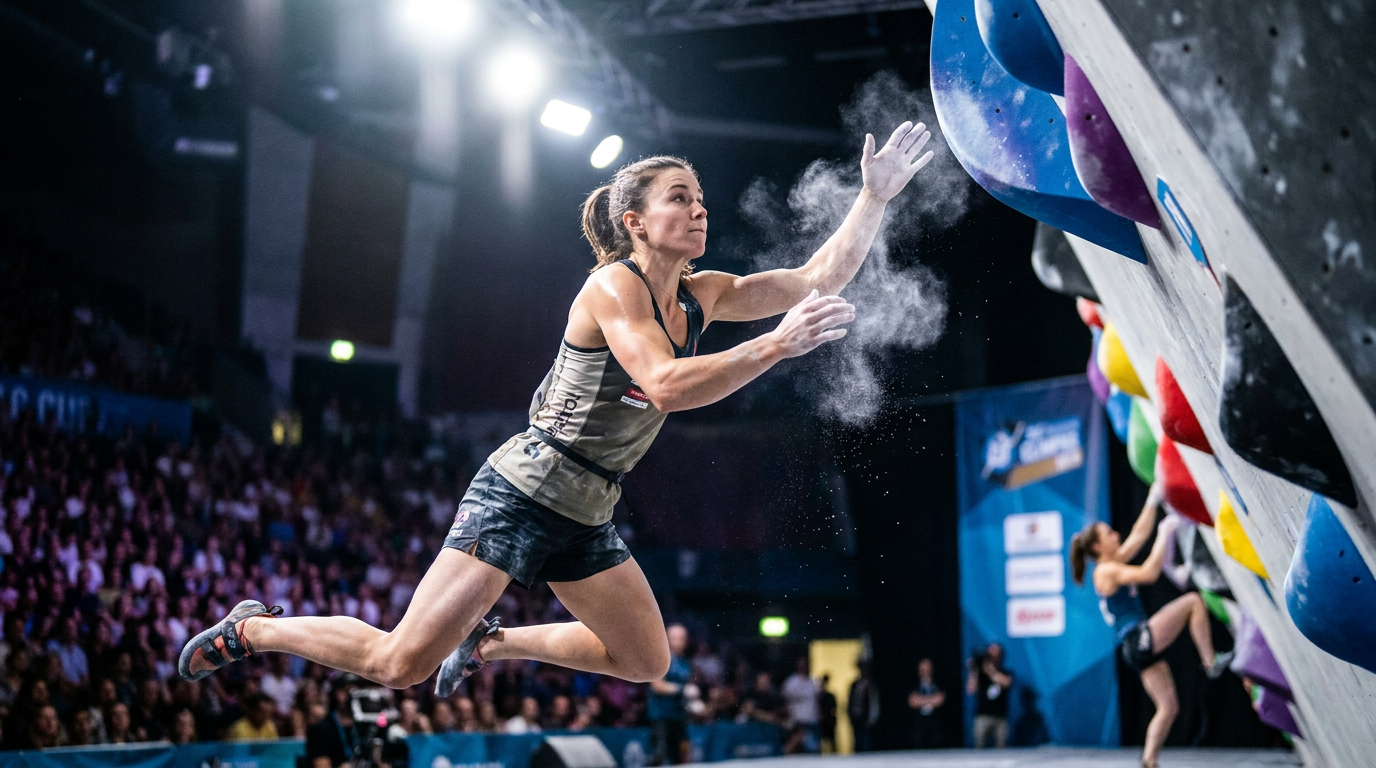
At the center of the standings shake-up is American phenom Annie Sanders, who has established absolute dominance in the women's field. In Prague, Sanders achieved the elusive "Prague Double," winning gold in both the Boulder and Lead disciplines during the same event.[1][3]
The magnitude of Sanders' achievement cannot be overstated. She became only the third woman in the history of competitive climbing to win two disciplines at a single World Series event, joining the legendary ranks of France's Sandrine Levet and Slovenia's Janja Garnbret.[1]

Sanders secured her Boulder victory by setting a blistering pace right out of the blocks. She was the only finalist to top the opening problem, a feat that gave her the necessary margin to edge out Great Britain's Erin McNeice by a mere two-tenths of a point. China's Yuetong Zhang took bronze, marking her first-ever World Series podium appearance.[1][3]
The next evening, Sanders returned to the wall for the Lead final. Surfing a wave of momentum, she navigated a highly physical, bouldery route to reach hold 37, surpassing South Korea's Chaehyun Seo (hold 35) to claim her second gold of the weekend and cement her place at the top of the overall 2026 standings.[1]
Sanders' momentum has shown no signs of slowing. Moving on to the Bern qualifiers shortly after, she posted a near-perfect score of 124.9 points across two groups, flashing four out of five boulders and signaling to the rest of the field that she is the undisputed athlete to beat this year.[5]
While Sanders dominated the women's events, the men's standings witnessed a historic geographic breakthrough. Indonesia's Putra Tri Ramadani stunned the climbing world by winning gold in the Men's Lead final in Prague, marking a watershed moment for his nation's climbing program.[1][2]
While Sanders dominated the women's events, the men's standings witnessed a historic geographic breakthrough.
Historically, Indonesia has been a global superpower in Speed climbing, producing world-record holders and Olympic champions in the vertical sprint. However, the nation had never secured a World Series gold in the highly technical Lead or Boulder disciplines until Tri Ramadani's flawless run in Czechia.[2]

Known affectionately as "Srondeng," the 20-year-old Indonesian climber delivered a masterful performance in the final. He pushed through a grueling, pump-heavy upper section of the wall to reach hold 43, comfortably defeating Japanese standout Neo Suzuki (hold 39) and Austrian climbing legend Jakob Schubert (hold 37).[1][2]
The victory sent shockwaves through the Indonesian climbing community. National team manager Wahyu Pristiawan Buntoro heralded the win as a historic milestone, proving that Indonesian athletes can compete—and win—against the world's best on the endurance-testing Lead walls.[2]
Meanwhile, the Men's Boulder standings continue to be paced by Japan's Sorato Anraku. Anraku claimed his first Prague Boulder victory by edging out South Korea's Lee Dohyun, adding another gold to his rapidly expanding resume and keeping Japan firmly atop the men's team rankings.[3]
As the World Climbing Series transitioned from Prague to Innsbruck, Austria, in mid-June, the spotlight expanded to include the Para Climbing circuit, which is experiencing its own unprecedented surge in global participation.[4]
The Innsbruck event shattered all previous attendance records, welcoming 298 Para Climbing athletes from 31 nations. This massive turnout—comfortably surpassing the previous record of 233—highlights the explosive growth and increasing professionalization of adaptive climbing ahead of the LA28 Paralympic cycle.[4]

The Austrian home crowd was treated to deeply emotional and inspiring performances. Jasmin Plank secured a dominant victory in the RP2 category, her second win of the season. The triumph carried profound personal significance for the 37-year-old, coming just weeks after the passing of her mother.[4]
Innsbruck also witnessed the arrival of the next generation of adaptive athletes. Sixteen-year-old Lilli Marie Laschitz, a visually impaired climber making her World Cup debut, captured a stunning silver medal in the B1 category, guided safely up the wall by the verbal commands of her coach.[4]

With 19 events scheduled across 13 locations in 2026, the World Climbing Series is proving to be a grueling but spectacular marathon. The season will culminate in October with a final Lead and Speed event in Santiago, Chile—the first time the series has concluded in South America.[6]
As athletes look ahead to the second half of the calendar, the standings tell a clear story: the sport is evolving rapidly. With athletes like Sanders setting new benchmarks and climbers like Tri Ramadani breaking geographic barriers, the race for the 2026 overall titles remains wide open and thrillingly unpredictable.[1][2][6]
How we got here
December 2025
The International Federation of Sport Climbing (IFSC) officially rebrands its premier circuit to the 'World Climbing Series'.
May 2026
The 2026 season kicks off with Bouldering events in Keqiao, China, setting the stage for a highly competitive year.
June 3-7, 2026
Annie Sanders and Putra Tri Ramadani secure historic, record-breaking victories at the World Climbing Series event in Prague.
Mid-June 2026
The Para Climbing series in Innsbruck shatters attendance records, hosting nearly 300 international athletes.
October 2026
The 2026 season is scheduled to conclude with a final Lead and Speed event in Santiago, Chile.
Viewpoints in depth
American Climbing Advocates
Celebrating Annie Sanders' historic double and the rise of the next generation of US climbers.
For followers of the US national team, the 2026 season is a validation of the country's youth development pipeline. Annie Sanders' ability to seamlessly transition between the explosive power required for Bouldering and the grueling endurance needed for Lead climbing places her in a generational tier of athletes. Advocates point out that her near-perfect qualification rounds and clutch finals performances prove she isn't just winning—she is dictating the pace of the sport on a global level.
Indonesian National Team
Viewing Tri Ramadani's gold as a paradigm shift that proves Indonesia can dominate beyond Speed climbing.
Indonesia has long been feared on the Speed wall, but the national federation has actively worked to shed the label of being a 'one-trick' program. Putra Tri Ramadani's gold medal in Lead is seen internally as the ultimate proof of concept. By defeating established European and Japanese legends on a highly technical route, the Indonesian camp believes they have finally unlocked the training methodologies needed to challenge for overall combined podiums in future Olympic cycles.
Para Climbing Community
Highlighting the record-breaking participation in Innsbruck and the growing visibility of adaptive climbing.
Adaptive climbing advocates view the 2026 Innsbruck turnout—nearly 300 athletes from 31 nations—as a tipping point for the sport. With Para Climbing officially integrated into the LA28 Paralympic Games program, the community emphasizes that the depth of talent is expanding exponentially. They point to the influx of teenage debutants and the fiercely competitive finals as evidence that Para Climbing has evolved from a niche exhibition into a premier, highly professionalized athletic circuit.
Neutral Competition Analysts
Focusing on the overall standings, the impact of the 2026 rebrand, and the fierce rivalries across disciplines.
From a purely analytical perspective, the 2026 World Climbing Series is delivering exactly what the organizers hoped for when they rebranded: global parity. Analysts note that the traditional dominance of a few select European nations is fracturing. With climbers from the US, Indonesia, China, and Japan consistently taking medals off established veterans, the overall standings are tighter and more unpredictable than they have been in a decade, forcing athletes to continually invent new beta and training techniques.
What we don't know
- Whether Annie Sanders can maintain her dual-discipline dominance through the grueling second half of the season.
- If Indonesia's breakthrough in Lead climbing will translate into consistent podium finishes across the remaining 2026 tour stops.
- How the record influx of new Para Climbing athletes will reshape the category rankings ahead of the LA28 Paralympic cycle.
Key terms
- World Climbing Series
- The premier international competition climbing circuit, rebranded in 2026 from the IFSC Climbing World Cup.
- Lead Climbing
- A discipline where athletes attempt to climb as high as possible on a 15-meter wall within a fixed time limit, clipping into quickdraws for safety.
- Bouldering
- A discipline where climbers solve short, complex routes on 4.5-meter walls without ropes, landing on crash pads.
- Speed Climbing
- A head-to-head race up a standardized 15-meter wall, historically dominated by nations like Indonesia and Poland.
- Zone
- A designated hold midway up a boulder problem that awards partial points if a climber controls it but cannot reach the top.
- Para Climbing
- Competitive climbing for athletes with physical or visual impairments, divided into categories based on the type and degree of impairment.
Frequently asked
What is the World Climbing Series?
It is the new name for the IFSC Climbing World Cup, rebranded in December 2025 to reflect the sport's global growth and streamlined presentation.
Who is Annie Sanders?
An American sport climber who made history in 2026 by winning both the Boulder and Lead disciplines at the Prague event, dominating the overall standings.
Why is Putra Tri Ramadani's win significant?
He became the first Indonesian climber to win a World Series gold medal in a discipline other than Speed climbing, proving the nation's versatility on the wall.
Where does the 2026 climbing season end?
The 2026 World Climbing Series will conclude in October with a Lead and Speed event in Santiago, Chile.
Sources
Source coverage
6 outlets
4 viewpoints surfaced






[1]World ClimbingNeutral Competition Analysts
Sanders Doubles Up; Tri Ramadani Makes History
Read on World Climbing →[2]TempoIndonesian National Team
Indonesian Climber Makes History With Gold at World Climbing Series
Read on Tempo →[3]World Climbing Series PragueNeutral Competition Analysts
Tri Ramadani Makes Indonesian History, Sanders Completes Prague Double
Read on World Climbing Series Prague →[4]World Climbing Series InnsbruckPara Climbing Community
The first medals of the World Climbing Series Innsbruck 2026 were awarded
Read on World Climbing Series Innsbruck →[5]Gripped MagazineAmerican Climbing Advocates
Annie Sanders Dominates World Climbing Series Qualification
Read on Gripped Magazine →[6]WikipediaNeutral Competition Analysts
2026 World Climbing Series
Read on Wikipedia →
More in sports
See all 11 stories →Standings
ISU Announces 2026-2027 Grand Prix Assignments, Setting the Stage for the Post-Olympic Race to Chongqing
0 sources
Injury
Petra Vlhova Targets Full World Cup Return Following Two-Year Injury Saga
0 sources
Standings
Odermatt and Shiffrin Cement Legacies as 2025-2026 FIS Alpine Ski World Cup Concludes
0 sources
Tennis Icon Return
Serena Williams Announces Shock Comeback to Professional Tennis at Queen's Club
0 sources
Every angle. Every day.
Get sports stories with full source coverage and perspective breakdowns delivered to your inbox.