
How Cross-Laminated Timber is Turning Homes into Carbon Sinks
Engineered mass timber is moving from commercial skyscrapers to residential construction, offering builders a renewable, prefabricated alternative to concrete and steel. By locking away carbon, these 'super plywood' panels are helping homes achieve net-negative emissions.
By Factlen Editorial Team
- Sustainable Architects
- View mass timber as a revolutionary tool to decarbonize the built environment while improving aesthetics.
- Environmental Pragmatists
- Support mass timber but caution that its climate benefits depend entirely on responsible forestry and supply chains.
- Policymakers
- See timber as a strategic lever to meet national net-zero emission targets and stimulate green jobs.
- Timber Industry Advocates
- Emphasize the structural equivalence to concrete, fire safety, and speed of construction.
What's not represented
- · Traditional concrete and steel manufacturers facing market disruption.
- · Local zoning boards navigating unfamiliar mass timber building codes.
Why this matters
The construction industry is responsible for nearly 40 percent of global carbon emissions. The transition to mass timber allows homebuyers and developers to actively sequester carbon while drastically reducing construction times and foundation costs.
Key points
- Cross-laminated timber (CLT) is an engineered wood product that matches the structural strength of concrete and steel.
- Because trees absorb carbon dioxide, buildings made of mass timber act as long-term carbon sinks.
- CLT panels are prefabricated off-site, drastically reducing construction timelines and labor costs.
- The material naturally resists fire by forming a protective char layer that insulates its structural core.
- The climate benefits of mass timber depend heavily on sustainable forestry and minimizing transportation emissions.
The global construction industry has a towering problem: it is responsible for nearly 40 percent of annual global carbon emissions, with the manufacturing of concrete and steel alone accounting for a massive share. For decades, builders seeking to reduce their environmental footprint had to rely on incremental efficiency gains. But a structural revolution is quietly moving from experimental commercial skyscrapers into residential neighborhoods. Cross-laminated timber, or CLT, is fundamentally rethinking how homes are built, replacing carbon-intensive materials with a renewable alternative that actually pulls carbon out of the atmosphere.[6]
Often described by architects as "super plywood," cross-laminated timber is an engineered wood product that behaves unlike traditional lumber. To manufacture a CLT panel, mills take solid sawn wood, lay the boards side-by-side, and then stack multiple layers on top of each other at alternating 90-degree angles. These layers are bonded together with high-strength structural adhesives and pressed into massive panels. This cross-hatching technique neutralizes wood's natural tendency to warp or shrink along its grain, resulting in a building material that boasts the two-way structural spanning strength of reinforced concrete.[4]
The primary driver behind the mass timber movement is its profound impact on a building's carbon math. Trees naturally sequester carbon dioxide from the atmosphere as they grow through photosynthesis. When a tree is harvested and manufactured into a CLT panel, that carbon remains locked inside the wood for the lifespan of the building. Instead of emitting massive amounts of greenhouse gases to forge steel beams or mix cement, builders are effectively constructing homes out of captured carbon.[5][6]

Government bodies are beginning to codify this climate advantage into national policy. In a recent roadmap to decarbonize the built environment, the UK Government highlighted that carbon storage can be up to 400 percent higher in large buildings that utilize engineered timber products like CLT instead of traditional concrete. By substituting high-emission materials with mass timber, the embodied carbon of a single building—the emissions associated with manufacturing and transporting its materials—can be slashed by 20 to 60 percent.[2]
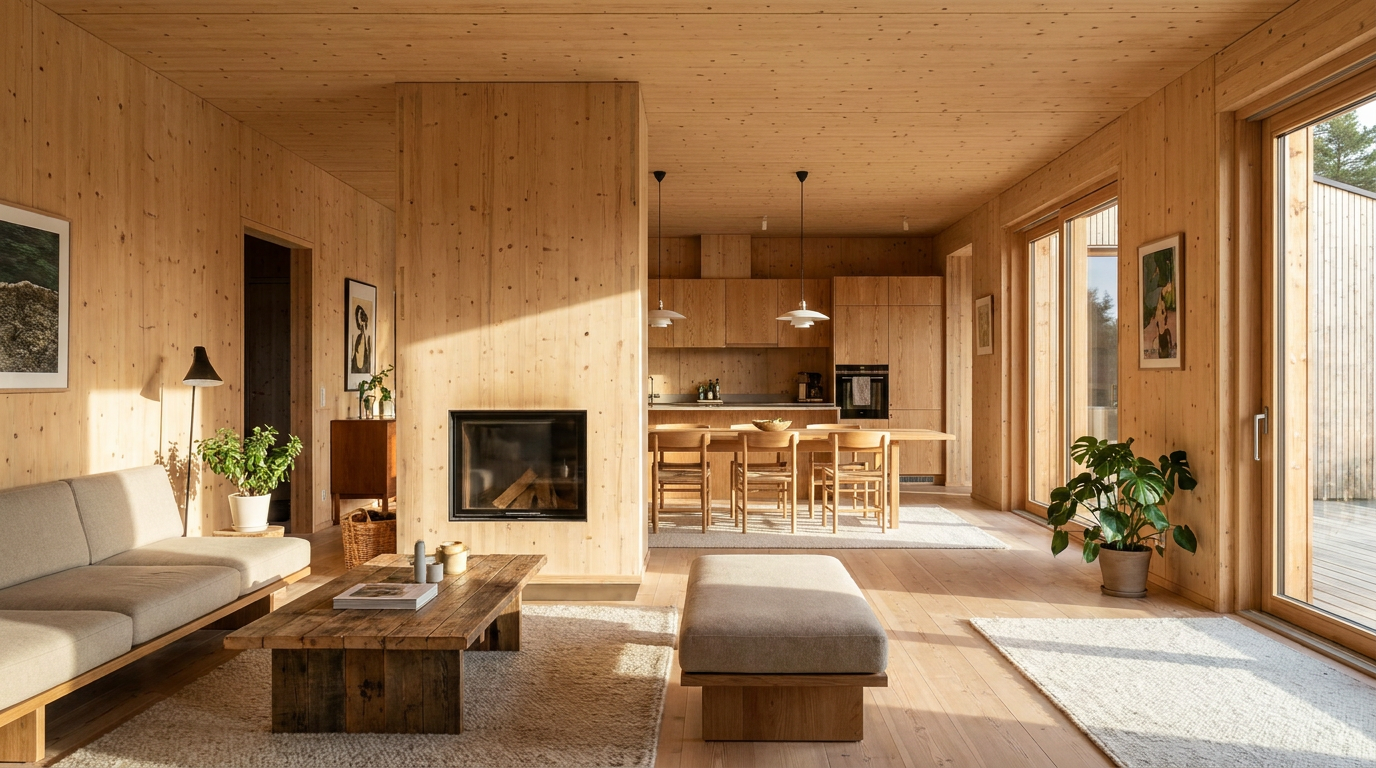
In residential construction, this carbon math can push a project past neutrality and into negative territory. When an Austin-based design firm set out to build a toxin-free demonstration home, they utilized CLT for the framing, flooring, and roof panels. By combining the mass timber structure with wood-fiber insulation and cork cladding, the resulting 1,000-square-foot "Cross Cabin" avoided the heavy emissions of a typical slab-on-grade build. Factoring in the biogenic carbon stored within the timber, the home achieved a net-negative carbon footprint, effectively keeping over 19,000 kilograms of carbon dioxide out of the atmosphere.[1]
In residential construction, this carbon math can push a project past neutrality and into negative territory.
Beyond the environmental benefits, CLT is radically altering the logistics of the construction site. Because mass timber panels are precision-engineered in a factory using computer numerical control (CNC) machines, they arrive at the building site pre-cut to the exact millimeter, complete with openings for doors, windows, and plumbing. This shifts the building process away from traditional on-site framing and closer to the assembly of a massive piece of flat-pack furniture.[4][6]
This prefabrication drastically accelerates project timelines. With a well-coordinated crew, builders can install up to 1,300 square meters of CLT in a single day. Furthermore, because mass timber is up to five times lighter than concrete, buildings require significantly less robust foundations, which further reduces both material costs and excavation time. While the upfront cost of the engineered wood itself can be 5 to 10 percent higher than conventional framing, the savings in labor, foundation work, and carrying costs often make CLT cost-competitive by the time the keys are handed over.[4][6]

The shift toward factory-based precision is also changing the role of the designer. Mark Anderson, a professor of architecture at UC Berkeley, notes that mass timber is bringing the physical realities of construction back into the architect's realm. Because the structural panels often serve as the finished interior surfaces, architectural detailing becomes a matter of expressive structural engineering rather than simply applying drywall and paint. This allows for the creation of modular, net-zero accessory dwelling units (ADUs) that can be entirely prefabricated off-site and dropped into urban backyards.[3]
Despite its structural and aesthetic appeal, the most common hesitation from homebuyers and regulators regarding mass timber is fire safety. The idea of living inside a multi-story wooden box instinctively feels hazardous. However, engineered mass timber behaves very differently in a fire than traditional light-frame 2x4 construction. When exposed to intense heat, the outer layer of a thick CLT panel chars predictably. This char layer acts as a natural insulator, protecting the unburned inner core of the wood and allowing the panel to maintain its structural integrity for hours, providing ample time for evacuation and firefighting.[4]
While the benefits of mass timber are well-documented, environmental pragmatists caution against viewing it as a flawless silver bullet. The assumption that all mass timber buildings are inherently carbon-neutral relies heavily on the origins of the wood. As sustainability experts at Atelier Ten point out, timber is only a climate solution if it is sourced from responsibly managed forests where the rate of harvesting does not exceed the rate of regrowth.[5]
If forests are clear-cut without regard for biodiversity, or if the logging process severely disrupts the carbon stored in the forest soil, the climate math quickly falls apart. Furthermore, because CLT manufacturing facilities are still relatively scarce compared to concrete plants, the carbon emitted by transporting massive wooden panels across continents can eat into the building's overall carbon savings. The industry must scale local supply chains to ensure the material's transportation footprint doesn't negate its biogenic benefits.[5][6]

As the supply chain matures and building codes adapt to permit taller wooden structures, cross-laminated timber is poised to transition from a niche architectural statement into a foundational element of the modern housing market. By turning our homes into long-term carbon sinks, mass timber offers a rare opportunity in the climate fight: a technological advancement that doesn't just do less harm, but actively works to heal the environment while providing warmer, more humane spaces to live.[6]
How we got here
Early 1990s
Cross-laminated timber is first developed and introduced in Austria and Germany as a new engineered wood product.
Mid-2010s
Mass timber begins gaining global traction for commercial projects, highlighted by the completion of tall wood buildings like Brock Commons.
2021
The International Building Code (IBC) is updated to allow mass timber structures up to 18 stories tall in the United States.
March 2025
The UK Government publishes a roadmap to significantly increase the use of timber in construction to meet 2050 net-zero targets.
Viewpoints in depth
Sustainable Architects' View
Mass timber is a revolutionary tool to decarbonize the built environment while improving aesthetics.
Architects and design-build firms argue that cross-laminated timber fundamentally changes the relationship between the builder and the environment. Rather than relying on carbon-intensive extraction, designers can utilize a renewable resource that actively stores carbon. Furthermore, the aesthetic warmth of exposed wood interiors creates more humane, biophilic living spaces compared to stark concrete and steel.
Environmental Pragmatists' View
The climate benefits of mass timber depend entirely on responsible forestry and supply chains.
While acknowledging the potential of biogenic carbon storage, environmental researchers caution against viewing CLT as a flawless silver bullet. They emphasize that if timber is sourced from clear-cut forests that destroy soil carbon, or if the heavy panels must be shipped thousands of miles on diesel-burning freight, the net carbon emissions can actually exceed those of traditional building materials. For this camp, the supply chain is just as important as the material itself.
Policymakers' View
Timber is a strategic lever to meet national net-zero emission targets and stimulate green jobs.
Government bodies are increasingly viewing mass timber not just as an architectural trend, but as a critical piece of national infrastructure policy. By incentivizing the use of engineered wood in both commercial and residential sectors, policymakers aim to drastically reduce the embodied carbon of the construction industry—which accounts for a massive portion of global emissions—while simultaneously boosting rural forestry economies.
Timber Industry's View
Engineered wood offers structural equivalence to concrete, superior fire safety, and rapid construction speeds.
Industry advocates focus heavily on the structural and logistical superiority of mass timber. They highlight that CLT panels can match the load-bearing capabilities of reinforced concrete while weighing up to five times less. By prefabricating panels off-site, developers can slash construction timelines and labor costs, making timber a highly competitive economic alternative to traditional building methods.
What we don't know
- How quickly local supply chains and CLT manufacturing plants will scale to reduce the carbon footprint of transporting the massive panels.
- Whether global forestry regulations can strictly enforce sustainable harvesting practices as demand for mass timber surges.
- How the long-term resale value and insurance premiums for mass timber residential homes will compare to traditional builds over a 50-year horizon.
Key terms
- Cross-Laminated Timber (CLT)
- An engineered wood panel made by gluing multiple layers of lumber together at alternating 90-degree angles for extreme strength.
- Embodied Carbon
- The total greenhouse gas emissions generated by extracting, manufacturing, and transporting a building's materials.
- Biogenic Carbon
- Carbon that was absorbed from the atmosphere by living organisms, such as trees, and remains stored within them.
- Slab-on-grade
- A common, carbon-intensive architectural practice where a concrete foundation is poured directly onto the ground.
Frequently asked
Is cross-laminated timber safe in a fire?
Yes. Unlike traditional light-frame wood, thick mass timber panels char on the outside when exposed to fire. This char layer insulates the inner core, allowing the structure to maintain its load-bearing strength for hours.
Is building with CLT more expensive?
The raw material can cost 5 to 10 percent more upfront than concrete or steel. However, because CLT is prefabricated and much lighter, builders save significantly on labor, construction time, and foundation costs, often making it cost-competitive overall.
Does mass timber lead to deforestation?
It can, if not managed properly. The climate benefits of CLT depend entirely on sustainable forestry practices, where harvested trees are replanted and soil health is maintained. Experts warn that 'not all wood is good wood.'
Can CLT be used for tall buildings?
Yes. While initially popular for low-rise residential projects, updated building codes and the material's immense strength-to-weight ratio have allowed for timber skyscrapers, such as the 18-story Brock Commons in Vancouver.
Sources
Source coverage
6 outlets
4 viewpoints surfaced






[1]Think WoodSustainable Architects
Carbon-Negative Home Goes All-Natural With Mass Timber
Read on Think Wood →[2]UK GovernmentPolicymakers
Timber in construction roadmap
Read on UK Government →[3]UC BerkeleySustainable Architects
How Cross-Laminated Timber is Changing Architecture
Read on UC Berkeley →[4]Naturally WoodTimber Industry Advocates
Cross-Laminated Timber (CLT)
Read on Naturally Wood →[5]Atelier TenEnvironmental Pragmatists
Debunking Mass Timber Myths
Read on Atelier Ten →[6]Factlen Editorial TeamTimber Industry Advocates
Synthesis by Factlen editorial team
Read on Factlen Editorial Team →

Every angle. Every day.
Get home stories with full source coverage and perspective breakdowns delivered to your inbox.