
The Science of Biophilic Design: Why 2026 Interiors Are Mimicking Nature
Moving beyond the basic houseplant, biophilic design has matured into an evidence-based architectural framework that uses spatial psychology and natural analogues to actively lower stress and improve cognitive function in the home.
By Factlen Editorial Team
- Environmental Psychologists
- Focus on the empirical, measurable impacts of nature exposure on cognitive function, cortisol reduction, and brain plasticity.
- Architectural Designers
- View biophilia as a structural framework to manipulate spatial flow, light, and materials to optimize human experience.
- Wellness Advocates
- Emphasize the home as a personal sanctuary, prioritizing trends like "cocooning" and earth-toned palettes to combat digital burnout.
What's not represented
- · Real Estate Developers balancing the cost of biophilic architecture against standard building practices
- · Renters who face limitations in making structural biophilic modifications to their homes
Why this matters
As remote work and digital overload keep people indoors for up to 90% of the day, the built environment has become a primary driver of public health. Understanding how to engineer spaces that lower cortisol and restore attention can fundamentally change how you feel and function in your own home.
Key points
- Biophilic design has evolved from a decorative plant trend into a science-backed architectural framework.
- The approach uses 14 specific patterns to lower human stress, including natural analogues and spatial psychology.
- Clinical evidence links nature-integrated spaces to reduced cortisol, better sleep, and faster hospital recovery.
- 2026 interior trends are embracing earth-rooted palettes, tactile materials, and "cocooning" wellness rooms.
- Adding plants to a room only works if the baseline indoor environmental quality (air and light) is strong.
The modern home is undergoing a profound psychological shift. In 2026, the stark, sterile minimalism that dominated the previous decade has given way to something fundamentally different: living spaces engineered to function as restorative ecosystems. This shift is driven by biophilic design, an evidence-based architectural framework that integrates natural elements to actively support human biology.[4][5]
While the term has floated around design blogs for years, 2026 marks its transition from a decorative afterthought to a foundational building philosophy. It is no longer about simply placing a potted monstera in a corner; it is about manipulating light, texture, and spatial flow to trick the human nervous system into feeling as though it is outdoors.[4][6]
The concept is rooted in the "biophilia hypothesis," popularized by biologist E.O. Wilson, which posits that humans possess an innate, evolutionary drive to connect with nature and other forms of life. Because our brains evolved in the natural world, artificial, sensory-deprived environments inherently trigger low-level, chronic stress.[6][7]
To translate this biological urge into the built environment, environmental consultants at Terrapin Bright Green codified the "14 Patterns of Biophilic Design." This framework provides a mechanism for architects and interior designers to systematically weave nature into a building's DNA, moving past subjective aesthetics into measurable environmental performance.[1]
These 14 patterns are grouped into three distinct categories. The first, "Nature in the Space," deals with direct, physical connections to the natural world. This includes maximizing dynamic daylight, introducing thermal and airflow variability, and integrating living ecosystems like floor-to-ceiling plant walls or indoor water features.[1][6]

The second category, "Natural Analogues," involves indirect mimicry. It utilizes biomorphic forms, fractal geometries, and materials that bear the honest marks of nature. In practice, this means utilizing wood grain with visible knots, honed stone, and complex textile patterns that mimic the mathematical symmetries found in leaves and river deltas.[1][5]
The third and perhaps most profound category is "Nature of the Space," which taps directly into spatial psychology. It replicates the spatial conditions our ancestors sought for survival, most notably the concept of "prospect and refuge." Humans feel most at ease when they have an unimpeded view of their surroundings (prospect) while their back is protected by a sheltered enclosure (refuge).[1][4]
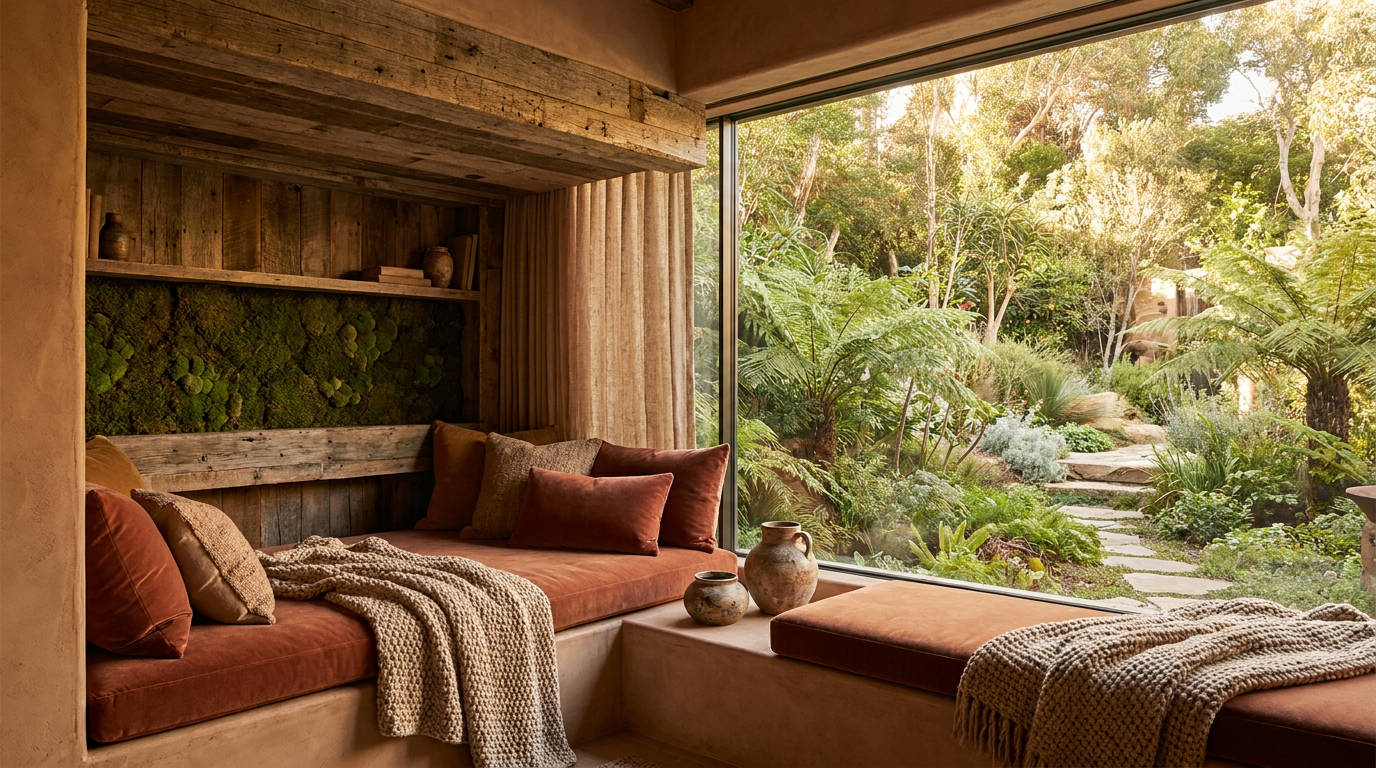
A home successfully utilizing prospect and refuge might feature a cozy, lowered-ceiling reading nook that looks out through expansive glass doors over a wide garden or open-plan living area. This satisfies the evolutionary desire to observe the environment without feeling exposed to potential threats.[4][7]

This satisfies the evolutionary desire to observe the environment without feeling exposed to potential threats.
The empirical evidence supporting these interventions is substantial. Environmental psychology and public health literature frequently link biophilic cues to accelerated stress recovery, attention restoration, and circadian rhythm regulation. When a space aligns with human evolutionary expectations, the nervous system naturally down-regulates.[3]
According to data compiled by the Global Wellness Institute, nature-integrated spaces can reduce cortisol levels and cut perceived stress by up to 20%. In clinical settings, biophilic hospital designs have been shown to reduce hospitalization times, lower patient mortality, and decrease the need for pain medication.[2][6]
Furthermore, a 2025 study exploring the link between biophilia and brain plasticity found that interactions with nature-mimicking environments help stimulate areas of the brain critical for memory and emotional regulation. Natural light, a cornerstone of the framework, plays a crucial role in regulating circadian rhythms, leading to improved sleep quality and daytime alertness.[2][3]
However, researchers caution against viewing biophilia as a superficial cure-all. The benefits are highly context-dependent and rely on a baseline of strong Indoor Environmental Quality (IEQ). The psychological benefits of nature cues are severely blunted if the fundamental architecture of the room is flawed.[3][7]

Adding a living wall to a windowless, poorly ventilated room will not yield meaningful psychological benefits. The natural cues must be layered with high-performing environmental fundamentals like clean air, thermal comfort, and acoustic dampening. "Greenwashing" a bad space with plants does not fix the underlying stress of a poorly designed room.[3]
In 2026, this nuanced understanding is reshaping consumer interior trends. Designers are moving away from stark whites and cool grays, embracing a "post-gray" era dominated by earth-rooted palettes. Warm neutrals, mossy greens, clay browns, and terracottas are being used to ground spaces and create a sense of permanence.[5][6]
The desire for restorative spaces has also birthed the "cocooning" trend, where homeowners dedicate specific rooms entirely to disconnection and sensory recovery. These wellness nooks utilize tactile materials like limewash, unlacquered brass, and handcrafted ceramics that invite touch and celebrate imperfection.[5][6]
To support these indoor ecosystems without compromising aesthetics, "invisible" technology has become crucial. Biological lighting, such as ambient grow lights, is now seamlessly integrated into architectural fixtures to sustain plant life in darker wellness nooks without casting the harsh, clinical glare associated with traditional indoor gardening.[6]

The boundaries between indoor and outdoor living are also being intentionally blurred. Large sliding doors and consistent flooring materials extend living spaces outward, while thoughtfully designed courtyards and skylights pull the sky and weather patterns deep into the home's interior.[4][5]
Ultimately, the maturation of biophilic design reflects a broader cultural recognition. As the outside world feels increasingly chaotic and digitally saturated, the home is no longer just a shelter for belongings. It is being actively programmed as a biological tool—a machine designed to work with human nature rather than against it.[4][7]
How we got here
1984
Biologist E.O. Wilson popularizes the "biophilia hypothesis," suggesting an innate human connection to nature.
2014
Terrapin Bright Green publishes the "14 Patterns of Biophilic Design," creating a standardized framework for architects.
2020-2022
The pandemic forces a global reevaluation of indoor spaces, sparking mainstream interest in home wellness and air quality.
2026
Biophilic design matures into a foundational interior trend, shifting focus from simple houseplants to immersive, biologically supportive ecosystems.
Viewpoints in depth
Environmental Psychologists
Focus on the empirical, measurable impacts of nature exposure on cognitive function and stress.
For environmental psychologists, biophilic design is less about aesthetics and entirely about neurology. They view the built environment as a constant sensory input that either up-regulates or down-regulates the nervous system. By measuring cortisol levels, heart rate variability, and EEG brain waves, researchers in this camp have proven that environments lacking natural complexity induce chronic, low-level stress. They advocate for biophilic design as a necessary public health intervention, particularly in high-stress environments like hospitals, schools, and corporate offices, where the cognitive and restorative benefits yield measurable returns.
Architectural Designers
View biophilia as a structural framework to manipulate spatial flow, light, and materials.
Architects and interior designers utilize the 14 patterns of biophilic design as a practical toolkit to solve spatial problems. Rather than just decorating a finished room, they integrate nature at the blueprint level—calculating the angle of the sun for dynamic daylighting, specifying porous, natural materials that age gracefully, and designing floor plans that naturally create zones of 'prospect and refuge.' For this camp, the challenge lies in balancing the biological need for nature with the practical constraints of modern construction, climate control, and urban density.
Wellness Advocates
Emphasize the home as a personal sanctuary to combat digital burnout and modern anxiety.
The wellness community views biophilic design through the lens of lifestyle and daily rituals. As digital overload and screen fatigue reach unprecedented levels, this camp champions the home as the ultimate antidote. They drive consumer trends like 'cocooning'—creating dedicated, tech-free spaces for meditation and rest—and the integration of invisible biological lighting to support indoor gardens. For wellness advocates, bringing nature indoors is a deliberate act of self-care, transforming the home into an active participant in emotional regulation and longevity.
What we don't know
- The exact 'dose' of biophilic exposure required to trigger measurable psychological benefits varies significantly between individuals.
- Long-term data on how artificial biophilic interventions (like digital nature screens or synthetic circadian lighting) compare to genuine outdoor exposure remains inconclusive.
- It is unclear how quickly the real estate market will adopt advanced biophilic architecture as a standard, given the higher initial construction costs.
Key terms
- Biophilia Hypothesis
- The scientific theory that humans possess an innate, evolutionary tendency to seek connections with nature and other forms of life.
- Natural Analogues
- Design elements that indirectly mimic nature, such as biomorphic shapes, fractal patterns, and materials like exposed wood grain.
- Indoor Environmental Quality (IEQ)
- A metric encompassing the fundamental health of a building's interior, including air quality, ventilation, thermal comfort, and acoustics.
- Circadian Lighting
- Lighting systems designed to mimic the natural progression of daylight, helping to regulate the human body's internal sleep-wake cycle.
- Cocooning
- An interior design trend focused on creating intimate, highly sheltered rooms dedicated entirely to sensory recovery and disconnection.
Frequently asked
Does biophilic design just mean buying more houseplants?
No. While plants are a component, true biophilic design is a structural approach that includes maximizing natural light, utilizing natural materials like wood and stone, and designing spatial layouts that mimic natural environments.
What is 'prospect and refuge' in interior design?
It is an evolutionary psychological concept where humans feel most comfortable in spaces that offer a clear, expansive view of their surroundings (prospect) while providing a safe, sheltered area at their back (refuge).
Can biophilic design work in a dark apartment?
Yes. While natural light is ideal, designers use "natural analogues" like earth-tone colors, wood textures, and biological grow lights to mimic nature's benefits even in low-light environments.
What are the proven health benefits of this design style?
Studies show that biophilic environments can reduce cortisol levels by up to 20%, improve cognitive function, regulate circadian rhythms for better sleep, and even accelerate recovery times in hospitals.
Sources
Source coverage
7 outlets
3 viewpoints surfaced







[1]Terrapin Bright GreenArchitectural Designers
14 Patterns of Biophilic Design
Read on Terrapin Bright Green →[2]Global Wellness InstituteEnvironmental Psychologists
Biophilic Design Positively Impacts Physical and Mental Wellbeing
Read on Global Wellness Institute →[3]Biophilic InnovationsEnvironmental Psychologists
Health benefits of biophilic design (what the evidence supports)
Read on Biophilic Innovations →[4]Home Planner AppWellness Advocates
Biophilic Design: The 2026 Trend Turning Houses Into Healing Sanctuaries
Read on Home Planner App →[5]Style SourcebookArchitectural Designers
What Is Biophilic Design in 2026?
Read on Style Sourcebook →[6]SoltechWellness Advocates
2026 Interior Design Trends: Biological-First Solutions
Read on Soltech →[7]Factlen Editorial TeamWellness Advocates
Synthesis by Factlen editorial team
Read on Factlen Editorial Team →


Every angle. Every day.
Get home stories with full source coverage and perspective breakdowns delivered to your inbox.