
SpaceX shatters options trading records following historic $85 billion IPO and Cursor acquisition
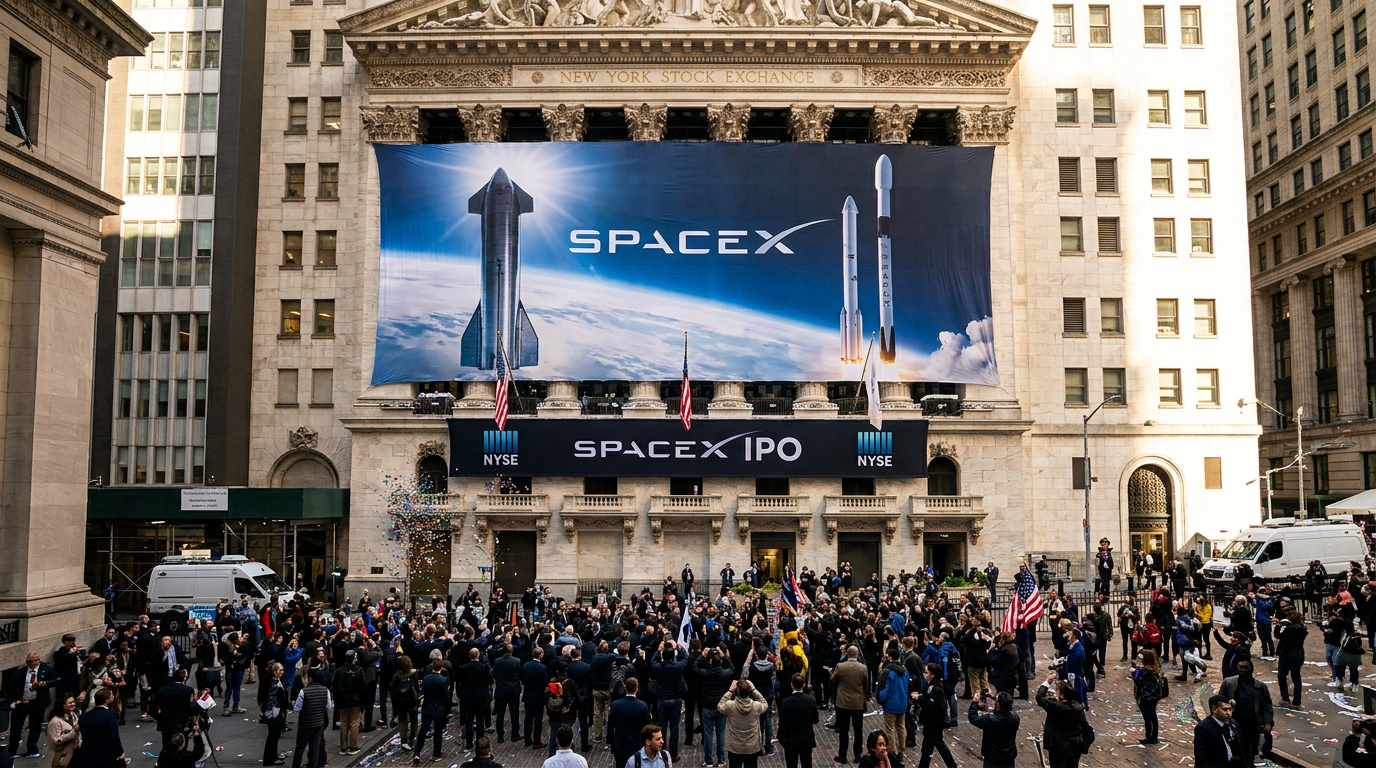
Following the largest initial public offering in U.S. history, SpaceX has set a new record for first-day options trading volume while simultaneously announcing a $60 billion acquisition of AI coding startup Cursor.
By Factlen Editorial Team
- Retail & Options Traders
- Focused on the immediate market mechanics, gamma squeezes, and the sheer volume of the options and ETF debut.
- Long-Term Space Investors
- Focused on the $85 billion IPO capital raise and the fundamental value of SpaceX's aerospace infrastructure.
- AI & Tech Strategists
- Focused on the $60 billion Cursor acquisition and the convergence of generative AI with space tech.
What's not represented
- · Legacy aerospace competitors facing a newly capitalized rival
- · Open-source AI developers reacting to Cursor's acquisition
Why this matters
The unprecedented market debut signals a massive shift in investor appetite toward commercial space exploration and AI integration, unlocking new capital for deep-tech ventures and reshaping the landscape of mega-cap technology stocks.
Key points
- SpaceX raised over $85 billion in its Friday IPO, setting a new record for the U.S. equity market.
- The company's options market debut saw over 1.3 million contracts traded, tripling previous first-day records.
- Heavy call-option buying and inflows into newly launched SpaceX ETFs drove the stock up as much as 17% on Tuesday.
- SpaceX announced the $60 billion acquisition of Cursor, an AI coding startup with over $3 billion in annual recurring revenue.
- The dual milestones highlight massive investor appetite for companies combining space infrastructure with generative AI.
SpaceX has fundamentally rewritten the record books of the U.S. financial markets in a matter of days, following up the largest initial public offering in American history with an unprecedented debut in the derivatives market. After raising more than $85 billion in its highly anticipated Friday IPO, the aerospace giant saw its options contracts begin trading on Tuesday to what analysts described as "bonkers" demand. The dual milestones inject a massive wave of liquidity into the deep-tech sector and signal a voracious investor appetite for commercial space exploration. But the market mechanics were only half the story on Tuesday, as the newly public company moved aggressively to consolidate its artificial intelligence capabilities by announcing a staggering $60 billion acquisition of the AI coding startup Cursor.[1][6]
The sheer scale of Friday's public offering easily eclipsed all previous U.S. equity market records, dwarfing the historic debuts of companies like Alibaba and Visa. By raising over $85 billion, SpaceX has secured an unprecedented war chest to fund its capital-intensive ambitions, which range from interplanetary colonization to deploying orbital data centers. Retail and institutional investors alike clamored for an allocation, driving the underlying stock well above its $135 offering price during its first days of trading. The successful float proves that public markets are willing to underwrite massive, long-term infrastructure projects when they are paired with a track record of consistent execution and technological dominance.[5]
That enthusiasm spilled over into the derivatives market on Tuesday, where SpaceX options shattered the previous first-day volume records. By mid-morning in New York, more than 600,000 options contracts had already changed hands, making the aerospace firm one of the most actively traded names in the entire U.S. options ecosystem. By the afternoon, volume had surged past 1.3 million contracts, more than tripling the previous first-day record set by Meta in 2012. The intense activity reflects a market eager to gain leveraged exposure to the company's post-IPO momentum, with traders pouring into the newly launched derivatives at a blistering pace.[2][4]

Derivatives analysts noted a strong preference for bullish call options, suggesting that many investors expect the stock's upward trajectory to continue in the near term. The most heavily traded contract was a $220 call option expiring later in the week, which alone accounted for trading volume equivalent to roughly 2.5 million shares. This elevated demand for upside exposure can create a self-reinforcing cycle known as a gamma squeeze, where market makers are forced to purchase the underlying stock to hedge their rapidly expanding options exposure, thereby driving the share price even higher.[2][3]
Adding fuel to the fire, a wave of newly launched exchange-traded funds (ETFs) designed to track or amplify SpaceX's stock performance saw a massive cash influx on Tuesday. Leveraged ETFs, which use financial derivatives to double or triple the daily returns of the underlying asset, experienced heavy early inflows as retail investors looked for fresh ways to play the hype. This combination of intense retail interest, high implied volatility, and heavy institutional hedging activity pushed SpaceX shares up as much as 17% early in the session, before the stock pared some of those gains to stabilize in the afternoon.[1][3]

Amidst the frenzy of the trading floor, SpaceX dropped a massive strategic bombshell that fundamentally alters the company's software trajectory. The aerospace giant announced it is exercising a previous agreement to acquire Cursor, a rapidly growing artificial intelligence coding startup, for $60 billion. Cursor's engineers have already been working closely with SpaceX in recent months, and the formal acquisition signals a deep, structural integration of generative AI into SpaceX's aerospace and satellite infrastructure. The move demonstrates an ambition to dominate not just the physical hardware of spaceflight, but the complex software layers required to operate it.[6]
Amidst the frenzy of the trading floor, SpaceX dropped a massive strategic bombshell that fundamentally alters the company's software trajectory.
Founded in 2022, Cursor has experienced a meteoric rise that is virtually unprecedented in the enterprise software industry. The company's AI-native code editor, which allows developers to write, edit, and debug software using natural-language instructions, has become a staple across the engineering world. By early 2026, Cursor had crossed $3 billion in annual recurring revenue and secured a foothold in more than half of the Fortune 500. The tool has been credited with profoundly changing the software engineering lifecycle, allowing top developers to write exponentially more code and dramatically accelerating product development timelines.[7][8]
While a $60 billion price tag is staggering for a four-year-old software startup, industry analysts argue that Cursor's explosive growth rate and strategic value justify the premium. Under the terms of their previous partnership, SpaceX had the right to acquire the startup outright for $60 billion or pay a $10 billion fee under alternative partnership terms. By choosing the full acquisition, SpaceX is bringing world-class AI capabilities entirely in-house. The integration is expected to accelerate SpaceX's own internal development cycles, potentially lowering the cost and time required to write the complex, mission-critical software that guides its reusable rockets and manages its global satellite broadband network.[6][7]

The convergence of space infrastructure and artificial intelligence represents a new frontier for mega-cap technology stocks. Market watchers note that the dual events—the historic public market debut and the massive AI acquisition—position SpaceX as a unique hybrid in the public markets. It is simultaneously an industrial manufacturing powerhouse, a global telecommunications provider, and now, a top-tier artificial intelligence developer. This multi-disciplinary approach allows the company to command a valuation multiple that blends the steady revenue of aerospace contracts with the hyper-growth expectations typically reserved for pure-play software companies.[5][8]
Looking ahead, the successful IPO and mega-acquisition inject massive optimism into the broader deep-tech sector. For years, venture capitalists and founders have debated whether public market investors had the patience to support capital-intensive, hardware-heavy businesses. SpaceX's record-breaking week definitively answers that question in the affirmative, proving that public markets have a voracious appetite for ambitious innovation when it is executed at the highest level. As the dust settles on the most consequential market debut of the decade, SpaceX has firmly established itself not just as an aerospace pioneer, but as a financial and technological juggernaut poised to reshape multiple industries.[1][5]
How we got here
2022
AI coding startup Cursor is founded, beginning its rapid ascent in the software engineering space.
Late 2025
Cursor reaches a $29.3 billion valuation as its annual recurring revenue crosses the $1 billion mark.
June 12, 2026
SpaceX executes the largest IPO in U.S. history, raising over $85 billion and beginning public trading.
June 16, 2026
SpaceX options debut to record-breaking volume, while the company announces its $60 billion acquisition of Cursor.
Viewpoints in depth
Retail & Options Traders
Focused on the immediate market mechanics, gamma squeezes, and the sheer volume of the options and ETF debut.
For retail investors and derivatives traders, the SpaceX debut is a generational volatility event. They view the unprecedented options volume and the influx of capital into leveraged ETFs as a clear signal of massive retail demand. This camp is heavily focused on the mechanics of the trade, particularly the potential for a gamma squeeze as market makers are forced to buy the underlying stock to hedge against the massive volume of bullish call options. To them, the fundamental valuation is secondary to the immediate price action and momentum.
Long-Term Space Investors
Focused on the $85 billion IPO capital raise and the fundamental value of SpaceX's aerospace infrastructure.
Institutional backers and long-term space enthusiasts see the market mechanics as a sideshow to the real story: the successful raising of an $85 billion war chest. This viewpoint emphasizes that space exploration and orbital infrastructure are incredibly capital-intensive endeavors. By securing the largest public float in history, SpaceX has guaranteed its ability to fund its Starship program, expand its Starlink broadband network, and begin deploying orbital data centers without returning to private capital markets. They view the premium valuation as justified by the company's near-monopoly on heavy launch capabilities.
AI & Tech Strategists
Focused on the $60 billion Cursor acquisition and the convergence of generative AI with space tech.
Technology analysts and software strategists are zeroing in on the Cursor acquisition as the most consequential news of the week. They argue that SpaceX is no longer just a hardware company, but a vertically integrated AI powerhouse. By bringing the world's fastest-growing AI coding assistant in-house, SpaceX can dramatically accelerate its software development cycles. This camp believes that the future of aerospace relies entirely on complex, AI-driven software, and that the $60 billion price tag for Cursor is a necessary investment to maintain an insurmountable lead over legacy aerospace competitors.
What we don't know
- How quickly SpaceX will fully integrate Cursor's AI capabilities into its mission-critical aerospace software.
- Whether the intense options volume will lead to sustained volatility or stabilize in the coming weeks.
- How legacy aerospace competitors will respond to SpaceX's massive new capital reserves and AI acquisitions.
Key terms
- Initial Public Offering (IPO)
- The process by which a private company offers shares of its stock to the public for the first time, allowing it to raise capital from public market investors.
- Options Contract
- A financial derivative that gives an investor the right, but not the obligation, to buy or sell a stock at a specific price before a certain date.
- Call Option
- A type of options contract that profits when the underlying stock's price increases, commonly used to gain leveraged upside exposure.
- Gamma Squeeze
- A rapid increase in a stock's price caused by market makers buying the stock to hedge against a massive volume of call options purchased by investors.
- Annual Recurring Revenue (ARR)
- A metric used by software companies to measure the predictable and recurring revenue generated by subscriptions over a 12-month period.
Frequently asked
How much money did SpaceX raise in its IPO?
SpaceX raised more than $85 billion in its initial public offering, making it the largest IPO in the history of the U.S. equity market.
What is Cursor and why did SpaceX buy it?
Cursor is an AI-native code editor that helps developers write software using natural language. SpaceX acquired it for $60 billion to integrate generative AI into its aerospace and satellite infrastructure.
Why did SpaceX options trading break records?
Investors eager for leveraged exposure to SpaceX's post-IPO momentum flooded the market, trading over 1.3 million contracts on the first day and shattering previous volume records.
What is a gamma squeeze?
A gamma squeeze occurs when heavy buying of call options forces market makers to purchase the underlying stock to hedge their risk, which in turn drives the stock price even higher.
Sources
Source coverage
8 outlets
3 viewpoints surfaced








[1]MarketWatchLong-Term Space Investors
Investors pile into moonshot SpaceX bets as first-day options trading shatters records
Read on MarketWatch →[2]TradingViewRetail & Options Traders
SpaceX Jumps 17% as 600,000 Options Contracts Trade
Read on TradingView →[3]Seeking AlphaRetail & Options Traders
SpaceX options frenzy fuels stock rally in third day of trading
Read on Seeking Alpha →[4]Crypto BriefingRetail & Options Traders
Investors flock to SpaceX options trading on record first day
Read on Crypto Briefing →[5]The Motley FoolLong-Term Space Investors
SpaceX IPO: What Your $5,000 Investment Could Be Worth
Read on The Motley Fool →[6]CNBCAI & Tech Strategists
SpaceX says it can buy Cursor later this year for $60 billion
Read on CNBC →[7]ForbesAI & Tech Strategists
AI startup Cursor, which Elon Musk's SpaceX plans to acquire, sees ARR surpass $4 billion
Read on Forbes →[8]Tech InsiderAI & Tech Strategists
Cursor AI valuation hits $60B: Anysphere's $2B revenue surge
Read on Tech Insider →


Every angle. Every day.
Get finance stories with full source coverage and perspective breakdowns delivered to your inbox.